Εμφάνιση αναρτήσεων με ετικέτα Orthodox South Africa. Εμφάνιση όλων των αναρτήσεων

Δευτέρα 3 Μαΐου 2021

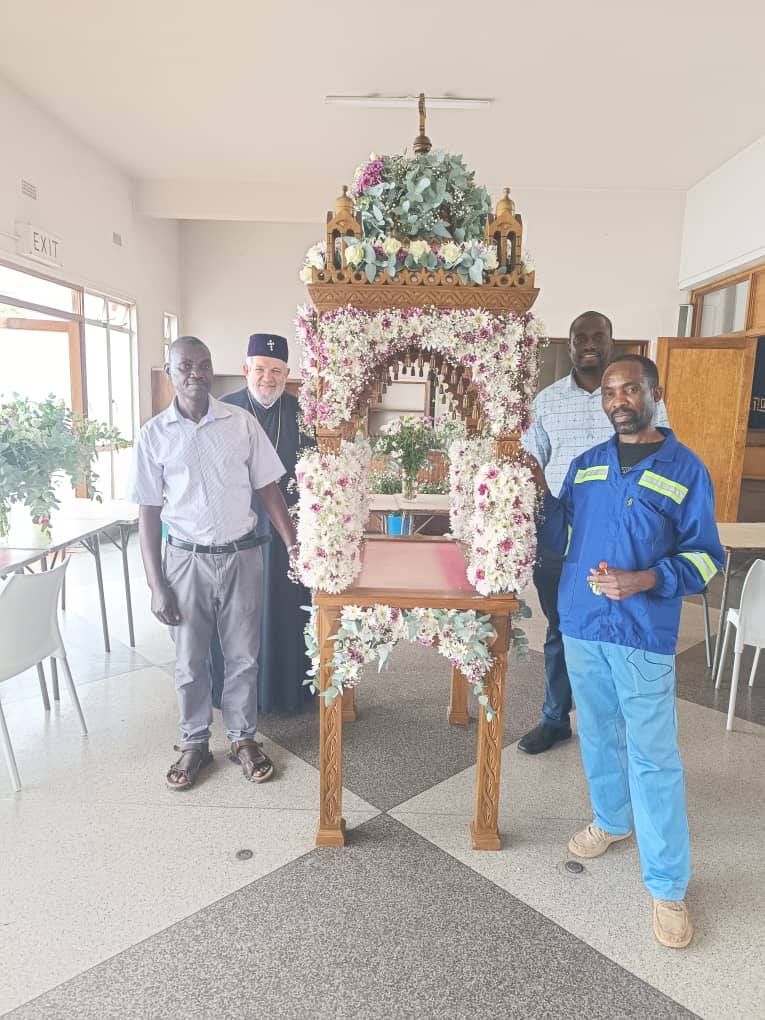
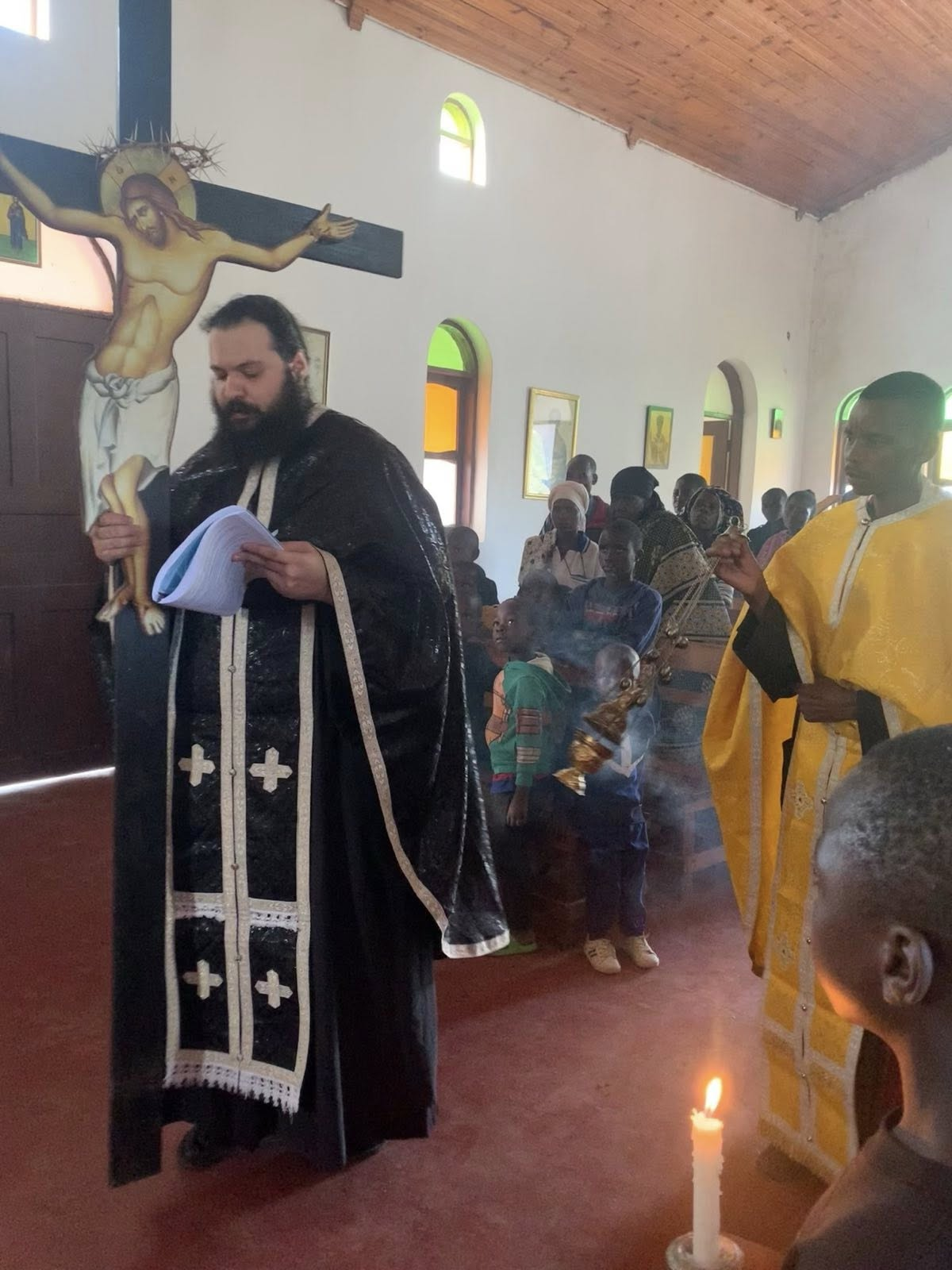
Orthodox Easter 2021 in Africa!...


Icon from here
 
In the Orthodox Vineyard of Africa

Paraskevi Namuyanja


Ουγκάντα (Uganda)

Ιερά Μητρόπολη Αξώμης Αιθιοπίας - Holy Archdiocese of Aksum Ethiopia


Αιθιοπία (Ethiopia)

St Barnabas Orthodox Orphanage & School


Κένυα (Kenya)

Rev Themi & Friends

 
Σιέρρα Λεόνε (Sierra Leone)

Orthodox Metropolis of Zambia


Ζάμπια (Zambia)

Uganda Orthodox Church - Holy Metropolis of Kampala

 
Ουγκάντα (Uganda)

Orthodox Cathedral of The Resurrection of The Lord, Lagos


Νιγηρία (Nigeria)

Orthodox Metropolis Of Good Hope - Cape Town

 
Ν. Αφρική (South Africa)

Ελληνική Κοινότητα Καΐρου


Αίγυπτος (Egypt)

Ιεραποστολή στην Επισκοπή Τολιάρας και Νοτίου Μαδαγασκάρης


Μαδαγασκάρη (Madagascar)

Orthodox Diocese of Gulu and Eastern Uganda

 
Ουγκάντα (Uganda)

Neo K Neofitos


Κένυα (Kenya)

Innocentios Byakatonda

 
Μπουρούντι (Burundi)

Φίλοι Ιεραποστολής Μπουκόμπα Τανζανίας

 
Τανζανία (Tanzania)

Uganda Orthodox Church - Holy Metropolis of Kampala


Ουγκάντα (Uganda)

IMKanangas

 
Κονγκό (

Democratic Republic of the Congo)

Yieronda Makarios Tillyrides Kenyas

 
Κένυα (Kenya)

Randrianaivo Vacilios Frederic

 
Μαδαγασκάρη (Madagascar)

Uganda Orthodox Church - Holy Metropolis of Kampala

 
Ουγκάντα (Uganda)


XΡΙΣΤΟΣ ΑΝΕΣΤΗ! ΑΛΗΘΩΣ ΑΝΕΣΤΗ!
 

English - Christ is Risen! Indeed, He is Risen!
Old English (Anglo-Saxon) - Crist aras! Crist sodhlice aras! (Lit: Christ arose! Christ surely arose!)
Middle English - Crist is arisen! Arisen he sothe!
Iyaric Patwa - Krestos a uprisin! Seen, him a uprisin fe tru!
Frisian - Kristus is opstien! Wis is er opstien!
High German
German - Christus ist auferstanden! Er ist wahrhaftig auferstanden!
Yiddish - Der Meschiache undzer iz geshtanen! Avade er iz ufgeshtanen!
Low German
Dutch - Christus is opgestaan! Hij is waarlijk opgestaan!
Afrikaans - Kristus het opgestaan! Hom het waarlik opgestaan!
North Germanic languages
Danish - Kristus er opstanden! Sandelig Han er Opstanden!
Icelandic - Kristur er upprisinn! Hann er vissulega upprisinn!
Norwegian - Kristus er oppstanden! Han er sannelig oppstanden!
Swedish - Kristus är uppstånden! Ja, Han är verkligen uppstånden!
Italic languages
Latin - Christus resurrexit! Resurrexit vere!
Romance languages
Italian - Cristo è risorto! È veramente risorto!
Catalan - Crist ha ressuscitat! Veritablement ha ressuscitat!
French - Le Christ est ressuscité! Vraiment Il est ressuscité!
Portuguese - Cristo ressuscitou! Verdadeiramente ressuscitou!
Romanian - Hristos a înviat! Adevărat a înviat!
Spanish - Cristo ha resucitado! Verdaderamente, ha resucitado!
Slavic languages
Church Slavonic - (Christos Voskrese! Voistinu Voskrese!)
East
Russian - Христос Воскресе! Воистину Воскресе! (Christos Voskrese! Voistinu Voskrese!)
Belarusian - Хрыстос уваскрос! Сапраўды ўваскрос! (Khrystos Uvaskros! Saprawdy Wvaskros!)
Ukrainian - Христос Воскрес! Воістину Воскрес! (Christos Voskres! Voistinu Voskres!)
South
Bulgarian - Христос Возкресе! Воистина Возкресе! (Christos Vozkrese! Voistina Vozkrese!)
Serbian - Христос Воскресе! Ваистину Воскресе! (Christos Voskrese! Vaistinu Voskrese!)
West
Czech - Kristus Vstal A Mrtvych! Opravdi Vstoupil!
Slovak - Kristus vstal zmŕtvych! Skutočne vstal!
Polish - Chrystus Zmartwychwstał! Prawdziwie Zmartwychwstał!
Baltic languages
Lithuanian - Kristus prisikėlė! Tikrai prisikėlė!
Celtic languages
Goidelic languages
Old Irish - Asréracht Críst! Asréracht Hé-som co dearb!
Irish - Tá Críost éirithe! Go deimhin, tá sé éirithe!
Manx - Taw Creest Ereen! Taw Shay Ereen Guhdyne!
Scots Gaelic - Tha Crìosd air èiridh! Gu dearbh, tha e air èiridh!
Brythonic languages
Breton - Dassoret eo Krist! E wirionez dassoret eo!
Welsh - Atgyfododd Crist! Yn wir atgyfododd!
Indo-Iranian languages
Indic languages
Sanskrit - (Kristo’pastitaha! Satvam Upastitaha!)
Southern Zone
Marathi - (Yeshu Khrist uthla ahe! Kharokhar uthla ahe!)
Albanian (Tosk) - Krishti u ngjall! Vërtet u ngjall!
Armenian - Քրիստոս յարեաւ ի մեռելոց՜ Օրհնեալ է յայտնութիւնն Քրիստոսի՜ (Christos harjav i merelotz! Orhniale harutjun Christosi! — Christ is risen! Blessed is the resurrection of Christ!)
Greek - Χριστος Aνεστη! Aληθως Aνεστη! (Christos Anesti! Aleithos Anesti!)
Altaic languages
Turkish - Hristós diril-Dí! Hakíkatén diril-Dí!
Austronesian languages
Malayo-Polynesian
Western
Chamorro - La’la’i i Kristo! Magahet na luma’la’ i Kristo!
Filipino (Tagalog) - Si Cristo ay nabuhay! Siya nga ay nabuhay!
Indonesian - KrÍstus tÉlah Bangkit! Benár día têlah Bángkit!
Central-Eastern
Carolinian - Lios a melau sefal! Meipung, a mahan sefal!
Hawaiian - Ua ala hou ´o kristo! Ua ala ´i ´o no ´oia!
Basque - Cristo Berbistua! Benatan Berbistua!
Dravidian languages
Malayalam - (Christu uyirthezhunnettu! Theerchayayum uyirthezhunnettu!)
Eskimo-Aleut languages
Aleut - Kristus aq ungwektaq! Pichinuq ungwektaq!
Yupik - Xris-tusaq Ung-uixtuq! Iluumun Ung-uixtuq!
Japanese - ハリストス復活!実に復活! (Harisutosu fukkatsu! Jitsu ni fukkatsu!)
Korean - (Kristo Gesso! Buhar ha sho Nay!)
Na-Dené languages
Athabaskan languages
Navajo - Christ daaztsáádéé’ náádiidzáá! T’áá aaníí, daaztsáádéé’ náádiidzáá!
Tlingit - Xristos Kuxwoo-digoot! Xegaa-kux Kuxwoo-digoot!
Niger-Congo languages
Luganda Kristo Ajukkide! Kweli Ajukkide!
Swahili - Kristo Amefufukka! Kweli Amefufukka!
Quechuan Languages
Quechua - Cristo causarimpunña! Ciertopuni causarimpunña!
Afro-Asiatic languages
Semitic languages
Central Semitic languages
Aramaic languages
Syriac - (Meshiha qam! Bashrira qam!)
South Central Semitic languages
Arabic languages
Arabic (Fus’hah, i.e., “standard” ) - (Al-Masih-Qam! Hakkan Qam!)
Maltese - Kristu qam! Huwa qam tassew!
Canaanite languages
Hebrew (modern) - (Ha Masheeha houh kam! A ken kam!)
South Semitic languages
Ethiopian languages
North Ethiopian languages
Tigrigna - (Christos tensiou! Bahake tensiou!)
South Ethiopian languages
Amharic - (Kristos Tenestwal! Bergit Tenestwal!)
Sino-Tibetan languages
Mandarin - 基督復活了 他確實復活了 (Jidu fuhuo-le! Ta queshi fuhuo-le!)
South Caucasian languages
Georgian - ქრისტე აღსდგა! ჭეშმარიტად აღსდგა!(Kriste aghsdga! Cheshmaritad aghsdga!)
Uralic languages
Estonian - Kristus on ülestõusnud! Tõesti on ülestõusnud!
Finnish - Kristus nousi kuolleista! Totisesti nousi!
Hungarian - Krisztus feltámadt! Valóban feltámadt!
Unclassified
A Nigerian language (of many spoken there) - Jésu Krísti Ébilíwõ! Ézia õ´ Bilíwõ!
Constructed languages
Esperanto - Kristo leviĝis! Vere Li leviĝis!
Quenya - (Ortanne Laivino! Anwa ortanne Laivino!)


Πέμπτη 25 Ιουνίου 2020

ST. MARK’S: A THEOLOGICAL ACADEMY WITH A DIFFERENCE (in South Africa)


stmarks
by Metropolitan Petros of Accra
Orthodoxy in dialogue
 
The Venerable and Ancient Patriarchate of Alexandria and All Africa has surprised us with its courage and initiative in the past. We need only recall the appointment of deaconesses by His Beatitude, Pope and Patriarch Theodoros II. While there was debate whether it constituted a true “ordination” (cheirotonia), rather than a blessing (cheirothesia), the fact remains that the Patriarchate took an initiative in such matters. The same can be said regarding the establishment of St. Mark’s Academy, offering theological education through distance learning. Other such Academies exist, but St. Mark’s promises a quality, contemporary, and challenging curriculum. Situated in Johannesburg, South Africa, by making use of electronic media it makes learning available to all, regardless of distance and location. In addition, due to favourable exchange rates for foreign students, tuition is affordable to many.
The faculty presently consists of a group of five highly qualified academics and an external independent moderator. Between them, there are five with doctorates and one with a master’s degree. More academics will be sourced as the need arises. The staff also consists of persons responsible for administration and financial issues.
St. Mark’s pilot course is the three-year Programme in Orthodox Christian Studies. It is not yet an accredited diploma, but is recognized by the Church. The Academy has been working together with the South African Department for Higher Education for accreditation. Presently, they require that students be present in Johannesburg for a formal written examination. This would greatly add to the cost. The Academy is exploring other possibilities.
The Programme covers the necessary subjects of Scripture, doctrine, liturgics, and church history, but also brings the faith to life as “theory becomes practice” in personal and social ethics, spiritual life, and pastoral care. Students are challenged to consider the relationship between the Church and the churches, their differences in beliefs and outlook, and the dialogues and meetings aiming at mutual understanding and greater unity. Contemporary theologies—liberation, feminist, African, alternative, etc.—are explored, as well as the Church’s response to these.  
Finally, a concise view of World Religions is offered, together with modules in missiology—the mission of the Church to the world and proclaiming the Gospel to all nations, something very dear to the heart of this Patriarchate.
It is possible that students may want to take single modules from the Programme, but St Mark’s cannot guarantee that, should the student be registered elsewhere, the credits would be recognised.
Each module includes an intensive reading programme. The Academy is presently developing an online library that contains the required and recommended set works. This is a substantial savings in costs of books that would otherwise need to be ordered. Students receive the syllabus, bibliography, and course objectives. They are guided in their reading and are given a series of questions and an essay topic to work on and submit within the allocated time. The final semester requires a longer assignment or research project on a topic of the student’s choice. After a successful three years, the student receives a Certificate in Orthodox Christian Theology.
Short courses on various topics are offered at various times, but tend, for the moment, to require physical presence.
Exciting prospects are open in the field of post-graduate studies (master’s and doctorates) as the Academy explores the prospect of “twinning” with a local, accredited college that would offer the degrees the recognition that students deserve. St. Mark’s will keep students and prospective students informed of developments.  
Under the auspices of the Patriarchate and the direction of Metropolitan Petros (Parginos) of Accra, who recently attained his doctorate, the Academy already has numerous students from such diverse places all over the world as Egypt, Italy, Belgium, Portugal, Zambia, and South Africa.
Registration may take place on one of two occasions, in time for the semester beginning in January or the one beginning in July.
Additional information can be found on the website of St. Mark’s Academy under Academic Programmes and Student Information, or by writing directly to info@stmarksacademy.co.za. 
Follow St. Mark’s Academy on Facebook.
Metropolitan Petros (Parginos) of Accra was born in Johannesburg, South Africa. After matriculating from SAHETI School he studied English and Greek Literature at the Universities of the Witwatersrand and of Johannesburg. He taught Greek language and culture at Saheti and was appointed head of the Greek Department for the high school.
In 1998 he was ordained to the diaconate and to the priesthood, and later obtained an MA in theology from Balamand, focusing on ecclesiology, and a second MA from the Catholic College of St Augustine in Johannesburg, focusing on spirituality and the Orthodox neptic tradition. He attended courses in Christian ethics, education, ecumenical and interreligious dialogue, pastoral care, and psychology. He holds a Licentiate in Logotherapy (existential psychology).
In 2019 he completed a Doctorate through the University of the North West, focusing on the dialogue of the Orthodox Church with the Roman Catholic Church.
In 2017, with the blessings of His Beatitude, the Pope and Patriarch of Alexandria and All Africa, Theodoros II and of the Holy Synod, he founded, organised, and administers St. Mark’s Academy, which offers theological education by means of distance learning, using electronic and online means of communication.
His Eminence was ordained to the episcopate as Metropolitan of Accra on December 6, 2019. In his episcopal ordination speech (full text here), he called for a Church “that is not afraid to debate, not only with other churches, confessions, and religions, but with the contemporary world and the sciences,” a Church “that is the voice and the harbour of the underprivileged, the persecuted, the forgotten, the marginalized, those that have need of compassion and humanity.”
 
See also

Orthodox South Africa
The Orthodox Church in the Republic of South Africa
St Nicholas of Japan, a multi-ethnic orthodox parish in Johannesburg
Afrikaans Ortodoks
 
 
Orthodox Mission in Tropical Africa (& the Decolonization of Africa)
How “White” is the Orthodox Church?

Orthodoxy and culture
 

Τετάρτη 13 Μαΐου 2020

Stephen Hayes, "The Year of the Dragon", a novel from South Africa


In the 1950s, when Lovecraft Country is set, black American fans of such literature were on the outside looking in, but what about Africa? African culture is different from American culture, and most of the literature of that kind that we have to read is from overseas somewhere. I was once reading The Lion, the Witch and the Wardrobe to some black South African children, and there were many foreign cultural references that needed to be explained. The only African literature that seems to me to be comparable is Amos Tutuola's My life in the bush of ghosts, but I think that is more for adults than for children. (from here)

I tried to write a children’s book with a South African setting, Of Wheels and Witches, and David was about to say something about the use of these tropes in that, but we moved quickly on to discussing other books. But, perhaps rather weirdly, in the light of Boneland, my recently-published The Year of the Dragon features some of the same characters as adults. (from here)

The Year of the Dragon
Smashwords

The year is 1988.
For 40 years the world has been in the grip of the Cold War, and South Africa has been in the grip of apartheid. For 71 years Russia has been under Bolshevik tyranny. Though few suspect it, this is about to change for ever.
On a farm in the picturesque southern Drakensberg of South Africa a woman dies, and a young lawyer, Richard Rutherford, and his friend Denis Walters combine business with a pleasure weekend in the mountains. They will visit the farm to take the first steps in settling the estate. They soon discover that others also have an interest in the estate, or at least some items in it, and that they are prepared to kill for them.
The contentious items seem to be some old Russian ikons, but how they got to a remote farm and why others are so anxious to get hold of them is a mystery. The search for answers leads them to a strange hermit and an even stranger priest, and a drive of a thousand miles in search of King Lobengula’s legendary treasure. 

Δευτέρα 27 Ιανουαρίου 2020

Orthodoxy and culture


Khanya e isoe ho Molimo holimo (Orthodox Christian blog from South Africa)
The 1st photo is from our post Nice orthodox women from Kenya 

“Orthodoxy and culture” is a huge topic, and it is impossible to do justice to it in a single blog post. That’s why it is a good topic for a synchroblog, in which it can be examined from different viewpoints. But even of fifty or a hundred people blog on it simultaneously, I doubt that we will have exhausted the topic.

“Culture” is usually defined by sociologists as ways of behaving and thinking that are learnt from other people, rather than being passed on by genetic inheritance. In that sense it is closely related to tradition, which is the transmission of values and patterns of behavious from one generation to the next. Though it is interesting how blurred that distinction can get in modern culture. People speake about organisations having DNA, when what they actually mean is corporate culture.
And like other human organisations, the Orthodox Church has a corporate culture that some may have have described (inaccurately) as DNA. Or, to be more accurate, the Orthodox Church has several different cultures, as it has inculturated itself into different human societies, and some traditions vary from place to place, but there is also a core culture, which we call Holy Tradition (with a capital T). But even Holy Tradition is not DNA, though the analogy comes a bit closer, because Holy Tradition is that part of Orthodox culture without which the Church would not be the Church. But unlike DNA, it is not passed on automatically and biologically. It is passed on by teaching, as St Paul notes (2 Tim 2:2), which is the essence of tradition. If Orthodoxy were in the DNA of the Church, then there would be no need to baptise the children of Orthodox parents, because they would have inherited it in the same way as they inherit hair and eye and skin colour. But as it is, the children of Orthodox parents are baptised (with four exorcisms beforehand) in the same way as those whose parents were not Orthodox, and are the first in their family to become Orthodox Christians.
But the Church lives in the world, and the world has its own culture, and when we speak of “Orthodoxy and culture” we are usually thinking of how Orthodox culture relates to the world’s cultures. This is a topic that has interested missionaries and missiologists a great deal. How does Christian culture relate to secular culture?
Lots of books have been written about that topic, and it would be impossible even to try to summarise then here. What I will try to do is to give a few exanples that may illustrate a few aspects of the theme of Orthodoxy and culture.

In the book Orthodox Alaska: A Theology of Mission by Michael Oleksa we can see something of the encounter of the Orthodox Church with people of a different culture. Orthodox mission in Alaska came at a time when Western Christian mission tended to be culturally pushy, and western missionaries often engaged in social engineering, setting out to make other cultures conform to Western norms. In Alaska this is particularly noticable, as Western missionaries followed Orthodox ones, and the contrast in their methods was easily seen. In his book Fr Michael Oleksa explores some of the theological and missiological reasons for the difference, but it is interesting that even secular social scientists — sociologists and anthropologists — have observed the difference and remarked on it.
The missiological point here is that Alaskan culture became Orthodox, and though in some ways Orthodoxy transformed Alaskan culture, it did not conquer it.
Something similar happeend in Russia, though it took many years, centuries even, from the first missionaries to the appearance of a culture that could be said to be Orthodox. The transformation was not complete, yet there was a sense in which people could speak of Holy Russia. The Emperor Peter the Great did not much like this, and sought to replace Russian Orthodox culture with Western modernity, a process that the Bolsheviks tried diligently and energetically to complete, often with the use of force. For much of the 20th century there were culture wars in Russia between Orthodox culture and Bolshevik culture.  But Orthodoxy had become so embedded in Russian culture that the Bolsheviks could not eradicate it without destroying Russian culture.
In 1995 I visited Russia to do research from my doctoral thesis on Orthodox mission methods, and spoke to a Russian missiologist, Andrei Borisovich Efimov. He said that the task of re-evangelising post-Bolshevik Russia would best be accomplished by the main thing that had overthrown Bolshevism, namely Russian Orthodox culture.
I was not so sure.
In the Boshevik period there had seemed to be a binary choice: Bolshevism or Orthodoxy. In the late Bolshevik period many people, despairing of the spiritual bankruptcy of Bolshevism, came to Orthodoxy. But I wasn’t sure if it would work in the post-Bolshevik era. I had passsed bookstalls outside the Metro stations in Moscow, and most of them were selling Russian translations of the works of authors like the American novelist Stephen King. The post-Bolshevik Russia was rapidly becoming multicultural, and reevangelising Russia was going to require a multicultural approach.

One of the cultures that needs to be approached is the punk-rock youth culture I mentioned in an earlier post — Pussy Riot: a cultural revolution? A Punk group, calling themselves Pussy Riot, put on an univited performance in the main cathedral in Moscow, after whicvh they were arrested and charged with disorderly conduct, or hooliganism, depending on which media reports you read. I have a certain fellow-feeling for the members of Pussy Riot, who were also accused of blasphemy.
Back on 9 June 1969 the Natal Mercury carried a banner headline on the front page: ‘Church profaned,’ says Bishop. The bishop was the Anglican bishop of Natal, the Right Reverend Thomas George Vernon Inman, and the one responsible for the profaning of the church, according to him,  was me. If you’re interested in knowing what provoked the bishop’s remark, you can read more about it here: Notes from underground: Psychedelic Christian Worship — thecages.
In the Pussy Riot case the dialogue, if it was a dialogue, was initiated by the punk rockers. They had performed in at least one other church before, so they obviously had something they wanted to say to the church. I would be interested to know what the response of the church was, though such things are not usually reported in the media. The Patriarch of Moscow has promised to make an official statement after the court case is over, but that is not the kind of dialogue I am thinking of. Have any priests, or other Orthodox Christians, visited them in prison? Has anyone from the church talked to them, rather than talking to the media about them? Maybe they won’t want to listen. Maybe they do not want a dialogue at all, but rather a monologue, in which they do all the talking and the church does all the listening. But one doesn’t know that until one tries.
The members of Pussy Riot have been facing the court, but there is also a sense in which the Church itself is on trial, and the followers of the punk rock culture will be giving their verdict. And it’s not as if it has never been done before — see here, for example: Punks to Monks: Eastern Orthodoxy’ s Curious Allure — Mind and Body — Utne Reader ["Ν": See also False Black: Gothic Orthodox?]
My parish priest and colleague, Fr Athanasius Akunda, recently wrote his doctoral thesis on “Orthodox dialogue with Bunyore culture”. The Banyore are the people of his home district in western , and their encounter with Orthodoxy has taken the form of a dialogue, as it did in Alaska.

 
We live in increasingly multicultural world, in which different cultures, which might never have encountered each other in the past, meet each other.
Orthodox culture is a kind of dual culture. Since the church is made up of human beings, the Orthodox Church has a human culture, but it also has a culture that emanates from God. In this the Church reflects the incarnation of its Lord, who had a divine and human nature. The human culture comes from the people among whom the church finds itself, and human cultures, like human nature, are fallen cultures, and have fallen away from God. But they do not need to be destroyed and replaced by some heavenly culture. Rather they need to be restored and transformed. It is the mandate for this that Father Michael Oleksa finds in the theology of St Maximus the Confessor.
Because the world’s cultures are fallen, there is always a sense in which Orthodoxy is countercultural. But there is also the hope of restoration and transformation. Sometimes it is difficult to see how this can be done, as in the example of the Izikhothane, which I wrote about in another of the lead-up posts for this synchroblog: Izikhothane — a new word for an old fashion. The behaviour of the Izikhothane is like a religious ritual, a ritual of sacrifice to Mammon. In rural areas people might offer a bull or a sheep or a goat from their herds as a holocaust, a whole burnt offering. Trampling on a bucket of Kentucky fried chicken is an urban version of the same ritual. Love of riches is far from Orthodoxy, and yet the sacrifices of the Izikhothane show that they despise and are somehow above the riches of this world. Is it all that big a step from that to rejecting the riches of this world to show that they have treasure in heaven?
____________
This blog post is part of a synchroblog (synchronised blog) on “Orthodoxy and culture”. A synchroblog is when different people blog on the same general topic on the same day, and then post a list of links to each other’s posts, so you can surf from one to the other, and see the topic from several different points of view.
Here are links to other posts on the topic, and more will be added as other synchrobloggers post their contributions:
See also: 
 
Hope for the Kikuyu (Kenya) / "The caves along the Tana River became the refuge for freedom fighters..."

The Kikuyu tribe proclaimed the Metropolitan of Nairobi as their “Elder”  
Natives Africans bishops in the Orthodox Church
An Orthodox Christian parish in Turkana desert

The Orthodox Church in the Republic of South Africa
St Nicholas of Japan, a multi-ethnic orthodox parish in Johannesburg
Afrikaans Ortodoks
 

"A generous orthodoxy" – And the journey of a South African spiritual seeker to the Orthodox Church

Eight principal areas of convergence between African spirituality and Ancient Christianity
Orthodox Mission in Tropical Africa (& the Decolonization of Africa)
African Initiated Churches in Search of Orthodoxy...
"THE WAY" - An Introduction to the Orthodox Faith
Theosis (deification): The True Purpose of Human Life
The god called “Earth”


Orthodox Mission in Tropical Africa (& the Decolonization of Africa)
How “White” is the Orthodox Church?  


The Kingdom of Heaven, where racial discrimination has no place   
The Sins of a Nation
«African needs to be helped, to find his divine roots, for his soul to be at peace, to become united with God...»
The Orthodox African Church (Patriarchate of Alexandria) denounces the exploitation of Africa by contemporary colonialists
Grace and “the Inverted Pyramid”
The Passion of Jesus Christ and the Passions of Africa

A Greek saint, who went from village to village, compared the ancient wisdom of the Orthodox Christians with the culture of the West

Τετάρτη 8 Ιανουαρίου 2020

Theophania and the church in her house


(Orthodox Christian blog from South Africa)

Today [26 August 2018] we went, as we do on alternate Sundays, to Mamelodi East where we join Theophania and the church in her house for the Hours and Readers Service. We used to meet in a school classroom, until they put the rent up, and then we began meeting in the houses of members, usually the oldest and most infirm. Theophania Malahlela has difficulty in walking, so we meet in her house.Today is the 13th Sunday after Pentecost, and the Epistle reading seemed especially appropriate for a house church — the closing slautation of St Paul’s first letter to the Corintians (I Cor 16:13-24).:
I am glad about the coming of Stephanas, Fortunatus, and Achaicus, for what was lacking on your part they supplied. For they refreshed my spirit and yours. Therefore acknowledge such men. The churches of Asia greet you. Aquila and Priscilla greet you heartily in the Lord, with the church that is in their house. All the brethren greet you. Greet one another with a holy kiss.
Shabi and Kamo Malahlela with their new books. Behind them is their great grandmother Theophania.

And so as the church that used to meet in the house of Aquila and Priscilla greeted the church in Corinth, so the church that meets in the house of Theophania greets Holy Transfiguration Church in Georgia, USA.
About a month ago we had a visitor from that churcfh, Carlie Frederick, who came with us to Divine Liturgy at St Sergius of Radonezh in Midrand, and bought us a gift of some books written by their deacon, Fr Deacon Stephen Muse.
This morning we gave the books to the youngest members of the church that meets in Theo9phania’s house, her great grandchildre4n, Shabi and Kamo Malahlela. We hope they enjoy reading them.
So thanks to Deacon Stephen Muse for sending the books, and Theophania and the Church that meets in her house send greetings.

More on the Mamelodi Church here 

Orthodox Christians in South Africa - Mamelodi Congregation
Mamelodi (South Africa) : Christina Mothapo’s funeral
The Orthodox Church in the Republic of South Africa
St Nicholas of Japan, a multi-ethnic orthodox parish in Johannesburg
Afrikaans Ortodoks


Δευτέρα 6 Ιανουαρίου 2020

"A generous orthodoxy" – And the journey of a South African spiritual seeker to the Orthodox Church


A number of people, several of them Orthodox, have asked me what I thought of Brian McLaren’s book A generous orthodoxy. I’ve now, at last, managed to get hold of a copy of the book, and I’m busy reading it so I thought I would write some preliminary impressions. Though it is possible that I may change my mind about it when I’ve finished reading it, I doubt that I will.
I’ve been trying to get hold of a copy of the book since before hearing Brian McLaren speak in Pretoria last year, looking for it in every bookshop I’ve gone into, and eventually had to get it by mail-order.
One person who asked me about it said
I thought you might be one of the best people to ask about the book named above, written by Brian McLaren (Zondervan 2004). It is making it’s rounds like wildfire in some church communities in Xxxxx (no Orthodox ones that I am aware of – thank goodness!) I just hate it when the word ‘Orthodox’ is used so generally – ie small ‘o’ orthodoxy. I am not a theologian, but would like to know if you have seen or heard of this book and how I might respond to someone supporting the very wishy-washy ‘all-inclusive’ tone. I have yet to get the book myself, just talked to some friends who are reading it – and they can justify just about anything as a result!…
And my initial response is that I think the book might be quite useful for some Protestants, to shake some of their presuppositions about what the Christian faith is.
There’s a lot in McLaren’s book that I agree with, and I reached many of McLaren’s conclusions some 40 years ago. And that was when I read Fr Alexander Schmemann’s book For the life of the world, and realised that the answers to many of the questions and problems I found in Western Christianity were in Orthodox Christianity all along.
For example, in the book McLaren describes seven different kinds of Jesus, four Protestant, one Roman Catholic, one Orthodox, and one a bit of a mixture of the others (Liberation Theology).
But in fact Orthodoxy encompasses all of them. Like other Western theological writers (such as David Bosch), the view McLaren ascribes to Orthodoxy is perhaps that part of Orthodoxy that is most noticeably missing in Western theology, but the others are not necessarily missing from Orthodoxy.
Western Christians have often latched on to one or other aspect of the Christian faith, and ignored or denied others. McLaren takes some of these, in the order in which he found them in his own spiritual pilgrimage, and describes their strengths and weaknesses.
And my own pilgrimage was similar.
My parents were what McLaren would probably call post-Christian — dropped out of church in their teens, my father was an atheist, my mother an agnostic, and I never went to a church service until I went to a Christmas service with a friend at the age of 11, and a few weeks later went to high school at a church school (St Stithian’s College, Methodist) that was just starting. Since it was a church school it had to have a scripture period, which was taken by the maths teacher, who didn’t have any discernible Christian faith, so he simply got us to take it in turns to read the Bible aloud, starting at Genesis 1. It was the first I’d heard of it, found it interesting and began reading ahead, and asked my parents for a Bible of my own on my birthday.
The following year we got some additional teachers, some of whom were Evangelical with a capital E, and so I became an Evangelical with a capital E, with a little bit of input from Zionists whom I’d met baptising people in the Jukskei River.
In my last year at school I got the idea that I ought to be an Anglican priest, without knowing anything about it. At the same time, however, the local Anglican parish had a mission, and my mother went along and and got converted, and passed along to me the books she had read as a result, Main line by A.W.G. Duffield and The King’s highway by George D. Carleton (sometime Archdeacon of Modderpoort, O.F.S.). The missioner who converted my mother was High Church Anglican, and the books (as the titles alone make clear) took the line that Mainline Christianity was Anglican, Roman Catholic and Orthodox, which were the three “branches” of the Catholic Church, and the rest were detours and by-ways. And so I became an Anglo-Catholic (a “spike” as opposed to a “prot”), and went to university where the chaplain, Tom Comber, was an Anglo-Catholic with a strong social conscience (he was a card-carrying Liberal at a time when it was very dangerous to be such a thing in South Africa).
I saw no reason to discard what I had learnt in my earlier Evangelical phase (personal commitment to following Christ). I just discovered that there was more to being a Christian than that — that the Christian faith was also expressed in ritual worship, and that it entailed seeking justice in the world.

I went ot the University of Natal and majored in Biblical Studies and Theology and learnt about Atonement Theories and Principalities and Powers, which led me to see that the political struggle in South Africa had roots that went down to the depths where angels and demons are locked in mortal combat. So in the mid-1960s I entered a Liberation Theology phase, at a time when the only book available on the topic was G.B. Caird’s Principalities and powers. A few years later my thoughts were more adequately articulated by writers like Walter Wink, though by the time his books came out, I’d moved on a bit.
Then I went to England for post-graduate study, and was appalled by the boss-nation theology of the Church of England, and found the liberal Protestantism of Bultmann and John “Honest to God” Robinson and the conservative reaction to it equally rebarbative, and reacted rather strongly against them, and wanted to shout “a plague on both your houses”, and became an African nationalist. I believed that British Christianity (and Western Christianity generally) were in fatal decline, and that the future of Christianity lay in Africa and Latin-America, where God spoke to and though oppressed and down-trodden people, and not in the materialist idolatry of the boss-nations of the West.
Then in 1968, shortly before returning to South Africa, I went to a seminar on Orthodox theology for non-Orthodox theological students — a week of lectures at the World Council of Churches study centre in Bossey, Switzerland, followed by Holy Week in St Sergius in Paris. It culminated in the Paschal Vigil, and seeing the entire congregation give each other the Easter Kiss (it lasted 45 minutes), followed by the Paschal Homily of St John Chrysostom just blew me away.

I returned to South Africa just in time for the Message to the people of South Africa to be released, which pointed out that apartheid was worse than a heresy, it was a pseudogospel. There was much talk of a confessing church, and “Obedience to God” groups were formed. But a few years later Bishop Bill Burnett, who had been general secretary of the South African Council of Churches at the time the “Message” was published, became disillusioned with the powerlessness of ecumenical and ecclesiastical bureaucracy. He said that after experiencing the baptism of the Holy Spirit  he realised that the one who does God’s work is God, and that too often bureaucratic structures and committees simply got in the way of the revolution of the Holy Spirit.
And so I became charismatic, which many Anglicans seemed to regard as a new brand of “churchmanship” — there had previously been “Anglo-Catholics” and “Evangelicals” and now there were “Charismatics” as well. I don’t think it was meant to be that way, and I  went to work in the Anglican diocese of Zululand, where the charismatic renewal had started in the 1940s and 1950s, earlier than in most other places in South Africa, and had come to permeate the whole life of the church and was not seen as something separate from it. I wrote a book about that called Black charismatic Anglicans (Unisa, 1991 — now out of print).
Back when I had been studying in England a sociological researcher  was doing a study of theological students in different institutions, and asked me to state my “churchmanship”. He offered the following choices.
  1. Anglo-Catholic
  2. Prayer-Book Catholic
  3. Modern Churchman
  4. Liberal Evangelical
  5. Conservative Evangelical
I said “none of the above” or “all except 3”, but those weren’t acceptable so he said he would put me down as “Prayer-book Catholic” because I came from South Africa, and that was what he thought other people who came from South Africa were. That led me to think about how I would describe my “churchmanship”, and at the end of my two years in college, when he came for the next round of interviews, I told him I was “revolutionary orthodox”.
And that brings me back to Brian McLaren, because back in 1968 I was using the term “orthodox” with a small “o” in much the same way as McLaren uses it in his book. Though my spiritual journey had followed a slightly different order to that of McLaren, I think we’ve touched most of the same bases.
McLaren likes to talk of being post-evangelical, post-Protestant, post-
liberal, post-conservative, post-modern and post- a few other things. But when I read his book as an Orthodox Christian I see it as primarily pre-Orthodox, because that is more or less where I was when I realised that whatever the strengths and weaknesses of the various Western visions of Christianity they simply weren’t going to get it together, and were going to carry on squabbling about them for the rest of my life time and for a long time beyond that. And even if two or three of the factions did get together, it would only be in order to gang up against the others. And meanwhile, the fulness of all I had been looking for, and partly found, was there all along in Orthodoxy with a capital O.
And so, like Brian McLaren, I can quote G.K. Chesterton, who wrote:
I am the man who with utmost daring discovered what had been discovered before… I did try to found a heresy of my own, and when I had put the last touches to it, I discovered it was orthodoxy.
And when I reached in my own life the stage that Brian McLaren describes in his book, I joined the Orthodox Church.
A generous orthodoxy is not a book that Orthodox Christians need to read, unless they want to discuss it with people who have read it, and have questions about it.
But if I knew people who found it very interesting, eye-opening and exciting, I would recommend that their next step should be to read Alexander Schmemann’s For the life of the world. It was fifteen years after I first read it that I actually joined the Orthodox Church, and God alone knows if it was only my own obstinacy that made it take so long, or because God had some more things to show me along the way.
But there is also a warning. If you do consider joining the Orthodox Church, you will not find perfection. The Orthodox Church is both a school for saints and a hospital for sinners. There is a full range, from the best to the worst. The Orthodox Church is full of very bad people, including bad bishops, bad priests and bad deacons. But, as we pray when we are about to receive the holy communion, the Lord Jesus Christ came into the world to save sinners, of whom I am the first.

See also

The Orthodox Church in the Republic of South Africa  
Orthodox South Africa (tag)  

 
Theosis (deification): The True Purpose of Human Life


Charismatic Revival As a Sign of the Times 
LIVE, BEYOND THE LIMITS!