Εμφάνιση αναρτήσεων με ετικέτα Human Rights. Εμφάνιση όλων των αναρτήσεων

Δευτέρα 23 Φεβρουαρίου 2026

Σουδάν: Σταματήστε τον λιθοβολισμό δύο μητέρων!


secure.avaaz.org

Δύο μητέρες καταδικάστηκαν σε θάνατο με λιθοβολισμό στο Σουδάν. Χωρίς μαζική διεθνή πίεση, κινδυνεύουν να εκτελεστούν σύντομα. Μπορούμε να βοηθήσουμε, αλλά πρέπει να κινητοποιηθούμε γρήγορα! Λάβε τώρα μέρος για να ξεκινήσουμε παγκόσμια κατακραυγή, να παραδώσουμε μια εκκωφαντική έκκληση απευθείας σε ανώτατους αξιωματούχους του Σουδάν, και να βοηθήσουμε τους δικηγόρους να ασκήσουν έφεση. 
 
Η μία απ’ τις γυναίκες είναι μητέρα 9 παιδιών. Ο σύζυγός της υποστηρίζει ότι ένα απ’ τα παιδιά δεν είναι δικό του.
Ο σύζυγος της άλλης γυναίκας την εγκατέλειψε μετά τη γέννηση του πρώτου τους παιδιού (πριν 7 χρόνια). Τώρα επέστρεψε και την κατηγορεί για μοιχεία.

Αυτά είναι τα «εγκλήματα» για τα οποία το δικαστήριο τις καταδίκασε σε φρικτό θάνατο με λιθοβολισμό, μετά από μια άδικη δίκη στην οποία οι γυναίκες δεν είχαν καν δικηγόρους υπεράσπισης.
Αλλά μπορούμε ακόμη να το σταματήσουμε: Πλέον έχουν δικηγόρους για να ασκήσουν έφεση, κι η διεθνής προσοχή μπορεί να βοηθήσει ώστε να έχουν μια δίκαιη δίκη.

Τα έχουμε καταφέρει και στο παρελθόν! Σε μια πολύ παρόμοια υπόθεση πριν λίγα χρόνια, το Avaaz κινητοποίησε πάνω από 1 εκατομμύριο πολίτες σ’ όλο τον κόσμο, με αποτέλεσμα ένα ανώτερο δικαστήριο να ανατρέψει την καταδίκη.
Τώρα πρέπει να το επαναλάβουμε. Ένωσε τη φωνή σου για να στείλουμε στη νομική τους ομάδα την υποστήριξη που χρειάζονται. Επίσης θα δημιουργήσουμε μια ενωτική έκκληση από μέλη του Avaaz, ομάδες του Σουδάν και διεθνείς οργανώσεις για τα ανθρώπινα δικαιώματα!


Υπογράψτε το ψήφισμα (εδώ)

Προς τις αρχές του Σουδάν: 

Σας ζητάμε επειγόντως να ανατρέψετε τις θανατικές ποινές με λιθοβολισμό των δύο μητέρων, να τις αποφυλακίσετε άμεσα λόγω των σοβαρών παρατυπιών στις υποθέσεις τους και να αναθεωρήσετε τον νόμο που επιτρέπει την επιβολή τέτοιων ποινών. Το Σουδάν πρέπει να διασφαλίσει ότι το ποινικό του σύστημα συμμορφώνεται με το διεθνές δίκαιο, συμπεριλαμβανομένης της Σύμβασης κατά των Βασανιστηρίων.


Αυτή η εκστρατεία υποστηρίζεται από:


Τρίτη 26 Αυγούστου 2025

Sierra Leone: Ban FGM Now!

 ΑΠΑΓΟΡΕΥΣΤΕ ΤΩΡΑ ΤΗΝ ΚΛΕΙΤΟΡΙΔΕΚΤΟΜΗ!

avaaz.org

Kadijatu Allieu was tied up, beaten, blindfolded, and gagged. Then the women who had taken her mutilated her genitals with a razor and left her lying in a pool of blood for three days before she escaped.

In a historic act, she brought her case to West Africa’s highest court, and the judges JUST ruled that female genital mutilation (FGM) is a form of torture and Sierra Leone must ban it.

Sierra Leone’s President Bio is sympathetic, but Parliament is blocking. Now it’s up to his leadership to push the ban through. Let’s show him the world is with him! We did it in The Gambia, backing survivors and activists. Let’s do it again – and if enough of us sign, we’ll take our call directly to his office with Sierra Leone’s youth and a hard-hitting ad campaign. Sign now on this page.  

To President Julius Maada Bio and all Members of Parliament, Sierra Leone:

As citizens from around the world, we are appalled that Sierra Leone’s law allows the cutting of girls’ genitals. We urge you to immediately implement the ruling of the Court of Justice of the Economic Community of West African States (ECOWAS), revise the Child Rights Act of 2025, and ban FGM. Protect the girls who haven’t yet been cut!


Image: Credited to Ivan Lieman, the photo depicts a razor blade being used to cut a girl’s genitals.
----

This campaign is run in partnership with A Girl At A Time -- an organisation empowering young girls in Sierra Leone to live free from violence, fear, and exploitation through advocacy, therapy, and education.

Tags:


Όχι στην κλειτοριδεκτομή: υπογράφουμε


 ΑΠΑΓΟΡΕΥΣΤΕ ΤΩΡΑ ΤΗΝ ΚΛΕΙΤΟΡΙΔΕΚΤΟΜΗ!

Μέσα στις επόμενες μέρες, ο πρόεδρος της Σιέρα Λεόνε καλείται να λάβει μια ιστορική απόφαση: Να προστατεύσει τα κορίτσια απ’ την κλειτοριδεκτομή. Το ανώτατο δικαστήριο της Δυτικής Αφρικής κι ο ίδιος ο πρόεδρος πιστεύουν ότι αυτό είναι το σωστό. Ωστόσο, αντιμετωπίζει ισχυρές αντιδράσεις στο Κοινοβούλιο, γι’ αυτό πρέπει να γνωρίζει ότι έχει την υποστήριξη του κόσμου. Ας υψώσουμε τη φωνή μας, όσο ο πρόεδρος εξετάζει τις επιλογές του!
ΑΠΑΓΟΡΕΥΣΤΕ ΤΩΡΑ ΤΗΝ ΚΛΕΙΤΟΡΙΔΕΚΤΟΜΗ!
Φίλη, φίλε,
Η Kadijatu Allieu δέθηκε, ξυλοκοπήθηκε, της έδεσαν τα μάτια και τη φίμωσαν. Στη συνέχεια, οι γυναίκες που την είχαν απαγάγει ακρωτηρίασαν τα γεννητικά της όργανα με ξυράφι και την άφησαν να κείτεται σε μια λίμνη αίματος για τρεις ημέρες, πριν τελικά καταφέρει να δραπετεύσει.

Παρόλα αυτά, βρήκε το θάρρος, κι έφερε την υπόθεσή της ενώπιον του ανώτατου δικαστηρίου της Δυτικής Αφρικής, κι οι δικαστές μόλις αποφάνθηκαν ότι ο ακρωτηριασμός των γυναικείων γεννητικών οργάνων αποτελεί μορφή βασανιστηρίου κι η Σιέρα Λεόνε πρέπει να τον απαγορεύσει.

Ο πρόεδρος της Σιέρα Λεόνε, Μπίο, βλέπει θετικά την απόφαση, αλλά το Κοινοβούλιο τον εμποδίζει. Τώρα η απόφαση είναι στα χέρια του. Ας του δείξουμε ότι ο κόσμος τον υποστηρίζει! Το κάναμε στην Γκάμπια, υποστηρίζοντας επιζήσασες κι ακτιβίστριες. Τώρα ας το κάνουμε ξανά, παραδίδοντας την έκκλησή μας απευθείας στο γραφείο του μαζί με νεαρές ακτιβίστριες της Σιέρα Λεόνε και ξεκινώντας μια δυναμική διαφημιστική εκστρατεία. Ένωσε τη φωνή σου:
Ο πρόεδρος Μπίο έχει υπερασπιστεί τα δικαιώματα των γυναικών στο παρελθόν: Έγραψε ιστορία επιλέγοντας την πρώτη γυναίκα υποψήφια αντιπρόεδρο, δήλωσε ότι «το μέλλον της Σιέρα Λεόνε είναι γένους θηλυκού» και πίεσε για την είσοδο περισσότερων γυναικών στη Βουλή. Εμπνευσμένος απ’ τη δύναμη της μητέρας του, θεωρεί τις γυναίκες τη ραχοκοκαλιά της χώρας κι έχει δηλώσει ότι: «Ενώ πρέπει να σεβόμαστε τον πολιτισμό μας, έχουμε καθήκον να προστατεύουμε τα κορίτσια και να διασφαλίζουμε την ασφάλειά τους».

Τώρα, πρέπει να κάνει πράξη τα λόγια του.

Ντόπιες ακτιβίστριες κι επιζήσασες ζητούν την άμεση απαγόρευση της κλειτοριδεκτομής και μας ζήτησαν να δυναμώσουμε τη φωνή τους για να δείξουμε στον πρόεδρο Μπίο ότι όταν αντιμετωπίσει το Κοινοβούλιο, δεν θα είναι μόνος: Θα έχει όλο τον κόσμο στο πλευρό του!

Ένωσε τώρα τη φωνή σου και μαζί με ακτιβίστριες της Σιέρα Λεόνε, θα μεταφέρουμε την έκκλησή μας απευθείας στο γραφείο του προέδρου και θα ξεκινήσουμε μια δυναμική διαφημιστική καμπάνια.
Το κίνημά μας μας έχει αγωνιστεί ακατάπαυστα για τα δικαιώματα των γυναικών και των κοριτσιών, απ’ τα αναπαραγωγικά δικαιώματα και την εκπαίδευση των κοριτσιών, μέχρι την κατάργηση των παιδικών γάμων. Πέρσι στην Γκάμπια καταφέραμε να προστατεύσουμε την υπάρχουσα απαγόρευση της κλειτοριδεκτομής. Τώρα ας συσπειρωθούμε ξανά για να απαιτήσουμε δικαιοσύνη στη Σιέρα Λεόνε και να σταθούμε στο πλευρό κάθε κοριτσιού που ακόμη κινδυνεύει.

Με ακλόνητη ελπίδα,

Muriel, Nate, Eza, Mo, Nadia, Huiting, Miguel, Antonia, Κατερίνα κι η ομάδα του Avaaz

Φωτογραφία: Αποδίδεται στον Ivan Lieman, κι απεικονίζει μια λεπίδα ξυραφιού που χρησιμοποιείται για τον ακρωτηριασμό των γεννητικών οργάνων ενός κοριτσιού.


Περισσότερες πληροφορίες:Αγγλικά:

Δευτέρα 21 Νοεμβρίου 2022

Παγκόσμια ημέρα για τα Δικαιώματα του Παιδιού

Eudokia Tampaki 

Παγκόσμια ημέρα για τα Δικαιώματα του Παιδιού !!!
Όλα τα παιδιά της γης πρέπει να έχουν ίσα δικαιώματα. Δικαίωμα στην ιατρική περίθαλψη και φροντίδα, δικαίωμα στην εκπαίδευση, στην ασφάλεια, στο νερό, στη στέγη, στην τροφή, στο χαμόγελο....
Υποστηρίζουμε, προωθούμε τα δικαιώματα των παιδιών για τη δημιουργία ενός καλύτερου κόσμου για τα παιδιά !!

Δευτέρα 14 Ιουνίου 2021

Africa: Millions More Cases of Violence, Child Marriage, Female Genital Mutilation, Unintended Pregnancies Expected Due to the COVID-19 Pandemic


allAfrica

United Nations — A clear view of the toll of the COVID-19 pandemic is only beginning to take shape, but experts estimate the human cost could be extraordinary. The economic and physical disruptions caused by the disease could have vast consequences for the rights and health of women and girls, a new analysis by UNFPA and partners shows.

Significant levels of lockdown-related disruption over 6 months could leave 47 million women in low- and middle-income countries unable to use modern contraceptives, leading to a projected 7 million additional unintended pregnancies. Six months of lockdowns could result in an additional 31 million cases of gender-based violence.

The pandemic is also expected to cause significant delays in programmes to end female genital mutilation and child marriage, resulting in an estimated 2 million more cases of FGM over the next decade than would otherwise have occurred. These delayed programmes, on top of growing economic hardships globally, could result in an estimated 13 million more child marriages over 10 years.

These figures - produced in collaboration with partners Avenir Health, Johns Hopkins University (USA) and Victoria University (Australia) - are rough estimates. A great deal is still unknown about how the pandemic, and the response to it, will unfold around the world. But together, the projections offer an alarming view of the future that could confront women and girls if efforts are not urgently made to secure their welfare and ensure their rights.

"This new data shows the catastrophic impact that COVID-19 could soon have on women and girls globally," said Dr. Natalia Kanem, UNFPA's Executive Director.

Violence surges, support dwindles

The world is already seeing signs of a surge in violence against women and girls, with increased reports to domestic violence hotlines, crisis centres and justice officials.

The new assessment foresees two ways the pandemic could contribute to more gender-based violence. The first is through disruptions in programmes to prevent violence and provide services, care and support to survivors. The second is through increased total acts of violence as lockdowns keep women inside with their abusers and as households endure stressors like economic turmoil.

Ghadeer Mohammed Ibrahim Qara Bulad has seen both of these factors play out already. She is the director of the Women's Development Project at the Islamic Charitable Association, which works with UNFPA in Homs, Syria.

"During the curfew period, I have met a lot of woman who face violence by their husbands," she told UNFPA. "It has clearly increased."

Many safe spaces have been closed, Ms. Bulad said, meaning that for those in abusive relationships, "the woman has been imprisoned in the house."

She also witnessed abuse first-hand while visiting families to raise awareness about disease prevention efforts: "I saw a woman being beaten by her husband during the curfew, as the husband lost his job and the woman was unable to control their nine children," she recalled. "One woman told me that she is exposed to intimate violence from her husband, repeated on a daily basis, since he had lost his job. I also saw a wife being beaten in front of her children."

Diminished choice

The world is also already seeing widespread disruptions in family planning services.

In many places, health facilities are closing or limiting services. Where health systems are overwhelmed with COVID-19 cases, clinical staff may not have the time or personal protective equipment needed to provide family planning counselling and commodities. In some places, women are refraining from visiting health facilities due to movement restrictions or fears about COVID-19 exposure.

Additionally, supply chain disruptions are limiting the availability of contraceptives in many places. Over the next six months, stock-outs are anticipated in more than a dozen of the lowest-income countries. On top of all that, UNFPA anticipates significant delays in planned efforts to scale-up access to family planning for the most vulnerable and marginalized populations.

The assessment looks at different possible degrees of service disruptions, and different lengths of disruptions. A minimal three-month duration of lockdown, with minimal service disruptions, would leave an estimated 13 million women unable to use modern contraceptives, resulting in 325,000 unintended pregnancies. In the most severe scenario, with significant service disruptions lasting for a full year, 51 million women would be unable to use modern contraceptives, resulting in 15 million unintended pregnancies.

"The pandemic is deepening inequalities, and millions more women and girls now risk losing the ability to plan their families and protect their bodies and their health," said Dr. Kanem.

Millions of girls at risk

FGM and child marriage are also projected to increase, in large part due to delays in the implementation of programmes to end these harmful practices. Programmes addressing these harmful practices are often communal, involving the exchange of information and perspectives. Without such programmes, UNFPA's analysis estimates that 2 million additional cases of FGM could take place over the next decade that otherwise would have been averted.

Similarly disrupted efforts to end child marriage will result in millions more child marriages over the coming 10 years. And because poverty is a known driver of child marriage - with families more likely to marry off daughters in times of economic stress to alleviate the perceived burden of caring for them - the anticipated economic fallout of the pandemic is expected to result in millions more early marriages. Together, it is expected that 13 million more child marriages could take place by 2030 than would have otherwise.

But these do not have to be our future, Dr. Kanem emphasized. The world can take steps to ensure continued access to reproductive health care and to protect the rights and dignity of all women and girls.

"Women's reproductive health and rights must be safeguarded at all costs," she said. "The services must continue, the supplies must be delivered, and the vulnerable must be protected and supported."

Παρασκευή 31 Ιουλίου 2020

African women: asserting their rights


From Africa Renewal: 

Michelle Bachelet, executive director of UN Women, the world body’s new agency on gender equality issues. 
Michelle Bachelet, executive director of UN Women, the world body’s new agency on gender equality issues.
Photograph: UN Photo / Paulo Filgueiras

As elsewhere in the world, women in Africa are struggling for their fair share of political power and economic opportunity. In recent decades — thanks in great measure to their own organization and energetic efforts — they have made important strides. As Africa shakes off its legacies of autocratic rule, social marginalization and economic disarray, women are staking their claim to participate fully in their continent’s promising future.
But progress has been halting and uneven, and each step forward has been won against difficult obstacles and stubborn resistance. As in many parts of the world, gender inequalities remain deeply entrenched. Women suffer violence and discrimination across the continent. They lack access to decent work and face occupational segregation and wage gaps. They are still too often denied access to education and health care. Few women are represented in key political and economic decision-making positions.
Accelerating women’s empowerment is obviously critical for women themselves. But as the UN’s global agency for women, UN Women, emphasizes, gender equality is more than just a basic human right: “Its achievement has enormous socio-economic ramifications. Empowering women fuels thriving economies, spurring productivity and growth.” When UN Secretary-General Ban Ki-moon launched UN Women in 2010, he observed: “Where women are educated and empowered, economies are more productive and strong. Where women are fully represented, societies are more peaceful and stable.”
Over the years, Africa Renewal has frequently reported on and analyzed many different aspects of the struggles of African women for political, economic and social advancement. This special edition of the magazine – with the generous support of UN Women — brings together a number of those articles, most of them with new and updated material.


The Africa Renewal articles highlight important developments at the summit of political power, such as the adoption by the African Union (AU) of a legally binding protocol to the African Charter on Human and Peoples’ Rights on the rights of women. The AU has also declared the current decade, 2010-2020, as the “African Women’s Decade.” A few countries, such as Angola, Mozambique and South Africa have exceeded the 30 per cent benchmark for women legislators, while Rwanda has the highest percentage in the world. But in all African countries women still have a long way to go.
In some areas gender gaps have narrowed noticeably, as in primary schools, where nearly as many girls as boys are now enrolled. But completion rates remain low, and many girls still are unable to go on to secondary or tertiary education. Meanwhile, health care for women and girls has scarcely improved, while HIV/AIDS continues to exact a deadly toll on Africa’s women.
Repeatedly, the articles in Africa Renewal have noted that it is the hard work and commitment of women at the grassroots that can make the difference: the women farmers, traders, entrepreneurs and activists who struggle day-in and day-out to better their lives and improve the prospects for their families, communities and nations. If Africa is to have a brighter future, gender equality must be achieved. 

African women’s long walk to freedom

Across Africa, women’s movements are now putting more emphasis on decision-making power 
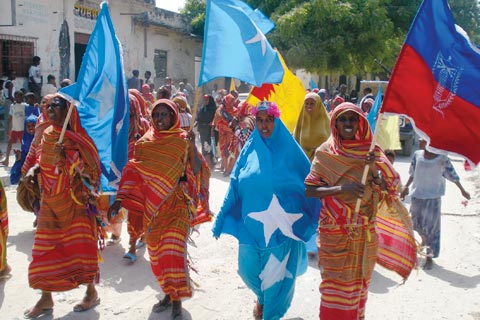
Across Africa, women’s movements are now putting more emphasis on decision-making power.
Photograph: Reuters / Mowliid Ibdi

Africa’s political independence was accompanied by a clarion call to eradicate poverty, illiteracy and disease. Fifty years after the end of colonialism, the question is: To what extent has the promise of that call been realized for African women? There is no doubt that African women’s long walk to freedom has yielded some results, however painfully and slowly.
The African Union (AU) now has a legally binding protocol to the African Charter on Human and Peoples’ Rights on the rights of women. The protocol spells out clearly women’s rights to equality and non-discrimination in a number of areas. It has been ratified by a growing number of African states, can be used in civil law proceedings and is being codified into domestic common law. The AU has also issued a Declaration on Gender Equality in Africa, under which member states are supposed to regularly report on progress.
The protocol and declaration both reflect and reinforce developments at the national level. Many African states have moved to enhance constitutional protections for African women — particularly in the area of women’s rights and equality. And the last two decades have seen the emergence of legislation to address violence against women, including sexual violence.
 
Political representation

These developments have been accompanied by improvements in African women’s political representation. The AU adopted, from its inception, a 50 per cent quota for women’s representation, which is reflected in the composition of the AU Commission.
Again, this standard reflects and reinforces efforts to enhance women’s representation at the national level. Angola, Mozambique and South Africa have exceeded the 30 per cent benchmark for their legislatures. Rwanda made history in 2008 when 56 per cent of legislators elected to parliament were women, the highest in the world. A few countries, including Nigeria, have seen women assume non-traditional ministerial portfolios, in defence and finance, for example. And Liberia also made history (“herstory”) by becoming the first African country to elect into office a female head of state, Ellen Johnson-Sirleaf.
Progress is evident, particularly in countries that have electoral systems based on or incorporating proportional representation. However, enhanced women’s representation has been harder to achieve in first-past-the-post electoral systems.
Even where there has been progress, the question is whether increased representation of women is catalyzing action by the executives and legislatures in favour of gender equality. That question arises because the battle for women’s representation is not only demographic (with political representation as an end) but also for gender equality (with political representation as a means).
Put another way, there has been a shift in the focus and strategy of the African women’s movement over the last two decades, from emphasizing capacity-building to improve African women’s access to resources to emphasizing decision making to enhance African women’s control over resources. This shift was made possible by real gains resulting from the capacity-building approach.
 
Education, poverty, health

These gains are most evident in African women’s education. Girls and boys are now at par with respect to primary school enrolment. Efforts to get girls into school have been accompanied by efforts to keep them in school and to promote role models by developing gender-responsive curricula. Gender gaps are also narrowing in secondary education. The real challenge now lies at the university level, both in the enrolment figures and in curricula to benefit young women. So much for the “illiteracy” element of the African independence clarion call.
Gains for women are harder to see in that call’s “poverty” element, however. It is true that since independence investments in micro-credit and micro-enterprises for women have improved their individual livelihoods — and therefore those of their families. Since African women have proved that they are good lending risks, micro-credit is now being offered not just by development and micro-finance institutions, but also by commercial financial institutions.
Yet there was a critique of such investments, especially in the decade of the 1980s when governments withdrew from social service delivery as a result of structural adjustment programmes. Under those circumstances, such investments essentially enabled redistribution among the impoverished, rather than at a larger level from the rich to the poor.
The end of that era thus saw a new focus on gender budgeting: looking at where national budget allocations and expenditures could enhance women’s status in the economy. Unsurprisingly, this approach has led African governments back towards public investments in social services.
It is now agreed, for example, that the benchmark for public investments in health in Africa is 15 per cent. The African women’s movement has called in particular for more to be directed towards reproductive and sexual health and rights. These areas are of critical concern to women, given the impact of HIV/AIDS, maternal mortality and violence against women, particularly in conflict areas. They are also of concern since African women’s continued lack of autonomy and choice over reproduction and sexuality lie at the heart of so much suffering. So much for the “disease” element of the independence call.
 
Where next?

Where to over the next 50 years, then? In light of the experience so far, the African women’s movement will be focusing not just on political representation, but also on the meaning of that representation for advancing gender equality and women’s human rights. And given recent retreats in Africa (such as the rise of the constitutional coup and “negotiated democracy”), the women’s movement will also be focusing on democracy, peace and security more broadly — that is, on the nature of the political system itself and not just on the means of getting into that system.
Economically, women will continue to focus on the macro-level, but in a deeper sense. What has emerged from gender budgeting efforts is the need to actually track budgetary expenditures, not just getting information about allocations.
It is also necessary to concentrate on the macro-economic framework for fiscal and monetary policies, especially in the context of stabilization programmes in response to the recent economic shocks. Previously that framework was assumed to be gender-neutral, but it clearly can have gendered consequences. This problem must be addressed to ensure that Africa’s growth will enhance women’s livelihoods.
Finally, the women’s movement will be focusing on reproductive and sexual health and rights. The battle over choice (including over gender identity and sexual orientation) is now an open one in many African countries. It is no longer couched politely in demographic or health terms.
The upsurge of conservative identity politics (in both ethnic and religious terms) is fuelling conflict on the continent. It constrains and dangerously limits women’s human rights, including reproductive and sexual rights. Such notions are not harmless — they have grave consequences for women’s autonomy, choice and bodily integrity. They therefore must be challenged.
African women’s long walk to freedom has only just begun.  

L. Muthoni Wanyeki is a former executive director of the Kenya Human Rights Commission.


Παρασκευή 28 Φεβρουαρίου 2020

Bogaletch Gebre, "the woman who began the rebellion of Ethiopian women"


En.wikipedia (photo)

Bogaletch "Boge" (pronounced Bo-gay) Gebre (1950s – 6 November 2019)[1] was an Ethiopian scientist and activist. In 2010, The Independent characterized her as "the woman who began the rebellion of Ethiopian women."[2] Along with her sister Fikirte Gebre, Gebre founded KMG Ethiopia, formerly called Kembatti Mentti Gezzima-Tope (Kembatta Women Standing Together).[3] The charity works to serve women in many areas, including preventing female genital mutilation and bridal abductions, the practice of kidnapping and raping young women to force them into marriage.[4] According to the National Committee on Traditional Practices of Ethiopia, such practices were the basis of 69% of marriages in the country as of 2003.[2]
The Independent reports that the organization has reduced the rate of bridal abductions in Kembatta by over 90%, while The Economist notes it has been credited with reducing female genital mutilation from 100% to 3%.[2][5] In 2005, Gebre was awarded the 2005 North-South Prize and in 2007 the Jonathan Mann Award for Global Health and Human Rights.[6] For her contributions to the development of Africa, Boge was awarded the King Baudouin International Development Prize in May 2013.[3][5][7]

Background

Herself a victim of female genital mutilation at the age of 12, Gebre was forbidden a formal education by her father but sneaked out of her home to attend a missionary school.[3][8] Ultimately, she studied microbiology in Jerusalem before attending the University of Massachusetts Amherst on a Fulbright scholarship.[2] While in the United States, she launched her first charitable organization, Development through Education, through which students in Ethiopian high schools and universities received $26,000 worth of technical books.[9]
After earning her PhD in epidemiology, Gebre returned to Ethiopia to help protect the rights of women in the 1990s. Following an initial public speech on the taboo topic of HIV/AIDS, Gebre realized that she would need to establish credibility with the community before she could effect change and so set herself to correcting problems that were pointed out to her, providing necessary supplies to build a bridge that would allow regional children to reach the nearest school and traders to reach the local market. Once the bridge was built, she and her sister formed KGM Ethiopia, opening community consultations village by village to protect the rights of women.

See also

References 

  • "Ethiopian Women Rights Advocate Passes Away". www.ezega.com. Retrieved Nov 12, 2019.
  • Hari, Johann (March 16, 2010). "Kidnapped, Raped, Married: The Extraordinary Rebellion of Ethiopia's Abducted Wives". The Independent. Retrieved 17 August 2014.
  • Rosenberg, Tina (July 17, 2013). "Talking Female Circumcision Out of Existence". The New York Times. Retrieved 17 August 2014.
  • "KMG Ethiopia". KMG Ethiopia. Archived from the original on 2013-04-23. Retrieved 17 August 2014.
  • "Standing up for women". The Economist. May 23, 2013. Retrieved 17 August 2014.
  • "Fulbright Alumna Awarded King Baudouin Prize in Belgium". Bureau of Educational and Cultural Affairs. United States Department of State. Archived from the original on August 19, 2014. Retrieved August 17, 2014.
  • "Bogalatech Gebre (Ethiopia)" (PDF). eeas.europa.eu. Retrieved 17 August 2014.
  • "Abducted. Raped. Married. Can Ethiopia's wives ever break free?". Abbay Media. March 17, 2010. Archived from the original on 2014-08-19. Retrieved 17 August 2014.
    1. Shetty, Priya (June 23, 2007). "Bogaletch Gebre: ending female genital mutilation in Ethiopia". The Lancet.

    Πέμπτη 26 Σεπτεμβρίου 2019

    Women and education in Africa


    Womafrika / Being a Woman in Africa

    „The whole purpose of education is to turn mirrors into windows.“ [1]
    (Sydney J. Harris)


    When you look into a mirror you can only see yourself and the little part of the world behind you. Otherwise, when you look through a window you are able to see the horizon, the sky, trees and the street you can walk along.
    Until now, many educational windows are still closed for a great amount of African women; windows that symbolize career opportunities, protection against exploitation, the chance to emancipate themselves, the possibility to develop and to provide a basis for a better life.
    The only way to turn all the mirrors of suppression and external determination into windows is education! ...


    Right to education

    The Declaration of Human Rights contains among various others the right to education.
    Nevertheless this right is not observed in many countries all over the world, due to a lack of resources for building schools and due to the absence of teachers or because of cultural reasons.

    Africa is an example for the disregard of the right to education. There a great percentage of children is excluded from the right to education; about 55 percent of the children who do not go to school are female. [2]
    In order to point out some of the reasons why girls aren’t allowed to go to school you could answer the question “Why are women and girls often excluded from the access to (higher) education?”
    One reason, why girls often cannot go to school is, that education is not accepted as an essential right in many countries of Africa; and that is why there is not enough money spent for building schools or to pay for teachers.


    Girls – unworthy to be educated?
    Child and desk
    Another point is the traditional role of girls and women in African society.Their duty is to take care of the children and the household. And many fathers do not send their daughters to school for that reason and because they think that the education of girls is not as important as the education of boys. Due to the tradition that daughters get married at a young age and therefore do not have the possibility to take care of their parents when they get old, there is no necessity to spend money on one´s daughter´s education.
    The conviction of many African people that girls are stupid and therefore education is wasted on girls also hinders many girls from going to school.
    And even if there were schools many parents would not let their daughter go, fearing that their daughter would get harmed on her way to school.

    To understand the urgency of fighting against the contravention of the right to education, it is important to realize the answer to the question “Why is education so important for women in Africa?”

    Escape from suppression

    First of all education would enable women to question the system of gender-related division of labor and the dependence of a woman on her husband. If women understood their suppressed and unjust situation and role in society -respectively in their families-, they would consequently start to fight this injustice and offer their children – especially their daughters – more freedom of action and a greater range of self-determination.
    That would entail an opportunity for the daughters to live a more unconstrained life than their mothers have and an opportunity to break out of this inflexible system of suppression.
    In addition to that mothers, who are educated, would also impart a lot of their knowledge to their children and therefore show them how important education is.
    They would give their children confidence and would probably take care that they can go to school, too.
    Besides that, women, who are able to read and to calculate, can protect themselves from fraud when they buy food or other goods.
    Another positive consequence would be, that higher educated women can participate in politics and economics and be a role model for many other African girls.


    Education – a basis of health

    Furthermore, if more girls and women in Africa were enlightened on sexual matters and on the risk of a the possible infection with HIV or other venereal diseases, they would get to know how to prevent these diseases and therefore begin to preserve their health and help to slow down the spreading of HIV and additionally do a more conscious family planning.

    Education – a chance of survival

    Basic knowledge in writing, reading and calculating is a requirement for further vocational education and development. It gives women the chance to get a job, to earn money and to nourish their children when their husbands leave the family. That happens frequently, because African men often abandon their families just because the wife was violated, although women can´t defend themselves against abuse.
    Altogether education always means empowerment in every area of life.

    4-A scheme
    Group of Children
    It is important to offer the girls and all other children in Africa an education that fits their life situation, helps them to understand their lives and to deal with it, as it promises them a better life and helps them to get on in their course of life. Therefore, education has to be accessible, acceptable and adaptable and above all this it has to be available.
  • Education is only then available, when there are enough schools in Africa, enough well educated teachers and learning aids.

  • Education is only then accessible, when every child in Africa has the possibility to go to school, both physically and economically.

  • Education is only then acceptable, when school is safe, lessons have a good quality and when the culture of the area where children are educated is taken into consideration.

  • Education is only then adaptable when one is able to adapt education to changes in society. [3]

  • To comply with all these conditions of good and adjusted education is not easy, and to assist girls and women in standing up for their rights is not easy as well. But instead of being discouraged because of these facts, everybody should – confirmed by all the positive aspects of education – do whatever one can do to provide girls and women in Africa with the education that everyone is entitled to.

    Magdalena Thalhammer

    Sources:

    [1] Sydney J. Harris qoutes, http://thinkexist.com/quotes/sydney_j._harris/ (25.04.2010)
     

    [2]Grundbildung ist ein universales Menschenrecht, http://www.plan deutschland.de/schule-afrika/kinder-afrika/ (02.01.2010)

    [3]Prof. Ralf Poscher, Thomas Langer: Verbindliche Orientierung: Das Recht auf Bildung im Völkerrrecht, http://gew.de/Verbindliche_Orientierung_Das_Recht_auf_Bildung_im_Voelkerrecht.html vom 24.02.2009 (01.01.2010)

      
    Frauen in Afrika und Bildung