Εμφάνιση αναρτήσεων με ετικέτα Orthodox Legacy. Εμφάνιση όλων των αναρτήσεων

Παρασκευή 5 Ιουνίου 2026

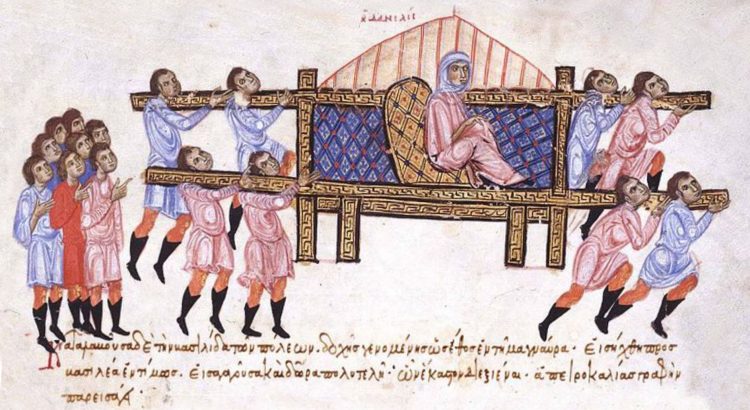
The True Dignity of Human Beings – Saint Gregory of Nyssa on Slavery


by Fr. Stephen Freeman  

Αncient faith / Glory 2 God for all things

Orthodox Outlet for Dogmatic Enquiries

One of the most rewarding aspects of reading historical material is how it reveals the human mind even at a great remove from our own. There is a myth in our culture that history is the story of progress. It presumes that only in our modern times have we begun to free ourselves from the false ideas of the past. What you discover when you actually read historical materials is that many of the worst ideas ever espoused were specifically “modern” ideas (eugenics, racial superiority, abortion, euthanasia, etc.).

Occasionally, you come across a piece of ancient writing that simply shatters these false assumptions. A case-in-point is this excerpt from St. Gregory of Nyssa’s fourth homily on Ecclesiastes. He is writing in the 4th century, A.D., when the Church is squarely in the Byzantine period. The homily is a commentary on Ecclesiastes 2:7 in which the writer describes his growing wealth and his acquisition of slaves. Nyssa uses the occasion for the most scathing critique of slavery in the annals of Christian preaching. It shows a wonderful clarity of theological insight and understanding – something that would and should have been available and understood both by his contemporaries and by Christians of all times. He did not invent this understanding – he simply demonstrates that its ideas are timeless and not the product of some later historical progress.

There is truth. It abides. There is sin. It obscures.

From the 4th Homily on Ecclesiastes – St. Gregory of Nyssa

Ecclesiastes 2:7
I got me slaves and slave-girls,
and homebred slaves were born for me,
and much property in cattle and sheep became mine.


The writer of Ecclesiastes sets out in careful order virtually everything in his own experience through which the futility of our activities in this life is known. But at this point he touches on what appears to be a more serious piece of evidence from his deeds through which he can be accused of the affliction of arrogant pride. What is there in what he has laid before us so far which leads to such a level of conceit? He has told us about a valuable house, an abundance of vines, elegant gardens and water features, nicely constructed swimming pools, extensive beautiful parkland. Yet, none of this can compare to his presumption that, as a human being he believes he can lord it over people who in essence are just like him. Because then he goes on to say: “I got me slaves and slave-girls, and homebred slaves were born for me”.

Do you detect the excessive arrogance? An utterance like this shows that he is exalting himself against God. We know from the words of the prophets that absolutely everything is subject to the supreme authority in the universe (Psalm 119/118.91). But this man counts as his own what truly belongs to God and gives to the likes of himself the kind of power which makes him think that he can be the master of men and women. When he sees himself as so different from those who are subject to him one can only conclude that pride has led him to go beyond what is appropriate for his nature.

“I got me slaves and slave-girls.” You are condemning to slavery human beings whose nature is free and characterized by free will. You are making laws that rival the law of God, overturning the law appropriate for humankind. Human beings were created specifically to have dominion over the earth; it was determined by their creator that they should exercise authority. Yet you place them under the yoke of slavery, as though you are opposing and fighting against the divine decree.

Have you forgotten the limits of your authority? Your rule is limited to control of irrational creatures. In scripture we read: “let them rule over birds and fish and four-footed creatures”. (Gen 1.26) How then do you go beyond what is subject to you and exalt yourself against a nature which is free, counting people like you among four-footed or footless creatures. “You subjected everything to humankind” declares the scripture through prophecy and it goes on to list what is under human control: domestic animals, cattle and sheep. (Psalm 8/7.8) Surely human beings have not been born to you from domestic animals? Surely cattle have not given birth to human offspring? Irrational creatures alone are subject to humankind. “He makes grass grow for animals and green plants for people’s slaves”. (Psalm 104/103.14) . But you have torn apart the nature of slavery and lordship and made the same thing at one and the same time enslaved to itself and lord of itself.

“I got me slaves and slave-girls.” Tell me what sort of price you paid. What did you find in creation with a value corresponding to the nature of your purchase? What price did you put on rationality? For how many obols did you value the image of God? For how many coins did you sell this nature formed by God? God said: “Let us make human beings in our own image and likeness” (Gen 1.26). When we are talking about one who is in the image of God, who has dominion over the whole earth and who has been granted by God authority over everything on the earth, tell me, who is the seller and who the buyer? Only God has this kind of power, or, one might almost say, not even God. For scripture says that the gifts of God are irrevocable (Romans 11.29). God would not make a slave of humankind. It was God who, through his own will, called us back to freedom when we were slaves of sin. If God does not enslave a free person, then who would consider their own authority higher than God’s?

How can people be sold who have dominion over the earth and everything on the earth? It is essential that the assets of people being sold are sold with them. How can we value the contents of the whole earth (Genesis 1.26)? If these are beyond any valuation then tell me, what is the value of the one who is over them? If you said “the world in its entirety”, even then you would not have found anything approximating to the value (Matthew 16.26; Mark 8.36). Someone knowing the true value of human nature said that not even the whole world is worth enough to be given in exchange for the human soul. So when a human being is for sale, it is nothing other than the lord of the earth being brought to the auction room. This means that creation as we know it is at the same time being put up for public sale. That is earth, sea and islands and all that is in them. How then is the purchaser going to settle the payment? What will the vendor accept considering the greatness of the property involved in the transaction?

Did the little notebook, the written agreement and the calculation in obols trick you into thinking that you could be master of the image of God? What utter folly! If the contract was lost, if the writing was eaten by moths, if a drop of water fell on it and washed it away, where is there any proof that you have a slave? Where is there anything that supports you in being a master? You have somebody who is named as your subordinate, but beyond the mere name I see nothing. 

What did such power add to your real nature? It did not give you extra years or any genuine superiority. Your lineage is still human, your life is similar, the sufferings of the soul and the body prevail upon you both in the same way, with you as master and another in subjugation you are still both affected by agony and delight, gladness and distress, sorrow and joy, anger and fear, disease and death. Surely there is no distinction in such things between slave and master? Do they not draw in the same air when they breathe? Do they not see the sun in a similar way? Do they not both sustain their life by taking in nourishment? Is not the make-up of their bodily organs the same? Do they not both return to the same dust after death? Do they not both face one and the same judgment? Is not the prospect of heaven and hell the same for them both?

So when you are equivalent in every way, tell me in what particular way you have more so that you think you can become master of another human being even though you are a human being yourself. “I got me”, you say, “slaves and slave-girls,” as though they were a herd of goats or swine. After saying “I got me slaves and slave-girls,” he added the good cheer that comes through flocks and herds. For he says “And much property in cattle and sheep became mine”, as though animals and slaves were subject to his authority to an equal degree.

This text is copied from the website Early Church Texts – edited by Revd Andrew Maguire

Σάββατο 20 Απριλίου 2024

When the God became a human


Pity us, O God, and spare Your inheritance by overlooking now all of our iniquities, for this accepting the fervent prayers of her who without seed gave birth to You on earth, O Christ our God, who in Your great mercy willed to take on flesh, thus assuming the form that was not Your own.
 
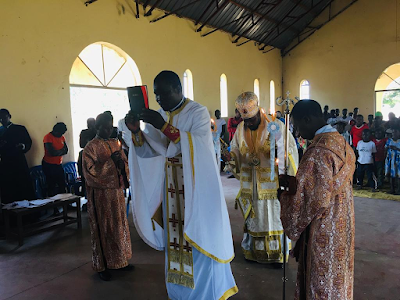
The Akathist Hymn of the Most Holy Theotokos at St. Anargroy valley road. Kenya.

Δευτέρα 8 Απριλίου 2024

Passionately Drunk


Fr. Stephen Freeman

Glory to God For All Things

The Philokalia, that wonderful collection of writings by the fathers on prayer of the heart, has as its full title, The Philokalia of the Neptic Saints gathered from our Holy Theophoric Fathers, through which, by means of the philosophy of ascetic practice and contemplation, the intellect is purified, illumined, and made perfect. Little wonder it is known popularly as the Philokalia. That word, Philokalia, means “the love of beautiful things.” It is not a reference to expensive, decorative items, but to the things which are made beautiful by their union with God. All things are beautiful inasmuch as they are united to God, Who is Beauty itself.

Another important word in the title is the adjective, “Neptic” (νηπτικός). It has a variety of translations: sober, watchful, vigilant. It refers to those who, having their earthly senses purified, have become truly aware of God and dwell in Him. This title is especially used to describe the fathers of the Hesychast tradition in Orthodoxy, the tradition of ceaseless prayer and inner stillness associated with the monastic life.

To describe these fathers as “sober,” is very insightful. For our experience with the passions, the disordered desires of our body and soul, is often an experience of drunkenness.

For those who sleep, sleep at night, and those who get drunk are drunk at night. But let us who are of the day be sober, putting on the breastplate of faith and love, and as a helmet the hope of salvation. For God did not appoint us to wrath, but to obtain salvation through our Lord jesus Christ, who died for us, that whether we wake or sleep, we should live together with Him (1 Thess. 5:7-10).

The man who is drunk is famously unaware of his surroundings. He stumbles physically, mentally and spiritually, barely aware of his own imbalance. The passions have the same ability to blind us. In anger we are aware primarily of our own anger. What we see, we see through the haze of the energy that pulses through our mind and body.

All of the passions have this property. They consume us and become the primary lens through which we see the world and with which we react. Thus we are described as in “delusion.” Those who see the world through their passions do not see the truth of things. They see their own passions.

There is a social aspect to the passions – they are not restricted to an individual’s experience. Whole societies, or significant segments within it, can be drunk with the same passions. Thus a whole society can be drunk with the passion of fear or hatred.  Such a passion is reinforced by being repeatedly affirmed by those around us. Many aspects of culture are simply a communion of the passions.

We live in an age where the passions are carefully studied and used as the objects of marketing. Those things that are sold to us (even those that supposedly appeal to our intellect) are marketed to our passions. Apple computer famously researches the “feel” of its packaging, presenting a sensual experience that is associated with quality, precision and value. It is a successful strategy across the whole of our culture.

However, those who are “drunk” with the passions also yield themselves as victims to their intoxication. Political parties pour massive amounts of money into their campaigns simply to create and nurture the passions by which people vote. We are not governed by reason or informed decisions. Most of what you or I think about political subjects is a description of the passions to which we are enslaved. The political cynicism of many is, to a degree, a recognition of our disgust with the politics of passion.

By the same token, most of the opinions we nurture are equally the product of our passions. We think, we believe, we decide, we act largely in accord with the passions to which we are enthralled. Theological debates are generally arguments between one person’s passions and another’s. It is a conversation between drunks.

And so the Church values the holy, sober fathers. These are the men and women who have walked the narrow way of salvation, “putting to death the deeds of the body.” Inner stillness is the state of freedom from disordered passions. The neptic fathers do not cease to desire (they are not Buddhists). But their desires have been purified and healed – restored to proper order. Sobriety means desiring the right thing in the right way at the right time. Traditionally, this purification and healing come as a result of a life of repentance, fasting and prayer. It slays demons and heals the wounds of the soul. All things are brought into obedience to Christ.

It is the life that Scripture enjoins:

Be sober, be vigilant; because your adversary the devil walks about like a roaring lion, seeking whom he my devour. Rsist him, steadfast in the faith, knowing that the same sufferings are experienced by your brotherhood in the world (1 Peter 5:8-9).

There is a story in the Desert Fathers that illustrates such vigilance. A community of monks once heard a rumor that one of their number was harboring a woman in his cell. They went to the elder and complained. While they became yet more agitated, the elder slipped away to the cell of the erring monk. Finding the woman there, he hid her in a large earthen vessel. He placed the lid on the vessel and sat on it. Soon the angry monks arrived at the cell and began to search for the woman. Out of respect for the elder they overlooked the vessel on which he was sitting. Finding nothing, they apologized to the erring monk and left. The elder, rose from his seat and said to the monk, “Pay attention to yourself.”

It is a call to sobriety. The angry monks were drunk with their own self-righteousness. Their sin was at least as great as the erring monk. The elder alone was sober. His sobriety hid the sin of a man from those who would have harmed him, and revealed the sin to the one who needed to be healed. The word of healing was kind and without judgment. “Pay attention to yourself.” It is the simple word of St. Peter, “Be sober.”

For all of us, in every moment of the day with regard to all things and all people, it is good to pay proper attention to ourselves.

This prayer of St. Isaac of Syria, great among the neptic fathers, is one of my favorites:

I knock at the door of Thy compassion, Lord: send aid to my scattered impulses which are drunk with the multitude of the passions and the power of darkness.

Thou canst see my sores hidden within me: stir up contrition – though not corresponding to the weight of my sins, for if I receive full awareness of the extent of my sins, Lord, my soul would be consumed by the bitter pain from them.

Assist my feeble stirrings on the path to true repentance, and may I find relief from the vehemence of sins through the contrition that comes of Thy gift, for without the power of Thy grace I am quite unable to enter within myself, become aware of my stains, and so, at the sight of them, be able to be still from great distraction.


Σάββατο 30 Μαρτίου 2024

Digital Books about the Orthodox Church, Faith, Worship and Life


Orthodox Outlet for Dogmatic Enquiries (photo from here)


Book Presentations


 Download in .doc format

Holy Bible

·         Old Testament  (Compressed .zip format)

·         New Testament (Compressed .zip format)


Κυριακή 16 Απριλίου 2023

From Orthodox Uganda about Easter: "In the resurrection of Christ lies the hope for beloved country Uganda - It is a message of victory, victory over death and victory for eternal life!"

 
Easter Message (2023) by Metropolitan Jeronymos of Kampala

Video from Uganda Orthodox Church - Holy Metropolis of Kampala / Facebook

My beloved children in Christ,

Christ is Risen.

“I am the resurrection and life” (Jn. 11:25).

Jesus Christ, our Lord and Savior, came to earth to give us new life. This new life, is first and foremost, found in God, the true and living God. Here on earth, it is the life of saints. However, for this life to come about, it requires a clear knowledge of the true and living God. Christ revealed Him to us. One who has acquired it, is full of love and is in communion with this God, fellow human beings and creation. Most importantly, this new life is based on living according to the will of God, and away from sin. The fact is where there is sin, there is death. God who dwells in saints call us for constant repentance to be worth of His kingdom of heaven, His eternal life. Here, our Lord and Savior seals it by saying “I am the resurrection and life (Jn. 11:25)”, a special calling for Orthodox Christians.

That is why the Orthodox Church gives the resurrection of our Lord and Savior, Jesus Christ, a great importance. This feast is extremely important on the Orthodox Church Calendar. It is the feast of feasts, and the center of feasts. With the light from the source of light, Orthodox Christians celebrate the feast of the resurrection of Jesus Christ with great joy. It is a joy whereby everything is filled with life, the life from the empty tomb. This very life is the vision of a living reigning Lord. Giving everyone courage, hope, love and faith. Christ resurrected is all and in all. Mankind attains victory over death, in other words attains eternal life. The Church of Christ, which is the body of Christ, is to lead us to eternal life.

One has to visit Christ on the cross in order to grasp the depth and width of this new life. Truly speaking, Christ on the cross sheds His blood for the remission of our sins. He redeems us and reconciles us with God. At the entrance in Christ’s Church, we are born again by water and spirit. In the Church, our chief drink and food, as Orthodox Christians, is Christ’s blood and body. In communion, we get the remission of sins and everlasting life. Here one realizes the resurrection and life of Christ since in communion, Christ cleans our conscience and life and transforms our nature. Christ neutralizes the poison of sin and the bites of the devil. We are set free and drafted as sons and daughters of God, the Father, by Grace.

In the resurrection of Christ lies the hope for beloved country Uganda. As we confront the challenges of our great nation, the free sons and daughters of God the Father, by Grace, are ready and empowered with the vision of the resurrected Christ to raise this nation from heights to heights. Central to their being is the message of resurrection. It is a message of victory, victory over death and victory for eternal life. This victory is to bring about the quality of life for Uganda and indeed for all Ugandans. It is a message where love prevails in our communion with God, fellow citizens and creation. This message justifies our motto “For God and My Country”. And it puts Christ’s uniqueness and exclusiveness, as saviour able to give us true life, in the midst of our corrupt life, to the national agenda. We do re-orientate our hope to surpass the impassable which chokes our life. Let us shout loudly that Christ is Risen, each and every one in Uganda is free.

CHRIST IS RISEN! INDEED, HE IS RISEN!

DOWNLOAD THE LUGANDA VERSION OF THE MESSAGE BELOW

OBUBAKA BWA PASIKA (2023) ERI E’GGWANGA

Easter Message From Bishop Nektarios (Kabuye) of Gulu and Northern Uganda 
 

CHRIST IS RISEN! TRULY, HE IS RISEN!

Dear Brethren,

We celebrate this triumphant event in these words of the Troparion. Christ is Risen!

Resurrected joy is experienced and radiated regardless, of the favorable or unfavorable surroundings, even in conditions of poverty, disease, persecution, war and uncertainty. And we urgently need it right now that everything is set to drown us in the fume of death. This joy multiplies while it offers love where hatred abounds, and hope where despair prevails. Second, “we rejoice in the Lord who crushed the state of death and enlighten the race of men.” Let us draw courage by living the joy of our Church, despite the oppressive problems we faced, despite the trials we are going through. The resurrected Christ has the power to dispel every shadow of hell; to crush the state of death brought about by violence, injustice, arrogance, and the fury of destruction. He offers an insurmountable light to those who believe in and love Him. Christ is Risen, my brethren!  “This day has been made by the Lord. We rejoice and rejoice in it. To the pure, transparent truth, that the Gospel has been proclaiming for centuries: Certainty shared by billions of people over the centuries.

This is the characteristic of the Christian experience which defines and incessantly regenerates the believers. Undeniably, this belief is freely accepted or rejected.  Christ’s “descend into Hades” proclaims the final dissolution of death and has become a symbol of the Resurrection in the Orthodox Church.

Every believer associated with the suffering and Resurrected Christ lives in his personal life the experience of Psalmist: “Thou shalt not forsake my soul in hell,…You showed me the way to life. Thou shalt fill me with joy when I am near thee.” (Acts 2:27-28 – Psalm 15:10-11). Relying on the unceasing presence of the risen Lord, we can even in the most painful circumstances chant, “O divine, O friend, O sweet voice. With us, I pray onto the end of ages, Christ: if the faithful anchors have hope possessed, we rejoice.” The Resurrection is the foretaste of God’s final victory of love in the end. He brings the future within us and with the sanctifying energy of the Holy Spirit in the Mystery of the Church, makes it present.

However, in the light of the Resurrection, all these things are transformed and can be overcome. “Do not be surprised at the terrible trial by which you are tested,” advises the Apostle Peter. “On the contrary, rejoice in participating in the suffering of Christ, for thus shall you be filled with joy and joy when His glory is revealed” (1 Pet 4:12-13); And in hours of cruel persecutions, he affirms: God “who out of great mercy reborn us into a new life with the Resurrection of Jesus Christ,” enable us to truly hope, guards us with His power “until Salvation comes which is already ready to be manifested in the ends times. With this thought feel joy, even if you need for the time being to be distressed for a while by various trials” (1 Pet 1:3-6). At Easter, we celebrate the crushing of the state of death, the merciless enemy of man.

With Christ is Risen, we celebrate the most important event of history, which concerns the depth, the meaning, and the future of man’s existence. It may be that Various ramifications of death surround us with their strangest and most diverse masks, with unjust oppression, debilitating poverty, and unexpected suffering.  May the Resurrection of our Lord Jesus Christ change our minds, our hearts, our thoughts, our behaviors and our values as it did to the Apostles and all those who truly witnessed His Holy Resurrection from the dead two thousand years ago.

Amen.

Easter Message From His Grace Bishop Silvester (Kisitu) of Jinja and Eastern Uganda


Beloved children in the Lord God.

Christ Is Rsien!

Christos Anesti!

Kristo Azuukidde!

I greet you with this traditional ecclesiastical phrase which expresses the inexpressible world event ever, i.e., the transcendent triumph of our Lord Jesus Christ over sin and death. The resurrection of Christ marks the beginning of a new phase (fundamental change) in the history of mankind where by the powers of the hades are destroyed and man is regenerated and according to St. Paul, he becomes a new creature.

However, even though His resurrection fully reveals the immeasurable love of God for man by keeping His promises He made to the people of Israel, especially through Abraham and Moses; man has taken it for granted by misusing this freedom.

Today, the world has developed the ideology of humanism which encourages one to decide or act freely in his daily life, a situation that has resulted into relying on distorted truths and freedom with its numerous consequences one of which is the vice of homosexuality.

We thank God there is still some integrity among people which springs from God’s image in which man was created as well as His knowledge from the gospels. The original plan for a person is clear that God created man and woman and blessed the mystery of marriage for both so that in unity and happiness provided by God, they may praise and serve Him thus strengthening the family bond for the solidarity of the society.

Therefore, other forms of marital existence are foreign according to the teaching of the Church, traditions, as well as human nature and there are indeed controlled by the power of sin.

We thank God that here in Uganda our people continue to leave a Godly life and are not supportive of such ungodly, immoral, and unnatural behaviors in spite of the pressure from those trying to impose such evils into our societies.

In these circumstances, we pray for those that have been controlled by sin to be guided and come back to God, to normality as expected of a person / human being.

As we pray for all people, we must encourage them to repent and come back to God by denying inhuman behaviors and habits and then be able to resurrect together with Christ as a “new people” in Christ Jesus; the citizens of the kingdom of Heaven, living peacefully in the world together with other people as one godly family.

CHRIST IS RISEN! INDEED, HE IS RISEN!


Photo from here


Κυριακή 26 Φεβρουαρίου 2023

Forgiveness Sunday, also called Cheesefare Sunday, the final day of pre-Lent in the Orthodox Church


Orthodoxwiki.org

Forgiveness Sunday, also called Cheesefare Sunday, is the final day of pre-Lent. It is the Sunday after Meatfare Sunday and the Sunday before the Sunday of Orthodoxy.

Significance of the day

On this last Sunday before Great Lent, the last day that traditionally Orthodox Christians eat dairy products until Easter, the Church remembers the expulsion of Adam and Eve from Paradise. God commanded them to fast from the fruit of a tree (Gen. 2:16), but they did not obey. In this way Adam and Eve and their descendants became heirs of death and corruption.

On Forgiveness Sunday many attend Forgiveness Vespers on the eve of Great Lent. They hear on the Lord's teaching about fasting and forgiveness and enter the season of the fast forgiving one another so that God will forgive them. If you forgive men their trespasses, your heavenly Father will forgive you; but if you do not forgive men their trespasses, neither will your heavenly Father forgive you your trespasses (Matthew 6:14).

The Gospel reading of the day also gives advice on fasting. Moreover, when you fast, do not be like the hypocrites, with a sad countenance. For they disfigure their faces that they may appear to men to be fasting. Assuredly, I say to you, they have their reward. But you, when you fast, anoint your head and wash your face, so that you do not appear to men to be fasting, but to your Father who is in the secret place; and your Father who sees in secret will reward you openly. (Matthew 6:16-18).

The Rite of Forgiveness

After the dismissal at Vespers, the priest stands beside the analogion, or before the ambon, and the faithful come up one by one and venerate the icon, after which each makes a prostration before the priest, saying, "Forgive me, a sinner." The priest also makes a prostration before each, saying, "God forgives. Forgive me." The person responds, "God forgives," and receives a blessing from the priest. Meanwhile the choir sings quietly the irmoi of the Paschal Canon, or else the Paschal Stichera. After receiving the priest's blessing, the faithful also ask forgiveness of each other. 

Sunday of Cheesefare: Expulsion of Adam from Paradise


Orthodox Church in America

As we begin the Great Fast, the Church reminds us of Adam’s expulsion from Paradise. God commanded Adam to fast (Gen. 2:16), but he did not obey. Because of their disobedience, Adam and Eve were cast out of Eden and lost the life of blessedness, knowledge of God, and communion with Him, for which they were created. Both they and their descendents became heirs of death and corruption.

Let us consider the benefits of fasting, the consequences of disobedience, and recall our fallen state. Today we are invited to cleanse ourselves of evil through fasting and obedience to God. Our fasting should not be a negative thing, a mere abstention from certain foods. It is an opportunity to free ourselves from the sinful desires and urges of our fallen nature, and to nourish our souls with prayer, repentance, to participate in church services, and partake of the life-giving Mysteries of Christ.

At Forgiveness Vespers we sing: “Let us begin the time of fasting in light, preparing ourselves for spiritual efforts. Let us purify our soul, let us purify our body. As we abstain from food, let us abstain from all passion and enjoy the virtues of the spirit....” 

O Master, Guide to wisdom, / Bestower of prudence, / Instructor of the foolish, and Defender of the poor: / make firm my heart and grant it understanding. / O Word of the Father, / give me speech, for behold, I shall not restrain my lips from crying out to Thee: / "Have mercy, have mercy on me who have fallen."

Please read more about the meaning of this storytelling below.

1.  The dogma regarding Creation  

2.  Creation from nil  

3.  Existential consequences of the dogma on Creation  

4.  The consequences of man’s downfall  

5.  Christology 

6.  Salvation

7.  Ecclesiology