Εμφάνιση αναρτήσεων με ετικέτα Orthodox Libya. Εμφάνιση όλων των αναρτήσεων

Τρίτη 10 Μαΐου 2022

Martyr Christopher of Lycia (from Cyrenaica?), and, with him, the Martyrs Callinika and Aquilina


Orthodox Church in America

The Holy Martyr Christopher lived during the third century and suffered about the year 250, during the reign of the emperor Decius (249-251). There are various accounts of his life and miracles, and he is widely venerated throughout the world. Saint Christopher is especially venerated in Italy, where people pray to him in times of contagious diseases.

There are various suggestions about his descent. Some historians believe that he was descended from the Canaanites, while others say from the “Cynoscephalai” [literally “dog-heads”] of Thessaly.

From here: The roots of that iconography lie in a hagiographic narrative set during the reign of the Emperor Diocletian, which tell of a man named Reprebus, Rebrebus or Reprobus (the "reprobate" or "scoundrel") being captured by Roman forces fighting against tribes dwelling to the west of Egypt in Cyrenaica and forced to join the Roman numerus Marmaritarum or "Unit of the Marmaritae", which suggests an otherwise-unidentified "Marmaritae" (perhaps the same as the Marmaricae Berber tribe of Cyrenaica).

Saint Christopher was a man of great stature and unusual strength. According to tradition, Saint Christopher was very handsome, but wishing to avoid temptation for himself and others, he asked the Lord to give him an unattractive face, which was done. Before Baptism he was named Reprebus [Reprobate] because his disfigured appearance. Even before Baptism, Reprebus confessed his faith in Christ and denounced those who persecuted Christians. Consequently, a certain Bacchus gave him a beating, which he endured with humility.

Because of his renowned strength, 200 soldiers were assigned to bring him before the emperor Decius. Reprebus submitted without resistance. Several miracles occurred along the way; a dry stick blossomed in the saint’s hand, loaves of bread were multiplied through his prayers, and the travellers had no lack thereof. This is similar to the multiplication of loaves in the wilderness by the Savior. The soldiers surrounding Reprebus were astonished at these miracles. They came to believe in Christ and they were baptized along with Reprebus by Saint Babylus of Antioch (September 4).

Christopher once made a vow to serve the greatest king in the world, so he first offered to serve the local king. Seeing that the king feared the devil, Christopher thought he would leave the king to serve Satan. Learning that the devil feared Christ, Christopher went in search of Him. Saint Babylas of Antioch told him that he could best serve Christ by doing well the task for which he was best suited. Therefore, he became a ferryman, carrying people across a river on his shoulders. One stormy night, Christopher carried a Child Who insisted on being taken across at that very moment. With every step Christopher took, the Child seemed to become heavier. Halfway across the stream, Christopher felt that his strength would give out, and that he and the Child would be drowned in the river. As they reached the other side, the Child told him that he had just carried all the sins of the world on his shoulders. Then He ordered Christopher to plant his walking stick in the ground. As he did so, the stick grew into a giant tree. Then he recognized Christ, the King Whom he had vowed to serve.

Saint Christopher was brought before the emperor, who tried to make him renounce Christ, not by force but by cunning. He summoned two profligate women, Callinika and Aquilina, and commanded them to persuade Christopher to deny Christ, and to offer sacrifice to idols. Instead, the women were converted to Christ by Saint Christopher. When they returned to the emperor, they declared themselves to be Christians. Therefore, they were subjected to fierce beatings, and so they received the crown of martyrdom.

Decius also sentenced to execution the soldiers who had been sent after Saint Christopher, but who now believed in Christ. The emperor ordered that the martyr be thrown into a red-hot metal box. Saint Christopher, however, did not experience any suffering and he remained unharmed. After many fierce torments they finally beheaded the martyr with a sword. This occurred in the year 250 in Lycia. By his miracles the holy Martyr Christopher converted as many as 50,000 pagans to Christ, as Saint Ambrose of Milan testifies. The relics of Saint Christopher were later transferred to Toledo (Spain), and still later to the abbey of Saint Denis in France.

In Greece, many churches place the icon of Saint Christopher at the entrance so that people can see it as they enter and leave the building. There is a rhyming couplet in Greek which says, “When you see Christopher, you can walk in safety.” This reflects the belief that whoever gazes upon the icon of Saint Christopher will not meet with sudden or accidental death that day.

The name Christopher means “Christ-bearer.” This can refer to the saint carrying the Savior across the river, and it may also refer to Saint Christopher bearing Christ within himself (Galatians 2:20). 


Παρασκευή 24 Ιουλίου 2020

Holy Virgin Abbess Sarah of Sketis in Libya (July 13)

Orthodox Church in America
In Greek (& the icon) here
 
It is written in "The Paradise of the Fathers" that Mother Sarah spoke these words: “If I were to ask God that all people might be built up through me, I would be found expressing contrition at the door of each one who repents. But I pray to God especially that my heart may be pure with Him and with everyone.”
Once two great Elders and anchorites left Mount Pelusium (in the northeastern Nile Delta) and went to see Amma Sarah. Speaking among themselves they said, “Let us humble this old woman.” When they came to her she said, “Be careful, you may be humbled by the words you have spoken. Behold, anchorites have come to one who is a woman. According to nature, I am a woman, but not according to my worth.”
Once she went to Sketis, and she was offered some food. She did not eat any of the best food however, she ate only the plain food. This was because she did not want to use her journey and her visit as an excuse to relax her fasting. Then they said to her, “Truly, you are like those who dwell at Sketis.”
It was said of Amma Sarah, the ascetic of Sketis, that the blessed one lived above a river for sixty years, but she never looked out from her abode to see it.
Mother Sarah said, “It is a good thing for a person to give alms, even if he does so in order to win the approval of others, because by doing this, he will come to do it for God’s sake.”
Saint Sarah brought many women to monasticism by the example of her holy and God-pleasing life. She reposed in peace in the year 370 at the age of eighty. 


St. Theodore of Cyrene in Libya & St. Andrew of Crete 
Holy Martyr Asclas of Egypt & St Thalassios the Libyan
Saint Thalassios le Libyen 
The Holy Amma Piama (Piamun) the Vigrin of Egypt

St. Mary of Egypt القديسة مريم المصرية (5th Sunday of Great Lent) 
Great Martyr Catherine of Alexandria
About the African Martyrs Perpetua, Felicity, Saturus, Saturnius, Revocatus and Secundulus 
African Saints
Hymn to the African Saints


Κυριακή 9 Φεβρουαρίου 2020

Patriarch of Alexandria officially established this year as "the year of Saint Nektarios" (100 years from his assumption, 1920 - 2020)


Patriarch of Alexandria: “May St Nektarios be our consolation for the 21st century”

The Patriarch of Alexandria & all Africa Theodoros in the monastic cell of Saint Nektarios. Photo from here.

You can see in Greek here & here about the "year of St Nektarios"
 
In a moving atmosphere, His Beatitude Theodoros II, Pope and Patriarch of Alexandria and All Africa, officiated at the festive Divine Liturgy at the Cathedral of St Nicholas in the place where St Nektarios lived, in Hamzawi, Cairo, close to today’s Khan Khalili.
There, decades ago, at a distance of just a few hundred meters from where thousands of tourists visit from all over the world, is preserved on the most historic places, both for the Ancient Patriarchate as well as for the community, the house where St Nektarios lived when he served the Alexandrian Church as Patriarchal Vicar of Cairo.
“It is a great blessing for Cairo and Alexandria that he lived among us. Despite the bitterness that the place he loved created for him, he came twice. He is the Saint we know in sadness and joy, but he was a great theologian, as he knew by heart both the Old and New Testaments and the Psalter. Forty of his works adorn the Library of the Patriarchal Vicariate of Cairo. And his great work is the verses for the All Holy Virgin “Agne Parthene” (O Virgin Pure) emphasized Theodoros of Alexandria, speaking of St Nektarios, expressing “enormous gratitude because he preserved the old apostolic Divine Liturgy of the Apostle St Mark, which was maintained by St Meletios Pegas and was conducted by Kyrillos of Alexandria in the Holy Monastery of St George Old Cairo”.
Patriarch Theodoros also commemorated today the late Patriarch Petros VII, who together with him and Makarios of Kenya drew up the apology to St Nektarios.
“We, the clergy of Africa, are children of St Nektarios, as every Hierarch of the Alexandrian Throne, every missionary Priest in Africa, is also a child of St Nektarios”, noted the Alexandrian Primate.
And Patriarch Theodoros, following the custom that wants only St Nektarios to be on the patriarchal Throne on this day, placed his icon there and in conclusion said:
“May he be our consolation for the 21st Century and as long as this world exists, for generations to come to praise, they will grow old, they will praise the Saint of hope, of consolation and of love, our own Saint. And his grace from Cairo, Aegina, to reach into all the hearts of people who hrt, because in our day, pain and sadness are in abundance".

Please, see also

Photo from here
 

Τετάρτη 4 Ιουλίου 2018

St. Theodore of Cyrene in Libya & St. Andrew of Crete (July 4)

Orthodox Church in America

St. Theodore, Bishop of Cyrene in Libya & sts Cyprilla, Lucia and Aroa
 
St Theodoros of Cyrene, icon from the site 
of Metropolitan of Cyrene Athanasios

The Hieromartyr Theodore, Bishop of Cyrene, lived during the reign of the emperor Diocletian (284-305). Skilled at writing, and having attained great skill in calligraphy, he transcribed many books for the churches. His son Leo denounced him to the district governor, Dignianus, saying that his father possessed Christian books and was turning people away from idol worship, and bringing them instead to faith in Christ the Savior. 
Saint Theodore was brought to trial. Many Christians followed after him, including the women Cyprilla, Lucia and Aroa. The holy bishop was ordered to surrender his books and renounce Christ, but he refused this demand. They beat him with rods, but Saint Theodore was not intimidated. With a fiery zeal for the truth he destroyed the pagan sacrificial offerings. They tortured him for a long while, cut out his tongue, and then threw him in prison where he died. Also put to death were the women Cyprilla, Lucia and Aroa, and all who had accepted holy Baptism from the holy bishop. 

More in our post Ancient Orthodox saints from Libya, who celebrate July 4th 

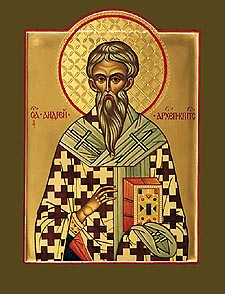
St. Andrew the Archbishop of Crete
Ελληνικά για τον άγιο (και τους αγίους της ημέρας) εδώ
 
Saint Andrew, Archbishop of Crete, was born in the city of Damascus into a pious Christian family. Up until seven years of age the boy was mute and did not talk. However, after communing the Holy Mysteries of Christ he found the gift of speech and began to speak. And from that time the lad began earnestly to study Holy Scripture and the discipline of theology.
At fourteen years of age he went off to Jerusalem and there he accepted monastic tonsure at the monastery of Saint Sava the Sanctified. Saint Andrew led a strict and chaste life, he was meek and abstinent, such that all were amazed at his virtue and reasoning of mind. As a man of talent and known for his virtuous life, over the passage of time he came to be numbered among the Jerusalem clergy and was appointed a secretary for the Patriarchate -- a writing clerk. In the year 680 the locum tenens of the Jerusalem Patriarchate, Theodore, included archdeacon Andrew among the representatives of the Holy City sent to the Sixth Ecumenical Council, and here the saint contended against heretical teachings, relying upon his profound knowledge of Orthodox doctrine. Shortly after the Council he was summoned back to Constantinople from Jerusalem and he was appointed archdeacon at the church of Hagia Sophia, the Wisdom of God. During the reign of the emperor Justinian II (685-695) Saint Andrew was ordained bishop of the city of Gortineia on the island of Crete. In his new position he shone forth as a true luminary of the Church, a great hierarch -- a theologian, teacher and hymnographer.
Saint Andrew wrote many liturgical hymns. He was the originator of a new liturgical form -- the canon. Of the canons composed by him the best known is the Great Penitential Canon, including within its 9 odes the 250 troparia recited during the Great Lent. In the First Week of Lent at the service of Compline it is read in portions (thus called “methymony” [trans. note: from the useage in the service of Compline of the “God is with us”, in Slavonic the “S’nami Bog”, or in Greek “Meth’ Humon ho Theos”, from which derives “methymony”], and again on Thursday of the Fifth Week at the All-night Vigil during Matins.
Saint Andrew of Crete gained renown with his many praises of the All-Pure Virgin Mary. To him are likewise ascribed: the Canon for the feast of the Nativity of Christ, three odes for the Compline of Palm Sunday and also in the first four days of Holy Passion Week, as well as verses for the feast of the Meeting of the Lord, and many another church hymns. His hymnographic tradition was continued by the churchly great melodists of following ages: Saints John of Damascus, Cosma of Maium, Joseph the Melodist, Theophan the Written-upon. There have also been preserved edifying Sermons of Saint Andrew for certain of the Church feasts.
Church historians are not of the same opinion as to the date of death of the saint. One suggests the year 712, while others -- the year 726. He died on the island of Mytilene, while returning to Crete from Constantinople, where he had been on churchly business. His relics were transferred to Constantinople. In the year 1350 the pious Russian pilgrim Stephen Novgorodets saw the relics at the Constantinople monastery named for Saint Andrew of Crete. 

See also

The Great Canon of St Andrew of Crete, a dialog between a man and his soul!
ΕΛΛΗΝΙΚΑ για το Μεγάλο Κανόνα εδώ
 

Δευτέρα 21 Μαΐου 2018

Saint Thalassios le Libyen


Fr.wikipedia
Les images saintes sont d'ici et ici.

Thalassios le Libyen (ou l'Africain) est un moine chrétien du VIIe siècle, écrivain religieux de langue grecque dont quatre Centuries (recueil de cent sentences) figurent dans la Philocalie des Pères neptiques. C'est un saint, fêté par l'Église grecque le 2 Juin (le 20 Mai).
Les seules informations sur sa personne découlent de ses relations avec Maxime le Confesseur. Les deux hommes semblent avoir fait connaissance après l'arrivée de Maxime dans la province d'Afrique vers 628/630. Thalassios est le destinataire de l'un des principaux ouvrages de Maxime : les Questions à Thalassios sur des passages difficiles de l'Écriture Sainte, recueil de soixante-cinq questions-réponses composé dans les années 630/634 ; contrairement à ce que peut laisser penser le titre traditionnel, il s'agit d'un questionnaire transmis par Thalassios à Maxime et des réponses de ce dernier. D'autre part, les deux hommes ont échangé une correspondance : le patriarche Photius connaissait cinq lettres de Maxime à Thalassios1 ; actuellement trois sont identifiées, qui sont la lettre 92, où Thalassios est appelé « prêtre et higoumène », la lettre 263, où il est dit seulement « presbytre », et d'autre part une lettre connue uniquement en traduction latine et postérieure à la promulgation de l'Ecthèse en septembre ou octobre 6384. La lettre 9, elle, est antérieure aux Questions5. Aucune lettre de Thalassios à Maxime n'a été conservée.
On peut en conclure que Thalassios était l'higoumène d'un monastère de la province d'Afrique dans les années 630. On n'a conservé de lui que quatre centuries sur la vie spirituelle intitulées De la charité, de la tempérance et du genre de vie selon l'intellect (Περὶ ἀγάπης καὶ ἐγκρατείας καὶ τῆς κατὰ νοῦν διαίτης). Elles sont inspirées notamment par Évagre le Pontique. Le texte grec en a été pour la première fois imprimé dans la Bibliothèque d'Andrea Gallandi, à la suite des œuvres de Maxime le Confesseur, avec une traduction latine d'Œcolampade. Il a été intégré ensuite dans le volume II de la Philocalie des Pères neptiques. Le petit écrit qui figure après les centuries dans la Patrologie de Migne n'est pas de lui, mais d'un autre moine Thalassios, contemporain de Théodose le Jeune, à qui, maltraité par Nestorius, il adresse une requête.

Bibliographie
  • Marie-Théophane Disdier, « Le témoignage spirituel de Thalassius le Libyen », Revue des études byzantines 2, 1944, p. 79-118.
  • Michel Van Parys, « Un maître spirituel oublié : Thalassios de Libye », Irenikon, vol. 52, n° 2, 1979, p. 214-240.
  • Aimé Solignac, article « Thalassius, moine libyen », Dictionnaire de spiritualité, t. 15, col. 323.
Notes et références
  1. Codex 192B de la Bibliothèque.
  2. PG 91, col. 445-449.
  3. PG 91, col. 616-617.
  4. Mansi, Conciles, t. X, col. 677-678.
  5. Maxime le Confesseur, Questions à Thalassios, coll. Sources chrétiennes (n° 529), t. 1, introduction de Jean-Claude Larcher, p. 9 à 11.
 
Voir aussi  
 

Holy Martyr Asclas of Egypt & St Thalassios the Libyan (May 20)

Orthodox Church in America

The Holy Martyr Asclas was a Christian, born in the city of Great Hermopolis (Middle Egypt). The saint suffered under Diocletian (284-305). Brought before the governor Arrian, Saint Asclas boldly confessed his faith and refused to offer sacrifice to the pagan gods. The saint predicted to Arrian that there would come a time when he himself would be forced to call on Jesus Christ as the one true God.
By Arrian’s order, they began to torture the saint cruelly, they suspended him and raked him with iron instruments, so that pieces of his flesh fell to the ground. Saint Asclas quietly endured the torments. When one of those present said, “Look, he is already unconscious and near to death,” the holy martyr answered, “I have not lost consciousness, and unceasingly do I glorify my God and Savior.”
The governor Arrian gave orders to to resume the martyr’s tortures in the city of Antinoe, on the opposite bank of the Nile, where he himself soon intended to go. But the martyr prayed to God, beseeching Him to hold back Arrian’s boat until he confessed the Lord Jesus Christ before all the people.
The boat suddenly halted in the middle of the river, and not even oars could move it from the spot. Arrian ascribed the miracle to sorcery. In drawing up the sentence of the saint, the governor happened to say something about the one true God, and then the boat sailed on to shore. Going into the city, Arrian again gave orders to suspend Saint Asclas and scorch him with fire.
Finally, the saint was sentenced to be drowned in the river. The martyr said to the Christians accompanying him, “Strive, brethren, to receive the rewards of the Lord God. My children, come to the north part of the city in three days and find my body. Bury it with the stone that will be tied to it.”
The martyrdom of Saint Asclas occurred around the year 287, not far from the city of Antinoe. On the third day, Christians found the body of the martyr and buried it with the stone.

St. Thalassios the Libyan

Inner Light Productions (icon from here)
 
St. Thalassios the Libyan was abbot of a monastery in Libya in the late sixth and early seventy centuries. There is little information in his biography beyond saying that he was a contemporary and friend of St. Maximos the Confessor (580 - 662). St. Maximos wrote his largest work as a theological treatise addressed to St. Thalassios.

- by St. Thalassios the Libyan

-- The truly physician-like intellect is one that first heals itself and then heals others of the diseases of which it has been cured.

-- Our Lord Jesus has given light to all men, but those who do not trust in Him bring darkness upon themselves.

-- Do not think that the loss of virtue is a minor matter, for it was through such a loss that death came into the world.

-- He who has put his passions to death and overcome ignorance goes from life to life.

-- Search the Scriptures and you will find the commandments; do what they say and you will be freed from your passions.

-- Obedience to a commandment purifies the soul, and purification of the soul leads to its participation in light.

-- The tree of life is the knowledge of God; when, being purified, you share in that knowledge you attain immortality.

-- The first step in the practice of the virtues is faith in Christ; its consummation, the love of Christ.

-- Jesus is the Christ, our Lord and our God, who grants us faith in Him so that we may live.

-- Let us acquire faith so that we may attain love; for love gives birth to the illumination of spiritual knowledge.

-- The acquisition of faith leads successively to fear of God, restraint from sensual pleasure, the patient endurance of suffering, hope in God, dispassion and love.

-- Genuine love gives birth to the spiritual knowledge of the created world. This is succeeded by the desire of all desires: the grace of theology.

-- When you have been given faith, self-control is demanded from you; when self-control has become habitual, it gives birth to patient endurance, a disposition that gladly accepts suffering.

-- The sign of patient endurance is delight in suffering; and the intellect, trusting in this patient endurance, hopes to attain what is promised and to escape what is threatened.

-- He who has tasted the things for which he hopes will spurn the things of this world: all his longing will be spent on what he hopes for.

-- It is God who has promised the blessings held in store; and the self-disciplined person who has faith in God longs for what is held in store as though it were present.

-- The sign that the intellect dwells among the blessings for which it hopes is its total oblivion to worldly things and the growth in its knowledge of what is held in store.

-- The dispassion taught by the God of truth is a noble quality; through it He fulfils the aspirations of the devout soul.

-- According to the degree to which the intellect is stripped of the passions, the Holy Spirit initiates the intellect into the mysteries of the age to be.

-- The more the intellect is purified, the more the soul is granted spiritual knowledge of divine principles.

-- He who has disciplined his body and dwells in a state of spiritual knowledge finds that through this knowledge he is purified still further.

-- Initially our search for wisdom is prompted by fear; but as we attain our goal we are led forward by love.

-- The intellect that begins its search for divine wisdom with simple faith will eventually attain a theology that transcends the intellect and that is characterized by unremitting faith of the highest type and the contemplation of the invisible. END

from G.E.H. Palmer, Philip Sherrard, and Kallistos Ware, trans., The Philokalia -- vol. II, (London: Faber and Faber, 1981), pp. 328 - 330.


A PRAYER -- St. Thalassios

Christ, Master of all, free us from all these destructive passions and the thoughts born of them.

For Thy sake we came into being, so that we might delight in the paradise which Thou hast planted and in which Thou hast placed us.

We brought our present disgrace upon ourselves, preferring destruction to the delights of blessedness.

We have paid for this, for we have exchanged eternal life for death.

O Master, as once Thou hast looked on us, look on us now; as Thou becamest man, save all of us.

For Thou camest to save us who were lost. Do not exclude us from the company of those who are being saved.

Raise up our souls and save our bodies, cleansing us from all impurity.

Break the fetters of the passions that constrain us, as once Thou hast broken the ranks of the impure demons.

Free us from their tyranny, so that we may worship Thee alone, the eternal light,

Having risen from the dead and dancing with the angels in the blessed, eternal and indissoluble dance. Amen.
 

More about st Thalassios here.

Other Saints on May 20
Apprivoiser les passions
 

Τετάρτη 25 Απριλίου 2018

Saint Mark, the African Apostle & Evangelist, & st Anianus of Alexandria, the first disciple & successor of St Mark (April 25)

 
Vasili Nesterenko. An Étude for “Apostle 
and Evangelist St Mark”. 1995 (from here).

About st Mark, please, see here:
Saint Apostle & Evangelist Mark, from Cyrene of North Africa, the founder of the Church of Alexandria (April 25 or Tuesday after Easter) 

St Anianus of Alexandria (Orthodoxwiki)

A cobbler at work in the port town of Massawa, Eritrea
a country still recovering from decades of civil war (photo from here)
  
Anianus of Alexandria was the Bishop of Alexandria from 68 to 82, serving as the successor to the Apostle Mark the Evangelist. His feast day is April 25.
Anianus was a cobbler who was the first person that St. Mark won to Christianity after his arrival in Alexandria. Having stopped for Anianus to repair his sandal, Mark took the opportunity to preach the Gospel of Christianity to him after Anianus exclaimed "Heis ho Theos" ("God is one") when he cut himself making the repair.[1] Having shown himself a believer in monotheism, Anianus invited Mark to his home where he taught Anianus' family the Gospel and baptized all of them and then quickly converted a large number of the local people.

Before he temporarily left Alexandria, Mark ordained Anianus a bishop as well as three presbyters and seven deacons and charged them with overseeing the church of the area in his absence. After the martyrdom of Mark, Anianus succeeded him and led the church in Alexandria for the next fourteen years, ordaining new priests and deacons for the growing church.
St. Anianus died peacefully in the year 82 and was buried next to St. Mark at the church in Bucalis. 

Feast of st Mark 2018, Orthodox 
Church of Zambia (from here)
Reference
  1. Atiya, Aziz S.. The Coptic Encyclopedia. New York: Macmillan Publishing Company, 1991. ISBN 0-02-897025-X.

Succession box:
Anianus of Alexandria
Preceded by:
Mark
Bishop of Alexandria
68-82
Succeeded by:
Melyos/Avilius


In Greek for st Anianus here!
Pope Anianus of Alexandria, in Wikipedia
St. Simon of Cyrene
Orthodox Libya 

A greek holy icon of st Mark (from here)

Κυριακή 4 Μαρτίου 2018

Apprivoiser les passions


De même que le jardinier qui n’arrose pas son jardin laisse ainsi mourir ses légumes, ainsi l’intellect qui ne purifie pas ses pensées ruine ses efforts.
Saint Thalassios le Libyen (Icône sacrée d'ici)


Les passions naissent par l’intermédiaire de nos sens. Si vous aspirez à devenir véritablement libre et à apprendre à vivre selon la volonté de Dieu, vous avez besoin d’apprendre à maîtriser les passions qui résultent de la façon dont vous réagissez à vos sens. Par exemple, vous pouvez avoir un besoin irrépressible de certains aliments. Lorsque vous en êtes privé vous en êtes perturbés et cela vous met peut-être même en colère.
Vous libérer de ces goûts et de ces dégoûts c’est ce que nous entendons par dompter les passions. Lorsque vous serez capable de faire cela, vous acquerrez la liberté de faire la volonté de Dieu et d’aimer les autres en étant moins concentré sur vos propres désirs. Cela ne signifie pas que vous devez vous priver de bonne nourriture ou de divertissement. Tout ce que Dieu a créé est bon. Il signifie que vous pouvez jouir de ce qui est nécessaire pour votre bien-être, mais aussi que vous devez renoncer à toutes les complaisances fondées sur vos désirs du plaisir sensuel. Vous ne pouvez pas tout simplement ignorer les passions. Vous avez besoin de les reconnaître, puis de les amener à passer sous le contrôle de votre âme et de votre esprit.
Voici comment vous pouvez vivre de manière à ne pas nuire à votre santé, votre sécurité, et en l’absence de tendances au péché comme la colère. Avoir des passions non domestiquées, c’est comme avoir un troupeau de chevaux sauvages pour tirer votre chariot. Vous pensez que vous êtes le conducteur, mais les chevaux décident d’aller où ils veulent. Ces chevaux sauvages sont les passions sauvages. Le défi consiste à harnacher et à dresser vos passions de telle sorte qu’elles obéissent à vos ordres, tout comme un attelage de chevaux entraîné est obéissant aux ordres du cocher.
Foto d'ici
Cette tâche commence par la reconnaissance que vous êtes souvent guidés par vos goûts et vos aversions. Commencez par apprendre à dire non quand vous êtes amené à vous livrer à quelque chose que vous savez n’être pas bon pour vous. Acquérir de la discipline dans ce que vous mangez est une des premières choses à faire. C’est l’un des avantages du jeûne qu’il nous est conseillé de faire. En choisissant de ne pas manger certains aliments, vous entraînez en effet votre esprit à être plus obéissant. Quand il deviendra obéissant, alors il deviendra davantage capable de faire la volonté de Dieu. Vous allez acquérir une plus grande liberté. Dans la tradition de l’Église, le jeûne a toujours été l’une des premières disciplines enseignées après la prière. Cela a été enseigné par le Christ lui-même. La première chose qu’il fit après son baptême fut d’aller dans le désert pour jeûner et prier pendant quarante jours. Comme Il était à la fois pleinement homme et pleinement Dieu, Il avait à dompter ses passions d’homme.
Le mode vie orthodoxe implique de nombreuses périodes et jours de jeûne. Il y a le Grand Carême, avant Pâques (voir le cycle liturgique), nous devons jeûner chaque mercredi et chaque vendredi, et nous jeûnons avant de recevoir la Sainte Communion. Vous pouvez suivre le calendrier liturgique pour le jeûne et les consignes qui ont été établies par l’Église pour vous aider dans vos efforts pour dompter vos passions. Demandez néanmoins toujours l’avis de votre père spirituel sur ce qui est approprié à votre situation personnelle.


Δευτέρα 26 Φεβρουαρίου 2018

St. Simon of Cyrene & Black History Month (February 27th: St. Simon’s Day)


"As places of worship gather this month to celebrate Black History Month, the norm among many Ecclesial Organizations has been to set apart the time to celebrate the lives of African American engineers, inventors, community leaders and the like that helped shaped our nation. Sadly, many African Americans, West Indians, Carribeans, and Afro Latinos have not experienced the witness of the African witness of the undivided Church.
February 27th is the Feast Day of one of the most commercially known African Saints, St Simon of Cyrene. Our mission parish will be celebrating our patronal feast this feast this evening at Great Vespers. This will be the very time this feast will be celebrated on the Liturgical Calendar. Join us this evening as we not only honor this blessed saint but also continue to uncover the witness of African Saints, Martyrs, and Passion Bearers of the One, Holy, Catholic, and Apostolic Church."

St. Simon of Cyrene Orthodox Mission


St. Simon’s Day: Calendar & Common Ground


The Modern Monastic Order Of Saint Simon of Cyrene

When I launched the idea and gave an explanation of why African-Americans and Orthodox Christians should celebrate the feast day of St. Simon of Cyrene, a couple of criticisms came up from within the church.  One criticism is a reasonable issue.  In most calendars of the saints we honor, this saint is not found.  Indeed, there is a question of whether or not he was canonized in the first place.
Deacon Samuel Davis who leads the St. Simon of Cyrene Orthodox Mission Parish in New Brunswick, NJ pointed me out to Hieromonk Herman Majkrzak of the St. Tikhon’s Seminary in South Canaan, PA who confirmed the date and canonization of the saint:
Dear John,
God bless you!
I found this information in the Ormylia Synaxarion compiled by Hieromonk Makarius of Simons Petras, which is the most well-researched Orthodox collection of saints’ lives that I know of. In this collection he is assigned to Feb. 27th, with a footnote that says:
“This commemoration is found only in the Lectionary Paris BN gr. 282 (9th cent.).”  (Vol. 3, p. 630)
As this is a saint with almost no history of veneration in the Orthodox Church – no service in the Menaion, no date on most calendars, and no life in the Synaxarion – there is very little information to go on.
I wish I could be more helpful!
In Christ,
Hieromonk Herman
Even though he is rarely honored, St. Simon of Cyrene does have a feast day.
This is not to say that the Orthodox Church has relegates African saints to a “file 13.”  On the contrary, one can visiit any website of any jurisdiction and find where several saints from the continent are honored with feast days.  Looking at my Antiochian calendar, Anthony the Great is celebrated on January 17th, Athanasius the Great on the 18th, Macarius the Great on the 19th, Mary of Egypt is honored on April 1st and  the Fifth Sunday of the very important Great Lenten Fast, Pachomius the Great on May 15th, and  Pimen (Poemen the Shepherd) the Great is on August 27th.  In addition to these great ones, there are many more well and lesser known heroic men and women of the faith listed in our records of the saints.
Many of the other great saints of Orthodoxy acknowledge their debt to the Desert Fathers in their quest for spiritual growth.  Saints Basil the Great and John Cassian spent time among them.  Saints Ignatius Brianchaninov and Theophan the Recluse referred to them in their writings.  The very influential Hieromonk Seraphim Rose taught; “You read the words of St. Macarius who lived in the deserts of Egypt in the fourth century, and he’s speaking to you now. …” [Hieromonk Damascene, Father Seraphim Rose:  His Life and Works,  St. Herman of Alaska Press, Platina CA, pg. 471]. Everyone can find a variety of saints of any race and part of the world to honor.

Holy icon "The Road to Calvary" (in Greek "Helkomenos"), orthodox church of St George in the village of Melissourgaki (Mylopotamos district, Rethymno, Greece)

So, why St. Simon of Cyrene?  Why shouldn’t we highlight some other better known saint to help evangelize and find common ground with African-Americans?  During my last year serving as the pastor of a black Baptist congregation, I did my best to expose my congregation to the African saints.  I brought in icons, introduced prayers, I even wrote a skit where a young man meets some of these great men and women in a dream.  The congregation acted it out as part of our Black History Month program.  But after February, no one wanted to hear me speak of these saints (or anything else about Orthodoxy) because they didn’t see them in the Bible.  African-American Christians are overwhelmingly Protestant and firmly believe in the principle of Sola Scriptura, scripture alone.  The Lives of the Saints, Sayings of the Desert Fathers, Menaions, Synaxarions; none of these mean anything to a people who believe that the Bible is the “Word of God.”

Simon of Cyrene is in the Bible.  He is often depicted as a black man.  His feast day is during Black History Month.  Nearly every black church has some sort of display on a bulletin board that month.  On that board are pictures of Oprah Winfrey (New Age), Malcolm X (Nation of Islam/Orthodox Islam), and others who are everything from African Methodist Episcopal (the oldest black American denomination) to those who are “spiritual, but not religious.”  We can offer icons of the first man of any race to carry the cross of our Lord to be a part of these cultural heroes.  We may generate interest in other black saints.  We may generate interest in other saints and in the Church.  Does that mean we will have 3,000 new converts from the African-American community, or only three?  Shame on us if we don’t try to evangelize with the tools we have been blessed with.  Shame on us if we don’t use the tools we have to find some common ground in this highly divisive society.
And I am not suggesting we do anything new or modern that has never been done in Orthodoxy before. 
Saints Cyril & Methodius didn’t ignore the Slavs need for the Gospel to be preached in a language they could understand.  They created Church Slavonic. Saints Herman and Innocent wait for the Native Alaskans to learn Slavonic before reaching out to them in love. They translated the scriptures and other religious books in their native languages.  Painting icons of Martin Luther King Jr. or jazz great John Coltrane as saints is out of the question as they were not Orthodox and cannot be canonized as saints in the Church (although we do honor the great Civil Rights leader and can enjoy ‘Trane’s music).  But, Simon of Cyrene is a saint in our records and the most common holy book that black people have access to.  We may not know about his life before or after he carried the cross, which is why he is not prominent on our calendars.  But, we do know that he did it because the Holy Bible that our Church put together tells us he did.  For (we) Orthodox Christians to honor this feast day which is on a day of the month where (we) African-Americans celebrate (our) their heritage is an act of finding common ground.

A Proposal to Celebrate Saint Simon of Cyrene Day, February 27th


The Modern Monastic Order Of Saint Simon of Cyrene

Every March 17th, people of Irish ancestry lead the celebration of their patron, St. Patrick. For one day, we all wear something green, eat corned beef & cabbage, look for four-leafed clovers, and drink Irish beer & whiskey.  While we don’t honor him in the black church, we don’t mind joining in the spirit of the day.
Every February 14th, men in particular spend money on cards, candy, flowers, and other gifts to woo their sweethearts in honor of St. Valentine. Chances are that he lived as a celibate monk without candlelight dinners and roses.  Quite a few churches have couples events with Cupid symbols as decorations.
And then there is good ol’e St. Nicholas. His feast day is on December 6th.  But, of course, we delay his special day, turn him into a more Nordic incarnation, and honor him on the same day we do Jesus Christ.  As we confuse the two in the church and get mad when those outside of the church reject the later and embrace the former.
How come the black church does not celebrate a black saint whose example can be embraced by all people? What if there was a black saint who, unlike the fore mentioned heroes of early Church history, is found in the Bible?  And wouldn’t it be great if this saint’s feast day happened to fall on a day during Black History Month?  Well, our “what if’s” are solved by one man, Simon of Cyrene!
We all know the story of this African saint. In the first three (Synoptic) Gospels, Simon is the man who is forced by the Romans to carry the cross for Jesus up on Calvary for the crucifixion *.  Apparently, the cross bearer must have seen something holy in the condemned One.  Perhaps he also bore witness of the Lord’s resurrection.  Looking at both the Gospel of Mark and Paul’s letter to the Romans, Simon clearly raised two sons to be notable sons in the early Church.  And, according to ancient Christian tradition, his feast day is February 27th.
Why do we need to celebrate St. Simon of Cyrene Day? I refer back to the example of St. Patrick.  Every Christian culture needs to honor someone among them who has been an example of holy living.  Simon was forced to carry the cross, yet found the truth of the Gospel beyond the way he was introduced to it.  This is not any different from our forefathers and mothers in America who were introduced to being Christians by hypocrite white supremacist, yet they found salvation in Jesus.  Why shouldn’t we celebrate a Biblical African whose story is like ours?
But, shouldn’t we glorify God and Him alone? Let us consider that we have the pastor’s anniversary, choir anniversary, deacon’s day, dearness’ day, trustee’s day, junior usher’s day, … .  We don’t glorify these people.  But we honor them for the service they provide to the body of Christ.  Name one African or person of African descent that has done more for Christ than literally lift and carry His cross.  Not even his disciples did this.  Even more so, Jesus taught us that to follow Him, one must deny himself and carry his cross.  Simon is the first example of this.  Surely he should be honored like a pastor or a junior usher for a day.

Icon by fr Jerome Sanderson

To honor this saint, one need not dig into church history books. Just open up the Gospels of Matthew, Mark, and Luke and read the scripture of Jesus being led to Golgotha.  This isn’t a new passage of the Bible for most of us.  It’s in many of our Sunday School lessons before Easter.  We hear the words during Holy Week services.  Incorporating Simon of Cyrene Day during a worship service, or holding a day service in his honor is re-enforcing the Gospel lesson of our Lord’s death that conquered death.  There is nothing wrong with telling the story over and over again.
Referring back to the scripture references in Mark and Romans, it is no secret that there is a high number of absentee fatherhood in our community. Why not then set St. Simon as an example as a role model for Christian fatherhood.  Just as parents are our kid’s first teachers, fathers (laymen as well as clergy) ought to be first preachers and examples of Christian manhood for our children and our sons in particular.  Our boys and young men need fathers who will teach them to pray, read scripture, and lead Godly lives.  Sermons and Sunday School lessons can focus on the role of the man being the head of the house and being the type of man who our women and wives can respect and love and that our girls and daughters will grow to look for in a husband.
Simon of Cyrene is often depicted as a black man. Fr. Jerome Sanderson, and African-American priest in the Bulgarian Orthodox Archdiocese, has produced an icon of the saint.  It was made specifically for the St. Simon of Cyrene Mission Parish of the Orthodox Church of America in New Brunswick NJ, pastored by Fr. Deacon Samuel Davis,  according to the traditional canons of our faith.  You are welcome to contact Fr. Jerome about the use of the icon.  Or, you may use some other image of your choosing.  I understand, as a former Baptist pastor, that you have your arguments against iconography.  I will not debate the point and offer the use of images as a suggestion.
We are in a long-standing battle against white supremacy in this nation. Too often, white skin has been used as a symbol of purity and truth while black represents evil and wickedness.  Yet, here it is; a black man bears the cross of our Savior.  In the scriptures, Simon was forced to bear the cross for the native Palestinian Jewish Messiah who couldn’t have had pale skin, blonde hair and blue eyes.  By one tradition, this same black man helped remove the nails from the Lord’s body.  And obviously, he raised two black sons with a wife considered to be like a mother to the Palestinian Jewish Apostle who brought the Gospel to Europe.  Celebrating Simon of Cyrene is a wonderful counter-balance to the myth of white supremacy as God has shown that our race has been proven worthy of His kingdom from the very beginning of Christianity.

It does us no good, however, to boast that we belong to the race of the first man to take up the cross of Christ and not demand that we do this today. We must raise the bar for ourselves as black men.  Not only to overcome obvious demons of drugs, gangs, and the like.  But, that we must also struggle against hidden sins such as anger, greed, and lust.  As we raise the example of the cross-bearer, we should live his example as well.  Our Lord taught us that if we clean the inside of the dish, the outside will be clean as well.  And we can present this clean dish as an example of the Christian faith.  This clean presentation is not some “hand-me-down” to gain favor among conservative evangelicals.  No, we do this to honor the black man who was the example of cross bearing manhood for all Christians.
The name “Simon” means “obedient.”*** We can clearly see that the Romans forced him to carry the cross.  But, no one ordered him to believe that Jesus was the Son of God.  No one made him raise his sons to be Christians.  Like the Roman soldier who witnessed the crucifixion and confessed that Jesus must have been the Son of God****, so was Simon compelled to belive in the One he carried the cross for.  And doesn’t that sound like the African-American Christian experience.  
Frederick Douglass and other slaves had a “Christian” identity placed on him.  But yet the abolitionist leader saw the love and mercy of Jesus Christ beyond the brutal hypocrisy of white Christians slaveholders and their allies.  Bishop Henry McNeil Turner was taught the faith as a boy.  But, surely he came to know that Jesus was the suffering savior of the oppressed and not the God of self-righteous oppressors.  Even Marcus Garvey, the father of black nationalism, had a strong belief in Jesus Christ as he was a critic of lynch mobs.  Black Christians have always had a faith that went beyond our circumstances.  It is only fitting that we honor the first black man, the Biblical black man who did this.
And St. Simon’s feast day is within African-American History Month, February 27th. Among the men and women we honor that month, some were not Christian.  Others were athletes and entertainers.  Others were known for their inventions and innovations in science and technology.  Still others were political leaders.  Of course there are preachers, pastors, and laymen & women among our great men and women of the past.  But, if we can salute these heroes, surely we can salute the Biblical hero who kept the faith, endured a grueling contest, was an example of holy living, gained a portion of the heavenly kingdom, and lived the Gospel.
I propose that every African-American Christian of all denominations and non-denominations celebrate the feast of St. Simon of Cyrene. This can be done on the last Sunday of February as many of us tend to have evening programs during Black History Month.  That Sunday, the Sunday School teachers and preachers can use the scriptures referring to him and his son in lessons and sermons.  The recognition of St. Simon can be a part of the morning worship without an evening service, if prefered.  There can be evening services on February 27th, which falls on a Tuesday.  Orthodox Christians may choose to have Vespers services on the 26th as the liturgical day begins at sunset the day before.  This will also allow us to participate with our non-Othodox brothers & sisters.  We can have traditional (or modern, healthy) soul food meals, have special projects for the poor among us, perhaps a concert of Negro Spirituals.  This need (and should) not be a “black only” event.  Just as we are all Irish on St. Patrick’s Day, we can invite people of all races to be black Christians willing to bear the cross of our Lord, establish Christian marriages, and raise up our children in the faith.   Perhaps this could lead to discussions on race that go deeper than the political rhetoric and counter rhetoric that hasn’t been spiritually productive.
In the coming months and weeks, I will write more on this topic and proposal. There are plenty of things here that I can highlight.  But, for now, let us begin the process of celebrating our identity as a Christian people through the saint that has shown us how to bear the cross.  Let us compel ourselves to live in a greater sense of repentance, self-denial, and holiness.  Thank you for your time and consideration.

Sanderson Icons can be found at here.
More information about the St. Simon of Cyrene Orthodox Mission can be found at here (& here)
 
* Matthew 27:32, Mark 15:21, Luke 23:26
**Romans 16:13; This Rufus is believed to be one of the two sons of Simon of Cyrene
***Orthodox Study Bible, pg. 1412, footnote on Luke 23:26
****Mark 15:39

Click:

Hymn to st Simon of Cyrene from Patriarchate of Alexandria & all Africa (Metropolis of Cyrene) - in Greek (& here

See also

Ferguson, MO vs. Malcolm X: Are We Chasing Our Tails? - It is time for us all to come home...
The Least of These
The Desert Fathers: A Sad Omission of the Black Church - A Beacon for Evangelism

 
Native American Pathways to Orthodoxy
OBSERVING THE FEAST DAYS OF THE AFRICAN SAINTS
The Kingdom of Heaven, where racial discrimination has no place
African Saints
Hymn to the African Saints
Brotherhood of St. Moses the Black
St Mary of Egypt, a multi-cultural orthodox community in Kansas City
St Nicholas of Japan, a multi-ethnic orthodox parish in Johannesburg

"THE WAY" - An Introduction to the Orthodox Faith
Theosis (deification): The True Purpose of Human Life
LIVE, BEYOND THE LIMITS!
«African needs to be helped, to find his divine roots, for his soul to be at peace, to become united with God...»