Εμφάνιση αναρτήσεων με ετικέτα Racism. Εμφάνιση όλων των αναρτήσεων

Κυριακή 7 Αυγούστου 2022

Christianity, Nationalism and Racism


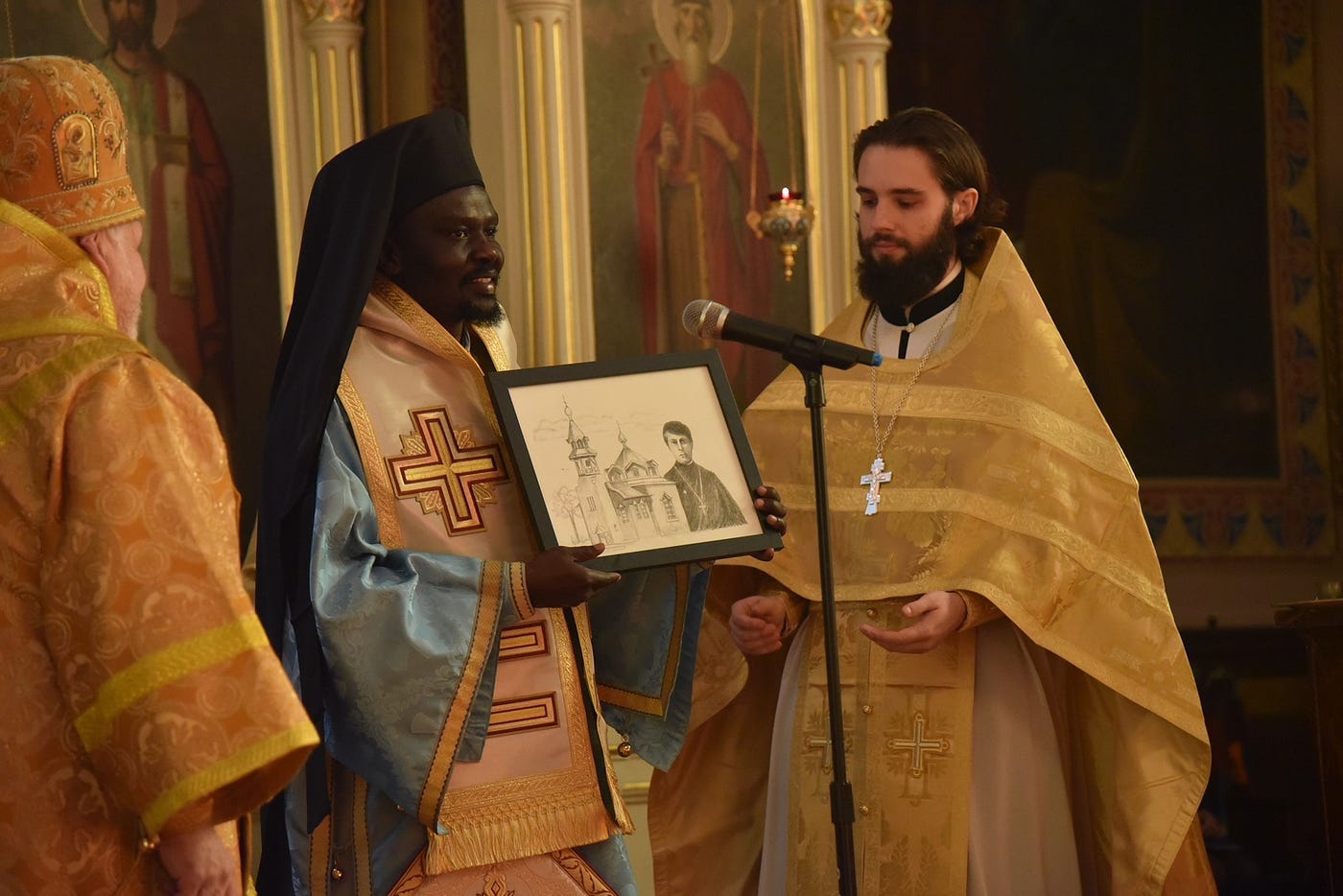
Photo: Bishop Innocentios of Burundi and Rwanda (of Africa) during a pilgrimage by Orthodox African Christians to the mountains of the Caucasus to honour Saint Nina who, during the 4th century had brought Christianity to the land of Georgia (from here)

Ελληνικά: Χριστιανισμός, εθνικισμός και ρατσισμός

By Theodore J. Rigniotes, Theologian

Translate A.N.

Ours is an age of panic:  with an economic crisis that increasingly impacts the weakest... with mental stress intensified by the (with or without quotation marks) pandemic... with a serious deficit in the State’s presence in support of the citizen... with various external threats (for example, even from neighbouring lands) and a host of other thorny issues... all test our patience and our endurance by shredding people’s dignity and jeopardizing the sense of security that they should be feeling - not only within their own country, but even as an immigrant in any “free” (whatever that may imply) and well-governed country.

No-one can even be sure that tomorrow it will be possible to switch on the light, have water in our glass and food on our plate... not to mention free healthcare and education, permanent jobs, etc. (these are becoming increasingly forgotten items).  There is also no certainty if people are actually being tracked by technology every minute, or being “sprayed” with unknown materials, or if humans have already been turned into faceless numbers of an electronic hyper-system, which can imminently direct their daily lives upon the decisions made by certain powerful individuals and in disregard if such things were desired or approved.

Of course there are thousands of fellow human beings who have already been deprived of all these basic needs (even potable water and daily nourishment!), which we, the “many”, have for decades taken for granted. But, being increasingly informed by the mass media and the bills that are sent to consumers every month, these important commodities are no longer self-evident.

As in every time of panic, so today, conditions have favoured the emergence of extreme political tendencies that promise the people liberation from their painful shackles. This is the reason one sees Nazist groups and extreme-right parties infiltrating Parliament and their ideas finding followers - even among people who do not vote for them.

Among other things, Christianity is also being turned into an element of political ideology. This can be expected, inasmuch as Christianity also possesses a social message (which is automatically a political message as well), but also because in the past, the Christian faith has often inspired the liberating revolutions – not only by the Greek populace, but also by other peoples of the world.

So, it looks like we are becoming politicized as Christians.  However, one must never forget that Christianity is primarily a spiritual matter.  Regrettably, in the recent past it had been misused as the (governing) dictatorship’s crutch... Likewise, during the Middle Ages it was twisted into a means of terrorizing and oppressing the Western European peoples by the so-called “Roman Catholic Church”, as well as by the kings of Europe. This is why care and awareness are imperative, that Christianity cannot be turned into a political faction, but rather should be inspiring a political stance for the benefit of the people. The viewpoint that Christianity should not be expressed publicly is not only erroneous; it is also suspicious, because the underpinning of Christianity is both revolutionary and liberating.

The political stance inspired by authentic Christianity is characterized by justice, charity towards all people (even criminals), respect towards every person, selflessness, and willingness for self-sacrifice and self-offering.

Most certainly a Christian (whether politicized or not) cannot remain apathetic towards issues such as social injustice, economic impoverishment, the exploitation of workers (even the major Fathers of the Church, such as the Three Hierarchs who had openly expressed a vehement critique against the authorities of their time, had risked their very lives in doing so!), but also towards issues which at first sight do not seem political - such as the humiliation of the human body by transforming it into a sexual object, and the bombardment with messages of violence and frenzy festering especially within the generation of teenagers (but also of children) through “entertainment” mediums that include scenes of murder and torture, stories of horror and cannibalism, monstrous and demonic “heroes”, etc. These items – and many others unfortunately! – have already shown their bitter fruits, both in the lives of young people but also in entire families and in society as a whole.

Reprehensible extremes

Reprehensible extremes incompatible with the Christian faith, which are nevertheless often muddled when ideologically labelled as “Christianity” (causing confusion and aberrations), are ideas such as nationalism, racism, conditional acceptance of violence (against a guilty party for example) - even the acceptance of fascism of varying hues.

Nationalism and racism, under the inclusive term “ethno-phyletism”, have been explicitly condemned by the Orthodox Church in 1872, by decision of the Great Local Synod in Constantinople, on account of the Bulgarian nationalism at the time, which had turned the Orthodox Church of Bulgaria into a weapon of domination of the peoples living in northern Greece’s Turk-occupied Macedonia and Thrace - which had triggered the Macedonian Struggle around 1900, with the participation of many Cretans also. This was of course preceded by the Greek nationalist movement by the Bavarians who ruled Greece in 1833 and had excised the Church of Greece from the Ecumenical Patriarchate - which finally recognized it by making it an Autocephalous (self-governing) Church.

Nowadays similar trends have been observed in certain places (i.e. newly pronounced, pseudo “States”), where an approving stance of the Ecumenical Patriarchate towards groups such as the nationalist charactered “Churches” of the Ukraine and the “Macedonian Church” in Skopje, which, from their non-canonical and marginal (schismatic) status were arbitrarily declared as canonical, legal Churches of those regions, AND autocephalous (=not dependent on any Patriarchate or any other, local Orthodox Church). Only God knows what the long-term consequences of this practice will be: therapeutic, or traumatic?

It would be useful to mention here the condemnation of negro slavery in the USA by the Ecumenical Patriarch Joachim II in 1862 (with an article of his in the Ecumenical Patriarchate’s magazine “Eastern Star”, republished in America), as well as the move by the Orthodox Archbishop Iakovos of America who had gone to Selma, Alabama and had stood by Martin Luther King for the second black rights demonstration march in March of 1965.

Apart from the above, it should be stressed that Greeks who embrace their cultural tradition should not be nationalists. “Philopatrids” – that is, patriots with a love for their homeland – yes; but not nationalists. 

Nationalism is the fruit of the efforts by Western European peoples to liberate themselves from the feudalism and the oppressive empires that were robbing them of their very lives.  The people of Greece had faced this problem too, during the centuries-long Turkish occupation; but until that time (or even during that time) they had belonged uninterruptedly for entire centuries to a multinational society that preserved individual and particular cultures and Histories, but whose members were united by common moral values ​​and common ideals. This society was the Christian Romaic Empire (or “Romania” as it was called during the last centuries of its history) – whose general description came to prevail as “Byzantium”.

Because of the name “Romania” (from which is also derived the name of the country of Romania), all the descendants of the “Byzantines” are characterized as “Romans”, while the totality of all the peoples who were once “Byzantines” is characterized as “Romanity”. (Note: “Romanity” is also the title of the much-sung rendition of the poem by Yannis Ritsos and the music by Mikis Theodorakis). Its message is Christian, but not nationalist.  “Roman” refers to every Orthodox Christian - not only of the Balkans, but also of Turkey (for example Saint Ahmed the Calligrapher, who was martyred by the Ottoman state for converting to Christianity), also Saint John of Damascus of Syria, Saint Makarios of Egypt, Martyrs of Palestine and of many other peoples. This had also been the aim of the major, exceptionally important Greek idealist, Rigas Feraios.

All Orthodox Christians are one with these - just as they are one with every Orthodox Christian of all peoples, wherever on earth (from Uganda for example to Alaska - and of course even to Russia, Ukraine, etc. – hence our grief being double over the current Russo-Ukrainian conflict), as they are all united by the Common Chalice of Holy Communion, which no-one is allowed to deprive us of - regardless if it is attempted in the name of fear, say, of a certain pandemic or for any other reason...

Although not united by the Common Chalice with other Christian groups and the faithful of other religions, we are however united in the teachings of Jesus Christ about love towards all people – and this is something that should never, ever be forgotten.

Romanity is “ecumenical” – inasmuch as it aspires to embrace all peoples in the world - but at the same time is opposed to the orientation of contemporary Globalization, which primarily aspires to self-interest (=looking out for one’s own interests) and is in the hands of powerful economic and political factors, who are anything but concerned with bringing man closer to God, which is the most important element and the most desirable aim in the life of Christians.

In political terms, Globalization is by nature colonialist. Romanity is its exact opposite.

As for conditional violence (with slogans such as “hang them in the public square!” as a reaction to criminals such as paedophiles, rapists, drug dealers etc. - even politicians), it seems quite clear that such behaviour does not befit people who simultaneously wish to be proper Orthodox Christians. Of course convictions, restraints and imprisonments of criminals are necessary – especially those guilty of heinous crimes!  However such condemnations should not be vindictive while simultaneously claiming to be proper Christians!. They should aspire to protect society and to rehabilitate – that is, to correct (if and where possible) the guilty parties.

It is understandably very difficult – even superhuman! – for one to defeat the natural human tendency towards hatred and revenge. However, a Christian should not be a “natural” person, but a “supernatural” one. We must all be human beings that rise above the earth heavenward to become angels... indeed more than angels – and become “children of God”.  It is the reason that Christ Himself (the only-begotten Son of God) had taught us to recite the Lord’s Prayer:  “Our Father...” as if we too are like Christ: as sons and daughters of God.  We should pay careful attention to this detail and at least strive to honour it.


Τετάρτη 6 Οκτωβρίου 2021

Orthodox Christians Against Color Racism


"We are Orthodox Christians who affirm traditional standards of ethnic identity (language, location, and religion) and thereby oppose the classification of personal ethnic identity based upon color categories" (see here).
 
You can see the page
 

Σάββατο 15 Μαΐου 2021

Two Trials, Two Tombs...


Nun Katherine Weston

Brotherhood of St. Moses the Black

Nun Katherine Weston - Facebook

Like many Americans I followed the high-profile trial from the opening statements through the historic
verdict. There were certainly many hopes and fears riding on it that were far greater than the
specific incident, decedent, or defendant. George Floyd’s death flashed into global consciousness
as a symbol, not as an incident. His tomb represents everything that Africans have endured in
America for the last 400 years.

The trial in its entirety was live-streamed, an unheard of level of transparency. I tried to
judiciously follow updates and not get too caught up. It was still, after all, Great Lent and we
continue to move toward the annual commemoration of a very different kind of trial—the trial of
the wholly innocent Son of God who takes away the sin of the world. This involves a wholly
different type of symbolism—the symbolism that allows us to speak in earthy language about
heavenly realities.

 
Photo from here
 

But back in America—Listening to the various defense arguments and lines of reasoning,
something struck me the other day. It’s as if the subtext of those arguments was that there is a
certain amount of abuse that a [Black] man should be able to take, and if he can’t take it, then it’s
his fault! A man should be able to handle lying prone, restrained, and under compression for an
indefinite period of time and if he can’t, well, he failed. So I go on record saying I completely
object to that valuation of human life. God didn’t create us for abuse. A man is not obligated to
be able to withstand a certain amount of it. Neither is any woman obligated to withstand a certain
amount of abuse lest it be her own fault that she is harmed. No children are obligated to
withstand a certain amount of abuse lest it be their own fault that they suffered harm. Each
person has their own threshold of experiencing harm in a given situation and we are all different.
We are rather obligated as Christians to respect the image of Christ in one another and to let that steer our interactions.


There are martyric situations in which Christians have had to endure hellish torments without
betraying their faith or their fellow Christians. Some of those were helped by the grace of the
Holy Spirit to overcome and have been canonized as saints. Others fell through human
limitation. Being interrogated for 13 days and nights without respite or sleep, until in a psychotically disoriented state, one might say or sign anything but for the grace of God. That
happened in the Soviet prisons. I pray that I, that we, may never face such a situation! As we
move toward the annual commemoration of Golgotha, let us continue to pray for the world. Let
us continue to pray moving forward from verdict to next steps that God’s will may be
done. Without the grace of God, how can anyone act with truth and honor? It is our vocation as
Christians, not to be bystanders or voyeurs, but to actively bring grace to difficult situations. In
this sense we approach both tombs with the myrrh of our prayers.

See also

Black Voices in the Orthodox Church

Σάββατο 10 Απριλίου 2021

African Americans Must Look to Orthodoxy for Peace in a Violent America

I am an Orthodox Christian under the spiritual care of the Orthodox Church in America (OCA). My intent is to spread the Orthodox Faith to African Americans.

Glory to Jesus Christ!

One could see that phrase today and think “How can he be rejoicing? This nation is falling apart! There are riots and a plague, and nothing is being done to combat racism is this country!”

Perhaps they are right, perhaps the nation is falling apart, and yet still we glorify our Great God and Saviour Jesus Christ, the one who calms the riots (Php 2:10) and heals the plague (Mt 8:4). But what about the healing of race relations?


As Christians, we know that we are all one in Christ regardless of race or identity (Gal 3:28), and yet despite that we are still divided among ourselves by ethnic lines. This verse is spiritual, we are all spiritually one in Christ, and nothing can be high enough to divide us in Him, but that does not mean that our earthly interactions are in any wise not manifested in accordance with our identities and inherent classifications. This is all to say that Black people, even as Christians, will almost universally have unique interactions with other Black people that will not be manifested in interactions with White people. Likewise, White people, even as Christians, will almost universally have unique interactions with other White people that will not be manifested in interactions with Black people.


Bishop Neophytos Kongai of Kenya (center) with Bishop Paul of Chicago (left) and Father Alexander Koranda (right) in the Holy Trinity Cathedral (2018)

How do we reconcile this fact with the current state of race relations in America? One might think my proposed solution would be to overemphasize our unity in Christ and minimize our ethnic differences, but that assertion implies that the current state of race relations is actually normal, and that we should use faith as sort of a foreign glue to keep a dying nation together. These riots and racial conflicts are NOT the normal of human interactions. It is absolutely not right for the peoples of the world or even within a nation to be fighting for that which does not save. I am proposing that we return to normal. That is not to say we return to a certain point in time, as all time periods are rife with the same conflict. Neither is that to say that we return to an idea of normal decided by the general population. We must return to an objective normal, Christ’s normal, wherein we are all according to our own, yet still in the service of the Immortal Word of God.

How do we reach this supposed normal? I seem to be making it out to be some utopia on earth, but of course we must be realistic in understanding that there will always be some obstinate enough to hold back the common good from prospering. We CAN still find a certain Divine Peace in this harsh world, however, it is all dependent on our repentance. We must absolutely flee from the very evils which perpetuate the dangerous times we are living in.

In a time of unjust killings and riots, African Americans are seeking hope where there appears to be none. The Orthodox Church has produced Black African Saints whose lives are beautifully recorded as ways which help us to see how we can walk in Christ and how we can acquire the Spirit of Peace which calms the eternal storm of a corrupted world. Our fight is not mostly physical, but spiritual. Demons attack man everyday, causing some to commit evil, and us to respond likewise with evil. We must be like our Orthodox Saints, who fought evil and injustice with love, securing with them the Kingdom of Heaven as a result.


Saint Kaleb, King of Axum; Saint Maurice, Commander of the Theban Legion; Saint Fulvianus Matthew, Prince and Bishop of Ethiopia; Saint Djan Darada, the Ethiopian Eunuch

Saint Moses the Black (AD 330–405) was a slave to an Egyptian government official. He was dismissed after being accused of robbery and murder. After this, poor and impoverished, he sought a life of crime, becoming a gang leader of a notorious group of bandits. This is not unlike the story for many African Americans today. Moses was once seeking to rob a local landowner, but the owner was alerted by the dog. In anger, Moses was now seeking to kill both the owner and the dog before robbing the estate. Moses tried again, and again the owner was alerted. In anger, Moses stole and slaughtered the sheep of the land, but at this point, the authorities sought to apprehend him.


He sought refuge in a local Orthodox Christian monastery. While there, he heard the call of the Lord to repentance, and requested to be tonsured an Orthodox monk, but he was initially rejected on his criminal past. The monks were not convinced of the sincerity of his repentance, but the former robber would not be driven away nor silenced. He continued to ask that they accept him. Saint Moses subjected himself to the harshest praying and fasting rules, proving himself to the monks and more importantly to God. He was subjected to constant attacks of temptation towards violence and lust, and yet with God through prayer, he overcame, and eventually was tonsured a monk. 

After years of service, the local Bishop saw it good and right to ordain Saint Moses as a priest. In testing him, the Bishop proclaimed “What is this Black man doing here?” An early display of discrimination on the basis of race, Saint Moses proved himself by refusing to rise to anger, and instead choosing to silently remove himself from the situation. The Bishop saw this and was impressed by Saint Moses’s repentance, and ordained him. Saint Moses shows us that we don’t need to let criminality define us. We don’t have to play into the game that tries to make us into criminals. With Christ, we can overcome what harms us. It will not come from listening to the Devil and his calls to violence.


Bishop Sylvestros of Gulu and Eastern Uganda, Metropolitan Innocentios of Rwanda, Metropolitan Jonah of All Uganda, Bishop Neophytos Kongai of Kenya

Riots arise out of anger and hatred. Modern movements attempt to get rid of this hatred towards their own by instead promoting hatred against others. Violence is the logical conclusion of hatred, and when our culture is taught to hate, conflict is inevitable. It is always man-made organizations which will fall into traps such as these, for they put their trust in the fallibility of man in hopes that by some means their torments in this life will cease. The Holy Scriptures warn us about putting our trust in Princes in whom there is no salvation (Ps 146:3). 

Organizations such as “Black Lives Matter” are truly a misnomer, for in their search of attempting to convince people of their namesake, they have removed the value of Black people and made them to be pawns in a greater game which only searches for destruction. They have idiotically convinced themselves that Black people will never rise out of their struggles, so they chose instead to force everyone to dwell in their struggles. “Black Lives Matter” will never be able to convince people of their position because the philosophy forming the groundwork their thought process cannot account for why any lives matter, let alone Black lives. Without Christ, the Objective Rule of Morality, there is no reason to assume Black lives actually do matter, since without Christ nothing matters. We see our Orthodox Saints fight for Black Lives in a way nothing in the modern world can compare to because they founded their defense of Black Lives on Christ our True God and his One, Holy, Universal and Apostolic Orthodox Church.


Saint Elesbaan of Ethiopia (AD 510–540), who is also known as Saint Kaleb of Axum, who is my patron Saint, shows us how to live a Godly life in defending Black Lives.

Saint Elesbaan of Ethiopia was an Orthodox Christian monarch of the Empire of Axum when it was brought to its greatest extent ever, and all for the protection of his Orthodox Christians. When given notice that Jewish Warlords were oppressing Orthodox Christians in Yemen and Himyaritia, much like how many slave ships to America were owned and operated by Jews, Saint Elesbaan mobilized immediately to invade the area, for he could not bear to sit idly by while his own people were being massacred. He declared war on Dunaan, but his military campaign was unsuccessful.


Wishing to learn the reason for his defeat, Saint Elesbaan, with prompting from above, turned to a certain hermit. He revealed to the emperor that he had proceeded unrighteously in deciding to take revenge against Dunaan, since the Lord had said, “Vengeance is Mine, I will repay!” (Heb 10:30). The hermit counseled Saint Elesbaan make a vow to devote his final days of life to God, to escape the wrath of God for his self-willed revenge, and then to defeat Dunaan. Saint Elesbaan made a vow to the Lord, and marching off with his army against the enemy, he defeated, captured and executed him. After the victory the Saint resigned as emperor, secluded himself within a monastery and for fifteen years he dwelt in strict fasting and asceticism.

What do we see here? This pious King let anger and unrighteous revenge overcome his mind, and as a result, lost his battle in defense of Black Lives. This is very reflective of the modern conflict in America, which only leads to more suffering for African American due to the refusal of our people to repent before God and seek righteous overcoming of every evil which perils us. African Americans are a divided flock. We are unsatisfied with our modern churches, which have all deviated from the Original Orthodox Faith. We fight ourselves, degrading both genders for baseless stereotypes, we murder our own unborn in the womb, we allow ourselves to be swayed by the simple propaganda of the mainstream media which lies to instigate us to violence. We do all these things when we could be saving ourselves and each other through our Lord Jesus Christ.

What if we are already plagued by sins? Certainly we all are. Many of us are hypocritically attending Church while going home to dwell in our iniquities: Fornication and Adultery, leading causes of the epidemic of Black Fatherlessness in America. Abortion, which kills us more than any outside group or disease. Innocent boys and girls robbed of their lives merely because it would be an inconvenience to us. Why do we not rise up against the destruction of Black Lives in the wombs just as much as we do when they are killed on the street? All these riots and not one destroyed Planned Parenthood! That shows where our priorities are as a people in America. Our churches have left us dissatisfied because they, too, submit to worldliness. It’s a testament to their deviation from the faith of the Apostles. John 5:39–40 [You search the Scriptures, for in them you think you have eternal life; and these are they which testify of Me. 40 But you are not willing to come to Me that you may have life.]

Despite all our sins, our God is a loving and merciful God, seeking the salvation of all who repent and turn to Him. Just as the scriptures say a murderer has no life in him (1 Jn 3:15), we are still offered Eternal Life by our Lord Jesus Christ (1 Tim 6:12, Rm 6:23, Gal 6:8) through his Orthodox Church (Mt 16:18). Our Orthodox Saints are the model of repentance.


Saint Fulvianus was a Prince of Ethiopia at the time the Apostle Saint Matthew arrived in the land. The Apostle Matthew established an oasis there using a miracle working rod given to him by God, and by the miracles displayed there brought many Black People to the Orthodox Christian Faith. This already dispels the tired myth that Christianity is a White Man’s Religion to oppress Black People. In truth, Orthodoxy is the Original Christian Faith, and it made some of its earliest work in African Nations, but I digress. 

Prince Fulvianus saw the miracles and was angered because he was a staunch pagan. Prince Fulvianus seized the Saint Matthew, setting up idols around the Holy Apostle and tying him down to burn him alive. Saint Matthew died and gave his soul up unto the Lord, but his body was miraculously unharmed. Prince Fulvianus was deeply troubled at the sight of this, but still had his doubts of the True Faith. He instructed that the Body of the Holy Apostle be thrown into the sea in a metal coffin, demanding that the God of Matthew protect his body again as it was protected from the flames. Later, the soul of the Apostle Matthew appeared to the Orthodox communities he established and told them to go to the shore, where they found the coffin washed up, and the incorrupt body of Saint Matthew within. 

Saint Fulvianus begged desperately for forgiveness for his sins, received baptism and confession from the Orthodox clergy there. The Prince abdicated his rule to dedicate his life to Christ, and became a priest, eventually becoming the Bishop there and spent the remaining years of his life preaching the Gospel of Jesus Christ. He was crowned with glory in Heaven for his repentance.

So we see, no matter how evil our deeds, God offers us the sacrament of confession, by which our sins are remitted. We must all live a life full of repentance so that the same end met by our Orthodox Saints is met by us.

We have already seen that these worldly organizations are not in the ultimate benefit of us, but how can we be so quick to trust the Orthodox Church?


Saint Djan Darada, also known as Saint Aetius, is the Ethiopian Eunuch in the Book of Acts.

Acts 8:26–40

[Now an angel of the Lord spoke to Philip, saying, “Arise and go toward the south along the road which goes down from Jerusalem to Gaza.” This is desert. So he arose and went. And behold, a man of Ethiopia, a eunuch of great authority under Candace the queen of the Ethiopians, who had charge of all her treasury, and had come to Jerusalem to worship, was returning. And sitting in his chariot, he was reading Isaiah the prophet. Then the Spirit said to Philip, “Go near and overtake this chariot.”


So Philip ran to him, and heard him reading the prophet Isaiah, and said, “Do you understand what you are reading?”

And he said, “How can I, unless someone guides me?” And he asked Philip to come up and sit with him. The place in the Scripture which he read was this:

“He was led as a sheep to the slaughter;
And as a lamb before its shearer is silent,
So He opened not His mouth.
In His humiliation His justice was taken away,
And who will declare His generation?
For His life is taken from the earth.”

So the eunuch answered Philip and said, “I ask you, of whom does the prophet say this, of himself or of some other man?” Then Philip opened his mouth, and beginning at this Scripture, preached Jesus to him. Now as they went down the road, they came to some water. And the eunuch said, “See, here is water. What hinders me from being baptized?”

Then Philip said, “If you believe with all your heart, you may.”

And he answered and said, “I believe that Jesus Christ is the Son of God.”

So he commanded the chariot to stand still. And both Philip and the eunuch went down into the water, and he baptized him. Now when they came up out of the water, the Spirit of the Lord caught Philip away, so that the eunuch saw him no more; and he went on his way rejoicing. But Philip was found at Azotus. And passing through, he preached in all the cities till he came to Caesarea.]

We see in the story of Saint Djan Darada the necessity to trust our Bishops, who have been given the authority to Bind and Loose on Earth as in Heaven (Mt 18:18), and have been given the power to forgive sins by our Lord and God and Saviour Jesus Christ (Jn 20:23). The Kingdom of Heaven is our Eternal joy (Heb 11:16), freedom from the bondage of sin (Rm 6:16), and the end of all earthly struggles (Rev 21:4). Anyone who can offer that is to be trusted and only the Orthodox Church can.

Even if you were to not look at the Kingdom of Heaven, for some bizarre reason, we can only see the fulfillment of proper race relations by the Orthodox Church. As seen before, no man-made organization is ultimately going to save us, they will lead us astray. Only the Orthodox Faith is capable of accounting for the ethical justification of why lives matter and applying that in a universal way.

“Orthodoxy is the only religion, the only worldview, that can properly, legitimately, and consistently apply the understanding of human dignity compared to any other worldview.” - David Medwhite

If we ever seek to end this reign of terror brought on by the enemies of mankind, we must begin at the beginning of the wisdom (Pr 9:10): the Fear of Our Lord Jesus Christ, the Only-Begotten Son of God.


I encourage everyone who has graced me with their reading of this article to visit an Orthodox Church near you. Try using this link to a directory.

May the Lord Jesus Christ, Son of God, have Mercy on all of us sinners.

Kaleb of Atlanta

See also

The Modern Monastic Order Of Saint Simon of Cyrene (African-American)
Brotherhood of St. Moses the Black
St. Simon of Cyrene Orthodox Mission
African Americans

Κυριακή 14 Ιουνίου 2020

Από τον φυλετικό στον ταξικό πόλεμο – Ένα "ακίνητο" κίνημα


Από τον φυλετικό στον ταξικό πόλεμο – Ένα ακίνητο κίνημα, Στάθης Σταυρόπουλος
Slpress.gr

Αν δούμε το πρόβλημα αντεστραμμένο, ίσως να διακρίνουμε και την πραγματική του φύση. Ήτοι: ο ρατσισμός που ανθεί στις ΗΠΑ και τη Δύση εν γένει, είναι περισσότερο αποτέλεσμα της ταξικής διάρθρωσης των κοινωνιών και λιγότερο της καταγωγής ή του (εικονικού ενίοτε) "συνανήκειν" των πολιτών. Είναι οφθαλμοφανές, ότι ένα ποσοστό των Αφροαμερικανών, καθόλου μικρό, είναι ενταγμένο στον αφρό της Αμερικανικής κοινωνίας, στις εταιρείες, τα ΑΕΙ, τη διακυβέρνησης, το στράτευμα, τη δημοσιογραφία, όπως επίσης και σε όλον τον παραγωγικό ιστό, μάνατζερ, δικηγόροι, γιατροί, εργάτες, διανοούμενοι και όλα τα άλλα.

Αυτοί οι Αφροαμερικανοί, μεγάλο πλήθος, που μένουν στην "απ’ έξω" είναι οι περιθωριοποιημένοι, οι ακατάγραπτοι, οι συνωστιζόμενοι στα γκέτο, οι αναλφάβητοι, οι λειτουργικώς αναλφάβητοί, οι παράνομοι, οι παρίες. Ποιος φταίει για όλους αυτούς; Η καταγωγή μόνον ή το σύστημα;

Ας αντιστρέψουμε για μιαν ακόμη φορά την εικόνα, τη σχέση αιτίου και αποτελέσματος.
Αν στις ΗΠΑ υπήρχε ισονομία για όλους τους πολίτες, αν η ανισοκατανομή του πλούτου δεν ήταν τόσο θηριώδης (και αιμοσταγής) αν η πρόσβαση στην εκπαίδευση ήταν ισότιμη για όλους σε ισότιμα σχολεία, αν δηλαδή τα ταξικά προβλήματα ήταν αμβλυμένα, πόσος χώρος θα έμενα για να ανθεί ο ρατσισμός;

Βεβαίως ο ρατσισμός που είναι απότοκος της ανθρώπινης (λευκής ή όχι) βλακείας δεν θα μπορούσε να έχει εξαληφθεί, και, ίσως να μην εξαληφθεί ποτέ (από τη Σκανδιναβία έως τις ΗΠΑ), αλλά οι διαστάσεις του θα ήταν πολύ μικρότερες από τον ρατσισμό που παράγει η ταξική δομή των κοινωνιών.


Η συνέχεια του άρθρου εδώ.
 

Τετάρτη 3 Ιουνίου 2020

The Glorified Black Body of Jesus


Ascension of our Lord (orthodox holy icon from here)

Deacon Jonathan Reavis
Brotherhood of St. Moses the Black
 
Christ is Ascended!

On this feast of Christ’s bodily Ascension into heaven, we are reminded of the importance of our incarnational existence. Put another way, Christ came to not only save disembodied souls, but bodies as well—the whole person. What is more, according to the Fathers of the Church, by assuming human nature, Christ glorified our humanity and our embodied existence! The third sessional hymn for the Ascension Matins service says:

When you came down from heaven to things on earth and as God raised up with you Adam’s nature which lay below in Hades’ prison, you brought it to heaven by your Assumption, O Christ, and made it sit with you on your Father’s throne, as you are merciful and love humankind.

The Vespers service for the feast says that the “angels marveled to see a human high above them.” Christ, in a glorified spiritual human body, entered the space reserved for the divine beings. Man has been deified! This scandalous ascent is of the same glory that provoked the Satan to jealousy. Surely, humans, who are made of the earth and dust, do not deserve such glory. What is more, Jesus’s ascent is the glorification of the lowest of humanity. The Gospels remind us that after Christ’s resurrection, he still bore in his glorious spiritual body the wounds of his death. This glorified human was executed as a criminal. As St. Paul says, quoting the Jewish Law, “Cursed is everyone hung on a tree.” The same body that was received into glory is that one that was despised, beaten, mocked and killed just forty-three days prior. We must not forget that Jesus was lynched. Further, we must not forget that Jesus’s body was subjected to derision even prior to his voluntary crucifixion.

The world in which Jesus lived was one that rendered him and his people as socially inferior. The Roman empire, as an occupying power, was entitled to exploit and abuse the Jewish people in all manner of ways. This is why James Cone states in his book, God of the Oppressed, that Jesus is Black: “He is black because he was a Jew. The affirmation of the Black Christ can be understood only when the significance of his past Jewishness is related dialectically to the significance of his present blackness.” 1 What Cone means is that because of Jesus’s identification with the oppressed in history, we can confidently affirm that he eternally identifies with the oppressed in every context. For America in particular (historical differences considered), this necessarily means that Jesus is Black.

This does not, by any means, form the theological foundation for the imposition of a victim identity on all Black Americans. James Cone was Black, and he spoke from a position of great strength and power, not victimhood. In truth, the power of the Gospel is in the fact that victims of sin, death and the Satan are transformed into victors through the voluntary acceptance of death. What this simply means is that if we fail to acknowledge the suffering and oppression of anyone, we fail to acknowledge those with whom Christ makes himself present.


Icon from here

In the weeks since the killing of Ahmaud Arbery, examples of this have flooded the public consciousness. Breonna Taylor was killed in her own home by police officers with a no-knock warrant, looking for someone else. Travis Miller was blocked-in and harassed by two white residents demanding to know why he was driving a delivery truck through their neighborhood. Video has emerged of a white woman calling the police on Christian Cooper for “threatening her” in a park after he asked her to leash her dog. Most recently, George Floyd was killed as the result of an excessive use of force when an officer knelt on his neck in the street for over six minutes. All of these instances have one thing in common: black skin was automatically associated with crime or danger. The results of this prejudice have produced unnecessary death and public harassment.

American attitudes toward blackness are unique in history and were built upon years of slavery and racism. Regrettably, there are many examples of how religion has served to perpetuate racism. And while American racism is quite particular, many aspects of Christian history and theology have been co-opted to feed this American demon. It would be either naïve or directly ingenuous to suggest that Christendom has never been complicit in contributing to dividing and oppressing people according to race. Even though it has been argued that our contemporary conceptions of race diverge greatly from those of antiquity, the work of scholars like Geraldine Heng demonstrate just how long people have negatively distinguished one another according to skin color— and not just black skin. Heng’s The Invention of Race in The European Middle Ages highlights the various people groups throughout the middle ages that were stigmatized based on what she calls epidermal race. 2 In the fourth chapter, however, Heng demonstrates the ways in which Christian theology was contorted to associate black skin with irredeemable evil, moral darkness and sin. This was not initially done with malicious intent, and the use of light vs dark imagery is not inherently racist. Darkness was initially a theological abstraction separate from particular bodies. 


Gradually, abstract blackness as a symbol for evil came into conflict with the existence of people with dark skin in the European consciousness. Given our particular context and history, such color-oriented religious language has provided unfortunate fodder for our anti-Black racism in America. One does not need to search very deeply in Church history for examples of holy men and women using black skin as an illustration for sinfulness or spiritual darkness. Again, this does not mean that they were racist in the same way Americans often are. In fact, as Heng points out, early examples of imagining blackness as sinful serve as a universal precondition for salvation. This historic association of dark skin with moral corruption, however, can play into our entrenched biases, originally racist or not. And Orthodox Christians are not exempt from this pitfall.
 
At the last Ancient Christianity and African American Experience Conference, organized by the Brotherhood of St. Moses the Black, Fr. Samuel Davis pointed out one often overlooked aspect of being Black and Orthodox in America. He noted how often Black male converts to Orthodoxy assume St. Moses the Black as their patron saint. On the one hand, this is often due to the fact that most Orthodox Christians are not familiar with any Black or African saints other than St. Moses. St. Moses, the deeply beloved patron of our brotherhood, while a shining witness of repentance, radical hospitality and nonviolence, was a criminal and gang-leader before he became a Christian. 

This in no way detracts from his sanctity. Saints are regarded as holy because they were repentant, not because they were perfect. Fr. Samuel’s point, however, was that underlying this trend is often the automatic assumption that Black American men would naturally identify with a dark-skinned gang leader and murder. We have so thoroughly associated blackness with moral degeneracy that we assume that all Black converts would resonate with St. Moses’s criminal past. And the fact that we have no familiarity with other African saints or don’t consider them Black in the same way may speak to our selective veneration and ignorance of the sanctity of those with dark skin. Perhaps there is a latent religious racism residing in the back of many white Orthodox minds that automatically associates black skin with the inherent evil of Black people.

Of course, this racist association couldn’t be further from the truth of our Tradition. That isn’t to say that black skin hasn’t been used by Church Fathers as an illustration of sinfulness, but the exact opposite is also true. In his commentary on the Song of Songs, Origen, the third century African theologian and teacher of St. Gregory of Nyssa, offers a profound and dignified allegorical reading of Solomon’s Black bride. Acknowledging the tradition of associating dark skin with corruption and moral inferiority, Origen interprets the bride as signifying the Gentile Church. In his poetic retelling of a dialogue between the Gentile bride and her Jewish interlocutors, Origen insists on the inherent beauty of a Black body:

She answers their objections thus: ‘I am indeed black, O daughters of Jerusalem, in that I cannot claim descent from famous men, neither have I received the enlightenment of Moses’ Law. But I have my own beauty, all the same. For in me too there is that primal thing, the Image of God wherein I was created; and, coming now to the Word of God, I have received my beauty. Because of my dark colouring you may compare me to the tents of Cedar and the curtains of Solomon; but even Cedar was descended from Ismael, being born his second son, and Ismael was not without a share in the divine blessing. You liken me even to the curtains of Solomon, which are none other than the curtains of the tabernacle of God— indeed I am surprised, O daughters of Jerusalem, that you should want to reproach me with the blackness of my hue. How have you come to forget what is written in your Law, as to what Mary suffered who spoke against Moses because he had taken a black Ethiopian to wife? How is it that you do not recognize the true fulfillment of that type in me? I am that Ethiopian. 3

Here, Origen recalls the Old Testament story of how Miriam insulted Moses’s wife for her dark skin. As a rebuke, God turned Miriam’s skin white. Later in this same commentary, Origen states explicitly that black skin has no inherent bearing on morality, saying that skin color is a matter of “circumstance” and is importantly different from the symbolic darkness of the soul. Nevertheless, he acknowledges the association of blackness with shame and uses it as an example of how God dignifies that which is considered by humans to be unclean— hence why the bride is a type for the Gentile Church. Blackness has its own inherent and distinct beauty, derived from the same source as all human skin— the Image of God. Here, Origen might be thought of as saying, in an extension of St. Paul’s words to Galatians, “There is no black nor white, for you are all one in Christ.” In this commentary, he points to the inaugural racial controversy of the Church between Jews and Gentiles, the settling word being Christ’s commandment to Peter: “Do not call unclean what God has made clean.” This, of course, was stated to accompany a “Gentile Pentecost,” in which non-Jews received the same Holy Spirit that came upon the Apostles at the feast of Pentecost. So, for James Cone, Jesus is Black; and for Origen, the Church is too.

And yet, two thousand years later in America, we are faced with the same problem and have struggled with it since the founding of our country. As a result of a long and complicated history with black skin, white people have been conditioned to regard blackness as a sign of danger. White Christians, too have (perhaps passively) presumed the guilt of Black bodies or tacitly considered them “unclean.” The fact that so many of us cannot identify with the struggle of Black men and women in this country is perhaps indicative of our failure to recognize Christ— and the Church— as Black. Black people bear the damning mark of stereotypes, all too often resulting in their mistreatment or even unjust death. But Christ and the Church are always found with those that are left out and marginalized. The very feast of Pentecost demonstrates nothing less than the fact that those who were once considered outsiders, foreign, unclean and strangers are now welcomed into the Body of Christ. What is more, within the Body of Christ, wherein are all shades of skin, what is maligned by the world is honored by the Church. By proclaiming that the Church is Black, we confront the racism that has resulted in our brothers and sisters being assaulted and slain for the color of their skin. Make no mistake, St. Moses and Jesus and the whole of the Church is with them today and on every day that Black men and women are killed unjustly. Are we with them?

On the feast of Ascension, we must remember that it was a Jew that was elevated to the heavenly places. How scandalous it was for the angels to witness a human ascending God’s throne. Scandalous still, it must have been, for the Romans and divine kings of the earth to see a Jew glorified above the gods. Scandalous again it was for Peter and the Jewish Church to see God’s own Spirit indwell the unclean Gentiles. It was scandalous for Origen to co-opt the negative image of blackness as an icon of the Gentile Church. Perhaps it was scandalous for James Cone to insist that Jesus is Black. It would be very much out of place, then, for us not to continue the scandal and insist that Black lives matter, that black skin bears the image of God and stand in solidarity with the Black bodies that are slandered and murdered.

1 James Cone, God of the Oppressed (New York: Orbis Books, 1997), 123.
2 Geraldine Heng, The Invention of Race in the European Middle Ages (Cambridge: Cambridge University Press,
2018).
3 Origen, The Song of Songs Commentary and Homilies, trans. R.P. Lawson (Westminster, MD: The Newman Press,
1957), 92-93. 


See also

Orthodox Bishops of the USA: Solidarity with those who condemn racism and inequality
The dark-skinned race at the Birth of Christ 
A "black" orthodox christian icon of the Nativity of Mother of God
 
Orthodox Christian Clergy Against Racism
Racism: An Orthodox Perspective

The Heresy of Racism
Racism (tag)
 

Orthodoxy, Torture & death penalty
The Kingdom of Heaven, where racial discrimination has no place
Grace and “the Inverted Pyramid”
 

Race and the Fall 

St Moses the Black - You Tube

Orthodox Bishops of the USA: Solidarity with those who condemn racism and inequality


Terrence Floyd, George Floyd's brother visits the location where his brother was killed, June 1 (photo from here)

Orthodox Times
St. Simon of Cyrene Orthodox Mission (about)

The Executive Committee of the Assembly of the Canonical Orthodox Bishops of the USA is calling on a moment of silence and solidarity for all victims of racial violence on Wednesday at 12.00, on the occasion of the recent incidents and unrest that are taking place in many American states, due to the murder of George Floyd.
The Orthodox Bishops express their unequivocal solidarity with all those who condemn racism and inequality, “which betray the spirit of democracy in our nation, i.e. ‘one Nation under God, indivisible, with liberty and justice for all’.”
As they typically report, “violence is a horrible and tangible manifestation of the reign of sin in our world. It is expressed in many faces, all of which seek to deny the image and likeness of God in each human person, in whom God has placed an irreducible dignity and sacredness.”
“Thus, as Orthodox Hierarchs, we condemn all actions and words that promote hatred and racism, but also all acts of violence and destruction.”

 Photo from here (Orthodox Archbishop of America Elpidophoros)

See also

en.Wikipedia / Killing of George Floyd
Greek Orthodox Archbishop Iakovos of USA, Martin Luther King Jr. & Reverend James Reeb 
Ecumenical Patriarch Joachim II Opposes American Slavery in 1862
OLD PROBLEMS IN THE NEW WORLD: A Forum on Modern Slavery in the Ecumenical Patriarchate

Orthodox Christian Clergy Against Racism
Racism: An Orthodox Perspective

The Heresy of Racism
Racism (tag)  

Orthodoxy, Torture & death penalty
The Kingdom of Heaven, where racial discrimination has no place
Grace and “the Inverted Pyramid” 

Race and the Fall