Εμφάνιση αναρτήσεων με ετικέτα Shanty Towns. Εμφάνιση όλων των αναρτήσεων

Τετάρτη 3 Μαρτίου 2021

Η εφιαλτική πραγματικότητα του Κρού Μπέι και το νέο σχολείο της Ιεραποστολής (Σιέρρα Λεόνε)

Ιεραποστολικός Σύνδεσμος "Άγιος Κοσμάς ο Αιτωλός"

Τετάρτη 10 Ιανουαρίου 2018. Ήμασταν ήδη μια εβδομάδα στη Σιέρρα Λεόνε, προσκεκλημένοι του Ιεραποστόλου πατρός Θεμιστοκλή Αδαμόπουλου. Είχαμε συγκλονιστεί από τις αλλεπάλληλες εικόνες ανθρώπων σε κατάσταση έσχατης ένδειας. Δεν μπορούσαμε να φανταστούμε ότι η επίσκεψη που είχε οργανώσει ο πατήρ Θεμιστοκλής στην παραγκούπολη του Κρου Μπέι θα ήταν πραγματική γροθιά στο στομάχι.


Η συνοικία Κρου Μπέι όπου χτίστηκε το νέο σχολείο της ορθόδοξης ιεραποστολής

Όταν φτάσαμε στον συνοικισμό και αρχίσαμε να οσφραινόμαστε τη βαριά μυρωδιά της ατμόσφαιρας, συνειδητοποιήσαμε την χαώδη διαφορά ενός ντοκιμαντέρ για την Αφρική που παρακολουθείς αναπαυτικά μέσα στην άνεση του σπιτιού σου, όσο ρεαλιστικό κι αν είναι, από τη ζωντανή, εφιαλτική πραγματικότητα, η οποία σε τσακίζει, σε διαλύει, σε κάνει να αισθάνεσαι ένοχος γι’ αυτό που είσαι, για τις όποιες μικρές ή μεγάλες ανέσεις απολαμβάνεις.. Να νιώθεις αίσθημα μεγάλης αδικίας να σε πνίγει.

Καθώς προχωρούσαμε σοκαρισμένοι, φτάσαμε στην γέφυρα του Τζώρτζ Μπρούκ. Οι σκηνές που αντικρίσαμε ξεπερνούσαν κάθε φαντασία. Ένας κατάμαυρος χείμαρρος αποβλήτων κυλούσε αργά κάτω από τα πόδια μας, ανάμεσα σε τόνους απορριμμάτων, δημιουργώντας αφόρητα αποπνικτική ατμόσφαιρα, την οποία επέτειναν δεκάδες χοίροι που περιφέρονταν ελεύθεροι ανάμεσα στα σκουπίδια και μέσα στα λύματα. Στις όχθες του, σειρά νοικοκυριών στεγασμένων σε παράγκες φτιαγμένες από σκουριασμένες λαμαρίνες δημιουργούσε εφιαλτικό σκηνικό. Άνθρωποι περιφέρονταν ανάμεσα στα σκουπίδια, μέσα στα λύματα και δίπλα στους περιπλανώμενους χοίρους, ενώ παιδιά έπαιζαν με αντικείμενα που είχαν μαζέψει από αυτά ή με αυτοσχέδιους αετούς που είχαν φτιάξει, σχίζοντας με τα δόντια τους σακούλες από τα σκουπίδια.

Απέναντι από τη γέφυρα ανοιγόταν μία αλάνα και δεξιά της ένα καταθλιπτικό κτήριο που έμοιαζε με κρατητήριο. Για να μπεις σ’ αυτό, έπρεπε να υπερπηδήσεις φράχτη από τσιμεντόλιθους που εμπόδιζαν τα μολυσμένα νερά του Τζώρτζ Μπρούκ να πλημμυρίσουν τον χώρο κατά την μακρά περίοδο των βροχών. Όπως πληροφορηθήκαμε, ήταν το Δημοτικό Σχολείο του οικισμού, το οποίο είχε κτίσει μία μη κυβερνητική φιλανθρωπική οργάνωση πριν από μερικά χρόνια.

Δρασκελώντας τον φράχτη, μπήκαμε στο σχολείο. Το καταθλιπτικό περιβάλλον, που περισσότερο θύμιζε κελί φυλακής παρά σχολείο, σε συνδυασμό με την άθλια κατάσταση του εσωτερικού του κτηρίου μας είχε αφήσει άφωνους. Σκεφτόμασταν τι μάθημα να έκαναν τα δυστυχισμένα αυτά παιδιά σ’ έναν τέτοιο χώρο, σ’ ένα τέτοιο περιβάλλον.

Ο πατήρ Θεμιστοκλής κοιτούσε θλιμμένος γύρω του και σε μία στιγμή τον ακούμε να μονολογεί: «Να είχα τα χρήματα να αναλάβει η Ιεραποστολή αυτό το σχολείο, να δώσουμε σ’ αυτά τα τόσο πονεμένα κι αδικημένα παιδιά μία ελπίδα…!» και απευθυνόμενος σε μας λέει: «Θα μπορούσαμε να κάνουμε κάτι γι’ αυτά τα παιδιά;» Το έλεγε κι ένας βαθύς πόνος έβγαινε από την καρδιά του. Αυθόρμητα απαντήσαμε: «Θα κάνουμε ό,τι μπορούμε, πάτερ».Κάναμε έναν πρόχειρο οικονομικό προϋπολογισμό του έργου κι αρχίσαμε να μοιραζόμαστε το άπιαστο όνειρό μας με τους συνανθρώπους μας στην Ελλάδα. Και το θαύμα έγινε. Μέσα σε πέντε μήνες συγκεντρώθηκε όλο σχεδόν το ποσό που απαιτούνταν για να ξεκινήσει το έργο.

Σάββατο 10 Νοεμβρίου 2018. Έντεκα μήνες ακριβώς από την πρώτη επίσκεψή μας στην παραγκούπολη Κρού Μπέι, μας αξίωσε και πάλι ο Θεός να βρισκόμαστε εκεί για την θεμελίωση του σχολείου.Σήμερα το καταθλιπτικό εκείνο κελί-σχολείο αποτελεί παρελθόν. Κατεδαφίστηκε. Στην θέση του ανεγείρεται ένα λιτό σύγχρονο καλαίσθητο κτήριο επτά αιθουσών, που θα ανταποκρίνεται πλήρως στις εκπαιδευτικές ανάγκες των διακοσίων και πλέον μαθητών, πού κατά την ερχόμενη σχολική χρονιά συν Θεώ θα το γεμίσουν χαρούμενες φωνές.

Η νέα πρόκληση που ανοίγεται τώρα μπροστά μας είναι η λειτουργία και η συντήρηση του έργου. Στο χέρι μας είναι να καταστεί το έργο αυτό φωτεινός φάρος, που θα δώσει ελπίδα στους ανθρώπους της τόσο υποβαθμισμένης αυτής περιοχής και θα τους βοηθήσει να δουν το μέλλον με περισσότερη αισιοδοξία. Στο χέρι μας είναι να μην μείνει κανένας μαθητής του σχολείου ούτε μία ημέρα χωρίς εκπαίδευση και φαγητό.

Ι. Περράκης

Στηρίξτε την λειτουργία και συντήρηση του σχολείου στο Κρου Μπέι, στη Σιέρρα Λεόνε :

http://www.ierapostolos.gr/support.php

Σχολείο Κρου Μπέι

Σε λιγότερο από δύο χρόνια, σε μια από τις πιο εξαθλιωμένες περιοχές του πλανήτη μας, την παραγκούπολη Κρού Μπέι στην πρωτεύουσα Φριτάουν της πάμφτωχης Σιέρρα Λεόνε, με δωρητές από την Ελλάδα και το εξωτερικό ολοκληρώσαμε την ανέγερση ενός σύγχρονου Δημοτικού Σχολείου που θα ανταποκρίνεται πλήρως στις εκπαιδευτικές ανάγκες των δασκάλων και των διακοσίων και πλέον μαθητών που την ερχόμενη σχολική χρονιά θα το πλημμυρίσουν με τις παιδικές τους φωνές.

Ψυχή αυτής της μεγάλης προσπάθειας ήταν ο συνεργάτης μας και καθηγητής Θεολογίας του 1ου Γυμνασίου Χαλανδρίου κ. Ιωάννης Περράκης ο οποίος επισκεπτόμενος δύο φορές την Σιέρρα Λεόνε και αντικρίζοντας την ζοφερή εικόνα του Κρου Μπέι ξεκίνησε την συγκέντρωση χρημάτων ευαισθητοποιώντας φίλους και γνωστούς. Μέχρι σήμερα δαπανήθηκαν ενενήντα χιλιάδες ευρώ και υπολείπεται ο εξοπλισμός του Σχολείου που θα κοστίσει δέκα χιλιάδες ευρώ.

Το έργο αυτό είναι καθοριστικής σημασίας για την περιοχή αν αναλογιστεί κανείς ότι διαγράφεται μία νέα πορεία για τα παιδιά των ευάλωτων αυτών κοινωνικών στρωμάτων που η μοίρα τα έφερε να ζουν σε πάμφτωχες κοινότητες. Παρόμοια προγράμματα στηρίζει ο Οργανισμός μας και σε άλλα υπανάπτυκτα κράτη.

Μέλημά μας τώρα είναι να στηριχθεί η λειτουργία αυτού του τόσο σημαντικού έργου. Να καλύπτουμε σε μόνιμη βάση τα λειτουργικά έξοδα, τους μισθούς των δασκάλων, το αναγκαίο εκπαιδευτικό υλικό, την καθαριότητα και την καθημερινή σίτιση των παιδιών.

Βασιζόμενοι στην αστείρευτη αγάπη όλων των συνανθρώπων μας και στην δική σας προαίρεση, παρακαλούμε να στηρίξετε και αυτήν την προσπάθεια.

Ιεραποστολικός Σύνδεσμος "Άγιος Κοσμάς ο Αιτωλός"

Επίσκεψη του Υπουργού της Εκπαίδευσης της Σιέρα Λεόνε στο σχολείο του KrooBay με 250 μαθητές !!! Group photo with the Minister of Education outside our new Mission school in KrooBay including Deaconess Mary.


KrooBay School, Siera Leone, February 2021

The Minister of Education, Dr. David Sengeh visiting orthodox christian mission School in KrooBay as part of his birthday celebration which included free lunch for approx. 250 pupils


Bridge over troubled waters leading to new orthodox mission School in KrooBay, Siera Leone

https://www.facebook.com/realRevThemi

Δείτε επίσης 

π. Θεμιστοκλής Αδαμόπουλος από Σιέρρα Λεόνε, ομιλία στην Αθήνα (βίντεο)

Orthodox Sierra Leone (ενότητα)

2020 - Documentary on the Orthodox Church & Fr Themi in Sierra Leone

Sierra Leone - Poverty, diamonds, war & the Orthodox Church
Fr. Themi: The Atheist Rocker Who Became an Orthodox Priest and Missionary In Africa
Interview With Father Themi Adamopoulo on Orthodox Missionary Work in Africa Videos from Sierra Leone – There the Orthodox Christians fighting for a better world...

Fr Themi Adamopoulo, talk al little about his trip from Atheist to Christianity...


Τετάρτη 10 Μαΐου 2017

Tales from Dystopia XXI: Capitalism and alcoholism (a voice from South Africa)


"...It was about capitalism, not alcoholism. It was not about the failings of the flesh of flesh and blood alcoholics, but about the world powers (kosmokratores) of this present darkness (Ephesians 6:10-12)."


One of the notable features of life in post-apartheid South Africa is the way the Christian churches seemed to drop the ball after 1994. Before 1994 many Christian groups were quite vocal in their critique of apartheid, and in analysing the ills of society. Once the first democratic elections were over, however, they seemed (with a few exceptions) to breathe a collective sigh of relief, sit back and take the attitude that the government should get on with fixing things. After all, the government was now a democratically-elected one.
Perhaps this contributed to the government’s losing its moral compass, and the government seemed to become aware of it before most of the Christian bodies, and the Moral Regeneration movement was a government initiative, though even that has now been forgotten.


Now there is talk of “white monopoly capitalism” and “radical economic transformation”, which I think is more smoke and mirrors, but perhaps that, and some aspects of Christian blindness, can be illustrated by some more tales from the apartheid dystopia.
If I name names, it is not to blame particular people (I think the people named are probably dead by now, and anyway they are no more to blame than many others) but rather to show that this took place in concrete history.
In 1980 I attended a consultation called by the South African Council of Churches (SACC) at Hammanskraal. It was ostensibly called to evaluate the World Council of Churches’ (WCC) Programme to Combat Racism, but it didn’t do that at all.
I was in a group that was discussing racism in the church, and one member of the group, Ben Ngidi, of the Congregational Church, called for a Black Confessing Church. He said it was necessary because blacks responded to the gospel from a position of poverty and oppression, while whites did so from a position of power and privilege. I thought that this was something of an oversimplification, because here we were, a bunch of mainly middle-class mainly clergy, and that black middle-class church leaders were probably not in a better position to respond from a position of poverty and oppression than white middle-class leaders. I was trying to point out that we needed to look at class as well as race.
I gave an example of a black Christian business man whose behaviour could be seen to be oppressive, and everyone in the group sought to justify it. One member of the group, Maredi Choeu, himself a businessman, said, “Perhaps he gives bursaries.”

The example I gave had to do with Nondweni, a resettlement area in Zululand.
In South Africa white people built towns and established businesses, but complained about the shortage of labour. They induced black people to settle close to the towns (but not in them) in places called “locations” or “townships” to provide the labour needed. So there was established a pattern of a white bourgeoisie and a black working class.
When apartheid came in 1948, however, the Nationalist government thought the “locations” were too close to the towns, so they established a different pattern. They built large rural “towns” further away from the white towns, so that the “labour” would commute long distances by bus, train or taxi. But these “towns” where people settled were unnatural. They were urban residential areas in rural areas. There was no industry, no employment. When they were established, and people were forcibly moved to them there were no public buildings at all. There were no shops, no schools, no churches, no clinics. Such places were the product of ethnic cleansing, and most of the people who lived there were unemployed, because there was no work nearby, and as it was an urban area, people could not keep cattle, sheep or goats, which normally fed people in rural areas.
Nondweni was such a place.
And the first public building in Nondweni was a bottle store (liquor store). It was owned by a Christian businessman, Gideon Mdlalose.

The Mthonjaneni Deanery of the Anglican Diocese of Zululand, of which I was then a member, was aware of this, and it was discussed at a deanery conference. In many of the resettlement areas where black people were forced to move the first public building that was erected was a bottle store, so that the unemployed could squander what little money they had on booze, and the businessmen who owned the bottle stores, whether they were black or white, were making private profit out of public misery.
Location of KwaZulu (red) within S. Africa

The Deanery Conference, after discussing this, proposed a very cautious and diplomatically-worded motion on this to be presented to the Diocesan Synod, to the effect that the synod requested the KwaZulu government to be very careful about granting liquor licences in places of high unemployment. The resolution named no names, pointed no fingers at anyone. It did not mention Nondweni specifically, because there were many such places.
The problem, of course, was that the liquor trade was lucrative. KwaZulu was then a “homeland” controlled by an army of (white) civil servants from the central (Nationalist controlled) government in Pretoria, many of whom taught everything they knew about corruption to their black underlings (yes, blaming corruption on apartheid is not entirely wide of the mark).
We debated all this in the Deanery Conference. We could propose blustery resolutions condemning such abuses “in the strongest possible terms” (without, of course, actually using such terms), but we felt that that might make us feel good and self-righteous, but would not actually change anything. So we sent the diplomatically-worded motion to the diocesan office to be included in the synod agenda.
The people at the diocesan office, when they received the motion, decided that it was marvellous, and decided they were going to make it the central focus of the whole synod. The only trouble was, they got it spectacularly wrong.


They hired a film on alcoholism, and were going to get some social worker or someone to speak about alcoholism. And when it came up for discussion at the synod, the clergy, in particular, got up one after another to speak and denounce drinking as a sin. Only one (who was one of the very few white clergy) got up to point out that it was not drinking, but drunkenness that was a sin.
But the sin that the motion was aimed at was not drinking, or even drunkenness, but the sin of economic
exploitation, and one of the chief sinners actually got up and confessed his sin — Gideon Mdlalose himself got up and confessed that the first public building in Nondweni was a bottle store, and that he was the owner of that bottle store, and that terrible things happen there, but if it wasn’t there people would just go to buy their liquor at Nqutu, or if that was closed, they would go to Dundee. But the point of the motion was that hardened drinkers might well do that, but the young children would not. I read Nehemiah 5:7-13 to the synod. Does that not have something to say to all of us, black and white, about “radical economic transformation”?

And it was that example that I put before Maredi Choeu and others at Hammanskraal.
Yes, there is a problem with white monopoly capital. But there is also a problem with Indian monopoly capital, represented by the Guptas. The problem is not with the colour of the capital, but with monopoly capital itself. The ones who are concerned about the colour of the capital are themselves the bourgeoisie. So talking about “white” monopoly capital is something of a smokescreen.

But it is the other problem concerns me more — that a motion to a church synod about capitalism should be transformed into one about alcoholism. By doing so, the church was essentially blaming the victim. Yes, if people did not drink, there would be no business opportunity for a bottle store. But the business opportunity arose because of an unjust political system which removed people from their homes and dumped them in the veld where there were no churches, schools, clinics, sports clubs and above all no work — what else was there to do but drink?
And yes, if a Christian businessman had had scruples about establishing a bottle store in a place like Nondweni, a non-Christian businessman would have even fewer scruples about doing so. Gideon Mdlalose was not a bad man, and I’m not trying to get at him. In fact he was one of the most perceptive people at the synod, because he was one of the few, outside the Mthonjaneni Deanery, who could see what the motion before the synod was really about. It was about capitalism, not alcoholism. It was not about the failings of the flesh of flesh and blood alcoholics, but about the world powers (kosmokratores) of this present darkness (Ephesians 6:10-12).
And the problem persists in our day. We still fail to see the wood for the trees. It is not the racial epithets we put in front of monopoly capitalism, it is monopoly capitalism itself, and the value system that serves it, that we need to be aware of.
___
This is part of a series of blog posts on Tales from Dystopia — memories of the apartheid years in South Africa.

See also

How “White” is the Orthodox Church?
Orthodox Mission in Tropical Africa (& the Decolonization of Africa)
 
A spiritual trip to South Africa in 2010!

Capitalism Orthodox Church & Capitalism: Orthodox Fathers of Church on poverty, wealth and social justice
Is capitalism compatible with Orthodox Christianity?


Δευτέρα 16 Ιανουαρίου 2017

Father Antipas of Kenya: "I appeal to all of you to set your hearts up summing a foundation that will help support our work here in Africa"...


Basil Vetas, In the Orthodox Vineyard of Africa

The distinguished guests, ladies and gentlemen, on behalf of His Eminence Archbishop Makarios of Kenya, the school board, parents, teachers and students I greet you in the name of the Father and of the Son and of the Holy Spirit, Amen.

I am Reverend Father Antipas, a Greek-Orthodox priest (*) serving within the Patriarchate of Alexandria and All Africa, of the Holy Archbishopric of Kenya. I was born on the 23rd July 1974, as a first born in a family of 5 children. My mother fell ill and remained in that condition for almost two years before she passed on. My father was a peasant farmer, and it became only natural for me to join my father on the farm. I also had to leave school from time to time to go and engage in child labor. Instead of being in school, I had to work on tea and sugarcane farms for a meager pay to help supplement my father’s effort to make ends meet.

(*) Note of our blog: "Greek-Orthodox" here means "Byzantine", the ancient Christian Church = the Orthodox Church (Patriarchate of Alexandria and all Africa).

I was therefore on and off from school until I met a Coptic Orthodox priest who took me back to school in grade seven. I completed my primary education, and he later took me to a good high school. Unfortunately, this priest also passed on. I once again dropped out of school and left my rural home and came to Nairobi in search of a better life, where I visited a Coptic Orthodox church and served there briefly as a reader.

I met Father Philippos who Introduced me to a Greek-Orthodox priest, Father Innocentios, who is now the Orthodox Bishop of Rwanda and Burundi . This priest developed in me the desire for priesthood; he sponsored me for a teachers training course and later helped me to join the Orthodox Seminary, after which I became a priest. 

The Orthodox Bishop of Rwanda and Burundi Innocentios (from here)

Today, I am a married priest with two children, and I thank God for the opportunity to give back to the society through my priestly ministry and through the Dagoretti School.

My ministry as a priest enabled me to interact with many slum children in Nairobi. Many of these children lived in conditions far worse than what I experienced as a young boy; their plight and my own experience planted in me the desire to establish a school for them.

I shared my vision with my bishop and he gave me his blessing. I then approached a few friends and we founded this school as a community-based organization to end up providing the children with education, talent development, mentorship and technical training. Today we have a full primary school and we have also started St. Nektarios High School as a project of Dagoretti School to help us provide secondary education to the children. We hope to find partnerships, partners and well-wishers who will help us to buy land and build a proper school, and a training center and an Orthodox chapel to help us serve the children better.

Many of our children came from single families. Some are orphans mainly due to the HIV scourge. Some are drawn from the streets where they begged for assistance. Some were exposed to child prostitution and sexual molestation. We therefore need to feed, educate, council, rehabilitate and mentor them.

For this reason, I count myself privileged to have met Mr. Basil who agreed to help fund my studies for a Bachelors of Arts in Sustainable Human Development. I thank you all for meeting here today to fundraise for this noble cause. This degree will help me acquire a new set of skills and competencies for a better service to God and to the community.

I therefore appeal to all of you to set your hearts up summing a foundation that will help support our work here in Africa. I encourage you to have a very close partnership with us so that you can work with us to ensure a transparent and accountable use of finances. In order to share with you proper documentary of the situation, kindly plan for an invitation and support to make it possible for me to be able to travel to the U.S. and share more about the school and about the projects we are running here.

Remember us in your prayers and may God bless us all. Amen.

See also

Orthodox Kenya (tag) 
African Orthodox Church of Kenya / Facebook

Τρίτη 19 Ιουλίου 2016

This is urgent!!! Fr Agapios Lipesa Omukuba and the 20 orphans...


FATHER AGAPIOS LIPESA OMUKUBA and the 20 orphans in his charge who have ran out of food and need food desperately RIGHT NOW! Please read and donate through Western Union! This is urgent!!! You can donate through Western Union on line! Here is the address:
HABBIL LIPESA OMUKUBA
BOX 21405
CODE 00505
NAIROBI, AFRICA 

Please read more... Father Agapios has a wife and four children and receives $150 a month as a Priest. He has a tiny little cafe where they sell meals since he needed some income for his wife and four children. He plans on selling this business for $500 and use the money to pay the rent for the building the orphans live in and his own humble little house. 
They have no money for their rent! father Agapios also owes utilities and needs to pay two care givers their small little salaries. Food is not cheap in this slum area and Father Agapios has no land to raise any food. When he sells his little cafe he will not have that little bit of money to support his family. Father Agapios must move from the slum area because it is not safe for the children. They have had rioting, bullets flying, tear gas sending some of the orphans for medical care. 
He hopes to be able to get donations so that he can move the orphans to a safer area that will have a little land to grow some food on to to help feed the children. The children are missing meals right now and have been missing meals! How would you feel if you had to watch your children go without food? Any gift will help, any amount, they are desperate! Please open your hearts and your pocket books and feed the hungry as our Lord instructed us. For those of you who have absolutely nothing to give, PLEASE PRAY that God will move people to have compassion to feed these precious children. Thank you for reading this, your prayers and any donations you give so these children can live!
Please, see our tags Orthodox Kenya, African Children

Κυριακή 11 Οκτωβρίου 2015

The action of the Orthodox Church in the shantytown of Kibera, Nairobi, Kenya


Orthodox Epitaph in Kibera, Holy Friday 2015 (photo from here). 

"...The Orthodox Church operates strongly in this region, where there is today a church, Community Hospital, kindergarten and primary school with 200 children, who daily get free breakfast and lunch..."

Photo from here.

Orthodox Africa - Orphanage, Charity, Charities For Children

"...I’ll also go to the St. Tabitha Community Center where Fr. Agapios currently cares for eighteen orphans. There are many more that need care, but there simply is no space at the time. They try to provide food, clothing, shelter, clean water, a quality education, and empowerment to become productive members of society.
St. Tabitha’s is located in Kibera slums — the biggest slum in Africa. There’s over a million people with no running water or sanitation. ..." (from here)


Father Agapios and his Presbytera Dorah, St. Tabitha House

Serving the Least of the Brethren: the Missionary Work of "Orthodox Africa"!

About Orthodox Church in Kenya, please see here.

 
St. George's Orthodox Church, Kibera (photo from here)

Τετάρτη 7 Οκτωβρίου 2015

Kutana na Wanadamu wa Kibera, Makazi ya ‘Uswahili’ zaidi Barani Afrika


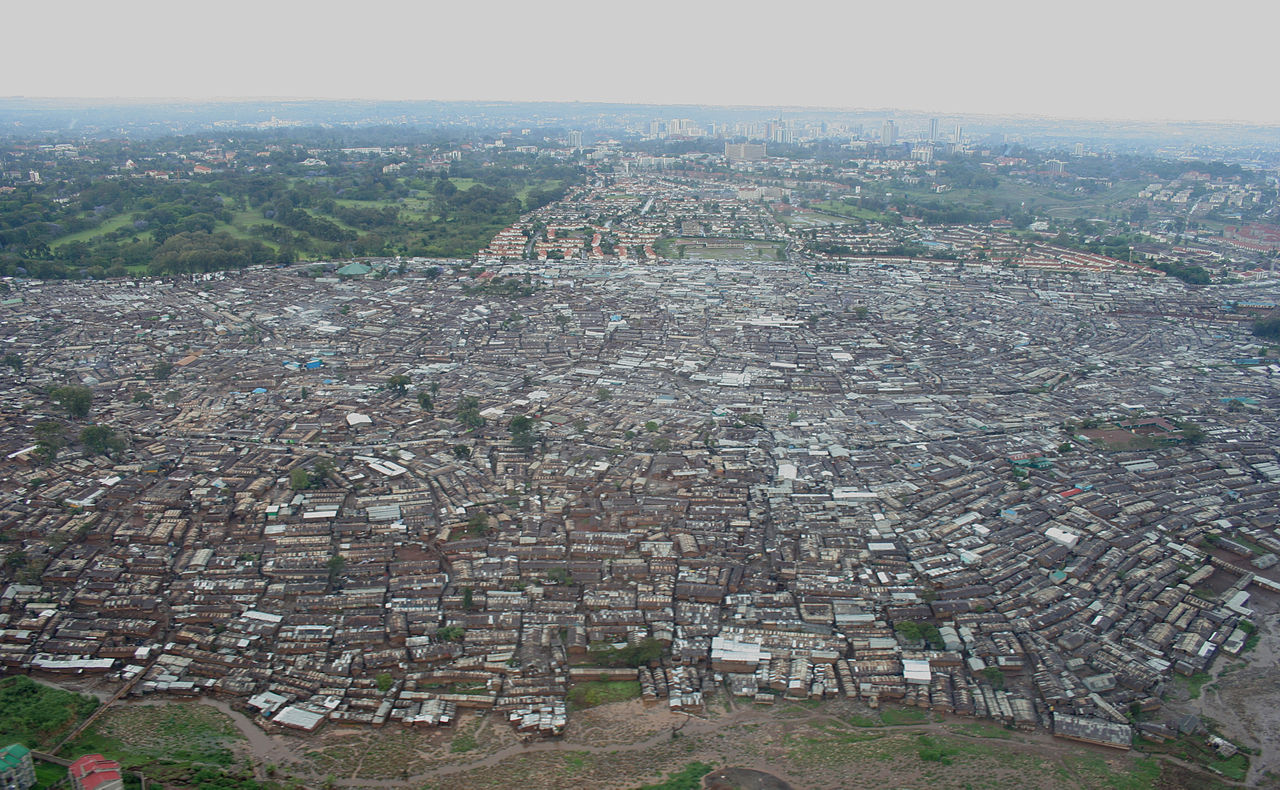
 Aerial view of Kibera slum in Nairobi, Kenya. Photo
Picha ya angani ya makazi duni ya Kibera Nairobi, Kenya. Picha imeruhusiwa kutumika chini ya leseni ya Creative Commons na PSchreibkraft.

Global Voices in Swahili
 
Kuna tovuti ya picha inayoitwa wanadamu wa New York (Humans of New York) ambayo imehamasisha kuweko kwa wanadamu wa Kibera ama (Humans of Kibera). Huu ni mradi wa Mtandao wa Habari wa Kibera (KNN), kikundi cha waandishi vijana wa habari kutoka Kibera, Nairobi, Kenya. Mradi huu unatuonyesha vyema maisha ya wakazi wa Kibera—makazi duni yaliyo kubwa zaidi Kenya—kwa mtandao wa Tumblr.
Hizi ni picha kadhaa zinazosimulia maisha ya Wanadamu wa Kibera:


Alfred Majiga
“When we vote as citizens we don't get the exact result as per our expectation, I want Obama to talk to the electoral body of Kenya to be transparent with its citizen because those are the root cause of division in our Country.”  #ObamavisittoKenya #HumansofKibera.

Δευτέρα 31 Αυγούστου 2015

The White Shantytowns Of South Africa - Apartheid Shanty Towns in Cape Town


The White Shantytowns Of South Africa

KnowledgeNuts
By Morris M. on Thursday, February 27, 2014
 
186341610
 
“Do you think, because I am poor, obscure, plain and little, I am soulless and heartless? You think wrong! I have as much soul as you, and full as much heart!” —Charlotte Bronte, Jane Eyre

In A Nutshell


South Africa has long been plagued by poverty. Across the nation, millions of citizens are forced to live in shantytowns and decrepit slums, a hangover from the enforced inequalities of the apartheid era. But while the majority of South Africa’s poor are black people, a completely new class has emerged since the seismic social shifts of 1994—formerly well-off white people who now eke out an existence in grinding poverty.

The Whole Bushel


When Nelson Mandela was elected president of South Africa in 1994, there was widespread hope that his government would wash away the extreme poverty and despair faced by millions of his countrymen. Unfortunately, a huge percentage of black South Africans continue to live below the breadline—only now they’re being joined by their white neighbors, too. It’s estimated that around 100,000 Afrikaners (descended from Dutch settlers) are currently camped out in shantytowns, trapped in dire poverty.
One of the most infamous of these is Coronation Park. In 1994, it was a getaway spot for wealthy whites wishing to escape the city. Today it’s a decaying slum: a wasteland of unemployment, malnutrition, and hopelessness. Families live in tents or broken shacks and rely on food hand-outs to survive. Drugs are a problem and the massive inequalities have given rise to an undercurrent of extreme racism in some parts of the park.
Although not as numerous as the country’s infamous townships, dozens of white camps like Coronation Park now exist across the country, each with their own unsolvable problems. Prior to the end of apartheid, South Africa had a system of guaranteed jobs, housing, and subsides for poor white citizens. With the end of minority rule, maintaining these subsidies became both immoral and logistically impossible. The result was a growing number of whites with no jobs, no backup, and no safety net. In 2008, then-presidential candidate Jacob Zuma visited another settlement at Bethlehem and expressed astonishment at the sheer number of whites living below the breadline.
Now, obviously these settlements need to be seen in a historical context. The number of black South Africans living in similarly impoverished conditions is huge, with the added downside that they were just as poor prior to 1994. That whites are now also penniless is an unfortunate side effect of bringing equality to millions.

Show Me The Proof


BBC News: South Africa’s hidden white poverty

Reuters: White poverty in South Africa (photo slideshow)

Radio Times: Reggie Yates on Extreme South Africa

Apartheid Shanty Towns in Cape Town


Capetown.at
 
Shanty Towns
During the fifties, the government replaced 2,000 African employees in the Western Cape with coloured and white workers, and pass laws were enforced by police trying to catch 'illegal' immigrant workers. However, the fast growing shanty towns on the edge of Cape Town were evidence that influx control was not really working.
In the early fifties, the necessity to supply alternative accommodation stopped the local authorities from destroying shacks. Central government's reaction was to impose 'The Prevention of Illegal Squatting Act' in 1952 which forced local authorities to set up 'emergency camps' where shanty dwellers could be 'concentrated and controlled', and permitted authorities to destroy 'illegal' shacks.
In the late 1950s the destruction of shack settlements increased in areas as diverse as Hout Bay and Elsies River. Over 5000 so-called 'bachelors' were forced to move into hostels, and thousands of 'illegals' - most of whom were women - were 'endorsed out' of the city.

In 1959, despite vocal protest from many employers, the Native Affairs Department decreed that no more Africans could be employed for work in Cape Town. At the same time, the conditions in the Eastern Cape reserves were deteriorating and therefore migrant labour became a more significant lifeline for many families.
The clearance of squatter camps continued throughout the sixties and seventies. The Modderdam squatter camp was destroyed by two bulldozers during one week in August 1977, and as residents watched their homes being razed they chanted freedom songs and hymns, charged policemen and threw furniture onto the road. Some even set fire to their own shacks before the authorities could reach them.
Crossroads
In the 1970s a shanty town developed at 'Crossroads', near the airport. It began when workers were told to leave a white farm and move to 'the crossroads'. Finding only bush, they built shacks and established a community that afforded families more scope for creating individual, respectable homes than the hostels of Guguletu.
As Crossroads was considered a temporary camp by the authorities, eviction orders were made in 1975. However, these were not enforced because a Men's Committee and a Women's Committee had formed in order to fight this decision, the latter of the two being particularly successful at gaining support from within and outside the community.
In 1977 a survey showed a total of 18,000 living at Crossroads.
The Black Sash began to support the 'Save Crossroads' campaign, and in 1978 it was declared an 'emergency camp' thereby obliging the Council to supply water taps and remove refuse for a small fee.
The battle to save Crossroads from destruction became a major battle of will between the government and the opposition movements during the late 1970s and 1980s.
However, tensions rose within the shanty town and violence erupted around the schism between supporters of Johnson Ngxobongwana as head of the residents committee, and those who contested his behaviour of favouritism and reward to his henchmen.
In 1983 there were bloody fights in Crossroads that spread into the nearby areas of KTC and Nyanga. A group of older Crossroads residents resented the rising influence of UDF supporters or 'comrades'. A group of these men, the 'witdoeke', wore white armbands and formed an alliance with the police to fight against these young 'comrades'.
The 'witdoeke' were sanctioned to use weapons, and in the attacks on neighbouring townships and the setting fire to all the shanty settlements in old Crossroads, they caused an enormous amount of violence and rendered 60,000 people homeless. Some residents moved 'voluntarily' to a tented town near Site C in Khayelitsha to avoid the violence
Khayelitsha
Meaning 'new home', Khayelitsha was intended by the government to provide housing to all 'legal' residents of the Cape Peninsula, whether they were in squatter camps or in existing townships, in one purpose built and easily controlled township.
The plan was to create 4 towns, each with 30,000 residents in brick houses, a proportion of which were to be privately owned. Settlement began with a tented town - rows and rows of tents, to which Crossroads residents fled.

By 1986 over 8,000 people lived in 4,150 'site and service' plots at Site C (site and service means demarcated plots, each with a tap and toilet), and a further 13,000 rented core houses in Town 1 (a core house is a small cement-brick structure that can be extended into a larger house).

Yet, by 1990 the population of Khayelitsha was 450,000 and unemployment stood at 80%. Only 14% lived in core housing, with 54% in serviced shacks and 32% in unserviced areas. A handful of residents had electricity and most families had to fetch water from public taps.

In conditions of overcrowding and lawlessness, unofficial councils elected by community members maintained social control in the neighbourhood, and enforced physical punishment upon adults and children who broke the local codes of behaviour.

Khayelitsha grew rapidly during the 1990s as migrants from the Eastern Cape, previously deterred by influx control, arrived to look for work. By 1995 there were over half a million people living in Khayelitsha. Many brought their cattle and were able to earn an income by selling milk to township residents.

The sight of cows crossing bridges over the N2 freeway reminds Capetonians of the strong rural connection of many of the city's residents.

Fire was a constant hazard until electricity was made accessible as residents used paraffin and candles for cooking and light. Winds blowing across the flats spread fires quickly, destroying many crowded homes.

Rates of domestic violence, rape, child abuse and murder increased dramatically during the 1990s on the Cape Flats. Police presence was minimal and in this climate, vigilante activities grew.

Taxi wars were another feature of the early-mid 1990s as associations of drivers fought to control the lucrative routes between the Cape Flats and the centre and suburbs. Passengers were not only at risk of being caught up in violent clashes and the work of 'hit squads', but were also frequently endangered by dangerous driving as drivers tried to make more money by rushing along their routes.

Slowly, however, developments began to transform the shanty towns into suburbs, although progress was slow (see the New South Africa). The open areas toward the False Bay coast were developed as 'site and service' plots in the mid-90s, such as Harare and Makhasa. Later a vast area beyond Harare was developed consisting of of tiny homes in long rows. The railway line was only extended to these areas in 2008. By this time the population of Khayelitsha was said to be over one million, although accurate data was lacking. There was still no hospital in teh entire area and other services, including policing, were - at best - controversial.

Steven Otter wrote a very readable book about his stay in Khayelitsha in the early 2000s called 'Umlungu in Khayelitsha'. 
 

See also
 
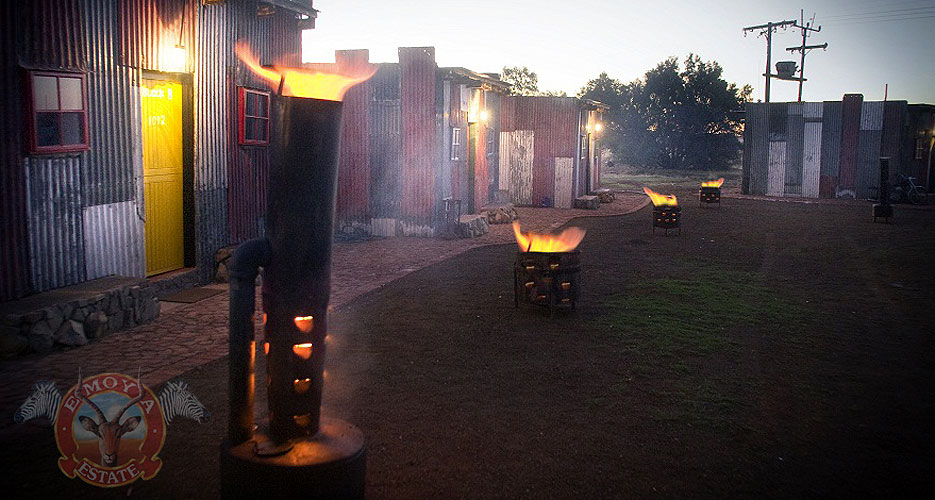
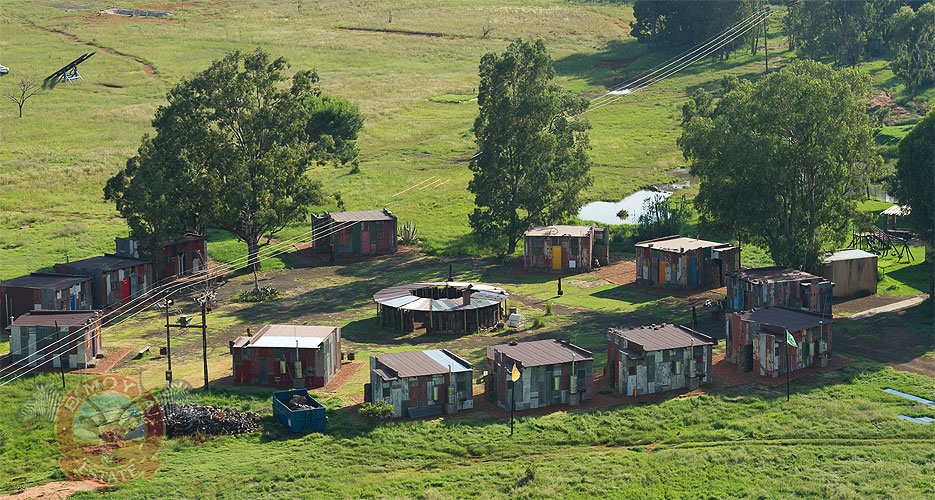
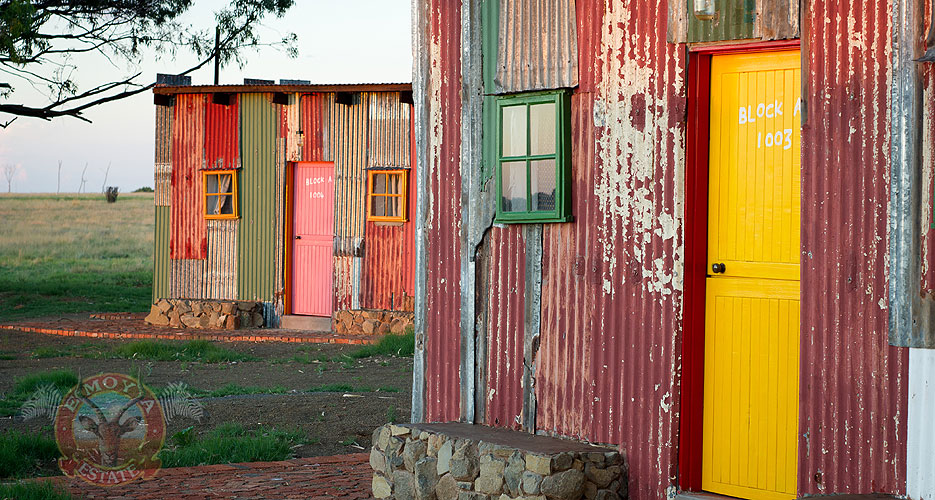
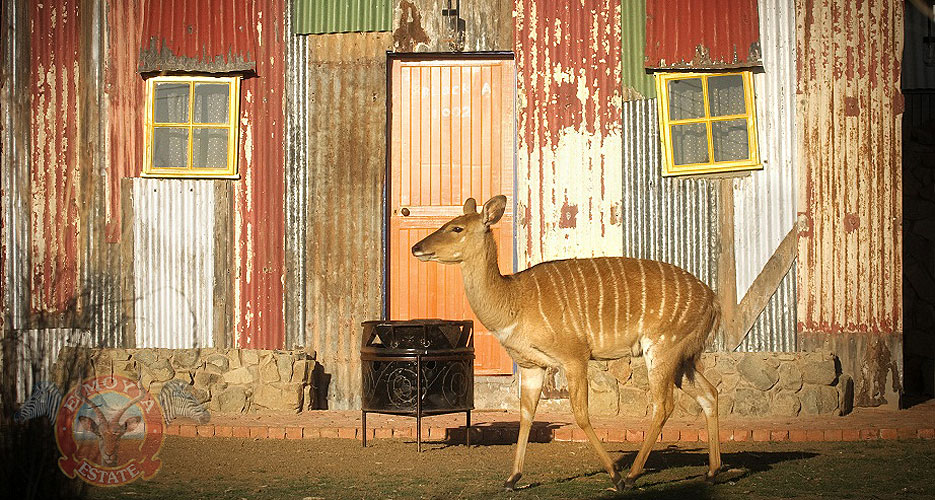
Shanty Town - Emoya Hotel & Spa (!!!) 

From here
 
Shanty Town for a unique accommodation experience in Bloemfontein

Millions of people are living in informal settlements across South Africa. These settlements consist of thousands of houses also referred to as Shacks, Shantys or Makhukhus. A Shanty usually consists of old corrugated iron sheets or any other waterproof material which is constructed in such a way to form a small "house" or shelter where they make a normal living. A paraffin lamp, candles, a battery operated radio, an outside toilet (also referred to as a long drop) and a drum where they make fire for cooking is normally part of this lifestyle.
Now you can experience staying in a Shanty within  the safe environment of a private game reserve. This is the only Shanty Town in the world equipped with wireless internet access!  
The Shanty Town is ideal for team building, braais, fancy theme parties and an experience of a lifetime.  Accommodates up to 52 guests. Our Shantys are completely safe and child friendly.

This is an experience you will never forget!
Shanty Town offers the following:

Electrical geysers     Electricity
Braai facilities on request     Bathroom with shower
Long-drop effect toilets      


Pricing (Incl. VAT)     Price
1 Person     R550
2 People     R650
3 or 4 People     R950
       
Breakfast optional @ R110.00      

Click the play button below for a quick glimpse into what the Shanty Town has to offer.  Click the Full Screen  button (below right) for a more detailed view.


Please note that Emoya Spa and Oopvuur Restaurant are operated separately and is billed separately from Emoya Basotho Village and Shanty Town

See also

Shanty town in the World
The shantytowns of Kibera & Mathare in Kenya