Εμφάνιση αναρτήσεων με ετικέτα Ghana. Εμφάνιση όλων των αναρτήσεων

Σάββατο 28 Μαρτίου 2020

Coronavirus (COVID-19) in Africa


Panafrikaniki.com/english/

Africa: The World Before This Coronavirus and After Cannot Be the Same


As COVID-19 Pandemic Rages, Women and Girls Are Even More At Risk

East Africa: EA Health Ministers Draw Covid – 19 Mitigation Plan 

Africa: Aid Organizations Scramble to Plan for COVID-19 Shutdowns
 

Nigeria: ‘Lagos’ COVID-19 Cases May Rise to 39,000′
 

Cameroon: Nation Should Protect Prison Population From COVID-19 

Ghana: Summary of the Restrictions Imposed on Selected Areas by Govt for Two Weeks

Coronavirus: 150 Tunisians self-isolate in factory to make masks
 

Morocco allocates cash for 100 000 coronavirus test kits
 

Nigeria struggles towards shutdown as virus fears grow
 

Central African Republic steps up measures after virus case
 

Coronavirus in Cameroon: Can the virus be a catalyst for peace?
 

WHO warns of ‘dramatic evolution’ of virus in Africa
 

Congo-Kinshasa: Lawyers Oppose Contacting Victims Before Setting Ntaganda Reparations Award 

Kenya: Dozens Injured As Police Brutality Marks Start of Curfew 

Uganda police shoot 2 for violating movement ban

Senegal: 10-minute coronavirus test may be on its way – for $1

Virus fears prompt Zimbabwe to let citizens pay in US dollars

Africa: MSF Calls For No Patents or Profiteering on COVID-19 Drugs, Tests, Vaccines


COVID-10 in Africa

Mozambique: Number of COVID-19 Cases Rises to Seven

Namibia: Lodge Locked Down After French Tourist Tests Positive For COVID-19

South Africa: COVID-19 – Testing to Be Ramped Up and New Tests in Pipeline

South Africa: The First Two Coronavirus Deaths – This Is What We Know

Seychelles: China, Abu Dhabi Donate Tonnes of Medical Supplies to Seychelles to Fight COVID-19


Παρασκευή 21 Φεβρουαρίου 2020

News from Africa...

 
Image from here
 

Παρασκευή 1 Νοεμβρίου 2019

Extreme poverty


En.wikipedia.org

Extreme poverty, abject poverty, absolute poverty, destitution, or penury, was defined by the United Nations (UN) in its 1995 report of the World Summit for Social Development as "a condition characterized by severe deprivation of basic human needs, including food, safe drinking water, sanitation facilities, health, shelter, education and information. It depends not only on income but also on access to services."[2] Historically, other definitions have been proposed within the United Nations.
In 2018, extreme poverty widely refers to an income below the international poverty line of $1.90 per day (in 2011 prices, equivalent to $2.12 in 2018), set by the World Bank. In October 2015, the World Bank updated the international poverty line, a global absolute minimum, to $1.90 a day.[3] This is the equivalent of $1.00 a day in 1996 US prices, hence the widely used expression "living on less than a dollar a day".[4] The vast majority of those in extreme poverty reside in South Asia, Sub-Saharan Africa, the West Indies, East Asia, and the Pacific. As of 2018, it is estimated that the country with the most people living in extreme poverty is Nigeria, at 86 million.[1][5][6]
In the past, the vast majority of the world population lived in conditions of extreme poverty.[7][8] The percentage of the global population living in absolute poverty fell from over 80% in 1800 to 20% by 2015.[9] According to United Nations estimates, in 2015 roughly 734 million people or 10% remained under those conditions.[10] The number had previously been measured as 1.9 billion in 1990, and 1.2 billion in 2008. Despite the significant number of individuals still below the international poverty line, these figures represent significant progress for the international community, as they reflect a decrease of more than one billion people over 15 years.[10]
In public opinion surveys around the world, people surveyed tend to incorrectly think that extreme poverty has not decreased.[11][12]
The reduction of extreme poverty and hunger was the first Millennium Development Goal (MDG1), as set by the United Nations in 2000. Specifically, the target was to reduce the extreme poverty rate by half by 2015, a goal that was met five years ahead of schedule. In the Sustainable Development Goals, which succeeded the MDGs, the goal is to end extreme poverty in all its forms everywhere. With this declaration the international community, including the UN and the World Bank have adopted the target of ending extreme poverty by 2030.
 
See also  
 

Τρίτη 10 Σεπτεμβρίου 2019

Africa before Transatlantic Enslavement


Black history month
 
The Transatlantic Slave trade not only distorted Africa’s economic development it also distorted views of the history and importance of the African continent itself. It is only in the last fifty years that it has been possible to redress this distortion and to begin to re-establish Africa’s rightful place in world history.


The African continent is now recognised as the birthplace of humanity and the cradle of civilization. We still marvel at the great achievements of Kemet, or Ancient Egypt, for example, one of the most notable of the early African civilizations, which first developed in the Nile valley over 5000 years ago. However, even before the rise of Kemet it seems likely that an even more ancient kingdom, known as Ta Seti, existed in what is today Nubia in Sudan. This may well have been the earliest state to exist anywhere in the world. Africa can therefore be credited not only with giving rise to the many scientific developments associated with Egypt, engineering, mathematics, architecture, medicine etc but also with important early political developments such as state formation and monarchy. This demonstrates that economic and political development, as well as scientific development was, during this early period, perhaps more advanced in Africa than in other continents.
The African continent continued on its own path of development, without significant external intervention until the fifteenth century of our era. Some of the world’s other great civilisations, such as Kush, Axum, Mali, and Great Zimbabwe, flourished in Africa in the years before 1500. In this early period Africans participated in extensive international trading networks and in trans-oceanic travel. Certainly some African states had established important trading relations with India, China and other parts of Asia long before these were disrupted by European intervention.
A North African conquest of the Iberian peninsular began in the 8th century and led to the occupation of much of Spain and Portugal for several centuries. This Muslim invasion re-introduced much of the knowledge of the ancient world to Europe and linked it much more closely with North and West Africa. It was gold from the great empires of West Africa, such as Ghana, Mali and Songhay, which provided the means for the economic take off of Europe in the 13th and 14th centuries and aroused the interest of Europeans in western Africa. Indeed it was the wealth of West Africa, especially as a source of gold, that encouraged the voyages of the early European explorers.
By the 15th century the African continent was already one of great of diversity. The existence of great kingdoms and empires, such as Mali in the west and Ethiopia in the east were in many ways exceptional rather than typical. In many part of the continent no major centralised states existed and many people lived in societies where there were no great divisions of wealth and power. In such societies there were generally more democratic systems of government by councils of elders and other kinship and age based institutions. As a consequence there was also a diversity of religious and philosophical beliefs. In many areas these beliefs remained traditional and stressed the importance of communing with common ancestors. The Ethiopian kingdom was unusual because the Orthodox Christian church, which was of ancient origin in that region, had increasingly important state functions. In Mali, and in some other areas of western and eastern Africa, as well as in throughout North Africa, Islam had already begun to play a significant role before 1500. Most importantly African societies were following their own patterns of development before the onset of European intervention.

Negative views

In the 18th century, racist views of Africa were most famously expressed by Scottish philosopher David Hume: ‘I am apt to suspect the Negroes to be naturally inferior to the Whites. There scarcely ever was a civilised nation of that complexion, nor even any individual, eminent either in action or in speculation. No ingenious manufacture among them, no arts, no sciences.’
Whilst some changed slightly over time, there were still some who continued to hold these derogatory views. In the 19th century, the German philosopher Hegel simply declared: ‘Africa is no historical part of the world.’ Later, Hugh Trevor-Roper, Regius Professor of History at Oxford University, expressed openly the racist view that Africa has no history, as recently as 1963.

Early achievements

We now know that, far from Africa having no history, it is almost certain that human history actually began there. All the earliest evidence of human existence and of our immediate hominid ancestors has been found in Africa. The latest scientific research points to the fact that all human beings are likely to have African ancestors.
Africa was not just the birthplace of humanity but also the cradle of early civilisations that made an immense contribution to the world and are still marvelled at today. The most notable example is Kemet – the original name of ancient Egypt – which first developed in the Nile valley more than 5,000 years ago and was one of the first monarchies.
However, even before the rise of Egypt, an even earlier kingdom was founded in Nubia, in what is present-day Sudan. Ta Seti is thought to be one of the earliest states in history, the existence of which demonstrates that, thousands of years ago, Africans were developing some of the most advanced political systems anywhere in the world.

Egypt

Kemet, more commonly referred to as the Egypt of the pharaohs, is best known for its great monuments and feats of architecture and engineering, such as the planning and construction of the pyramids, but it also made great advances in many other fields.
The Egyptians produced early types of paper, devised a written script and developed a calendar. They made important contributions in various branches of mathematics, such as geometry and algebra, and it seems likely that they understood and perhaps invented the use of zero. They also made important contributions to mechanics, philosophy and agriculture, especially irrigation.
In medicine, the Egyptians understood the body’s dependence on the brain more than 1,000 years before the Greek scholars came up with the same idea. Some historians now believe that Egypt had an important influence on ancient Greece, pointing to the fact that Greek scholars such as Pythagoras and Archimedes studied there and that the work of Aristotle and Plato was largely based on earlier Egyptian scholarship. For example, what is commonly known as Pythagoras’ theorem was well known to the ancient Egyptians hundreds of years before Pythagoras’ birth.

The rise of Islam

The continent progressed on its own path of development without major external intervention apart from the Arab invasions of North Africa that began after the rise of Islam in the mid-7th century. Those invasions and the introduction of Islam served to integrate North Africa, as well as parts of East and West Africa, more fully into the Muslim-dominated trading system of that period and generally enhanced the local, regional and international trading networks that were already developing throughout the continent.
Although sometimes spread by military means, Islam’s expansion was often facilitated by trade and the desire of African rulers to utilise Islamic political and economic institutions. The Arabic language also provided a script that assisted the development of literacy, book-based learning and record-keeping.
The empire of Songhay – which stretched from modern-day Mali to Sudan –was known for, among other things, the famous Islamic university of Sankoré based in Timbuktu, which was established in the 14th century. The works of the Greek philosopher Aristotle were studied there, as well as subjects such as law, various branches of philosophy, dialectics, grammar, rhetoric and astronomy. In the 16th century, one of its most famous scholars, Ahmed Baba (1564–1627), is said to have written more than 40 major books on such subjects as astronomy, history and theology and had a private library that held over 1,500 volumes.
One of the first reports of Timbuktu to reach Europe was by the North African diplomat and author Leo Africanus. In his book Description of Africa, published in 1550, he says of the town: ‘There you will find many judges, professors and devout men, all handsomely maintained by the king, who holds scholars in much honour. There, too, they sell many handwritten North African books, and more profit is to be made there from the sale of books than from any other branch of trade.’
The North African, or Moorish, invasion of the Iberian peninsula and the founding of the state of Córdoba in the 8th century had begun the reintroduction of much of the learning of the ancient world to Europe through translations into Arabic of works in medicine, chemistry, astronomy, mathematics and philosophy, as well as through the various contributions made by Islamic scholars. Arabic numerals based on those used in India were also transplanted, which helped to simplify mathematical calculations.
This knowledge, brought to Europe mainly by the Moors, helped to create the conditions for the Renaissance and the eventual expansion of Europe overseas in the 15th century.

Slavery in Africa

Between the 7th and 15th centuries, the external Muslim trading demand for African goods also included a demand for captives.
Forms of slavery have existed on all continents at different times in history – for instance, as a means of exploiting those captured in war – especially where there were labour shortages and an abundance of land. Slavery was certainly present in some African societies before the rise of Islam. In ancient Kemet, for example, there are descriptions of European slaves being branded. Later, in other African societies, especially those that were powerful states, enslaved or unfree people could be found, although generally their status was little different from that of poor farmers. It may indeed have been similar to that of the serfs of medieval Europe, who were required to produce an agricultural surplus or perform other duties for a particular ruler.
But when an external demand for enslaved people arose, some African societies could and did supply slaves. There was, for example, an export ‘trade’ in enslaved people, taking them via the Sahara from West to North Africa, following a similar route to other trade goods, such as gold and salt. Enslaved Africans were also forced to go to parts of the Middle East, to India and perhaps even as far as China. The most well-known slave of East African origin is Malik Ambar (1549–1626) who was born in what is now Ethiopia. Enslaved at an early age, he eventually became the regent of the Indian kingdom of Ahmednagar, famous for his military campaigns against the Mughals.
The development of states in Africa, increased the levels of inequality – between men and women, rich and poor, free and servile. In fact, inequality and economic exploitation were particularly prevalent in some of the most powerful and developed states, such as the Ethiopian kingdom. Indeed, historians generally consider Ethiopia to be a feudal society with many features similar to those of feudalism in Europe – that is, economic and political power was based on land ownership and the exploitation of those who were forced to work on that land.

Trading systems and gold

Before 1600, a massive regional and international trading system stretched from the coast of West Africa, across the Sahara to North Africa and beyond. It was sustained by the mining of gold in West Africa, as well as the production of many other goods there. For many centuries, it was dominated by powerful empires such as Ghana, Mali and Songhay, which often controlled both gold production and the major trading towns on the southern fringes of the Sahara.
A 9th-century historian wrote: ‘The king of Ghana is a great king. In his territory are mines of gold.’ When al-Bakri, the famous historian of Muslim Spain, wrote about Ghana in the 11th century, he reported that its king ‘rules an enormous kingdom and has great power’. He was also said to have an army of 200,000 men and to rule over an extremely wealthy trading empire.
In the 14th century, the West African empire of Mali, which was larger than western Europe, was reputed to be one of the biggest, richest and most powerful states in the world. The Moroccan traveller Mohammed Ibn Batuta, when giving his very favourable impressions of this empire, reported that he had found ‘complete and general safety’ there. When the famous emperor of Mali, Mansa Musa, visited Cairo in 1324, it was said that he brought so much gold with him that its price fell dramatically and had not recovered its value even 12 years later.
It was gold from these great empires of West Africa that prompted the early Portuguese voyages of exploration.

Traditional societies

In the centuries before 1500, some of the world’s other great civilisations, such as Kush (in present-day Sudan), Axum (in present-day Ethiopia) and Great Zimbabwe, flourished in Africa.
However, although the history of the continent before the transatlantic slave trade is often viewed as one of great empires and kingdoms, many of its inhabitants lived in societies with no great state apparatus. They were often governed by councils of elders or by other kinship- or age-based institutions. Religious and philosophical beliefs concentrated on maintaining communication with ancestors who could intercede with gods on behalf of the living and ensure the smooth functioning of society. (The Ethiopian kingdom was unusual because there the orthodox Christian Church, which was of ancient origin, performed increasingly important state functions.)
Many of these societies were small scale, occupied with farming, herding and producing enough from agriculture to survive and exchange in local markets. They could also be part of larger empires and, as such, were expected to produce a surplus or perform other duties for an overlord. In short, while these societies varied greatly and were governed in different ways, they were all developing according to their own internal dynamics.
The Igbo people, who still live in Nigeria, are an example of a society that was not part of a centralised state. They ruled themselves in village communities that, at different times, used slightly different political systems. As in many other African societies that used similar methods, everyone was taught rules and responsibilities according to age and groupings – men or women together in age sets – that cut across family or village loyalty. Sometimes the extended family was responsible for organising and training people and for liaising with other similar extended family groups, through councils of elders or elected chiefs. Therefore relationships based on age and kinship were often very important.
Even societies that had kings and more centralised political structures also used these other political institutions and ways of organising people. What is important about them is that they involved many people in decision-making and, in this respect, were African forms of participatory democracy. Religious ideas generally supported and underpinned these systems of government, most importantly giving people their own specific ways of understanding the world and the rules of their own society.

On the eve of the transatlantic slave trade

In most parts of Africa before 1500, societies had become highly developed in terms of their own histories. They often had complex systems of participatory government, or were established powerful states that covered large territories and had extensive regional and international links.
Many of these societies had solved difficult agricultural problems and had come up with advanced techniques of production of food and other crops and were engaged in local, regional or even international trading networks. Some peoples were skilled miners and metallurgists, others great artists in wood, stone and other materials. Many of the societies had also amassed a great stock of scientific and other knowledge, some of it stored in libraries such as those of Timbuktu, but some passed down orally from generation to generation.
There was great diversity across the continent and therefore societies at different stages and levels of development. Most importantly, Africans had established their own economic and political systems, their own cultures, technologies and philosophies that had enabled them to make spectacular advances and important contributions to human knowledge.
The significance of the transatlantic slave trade is not just that it led to the loss of millions of lives and the departure of millions of those who could have contributed to Africa’s future, although depopulation did have a great impact. But just as devastating was the fact that African societies were disrupted by the trade and increasingly unable to follow an independent path of development. Colonial rule and its modern legacy have been a continuation of this disruption.
The devastation of Africa through transatlantic slavery was accompanied by the ignorance of some historians and philosophers to negate its entire history. These ideas and philosophies suggested, that among other things, Africans had never developed any institutions or cultures, nor anything else of any worth and that future advances could only take place under the direction of Europeans or European institutions.

Τρίτη 18 Δεκεμβρίου 2018

Moderne Sklaverei existiert!


Auch heute ist Sklaverei noch weltweit verbreitet – und sie betrifft uns alle.


Sklaverei ist offiziell seit mehr als 150 Jahren weltweit abgeschafft – leider jedoch nur auf dem Papier. Zwangsarbeit, Zwangsprostitution, Politische Gefangenschaften, Kinderarbeit, Rekrutierung von Kindersoldaten sind Formen sogenannter moderner Sklaverei (Planet Wissen).

Schätzungsweise sind mehr als 40 Millionen Menschen weltweit von moderner Sklaverei betroffen (Global Slavery Index 2016), davon sind allein ca. 21 Millionen Menschen Opfer von Zwangsarbeit (ILO).

Auch in Europa und Deutschland arbeiten viele Tausende Menschen unter sklavereiähnlichen Bedingungen.


Moderne Sklaverei degradiert Menschen. Ihr Leben, ihre Gesundheit, ihre Gefühle und ihre Würde zählen NICHTS.

Wie werden Menschen Opfer moderner Sklaverei?

Besonders gefährdet sind Menschen in ungeschützten Situationen und extremer Not. Dazu gehören Menschen, die auf der Flucht sind und/oder in extremer Armut leben. Auch Menschen, die keine Perspektive haben – weil sie beispielsweise in instabilen politischen Verhältnissen leben oder keinerlei Zugang zu Bildung und Chancen auf einen regulären Job haben – sind besonders gefährdet. Die Rekrutierung für Arbeit unter menschenunwürdigen Bedingungen erfolgt oft bewusst in solchen Regionen und Situationen – so zum Beispiel unter den illegalisierten Flüchtlingen innerhalb Europas. Auch verlagern Unternehmen aus Kostengründen ihre Produktionen in solche Gebiete.
Informieren Sie sich über die verschiedenen Arten der modernen Sklaverei

Zwangsarbeit steckt hinter vielen Alltags-Produkten

Für jeden von uns arbeiten durchschnittlich 60 Sklav*innen.

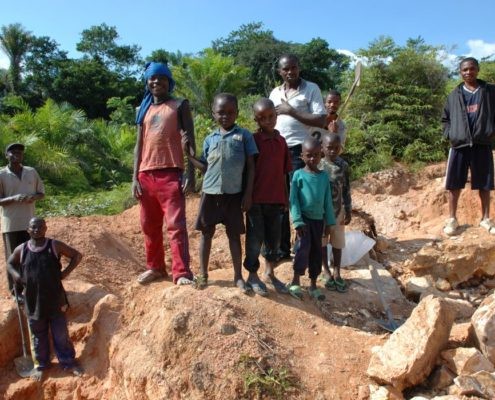
Viele Menschen hierzulande sind sich nicht darüber bewusst, unter welchen Bedingungen Produkte unseren alltäglichen Konsums (wie z.B. Kakao) hergestellt werden – und welch hohen Preis Menschen in Afrika oft für unsere billige Schokolade zahlen. Unser Lebensstil und Konsumverhalten ist mitverantwortlich für die Existenz und den Fortbestand von Lohndumping und Zwangsarbeitsverhältnissen. Insbesondere betrifft das die Arbeitenden am Anfang der Lieferketten, also bei der Gewinnung der Rohstoffe. Viele dieser Rohstoffe, die wir für unsere Produkte benötigen (zum Beispiel Kakao für Schokolade) werden aus afrikanischen Ländern importiert – am besten so billig wie möglich. Denn wer möchte schon teure Schokolade kaufen? Andere Menschen werden ausgebeutet, damit wir hier möglichst billig unsere Bedürfnisse befriedigen können.

Auch möchten wir als Verbraucher*in zu jeder Jahreszeit jegliches Gemüse und Obst in unseren zahlreichen Supermärkten vorfinden können. Selbst in der Erntesaison werden oftmals Importe anstatt Produkte aus dem regionalen Anbau angeboten. Produkte aus dem Ausland sind im Vergleich oft billiger, als die regional produzierten. Dabei achtet kaum jemand darauf, zu welchen Bedingungen diese Produkte im Ausland produziert werden. Denn Obst und Gemüse, das in Supermärkten billig verkauft wird, wird an anderen Stellen teuer bezahlt – es muss schließlich noch billiger produziert werden, damit das Geschäft sich lohnt. In den Ernteregionen, beispielsweise Spanien oder Italien, sind es zumeist die Arbeiter*innen, die ausgebeutet werden.

Alleine in der Provinz Almeria in Südspanien arbeiten bis zu 120.000 Menschen und produzieren knapp drei Millionen Tonnen Obst und Gemüse für den Export. Zu den Exportschlagern gehören Gurken, Paprika, Tomaten, Melonen und Orangen. Deutschland ist beispielsweise der wichtigste Abnehmer spanischer Tomaten in den Monaten Dezember bis April.
Jährlich werden Produkte im Wert von mehr als vier Milliarden Euro ins Ausland verkauft. In Südspanien leben die meisten Menschen somit von der Landwirtschaft. Die Erntehelfer*innen werden zumeist als Gelegenheitsarbeiter*innen durch selbsternannte Arbeitsvermittler eingestellt. Diese betrügen die Arbeiter*innen routinemäßig. Insbesondere illegalisierte Migranten und Flüchtlinge geraten leicht in die Fänge dieser Vermittler, da sie keine Möglichkeit haben, an reguläre Jobs zu kommen aber natürlich dringend auf ein eigenes Einkommen angewiesen sind. So arbeiten die meisten Erntehelfer für zwei bis vier Monaten und bekommen teilweise keinen Lohn oder werden frühzeitig entlassen, wenn sie zu erschöpft wirken und keine volle Leistung mehr erbringen können. Auch ist es die Regel, dass Agenturen weniger Tage angeben, als die Erntehelfer*innen eigentlich gearbeitet haben. Verzweifelte Menschen aus Marokko, Senegal oder Mali müssen als Erntehelfer*innen unter Folie arbeiten und unentgeltliche Überstunden leisten – bei Temperaturen von bis zu 50 Grad Celsius. Halten sie das nicht durch, verlieren sie ihren Job uns stehen wieder vor dem Nichts.

Nicht nur Gemüse und Obst sind Konsumgüter, die oftmals unter menschenunwürdigen Bedingungen produziert werden. Weitere Beispiele sind:
Blumen aus Kenia
Kakao aus Ghana
Metalle/seltene Erde für Elektrogeräte aus der DR Kongo
Obst und Gemüse aus Südeuropa
Billig-Fleisch aus Deutschland
Edelminerale und -metalle für Schmuck aus Minen in Konfliktgebieten

Innerhalb der EU ist es gesetzlich verboten, dass Pflücker*innen dort arbeiten, wo Pestizide versprüht werden – doch auch daran wird sich nicht gehalten. Oftmals werden sogar Chemikalien gesprüht, während die Arbeiter*innen pflücken. So klagen zahlreiche Arbeiter*innen darüber, dass sie krank wurden, nachdem sie auf pestizidbelasteten Feldern gearbeitet haben.

Nicht nur die Arbeitsbedingungen sind mehr als nur prekär – gleiches gilt zumeist auch für die Lebensbedingungen. Ein Großteil der Arbeiter*innen lebt im Niemandsland, weit weg von Ortschaften, ohne Zugang zu Strom und Wasser. Zumeist müssen diese in Elendsghettos zwischen den Plantagen hausen – in einem Plastik-Labyrinth, dessen Sicherheitstore gegen Abend geschlossen und die dort lebenden Menschen quasi eingesperrt werden.
Wie viele Sklaven arbeiten für Sie?


Im Durchschnitt arbeiten rund 60 Sklaven*innen für einen Konsumenten (Evi Hartmann, Professorin für „Supply Chain Management“ an der Uni Erlangen-Nürnberg). Wenn Sie wissen möchten, wie viele Sklav*innen für Sie arbeiten, können Sie das hier über den Slavery-Footprint der Organisation Made in a Free World ausrechnen: slaveryfootprint.org/. Anhand von elf Fragen zu den eigenen Konsumgewohnheiten wird berechnet, wie viele Menschen für Ihren Lebensstil arbeiten müssen. Das Ergebnis berechnet sich so: Die Organisation recherchierte hunderte Produktionswege von alltäglichen Gebrauchsgegenständen – so konnte jedem Produkt eine bestimmte Anzahl an Sklaven zugewiesen werden, die an der Herstellung des jeweiligen Produktes beteiligt sind.

Was können wir gegen die moderne Sklaverei tun?

Hinter günstigen Preisen verbergen sich oft Ausbeutungsprozesse von Männern, Frauen und Kindern in prekären Lebenssituationen. Um Menschen vor moderner Sklaverei und Ausbeutung zu schützen, können Sie mit kleinen Schritten im Alltag einen Unterschied machen.

Hier haben wir einige Möglichkeiten für Sie zusammengefasst und erklären, was GEMEINSAM FÜR AFRIKA gegen moderne Sklaverei tut. 


©CC0/Isaac Fryxelius


Opfer moderner Sklaverei – Die Stimmen Betroffener

Lisha, 22, aus Nigeria


Gideon, 16 Jahre, aus Ghana


Yvan Sagnet aus Kamerun


Falinga, 13 Jahre, aus Togo


Mustapha Sallah, 26 Jahre, aus Gambia

Dies könnte Sie auch interessieren


©GEMEINSAM FÜR AFRIKA


Soziale Gerechtigkeit


Wie Smartphones und Kinderarbeit zusammenhängen


Kinderrechtsverletzung: Kinderhandel in Togo

Τετάρτη 19 Σεπτεμβρίου 2018

A conversation with Ghana’s Fr. Joseph Kwame Labi

St Vladimir's Orthodox Seminary
St Simon of Cyrene Orthodox Mission
Pradeep Hatcher 

Alumnus Protopresbyter Joseph Kwame Ayete Labi (’80) was there when Ghana was “looking for the Orthodox Church” in the 1970s. After Fr. Kwame and a group of seekers met Fr. John Meyendorff and Fr. Thomas Hopko, among others, at the 1974 World Council of Churches in Ghana’s capital city of Accra, Fr. Kwame embarked on a journey from Africa to St. Vladimir’s Seminary and back that has seen him help to establish and strengthen the Orthodox Church in Ghana to the present day.
Fr. Joseph, now the vicar general of the Archdiocese of Accra, returned to St. Vladimir’s Seminary this summer and sat down to talk about challenges the Church in Ghana faces today, the Seminary’s St. Cyprian of Carthage Fund aimed at helping African seminarians, and what the Seminary's role could be in strengthening Orthodoxy in his home country in the years ahead.
Watch an extended conversation with Fr. Joseph below.


A conversation with Ghana’s Fr. Joseph Kwame Labi from St Vladimir's Seminary on Vimeo.

Click

Orthodox Ghana  (tag)

The Kingdom of Heaven, where racial discrimination has no place
"THE WAY" - An Introduction to the Orthodox Faith

Orthodox Mission in Tropical Africa (& the Decolonization of Africa)
How “White” is the Orthodox Church?

St. Justin Popovic: Whither does humanistic culture lead?
The Singular Goodness of God  
The Church as the Liberated Zone: "All we Christians are terrorist


Παρασκευή 18 Μαΐου 2018

Drug Trafficking in West Africa


Sustainable Development Under Threat From Drug Trafficking in West Africa


analysis
allAfrica
 
Drug trafficking is fast becoming the most serious problem in West Africa. The sub- region has seen an increase in drug trafficking, production and consumption which continues to ruin many lives.
There has also been an exponential increase in corruption and impunity which mainly favours drug barons in the region. This also has an adverse effect on citizens who possess or consume very little quantities of drugs.
As a whole, the proliferation of the drug trade in West Africa significantly undermines people's well being and possess a major road block to development efforts.
The yearly value of cocaine transiting through West Africa is estimated by the United Nations to be US$ 1.25 billion, which is higher than the national budgets of many West African countries including Liberia, Cape Verde , Sierra Leone, The Gambia, and Guinea-Bissau. This humongous amount which are direct proceeds of drug trafficking, production and consumption within the sub-region has a deadly effect on governance and sustainable development .
According to West Africa Commission Drugs (WACD) 2014 report, West Africa is not only a transit zone of drugs from Latin America to Europe. Also, local production of synthetic drugs such as, methamphetamine is increasingly being produced in West Africa for the Asian market. Furthermore, in some countries a strong protection economy for drug kingpins has emerged, allowing them to operate with impunity.
Organised crime syndicates exist at all levels of society in West Africa and pose a threat to good governance, peace and stability, economic growth and public health in West Africa, a region that has only recently emerged from decades of violent conflict. Drug trafficking is becoming a new threat for the "development" of West Africa.
Narcotics narratives are often portrayed as a security issue with a focus more on law enforcement through the criminal justice system without a deliberate link to development. The response to drug issues is similar in West Africa focusing on punishment with the aim of eradicating the supply of illegal drugs and having a "drugs free world" which can best be described as an illusion. The criminal justice response has failed.
According to statistics, despite the hundreds of billions of dollars spent in trying to eradicate illicit drugs, the industry is growing bigger than ever with a continuous growing number of drug users each day. From the United Nations Office on Drugs and Crime, World Drug Report 2015, it is estimated that a total of 246 million people, or 1 out of 20 people between the ages of 15 and 64 years, used an illicit drug in 2013. That represents an increase of 3 million over the previous year.
The current drug policy control approaches being practiced in West Africa and beyond is negatively affecting public health, economy, the rule of law, human rights, gender and social development.

Drugs and Public health

The primary objective of the international conventions is to protect the health and welfare of mankind. Unfortunately, in practice, the drug free illusion has led to so much focus on criminal justice, law enforcement, instead of public health and the protection of human rights.
In West Africa, the situation is becoming worst with public health being compromised with an increase prevalence of HIV among people who use drugs and lack of essential medicines for palliative care primarily for pain relief and the treatment of cancer patients. Statistics from UNODC's 2013 report on the world drug problem, states that the prevalence rate of cannabis use in West and Central Africa combined (12.4%) is higher than Africa and the global average, 7.5% and 3.9% respectively.
According to the Ghana's Minister of Foreign affairs during her statement at 2016 United General Assembly Specially Session (UNGASS) on drugs, " it is estimated that nearly 90% of cancer and AIDS patients in Ghana cannot be treated adequately on the current level of morphine supply". The current shortage of morphine in the Ghana hospitals has affected treatment given to the majority of cancer and AIDS patients.
The World Health Organization, UNODC, and UNAIDS have developed a 'comprehensive package' of harm reduction to reduce the risk of drug consumption related diseases such as HIV, hepatitis C, tuberculosis, overdose among others. These policy guidelines and programmes have been proven to be cost effective and have been endorsed by the African Union in its Common Africa Position (CAP) where AU called for the commitment to harm reduction programmes, including facilitating access to health care in prisons and promoting alternative non-custodial sentencing mechanisms for minor non-violent drug-related offences.
Unfortunately, in West Africa and Africa at large due to the repressive laws and related law enforcement policies and practices these programmes are yet to take full force. Currently, Senegal is the only country in West Africa implementing a harm reduction programme even though the laws are still very punitive. As a results less than 1% of people who inject drugs in Africa have little access to needle and syringe programmes or opioid substitution therapy
Unlike the visible presence of HIV retro-viral treatment available in the sub-region, hepatitis C remains a great threat in West Africa. The danger of hepatitis C can be seen in potentially serious health problems for those infected, with the possibility of liver failure, liver cancer, and premature death.
In West Africa when a drug user (who may be a problematic drug user (Addiction), as described by WHO as a chronic disease) is arrested, per the current regime, such a person has to be incarcerated if found guilty without given the opportunity to seek help for his or her problematic drug use. Over the years this approach of sending drug users to prison has only exacerbated their problem because the prisons settings are often characterized by overcrowding, inadequate ventilation and limited medical facilities for treatment, all of which contribute to the spread of diseases such as tuberculosis among prisoners. According to United Nations Office on Drugs and Crime, World Drug Report 2015 the incidence rates of tuberculosis in prisons could be 8-35 times higher than among the general population for some countries. Combined infections of HIV and tuberculosis are particularly serious, with each infection speeding up the progress of the other.

Drugs and the Economy

West African countries like their counterparts in the world tend to focus on eradicating the supply with little attention to the demand side. Policy makers have failed to appreciate that, demand drives supply. No matter the stringent methods adopted, drug users will always discover new ways of satisfying their cravings for drugs . An illustration of that is the balloon effect which was the cause of stringent measures put in place by the United States to impede drugs from Latina America to reach their coast. This led to the opening of new routes through West Africa.
West Africa is now a major hub in global drug trafficking. According to the UN, the yearly value of cocaine transiting through West Africa is estimated by the UN to be US$ 1.25 billion. For a region with a high rate of youth unemployment, this could lead to the implosion of social cohesion and an increase in crime.
In addition, this huge money can easily mount rebellion or terrorism to overthrow democratic elected government. For example, many analyses have been able to establish an interconnection between terrorist threat in the sub-region (precisely Mali) and drug trafficking.
Furthermore drug market encourages money laundering affecting the formal economy, and in turn discouraging investment in affected regions.
According to United Nations Development Programme Report June 2015, on 'Addressing the Development Dimensions of Drug Policy. "The existence of a large illicit sector in the economy can also distort economic data and, in turn, macroeconomic and structural analysis and policy making.

Drugs, Human Rights and Gender

Societal stigma makes drug users vulnerable to abuse either from law enforcement or related family and society as a whole. These violations include rape, arbitrary detention, unfair trial, torture, ill-treatment, lack of access to basic health care among others. Due to the harsh sentencing policy and fear of being arrested or reported, drug users are discouraged from seeking treatment and this exacerbates their situation.
Women, in particular, appear to face barriers to treatment. According to United Nations Office on Drugs and Crime, World Drug Report 2015 while one out of three drug users globally is a woman, only one out of five drug users in treatment is a woman. Women who inject drugs are often more vulnerable to HIV than their male counterparts. In Senegal HIV among Female Who Inject Drugs (21.1 percent) is three times higher than among Male Who Inject Drugs (7.5 per cent). In Nigeria HIV among Female Who Inject Drugs (21.0 per cent) is seven times higher than among Male Who Inject Drugs (3.1 per cent).
In addition, women who use drugs often fail to access harm reduction services - even when those are available - because of the high stigma associated with their use, and the lack of gender-sensitive services available to address their specific needs.

Links to Sustainable Development

Drug issues cannot be considered separately from a development paradigm.
The international drug control bodies, as well as West African countries, should shift their drug control approach and try as much as possible to embrace a holistic perspective of the issue in light of the debates that took place at and around the UNGASS on drugs in 2016, as well as the Sustainable Development Goals agreed upon in September 2015.
The measurement of success should not be about the number of people arrested or kilogram of drugs seized. The huge amount of money invested in law enforcement by West African government to operate prisons could be realigned to strengthen the health sector and fund development projects and programmes to address the drug problem.
There is a need to shift the objectives of drug policy away from process measures such as crop eradication statistics, arrest rates, seizures and imprisonment statistics. Governments need to explore and focus on solutions that promote public health, human rights and citizen engagement and participation. West African governments should integrate drug policy and human development in their development programs.

Leandre Banon is Capacity Development Programme Officer of the West Africa Civil Society Institute (WACSI).