THEODOROS II
BY THE GRACE OF GOD POPE AND PATRIARCH OF ALEXANDRIA AND ALL AFRICA TO THE PLENITUDE
OF THE APOSTOLIC AND PATRIARCHAL THRONE OF ALEXANDRIA
GRACE AND MERCY AND PEACE FROM OUR LORD AND GOD AND SAVIOUR
JESUS CHRIST, WHO WAS BORN IN BETHLEHEM
My dear and blessed brothers and sisters in Christ,
Filled with festive joy and rejoicing for the great and illustrious day of the Birthday of our Lord and God and Savior Jesus Christ, we exclaim together with the heavenly and bodiless powers “Glory to God in the highest and on earth peace, good will to men” (Luke 2:14). And on earth, peace! The moving proclamation of the Holy angels who on the night of the birth of our Great God appeared above the God-receiving Cave of Bethlehem, praising and glorifying God, as liturgical beings.
A universal, heart-felt, timeless request, remains unsatisfied after so many centuries! But what an irony! Christmas wishes for peace and happiness when fear, anxiety and terror, following the recent tragic events in the Middle East, have been spread over the globe; when innumerable people are uprooted from their homelands and take the bitter path of the refugee, without knowing the consequences and what will be their end. We are unimaginably pained by this “peace on earth” under conditions of terror!
In the twenty-one centuries that separate us in time from the unparalleled day of the Divine Incarnation, millions of people have sacrificed themselves in war operations, tons of blood have been shed on the battlefields and behind the lines, innumerable are the bloody pages of History, in which “people have shame the beasts.”
Have we ever wondered why? Because humans wanted to build a world without God; without the peace that He gives us. Some did not hesitate to proclaim His death. Most of us have banished Him from our lives to enthrone in His place our self, our vanity and our passions, our “happiness” as we define it. Or what is even most tragic, because some people in the name of God think they have the right to wreak havoc; to exterminate innocents in horrible ways; to destroy in the blink of an eye the labours and fortunes of an entire life, to plunge defenseless women and children and entire societies into fear and insecurity.
Peace according to the eternal and infallible word of our Lord goes hand in hand with justice. As long as humans wrong others, oppress them, exploit them, belittle them, peace cannot flourish.
Our ancient Patriarchate of Alexandria and all Africa, having the entire African continent under its pastoral and Canonical jurisdiction, has the direct and bitter experience of the peoples it has served and still serves over the centuries, of the unjust and cruel exploitation of them, of the bleeding of their wealth-producing sources, of conflict being caused between them by the powerful of the earth and of their displacement from their birthplaces.
My blessed children,
According to Christian teaching, peace is primarily a gift of God; a fruit of the Holy Spirit. We are at peace when Christ dwells in our hearts; when His eternal and unchanged Gospel law guides our steps and inspires our behavior. Peoples and nations coexist peacefully and harmoniously, when we see our fellow human beings as living images of God; if we actually respect the dignity and rights of others, persons and peoples. The word of the Apostle Paul about our Christ “He is our peace” (Eph. 2:14) assures us that the entire Gospel of Christ is essentially the only existing Science of Peace in the world.
With these paternal thoughts, we fervently bless you and paternally exhort each one of you individually: Open wide the doors of your hearts so that they may be filled with the peace of our Christ “which transcends all understanding” (Philippians 4:7). With your presence, your words and your actions, everywhere, in your family, in your work environment, in your friendly and social interactions, become peaceful people, “walk as children of light” (Eph. 5:7).
“Be at peace”, as commanded by Paul, the great apostle of the nations, “and the God of peace will be with you” (2 Cor. 13:11). And this peace is a consequence of the Nativity and a gift of the Incarnate Christ. But it is granted to those who pray and strive for it: “Make every effort to live in peace with everyone and to be holy; without holiness no one will see the Lord” (Heb. 12:14).
A joyous and peaceful Feast of the Nativity!
May the coming year 2024 be happy, blessed and peaceful!
† THEODOROS II
Pope and Patriarch of Alexandria and All Africa
In the Great City of Alexandria
Feast of the Nativity 2023

Θ Ε Ο Δ Ω Ρ Ο Σ Β’
ΕΛΕΩι ΘΕΟΥ ΠΑΠΑΣ ΚΑΙ ΠΑΤΡΙΑΡΧΗΣ ΑΛΕΞΑΝΔΡΕΙΑΣ ΚΑΙ ΠΑΣΗΣ ΑΦΡΙΚΗΣ
ΠΑΝΤΙ Τῼ ΠΛΗΡΩΜΑΤΙ
ΤΟΥ ΑΠΟΣΤΟΛΙΚΟΥ ΚΑΙ ΠΑΤΡΙΑΡΧΙΚΟΥ ΘΡΟΝΟΥ ΑΛΕΞΑΝΔΡΕΙΑΣ
ΧΑΡΙΣ ΚΑΙ ΕΛΕΟΣ ΚΑΙ ΕΙΡΗΝΗ ΠΑΡΑ ΤΟΥ ΕΝ ΒΗΘΛΕΕΜ ΓΕΝΝΗΘΕΝΤΟΣ
ΚΥΡΙΟΥ ΚΑΙ ΘΕΟΥ ΚΑΙ ΣΩΤΗΡΟΣ ΗΜΩΝ ΙΗΣΟΥ ΧΡΙΣΤΟΥ
Αδελφοί μου αγαπητοί και ευλογημένοι,
Πλημμυρισμένοι από εόρτιο χαρά και αγαλλίαση για την μεγάλη και επιφανή ημέρα των Γενεθλίων του Κυρίου και Θεού και Σωτήρος ημών Ιησού Χριστού ,αναφωνούμε μετά των επουρανίων δυνάμεων Ασωμάτων το «Δόξα ἐν ὑψίστοις Θεῷ καί ἐπί γῆς εἰρήνη, ἐν ἀνθρώποις εὐδοκία» (Λουκ. 2,14) Καί ἐπί γῆς εἰρήνη! Η συγκλονιστική διακήρυξη των Αγίων αγγέλων που τη νύχτα της γεννήσεως του Επιφανέντος Θεού εμφανίστηκαν πάνω από το Θεοδέγμον Σπήλαιο τής Βηθλεέμ, ανυμνούντες και δοξολογούντες τον Θεό, ως λειτουργικά όντα.
Ένα αίτημα πανανθρώπινο, καρδιακό, διαχρονικό, παραμένει ωστόσο μετά την παρέλευση τόσων αιώνων ανικανοποίητο! Τι ειρωνεία όμως ! Χριστουγεννιάτικες ευχές για ειρήνη και ευτυχία, όταν ο φόβος, η αγωνία και ο τρόμος, μετά και από τα προσφάτως τραγικά γεγονότα στην Μέση Ανατολή, έχουν απλωθεί πάνω από την υφήλιο· όταν αναρίθμητοι άνθρωποι ξεριζώνονται από τις πατρίδες τους και οδεύουν τον πικρό δρόμο τής προσφυγιάς, χωρίς να γνωρίζουν τίς συνέπειες και την κατάληξή τους. Μας πονάει αφάνταστα τούτο το «επί γης ειρήνη» υπό συνθήκες τρόμου!
Στους είκοσι και έναν αιώνες, που μας χωρίζουν χρονικά από την ανεπανάληπτη ημέρα της Θείας Ενανθρώπησης, εκατομμύρια ανθρώπων έχουν θυσιαστεί σε πολεμικές επιχειρήσεις, τόνοι αιμάτων έχουν χυθεί στα πεδία των μαχών και τα μετόπισθεν, αναρίθμητες οι ματωμένες σελίδες της Ιστορίας, στις οποίες «οι άνθρωποι ντροπιάζουν τα θηρία».
Αναρωτηθήκαμε ποτέ το γιατί; Γιατί οι άνθρωποι θελήσαμε να οικοδομήσουμε ένα κόσμο χωρίς Θεό· χωρίς την ειρήνη πού Εκείνος μας χαρίζει. Κάποιοι δεν δίστασαν να διακηρύξουν τον θάνατό Του. Η πλειονότητα τον εξορίσαμε από τη ζωή μας για να ενθρονίσουμε στη θέση Του το άτομό μας, τη φιλαυτία μας και τα πάθη μας, την «ευτυχία» μας, όπως εμείς την καθορίζουμε. Ή το τραγικότερο, γιατί κάποιοι στο όνομα του Θεού νομίζουν πώς δικαιούνται να σπέρνουν τον όλεθρο· να εξοντώνουν με φρικαλέους τρόπους αθώους· να καταστρέφουν εν ριπή οφθαλμού τούς κόπους και τις περιουσίες μιας ολόκληρης ζωής, να βυθίζουν στο πένθος τα ανυπεράσπιστα γυναικόπαιδα και ολόκληρες κοινωνίες στον φόβο και την ανασφάλεια.
Η ειρήνη κατά τον αιώνιο και αψευδή λόγο του Κυρίου μας συμπορεύεται με τη δικαιοσύνη. Όσο οι άνθρωποι αδικούμε τούς άλλους, τούς καταπιέζουμε, τούς εκμεταλλευόμαστε, τούς υποτιμούμε, ειρήνη δεν μπορεί να ευδοκιμήσει.
Το καθ' ημάς παλαίφατο Πατριαρχείο Αλεξανδρείας και πάσης Αφρικής, έχοντας στη ποιμαντική και Κανονική δικαιοδοσία του ολόκληρη την Αφρικανική ήπειρο, κατέχει την αμεσότατη και πικρή πείρα στους λαούς που διακονεί ανά τους αιώνες, της αδίκου και στυγνής εκμεταλλεύσεως αυτὠν, της αφαίμαξης των πλουτοπαραγωγικών πηγών τους, της προκλήσεως συγκρούσεως μεταξύ τους από τους ισχυρούς της γης και της εκτοπίσεώς τους από τους γενεθλίους τόπους.
Παιδιά μου ευλογημένα,
Η ειρήνη, κατά την χριστιανική διδασκαλία είναι πρωτίστως δώρο τού Θεού· καρπός τού Παναγίου Πνεύματος. Ειρηνεύουμε , όταν ενοικεί στις καρδιές μας ὁ Χριστός· όταν καθοδηγεί τα βήματά μας και εμπνέει τη συμπεριφορά μας ο αιώνιος και απαραχάρακτος Ευαγγελικός Του νόμος. Λαοί και έθνη συνυπάρχουμε ειρηνικά και αρμονικά, όταν βλέπουμε τους συνανθρώπους μας ως ζωντανές εικόνες τού Θεού· εάν σεβόμαστε εμπράκτως την αξιοπρέπεια και τα δικαιώματα των άλλων, προσώπων και λαών. Ο λόγος του Αποστόλου Παύλου για το Χριστό μας «Αὐτός γάρ ἐστίν ἡ εἰρήνη ἡμῶν» (Ἐφεσ. 2, 14) μας βεβαιώνει ότι όλο το Ευαγγέλιο του Χριστού στην ουσία είναι η μόνη στον κόσμο υπάρχουσα Επιστήμη περί της Ειρήνης.
Με τις πατρικές αυτές σκέψεις, σάς ευλογούμε διαπύρως και προτρέπουμε πατρικώς τον καθένα σας ξεχωριστά: Ανοίξτε διάπλατα τίς θύρες των καρδιών σας για να γεμίσουν από την ειρήνη τού Χριστού μας «τήν πάντα νοῦν ὑπερέχουσαν» (Φιλιπ.4,7). Με την παρουσία σας, τα λόγια και τίς πράξεις σας, παντού, στην οικογένειά σας, στο εργασιακό σας περιβάλλον, στις φιλικές και κοινωνικές σας αναστροφές, γίνετε οι ειρηνικοί άνθρωποι, « ὡς τέκνα φωτὸς περιπατεῖτε»(Ἐφεσ.5,7)
«Εἰρηνεύετε», όπως παραγγέλλει ο μέγας απόστολος των εθνών Παύλος, «καί ὁ Θεός τῆς εἰρήνης θά εἶναι μαζί σας» (Β’ Κορ. 13,11). Και αυτή η ειρήνη είναι συνέπεια της Γεννήσεως και δώρο του Ενανθρωπήσαντος Χριστού. Χαρίζεται όμως σε αυτοὺς που προσεύχονται και αγωνίζονται γι’ αυτήν· «εἰρήνην διώκετε μετὰ πάντων καὶ τὸν ἁγιασμόν, οὗ χωρὶς οὐδεὶς ὄψεται τὸν Κύριον» (Ἑβρ. 12 ,14).
Πανευφρόσυνα και ειρηνικά Χριστούγεννα!
Καλό, ευλογημένο και γαλήνιο το ανατέλλον έτος 2024!
† Ο Πάπας και Πατριάρχης Αλεξανδρείας και πάσης Αφρικής
Θ Ε Ο Δ Ω Ρ Ο Σ Β’
Εν τη Μεγάλη Πόλει της Αλεξανδρείας
Άγια Χριστούγεννα 2023
Please, see also


The vast majority of these Christmas movies have nothing whatsoever to do with the events described in the gospels. Christmas is thus a reference to itself (as a culture moment) rather than a reference to Christ or the Christian faith. Witness the popularity of Christmas in Japan, a country with only a 1 percent Christian population. Just a peek:
The popular fast-food restaurant, Kentucky Fried Chicken (KFC), is a national favorite in Japan at Christmas. According to the BBC, an estimated 3.6 million Japanese families celebrate with KFC on Christmas. During the Christmas period, the average KFC will increase their daily sales by 10 times their usual take. Often, families will have to order weeks in advance, or risk standing in line for hours.
In 1970, the manager of the first KFC in Japan, Takeshi Okawara, dreamt about a new promotional campaign called the “party barrel” to sell on Christmas. After overhearing two out of the country travelers in his store talk about missing turkey on Christmas, he hoped that chicken would suffice, and began marketing his Party Barrel as a way to celebrate Christmas.
In 1974, KFC took the marketing plan national and it became widely popular. Even the company mascot, Colonel Sanders, dresses up as Santa for the occasion. Many families in Japan view KFC on Christmas as a symbol of a family reunion. [This article is found here.]
Of course, the baby Jesus, is nowhere to be found in these cultural appropriations.
The Christmas story, on the level of history, is almost commonplace. Women have given birth to children in difficult circumstances from time immemorial. As poignant as its details might be (“no room in the inn”) they are still somewhat prosaic. Only theology can take us into the depths of that birth.
The mystery of Christ’s birth (just as the mystery of His conception) is the mystery of God’s union of Himself with His creation: God became man. Some reduce this mystery to a necessary step towards the crucifixion, in which Christ “paid for our sins.” This is a thought that says too little, and so diminishes the event itself.
In that the Child born at Christmas is God-made-man, His birth is also the birth into our world of the very meaning of the world itself. The meaning and purpose of everything and everyone, from human beings to the least sub-atomic particle, was already present in God from before creation. In Christ, the whole of that is born and comes among us. To honor Christ is to honor all.

Jesus
Christ, the "Immanuel", from the prophecy of Isaiah, "Behold, a virgin
shall conceive, and bear a son, and shall call His name Immanuel" (Is.
7:14) which means, "God is with us.". Orthodox holy icon from here
Back in the 50s, the British theologian, J.B. Phillips wrote the book, Your God is too Small. It is a fault of Christians that our Christmas is too small. Sentimentality (some of which is inescapable) essentially reduces Christmas to a set of feelings associated with a particular day. This makes of Christmas a very shallow holiday (rather than one of the greatest Holy Days).
Standing before the Child in that manger, our questions should turn towards what His coming means for all things. Orthodoxy sees in the manager an image of the tomb. Christ in swaddling cloths is an icon of Christ in the burial shroud. Christ in the burial shroud is the image of the whole of suffering: all suffering, everywhere, for all time. It is for us not only to help and comfort those who suffer, but to hold them in true veneration, for they bear in themselves the suffering of Christ.
The Child in the manger is also the self-emptying, self-sacrificial love of God, the love that does not hold the world at arms length, but enfolds it within His very being. It is well-spoken when we call Christmas the “Winter Pascha.”
I do not begrudge the sentiments of the world, nor the enjoyment of the feelings that accompany this feast. God Himself did not begrudge us our sins and refuse to come among us. I simply lament the fact that I myself too often settle for a little Christmas in place of the full feast. May God warm our hearts in the cold dead of winter as He warmed the universe, taking our flesh upon Himself.
The most wise Lord comes to be born,
Receiving hospitality from His own creatures.
Let us also receive Him,
That this divine Child in the cave may make us His guests
In the paradise of delights!

The Birth of Christ has always been celebrated and hymned by Christians in some way or other, as it is central to the Faith. The Word of God in past times may have appeared as an angel of the Lord, or the divine fire of the burning bush, but now, from this time onwards, He has become one of us; and not just as a fully-grown man descended from Heaven, but in humility God is born of a woman, and comes to us as a tiny, speechless, infant. This is what is shown in the Nativity Icon, and around this central historical event other stories surrounding the birth of Jesus Christ are depicted.
The common form of the Nativity Icon, with few variations, dates from around the 15th century, though it draws upon sources much older: the Old Testament Prophecies, the New Testament Gospel accounts, and ancient narratives on the life of the Virgin Mary.
The New Testament in the Nativity Icon

The child-Christ and His mother are shown in a cave, surrounded by impossibly sharp, inhospitable, rocks which reflect the cruel world into which Jesus was born. The Gospels record that Joseph and Mary could not find a room at any inn when they came to take part in the census at Bethlehem, and so Jesus was laid in a manger, an animal’s feeding trough. Common to the time, animals were not sheltered in wooden barns, but in caves and recesses in the hills, and so this “stable” is shown in the Icon.
High in the skies is a star which sends down a single shaft towards the baby Jesus. This star is being followed by the Magi, the wise Persians from the East, who are bearing gifts to the Christ. But they are shown in the distance, still on their journey. They are not there.
Thronged in the skies are a host of angels bringing the glad tidings of the birth of the world’s Saviour. On the right, the shepherds – people not regarded by anyone else – are the first to be given the Good News of Jesus’ birth. But they are also shown outside of the cave, still by their flocks. They too are not at Christ’s side yet.
Besides His mother, the only company Jesus Christ has in the first few hours of His earthly life are a lowly ox and donkey. This is the humility of God’s incarnation on earth.
The Old Testament in the Nativity Icon

The humbleness of Christ’s origins should not surprise us, as the manner of His birth was prophesied many hundreds of years prior to the event. The presence of the Ox and the Donkey in the Nativity icon fulfills one of many prophecies in the Old Testament book of Isaiah:
“The ox knows his owner, and the donkey his master’s crib” (Isaiah 1:3) . Here the animals are also shown providing warmth to Jesus by their breath.

Also found somewhere in most icons of the Nativity is a “Jesse Tree.” Named after an Old Testament patriarch, the tree’s presence is to remind us of another fulfilled prophecy from Isaiah:
“A shoot shall sprout from the stump (tree) of Jesse and from his roots a bud shall blossom. The spirit of the Lord shall rest upon Him” (Isaiah 11:1-2). In the flesh, Jesus can trace his ancestry through both His mother and adoptive father Joseph, all the way back to Jesse. This lineage is also sometimes shown in Icons of the Jesse Tree.
Other Ancient Texts in the Nativity Icon

Another important source for the story of Jesus’ birth is the Protoevangelium of James, a 2nd century text which describes the life of the Virgin Mary. This naturally includes a description of Christ’s Nativity, and the account is more detailed than those found in the Gospels. According to the Evangelium, Joseph brought along two women – a midwife and a woman called Salome – to help with the birth of Jesus. Salome is identified with a woman who later became a disciple of Christ, was the mother of the Apostles James and John, and was one of the women who discovered the empty tomb after Christ’s resurrection.

As well as declaring the glorious and joyous news of the Birth of Christ, the icon also acknowledges, as do the hymns of the Church, the great mystery of this event.
How is He contained in a womb, whom nothing can contain?
Left: Christ in the manger; Right: the Empty Tomb
No description of the Nativity Icon would be complete without mention of Jesus’ appearance in the manger.
It should be never forgotten that Jesus came to us in order to die – this was known by Him, at least, from the very beginning. Therefore, in Iconography, the manger in the Nativity Icon deliberately resembles a stone coffin, the swaddling clothes resemble a burial shroud, and the cave itself can even be said to prefigure Christ’s tomb.
With the side-by-side comparison shown above of the Icon of the Nativity with the Icon showing the Myrrh-bearing women discovering Jesus’ empty tomb, no more words are necessary.
Patriarch of Alexandria & all Africa: "God came down from heaven to earth, and transformed the earth into heaven!..."

Photo: African students of the School “Athanasios the Great”, which is
located in the patriarchal monastery of St. Savvas of Alexandria,
chanted the Christmas carols to Patriarch Theodore II of Alexandria and
All Africa (from here).
“I raise my hands and kneel in the humble manger of the newborn Divine infant and with a cry of agony, I ask God to enlighten the Mighty of the earth, so that the peace of Christ may prevail again and the sun of justice may rise once and for all”, Patriarch Theodore emphasized in his message.
My dear and blessed children,
Like every year, this year Christmas comes to assure us that the salvation of the world lies in the rebirth of our soul, the soul of each one of us.
Social life and happiness do not exist in the systems applied by the powerful of the earth, nor is it what justifies the wronged and marginalized man. Because it now proves that it is not logical for a man to serve the system, but the system to serve the man. That’s why Christmas comes to wake us up to see what we did for our poor fellow man, or what we should do, because, according to Schiller, “we were born for something better.”
But when was Christ born? When the time comes, the Scriptures answer us. When did He come? When hatred and evil were the main features of the human heart. When corruption, crime, and fratricide had taken over the world. When people lived far from the light of truth and walked in the darkness of sin. Christ came when the thirst for redemption reached the point of no return. And what did the coming of Christ bring us? He brought us the great gift, peace, and equality of people. Filled our hearts with love and hope!
God came down from heaven to earth, and transformed the earth into heaven! He preached the truth to us. He taught us to apologize. He showed us His infinite love and revealed to us our forgotten homeland, the upper Jerusalem.
And we, what do we do? Then we accepted His message and agreed, but now we disagree. We recognized him then, but we question him now.
The man of our time, intoxicated by his achievements and influenced by various slogans foreign to Orthodoxy, considers the presence of God to be unbearable. Love is exiled and forgiveness is rare. Everyone agrees to stop the hostilities and everyone deals with military equipment.
Peoples, countries, societies suffer from the selfishness of modern man, who aims to dominate at the expense of the weak and deprive him of freedom and the bread of the day. One of the most beautiful and blessed regions in the world, but at the same time, the most afflicted by hunger and poverty, Africa, for centuries now is trying to find its direction. But great geopolitical interests plague our African brother and keep him captive to his needs.
Our Patriarchate, with its Missionary work, from end to end in Africa, strives to alleviate the pain of thousands of people in practice and tries tirelessly night and day to see the “face of God” all our fellow human beings tormented by the problems of life. We do not stop, together with the bread and water, to carry to our poor brothers the message of peace.
I raise my hands and kneel in the humble manger of the newborn Divine infant and with a cry of agony, I ask God to enlighten the Mighty of the earth, so that the peace of Christ may prevail again and the sun of justice may rise once and for all”, Patriarch Theodore emphasized in his message.
Merry Christmas my children!
† THEODORE II
Pope and Patriarch of Alexandria and All Africa
*******
Orthodox Archdiocese of Zimbabwe


Ancient faith / Glory 2 God for all things
ΕΛΛΗΝΙΚΑ: Μαρία, η ευλογία των εθνών (φωτο)
In my childhood, it was not unusual to hear someone ask, “Who are your people?” It was a semi-polite, Southernism designed to elicit essential information about a person’s social background. The assumption was that you, at best, could only be an example of your “people.” It ignored the common individualism of the wider culture, preferring the more family or clan-centered existence of an older time. It was possible to be “good people” who had fallen on hard times, just as it was possible to be “bad people” who were flourishing. Good people were always to be preferred.
I am aware of the darker elements of this Southern instinct so foreign to today’s mainstream culture. I am also aware that within it, there is an inescapable part of reality: human beings never enter this world without baggage. The baggage is an inheritance, both cultural and biological that shapes the ground we walk on and the challenges we will inevitably confront. Fr. Alexander Schmemann is reported to have said that the spiritual life consists in “how we deal with what we’ve been dealt.” In some families, it seems that no matter how many times the deck is shuffled, the same hand (or close to it) appears.
The Scriptures are rife with this element of our reality. It is a story of fathers and sons, mothers and daughters, tribal destiny and inherited blessings. Two of the gospels give a chapter to rehearse the genealogy of Christ. Modern thought wants to imagine each human being entering the world as a blank slate whose life will be formed and shaped by their desires and choices. This is our imaginative version of freedom and we work to maximize its reality.
Nevertheless, human experience continues to be doggedly familial. Those who do family therapy carefully ask questions about the generations that have gone before. The battles of our lives are not about theory, but the cold hard truth of what has been given to us.
The Scriptures relate the stories of families, including their tragedies and horrific crimes. No Southern novelist ever did more than echo the iconic behaviors of Biblical failure.
This familial treatment is intentional and tracks the truth of our existence. There is never a pain as deep as that inflicted by someone who is supposed to love you. Such injuries echo through the years and the generations. The face that stares back at us in the mirror is easily a fractal of someone whose actions power our own insanity. We can hate a parent, only to be haunted by their constant presence in us.
This, of course, is only the negative, darker side of things. Blessings echo in us as well. In the delusion of modern individuality we blithely assume that we act alone in all we do. Life is so much more complicated!
What I am certain of, in the midst of all this, is that our struggle against sin and the besetting issues of our lives is never just about ourselves. If we inherit a burden within our life, so our salvation, our struggles with that burden, involve not only ourselves but those who have gone before as well as those who come after. We struggle as the “Whole Adam” (in the phrase of St. Silouan).
There is an Athonite saying: “A monk heals his family for seven generations.” When I first heard this, my thought was, “In which direction?” The answer, I think, is every direction. We are always healing the family tree as we embrace the path of salvation, monk or layman. Our lives are just that connected.
When the Virgin Mary sings her hymn of praise to God, she says, “All generations will call me blessed.” This expresses far more than the sentiment that she will be famous (how shallow). It has echoes of God’s word to Abraham, “In you, all the families of the earth shall be blessed” (Gen. 12:3). It is in the Offspring of Mary that the word to Abraham is fulfilled. In the Scriptures, God is pleased to be named the “God of Abraham.” That His name is tied to that of a human being brings no offense. Indeed, paradise itself is called the “bosom of Abraham.” It is right and proper that Christians should see the same treatment in the Virgin, the one in whom all these things are fulfilled.
“All generations” is a term that includes everyone – not just those who would come after her. For the salvation of the human race, in all places and at all times, is found only in Jesus, the Offspring of Mary. She is “Theotokos,” the “Birthgiver of God.” Mary is exalted in the bosom of Abraham.
When I look in the mirror these days, I see the unmistakable reflection of my father. No doubt, his reflection is seen elsewhere in my life, both for good and ill. I’m aware that some of my struggles are with “my daddy’s demons.” Of course, my vision is limited to just a few generations. I see my own struggles reflected in the lives of my children (for which I often want to apologize). I do not see the link that runs throughout all generations – throughout all the offspring of Adam – it is too large to grasp. What I do see, however, is the singular moment, the linchpin of all generations that is the Mother of God. In her person we see all generations gathered together. Her “be it unto me according to your word” resounds in the heart of every believer, uniting them to her heart whose flesh unites us to God.
Across the world, the myriad generations of Christians have sung ever since:
My soul doth magnify the Lord.
And my spirit hath rejoiced in God my Savior.
For he hath regarded the lowliness of his handmaiden.
For behold, from henceforth all generations shall call me blessed.
To which we add:
More honorable than cherubim,
And more glorious beyond compare than the seraphim,
Without corruption you gave birth to God the Word,
True Theotokos, we magnify you!
We are her people. Glory to God!

Antiochian Orthodox Christian Diocese of Los Angeles & the West
Adam and Eve (the first-created), the righteous Abel, son of Adam, the righteous Seth, son of Adam, the righteous Enos,son of Seth, the righteous Kenan, son of Enos, the righteous Mehaliel (Maleleim), son of Kenan, the righteous Jared, son of Mehaliel, the righteous Enoch, son of Jared, the righteous Methuselah, son of Enoch, the righteous Lamech, son of Methuselah, the righteous Noah, son of Lamech, the righteous Shem, son of Noah, the righteous Japheth, son of Noah, the righteous Arphachshad, son of Shem, the righteous Canaan, son of Arphachshad (in some versions of the OT, Canaan is called the son of Ham), the righteous Shelah, son of Canaan (some versions of the OT call Shelah the son of Arphachshad), the righteous Eber (from whom the Hebrews take their name), son of Shelah, the righteous Peleg, son of Eber, the righteous Ragab (Reu), son of Peleg, the righteous Serug, son of Ragab, the righteous Nahor, son of Serug, the righteous Terah, son of Serug.

The holy Patriarchs: the righteous Patriarch Abraham, son of Terah, the righteous Patriarch Isaac, son of Abraham, the righteous Patriarch Jacob, son of Isaac, the righteous Patriarch Reuben, son of Jacob and Leah, the righteous Patriarch Simeon, son of Jacob and Leah, the righteous Patriarch Levi, son of Jacob and Leah, the righteous Patriarch Judah (Christ was of this tribe), the righteous Patriarch Zebulon, son of Jacob and Leah, the righteous Patriarch Issachar, son of Jacob and Leah, the righteous Patriarch Dan, son of Jacob and Bilhah (Rachel's maid), the righteous Patriarch Gad, son of Jacob and Zilpah (Leah's maid), the righteous Patriarch Asher, son of Jacob and Zilpah, the righteous Patriarch Naphthali, son of Jacob and Bilhah, the righteous Patriarch Joseph, son of Jacob and Rachel, the righteous Patriarch Benjamin, son of Jacob and Rachel.
The righteous Pharez and Zerah, twin sons of Judah, the righteous Hezron, son of Pharez, the righteous Aram, son of Hezron, the righteous Aminadab, son of Aram, the righteous Nahshon, son of Aminadab, the righteous Salmon, son of Nahshon, the righteous Boaz, son of Salmon, the righteous Obed, son of Boaz and Ruth, the righteous Jesse, son of Obed.
The holy Prophet-King David, son of Jesse, King Solomon, son of David, King Rehoboam, son of Solomon, King Abijah, son of Rehoboam, King Asa, son of Abijah, King Jehosaphat, son of Asa, King Joram (Jehoram, an evil king), son of Jehosaphat, King Ochoziah (Ahaziah), son of Joram, King Jotham, son of Uzziah (Oziah), King Ahaz (a faithless king), son of Jotham, King Hezekiah, son of Ahaz, King Manesseh, son of Hezekiah, King Amos (Ammon), son of Manesseh, King Josiah, son of Amos, King Jechoniah, son of Josiah.
Shealtiel, son of Jechoniah, Zerubbabel (who led captives back to Jerusalem, and laid the foundations of the new Temple), son of Shealtiel, Abiud, son of Zerubbabel, Eliachem, son of Abiud, Azor, son of Eliachem, Zadok, son of Azor, Achim, son of Zadok, Eliud, son of Achim, Eleazar, son of Eliud, Matthan, son of Eleazar, Jacob, son of Matthan, St Joseph the Betrothed, son of Jacob.

The holy prophet Samuel, the holy prophet Nathan, the holy prophet Daniel, the three holy youths Hananiah, Mishael and Azariah.
The righteous Sarah, wife of Abraham, the righteous Rebecca, wife of Isaac, the righteous Leah, first wife of Jacob, the righteous Rachel, second wife of Jacob, the righteous Asineth, wife of Patriarch Joseph the all-comely, the righteous Miriam, sister of Moses, the righteous Deborah, Judge of Israel and prophetess, the righteous Ruth, wife of Boaz, the righteous woman of Zarephath, to whom Elias was sent (3 Kings 17), the righteous woman of Shunem, who was hospitable to Elisha (4 Kings 4), the righteous Judith, slayer of Holofernes, the righteous Esther, who delivered Israel from death, the righteous Hannah, mother of the prophet Samuel, the righteous Susanna.
By their holy intercessions, O God, have mercy upon us and save us. Amen.
Great are the accomplishments of faith, / for the Three Holy Youths rejoiced in the source of the flame, as if by restful waters,1 / and the Prophet Daniel appeared / as a shepherd of lions as of sheep. / By their prayers, O Christ God, save our souls.
(For when the Sunday before the Nativity falls on December 18-19)
You would not worship an image made by hands, O thrice-blessed youths; / but shielded by the ineffable Essence, you were glorified through your ordeal by fire. / In the midst of the unbearable fire you called upon God, crying: / "Hasten, O compassionate One, / and in Your mercy come to our aid, / for if You will, You can do so."2
(For when the Sunday before the Nativity falls on December 20-24)
Be glad, O Bethlehem! Prepare yourself, O Ephratha; / for the Lamb is on her way to give birth to the Great Shepherd she carries in her womb. / The God-bearing Fathers will rejoice, beholding Him, / and with the shepherds, they will praise the Virgin who nurses Him.

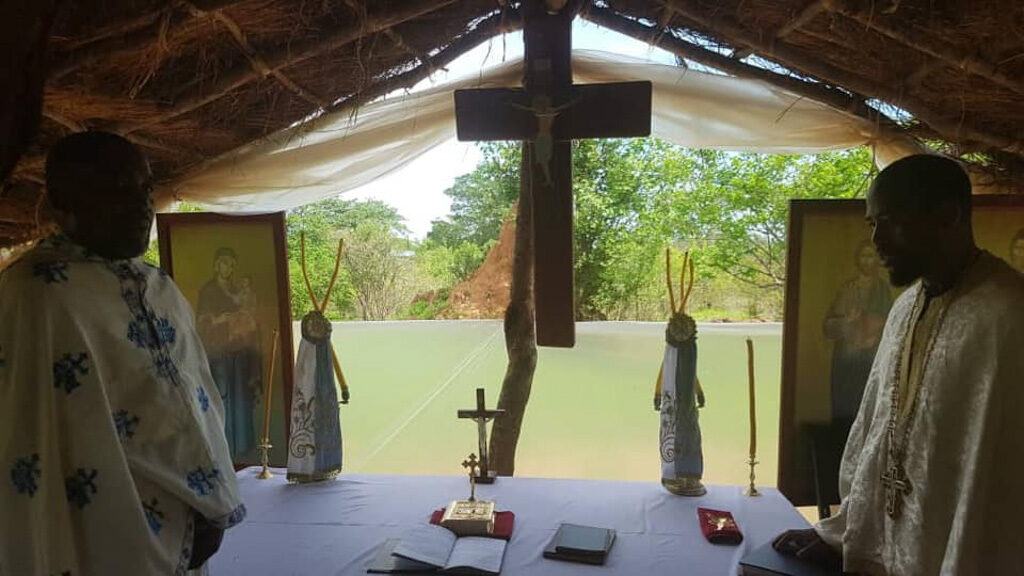
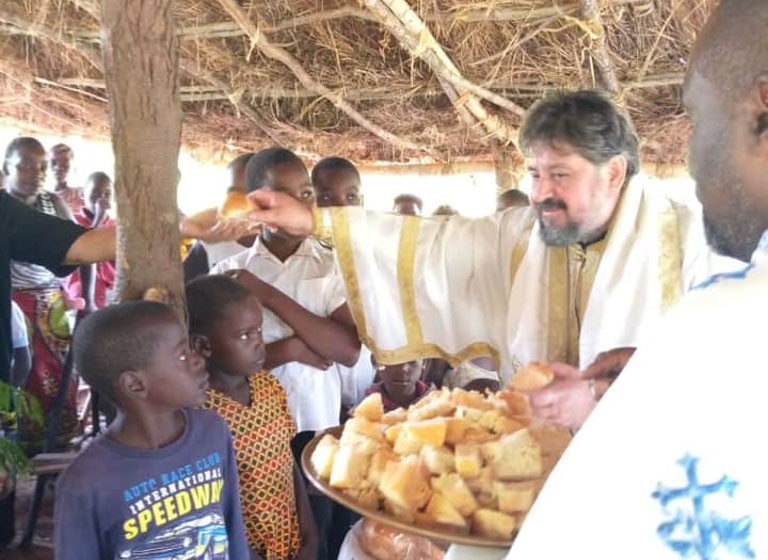
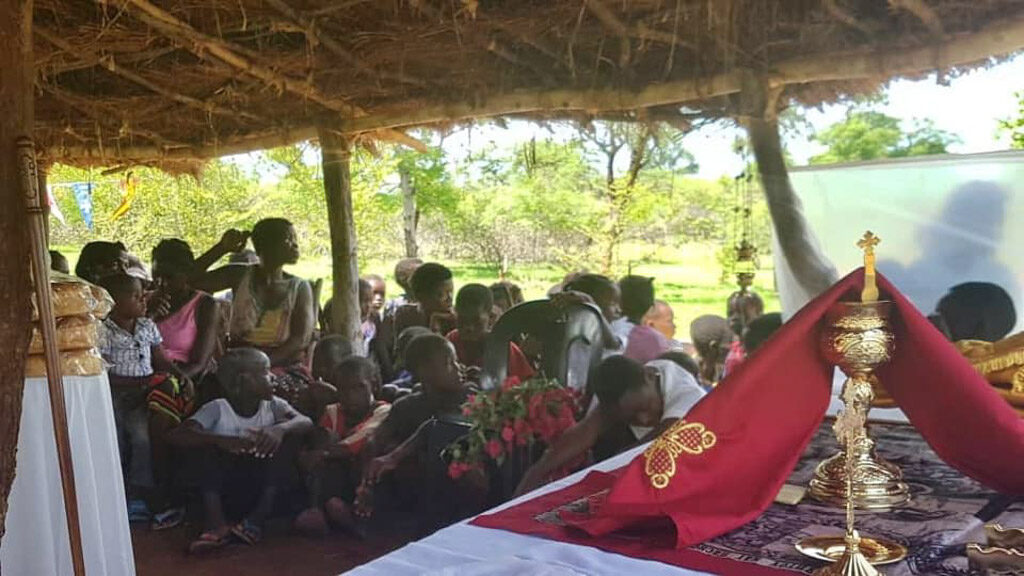
In the Mission, one can experience the beauty of Christmas and understand the true meaning of the Nativity since one follows the path of faith and piety, where Christ is constantly being reborn.
During the Divine Liturgy, Metropolitan John of Zambia wished all the best on behalf of Pope and Patriarch Theodore II of Alexandria and All Africa and informed the faithful that the works regarding the Missionary Centre were about to be completed.
In his homily, he addressed the faithful and stressed: “On the 25th of December, Christians celebrate the Birth of the Godman in a humble manger in order to show that hope and love can be found in the most unusual places. Christians honour the Miracle of the Nativity. They worship the Divine Infant. Christ of Love. The Godman of Humility.”
“It is noteworthy that this makeshift hut in this part of Africa has become a new manger that has been hosting the newborn Christ in the hearts of children over the last 20 centuries,” he added.