We are Orthodox Christian Greeks.
Because we are Orthodox Christians, we love our country, our people and all the peoples of the earth; this of course includes our African brothers and sisters.
Photos: The historic Orthodox Church of Saint George in Old Cairo (Patriarchate of Alexandria)
In the contemporary West, an interesting and revealing phenomenon is unfolding.
After decades of radical liberalism, individualism, and the dismantling
of every tradition, a new current of thought is beginning to emerge —
one described as “post-liberalism.” Among its principal exponents are
Patrick Deneen, John Milbank, and Alasdair MacIntyre.
Western thinkers themselves now openly acknowledge that a society
without moral bonds, without community, without a sacred center,
collapses. When man deifies the individual, he loses all meaning.
Freedom cannot survive in a society that has dissolved every moral tie,
every tradition, and every sacred cell — such as the family. Liberalism,
in attempting to liberate man from his roots, has left him defenseless,
stranded in a life devoid of substantive meaning.
What the West (Europe and the broader Euro-descended world) today
baptizes as “post-liberalism” is not a new wisdom. It is the awkward
admission of its failure. Having dismantled community, family, and
faith, it now seeks — even unconsciously — the very Romeike roots it
lost through the centuries, primarily under the weight first of Frankish
domination and subsequently of Papalism. It seeks the roots that we
have known for centuries as Romeosyne.
Romeosyne is neither an ideology nor a political current. It is the
living mode of existence of our Genos (sic) — our historic peoplehood.
For Romeosyne, freedom is not license but virtue and purification of
the heart. It is liberation from the passions. It is the fruit of
ascetic life and divine Grace. It is not the removal of every limit, but
the voluntary self-binding of man to the good. What Western thinkers
today rediscover as the need for a “moral framework” and self-restraint,
our tradition has lived for centuries as philotimo — the inner impulse
to do what is right not out of fear of the law, but out of love for God,
for one’s neighbor, and for the Genos.
Romeosyne has never known the isolated individual, the autonomous
self of modernity. It knows only the Person — and the Person exists only
in relationship: in the family, the parish, the ecclesial community,
the Genos. There, man does not merely “connect” sociologically; he
communes existentially. What the West now calls “the search for
community” is simply a belated discovery of a truth we have lived for
centuries. The freedom of the Romeos is a freedom of love, service, and
sacrifice — not of selfish isolation.
The economy must serve the needs of the community, not the reverse.
What some Western thinkers today formulate as a “new principle,” the
Romeike tradition always regarded as self-evident. Production and wealth
exist to sustain the family, the parish, and the Genos — not to
subjugate them. A contemporary, realistic patriotism must translate this
principle into action. Thus, for example, the complete tax exemption of
large families and the stable support of households with many children
are not mere social policy; they are elementary justice. The Romeike
tradition understands the family as the foundation of society, and the
economy must protect it, not crush it. The economy exists to safeguard
the hearth, not to liquidate it.
Our homeland [and the whole world] today needs a true return to its roots. It needs a
Romeike rebirth — a spiritual and ecclesial awakening that will first
free us ourselves from the dead ends of modernity’s ideology and, at the
same time, illuminate the path for the West, which increasingly finds
itself searching.
Romeosyne does not propose theories. It generates a way of life. From
this way of life, the necessary political orientations naturally
emerge, structured around four main axes:
a) Economy as service to need, grounded in the Gospel and in the
example of our Saints — men and women who lived love and communion in
practice. Not accumulation, but sharing. Not treasures on earth, but
treasure in heaven.
“He who has two coats, let him share with him who has none…” and “Lay not up for yourselves treasures upon earth…”
b) Education with roots — not mere transmission of information, but
initiation into truth, the cultivation of ethos, faith, and living
historical memory.
c) Productive self-sufficiency — for a people is free only when it
can feed itself, shelter itself, and create by its own labor, without
dependence on foreign powers. The economy serves man and community, not
the reverse.
d) Sovereignty and dignity — the protection of the homeland, of
borders, and of strategic structures is not a technical administrative
matter but a sacred trust and a duty toward both our ancestors and our
children.
The West, exhausted by its spiritual and social decay, gropes
awkwardly for a way out. Yet we have no new ideology to offer it. What
we offer is the witness of our way of life — our Romeosyne: our faith,
our philotimo, the love and the freedom born of communion with God,
which unites the Genos.
This inheritance must once again become the ground upon which not
only tomorrow’s Greece, but all those — personally or collectively — who
seek truth already lived and embodied in practice, may stand.
Christodoulos Molyvas Head of the Development and Investment Policy Department of NIKI
Ioannis Kon. Neonakis
Head of the Romeosyne Policy Department of NIKI
Notes:(a) The term “Romeosyne” was preferred over “Romanitas”, as it
better expresses the culture of the Roman Empire after the prevalence
of Christianity. (b) For reasons of more accurate phonological rendering and
simplification, the term “Romeos” was preferred over “Rhomaios” and
“Romeoi” over “Rhomaioi” (c) romeike (adjective): of the Romeos/Romeoi
One of the most rewarding aspects of reading historical material is how
it reveals the human mind even at a great remove from our own. There is
a myth in our culture that history is the story of progress. It
presumes that only in our modern times have we begun to free ourselves
from the false ideas of the past. What you discover when you actually
read historical materials is that many of the worst ideas ever espoused
were specifically “modern” ideas (eugenics, racial superiority,
abortion, euthanasia, etc.).
Occasionally, you come across a
piece of ancient writing that simply shatters these false assumptions. A
case-in-point is this excerpt from St. Gregory of Nyssa’s fourth homily
on Ecclesiastes. He is writing in the 4th century, A.D., when the
Church is squarely in the Byzantine period. The homily is a commentary
on Ecclesiastes 2:7 in which the writer describes his growing wealth and
his acquisition of slaves. Nyssa uses the occasion for the most
scathing critique of slavery in the annals of Christian preaching. It
shows a wonderful clarity of theological insight and understanding –
something that would and should have been available and understood both
by his contemporaries and by Christians of all times. He did not invent
this understanding – he simply demonstrates that its ideas are timeless
and not the product of some later historical progress.
There is truth. It abides. There is sin. It obscures.
From the 4th Homily on Ecclesiastes – St. Gregory of Nyssa
Ecclesiastes 2:7 I got me slaves and slave-girls, and homebred slaves were born for me, and much property in cattle and sheep became mine.
The writer of Ecclesiastes sets out in careful order virtually
everything in his own experience through which the futility of our
activities in this life is known. But at this point he touches on what
appears to be a more serious piece of evidence from his deeds through
which he can be accused of the affliction of arrogant pride. What is
there in what he has laid before us so far which leads to such a level
of conceit? He has told us about a valuable house, an abundance of
vines, elegant gardens and water features, nicely constructed swimming
pools, extensive beautiful parkland. Yet, none of this can compare to
his presumption that, as a human being he believes he can lord it over
people who in essence are just like him. Because then he goes on to say:
“I got me slaves and slave-girls, and homebred slaves were born for
me”.
Do you detect the excessive arrogance? An utterance like
this shows that he is exalting himself against God. We know from the
words of the prophets that absolutely everything is subject to the
supreme authority in the universe (Psalm 119/118.91). But this man
counts as his own what truly belongs to God and gives to the likes of
himself the kind of power which makes him think that he can be the
master of men and women. When he sees himself as so different from those
who are subject to him one can only conclude that pride has led him to
go beyond what is appropriate for his nature.
“I got me slaves
and slave-girls.” You are condemning to slavery human beings whose
nature is free and characterized by free will. You are making laws that
rival the law of God, overturning the law appropriate for humankind.
Human beings were created specifically to have dominion over the earth;
it was determined by their creator that they should exercise authority.
Yet you place them under the yoke of slavery, as though you are opposing
and fighting against the divine decree.
Have you forgotten the
limits of your authority? Your rule is limited to control of irrational
creatures. In scripture we read: “let them rule over birds and fish and
four-footed creatures”. (Gen 1.26) How then do you go beyond what is
subject to you and exalt yourself against a nature which is free,
counting people like you among four-footed or footless creatures. “You
subjected everything to humankind” declares the scripture through
prophecy and it goes on to list what is under human control: domestic
animals, cattle and sheep. (Psalm 8/7.8) Surely human beings have not
been born to you from domestic animals? Surely cattle have not given
birth to human offspring? Irrational creatures alone are subject to
humankind. “He makes grass grow for animals and green plants for
people’s slaves”. (Psalm 104/103.14) . But you have torn apart the
nature of slavery and lordship and made the same thing at one and the
same time enslaved to itself and lord of itself.
“I got me
slaves and slave-girls.” Tell me what sort of price you paid. What did
you find in creation with a value corresponding to the nature of your
purchase? What price did you put on rationality? For how many obols did
you value the image of God? For how many coins did you sell this nature
formed by God? God said: “Let us make human beings in our own image and
likeness” (Gen 1.26). When we are talking about one who is in the image
of God, who has dominion over the whole earth and who has been granted
by God authority over everything on the earth, tell me, who is the
seller and who the buyer? Only God has this kind of power, or, one might
almost say, not even God. For scripture says that the gifts of God are
irrevocable (Romans 11.29). God would not make a slave of humankind. It
was God who, through his own will, called us back to freedom when we
were slaves of sin. If God does not enslave a free person, then who
would consider their own authority higher than God’s?
How can
people be sold who have dominion over the earth and everything on the
earth? It is essential that the assets of people being sold are sold
with them. How can we value the contents of the whole earth (Genesis
1.26)? If these are beyond any valuation then tell me, what is the value
of the one who is over them? If you said “the world in its entirety”,
even then you would not have found anything approximating to the value
(Matthew 16.26; Mark 8.36). Someone knowing the true value of human
nature said that not even the whole world is worth enough to be given in
exchange for the human soul. So when a human being is for sale, it is
nothing other than the lord of the earth being brought to the auction
room. This means that creation as we know it is at the same time being
put up for public sale. That is earth, sea and islands and all that is
in them. How then is the purchaser going to settle the payment? What
will the vendor accept considering the greatness of the property
involved in the transaction?
Did the little notebook, the
written agreement and the calculation in obols trick you into thinking
that you could be master of the image of God? What utter folly! If the
contract was lost, if the writing was eaten by moths, if a drop of water
fell on it and washed it away, where is there any proof that you have a
slave? Where is there anything that supports you in being a master? You
have somebody who is named as your subordinate, but beyond the mere
name I see nothing. What did such power add to your real nature? It did
not give you extra years or any genuine superiority. Your lineage is
still human, your life is similar, the sufferings of the soul and the
body prevail upon you both in the same way, with you as master and
another in subjugation you are still both affected by agony and delight,
gladness and distress, sorrow and joy, anger and fear, disease and
death. Surely there is no distinction in such things between slave and
master? Do they not draw in the same air when they breathe? Do they not
see the sun in a similar way? Do they not both sustain their life by
taking in nourishment? Is not the make-up of their bodily organs the
same? Do they not both return to the same dust after death? Do they not
both face one and the same judgment? Is not the prospect of heaven and
hell the same for them both?
So when you are equivalent in
every way, tell me in what particular way you have more so that you
think you can become master of another human being even though you are a
human being yourself. “I got me”, you say, “slaves and slave-girls,” as
though they were a herd of goats or swine. After saying “I got me
slaves and slave-girls,” he added the good cheer that comes through
flocks and herds. For he says “And much property in cattle and sheep
became mine”, as though animals and slaves were subject to his authority
to an equal degree.
This text is copied from the website Early Church Texts – edited by Revd Andrew Maguire
Gabriel
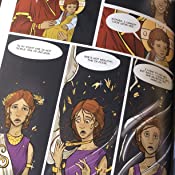
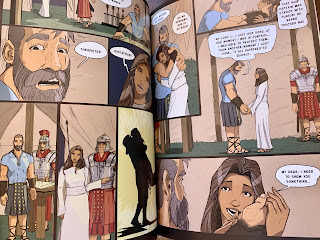
has done an excellent job of adapting the story of the Great and Holy
Martyr Katherine (305-313) into a gorgeously illustrated graphic novel
for ages 10 and up.
What a role model we find in this saint,
especially for girls! This young heroine loves learning. A governor's
daughter, she is intelligent, brave, and beautiful, but also very
confident. She tells her parents that she will enter into marriage only
with someone who has surpassed her in nobility, wealth, beauty, and
wisdom.
With the help of her secretly Christian mother, an elder monk,
and a miraculous dream, Katherine does find this Bridegroom, as she
ultimately chooses a Prince (of Peace) and puts her trust and hope in
Him.
Later,
Katherine's city is visited by the emperor Maximian. He comes to
Alexandria for a pagan festival and Katherine is horrified that
Christians are being burned alive and sacrificed because of their
refusal to deny Christ. She is compelled to speak with the emperor and
tell him about the True God, asking him to stop the human sacrifices.
Katherine
is cast into the dungeon and is visited by St. Michael the Archangel.
After the emperor sends 50 of his most renowned philosophers to debate
Katherine, they not only believe in Christ, but bravely face death for
their belief.
Now comes the part of the story that really sounds
like it was made for a graphic novel: The Wheel. Katherine, our brave
heroine, will not deny Christ and voluntarily walks up to her declared
method of cruel torture. Suddenly, St. Michael appears and blows the
dreaded wheel to smithereens!
Witnessing Katherine's bravery and
faith, Maximian's wife also comes to believe, along with the emperor's
military commander and 200 soldiers, who are beheaded.
And
that's not all...though St. Katherine herself is ultimately is
beheaded, angels miraculously transport her body to Mt. Sinai, where it
was discovered years later. To this day, her relics are still on Mt.
Sinai, at St. Katherine's Monastery.
At the end of the book is a historical note, along with several icons and the Troparion and Kontakion to St. Katherine.
From Ancient Faith Publishing:
Young
Katherine, born into noble wealth with an insatiable hunger for
knowledge, surpasses even her tutors when it comes to learning. But her
learning counts for nothing when she meets the only man worthy of her -
her heavenly Bridegroom. Trading worldly knowledge for eternal wisdom,
Katherine challenges even the emperor himself - and he prepares a cruel
invention to break her. Meet this great bride of Christ in the second
graphic novel in the Among the Saints series - written to inspire both
children and adults.
About the Author: Gabriel Wilson lives near his childhood home in
rural Indiana with his wife Emily and their three daughters. Their home
is over 100 years old - a true fixer-upper - and the subject of many of
his woodworking projects. In his free time, he pursues carpentry and
music and enjoys making homemade tacos with his wife and sketching with
his daughters. Graphic novels are his favorite form of artwork, and
aside from his comics based on the lives of saints, he has other secular
novels in the works. His first graphic novel was The Cross and the
Stag. (read my review, here)
Blessed
first day of Advent (if you're an Orthodox Christian). St.
Katherine/Catherine is commemorated in the Orthodox Church on November
24 or 25, depending on the tradition. The Broken Wheel
is a nice sized soft cover book, 7 x 10 inches, with 104 pages. It
would make a wonderful gift for any Katherine/Catherine in your life.
A comment from here:
"This book is
an Orthodox graphic novel. Yes, you read that right.... a graphic novel
for Orthodox youth and it is BEAUTIFUL. The artwork leaps off the page
with vibrant colors, expressive characters, and page-turning drama. I
found myself engrossed in Katherine's story, as I watched her come to
know the faith at age thirteen and then valiantly defend that faith at
the age of 16.
This novel covers so many important moments of the life
of St. Katherine in a way that is appealing and enthralling for young
readers. Her martyrdom is beautifully handled in the novel as a moment
of triumphant and peaceful resolve with the Archangel Michael by
Katherine's side. As much as I loved reading this book as an adult, this
book would have been so meaningful for me as an Orthodox teen,
especially a female Orthodox teen. St. Katherine exemplifies all the
qualities we strive to achieve with her unshakeable faith, unyielding
strength, and ever-flowing grace. Her young age and the artistry of the
author, Gabriel Wilson, in bringing her story to life in a relatable
format for Orthodox youth is strikingly effective. This is a "must-have"
for every Orthodox teen! (I'll have to order a second copy to gift
because I love it so much I am keeping my first copy!)".
*****
The Cross and the Stag; the Incredible Adventures of Saint Eustathius
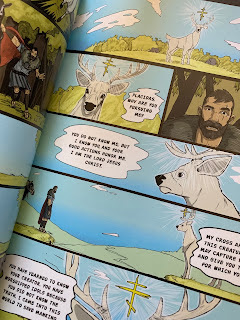
Today I'd like to introduce you to an inspiring new graphic novel for kids - The Cross and the Stag;the Incredible Adventures of Saint Eustathius, by Gabriel Wilson. It is Ancient Faith Publishing's
inaugural book into the graphic novel format, the first in their new
"Among the Saints" series written to inspire both children and adults. I am so excited about this book! Gabriel
Wilson's illustrations are striking, and graphic novels are a great way
to introduce kids to stories of the saints!
For those unfamiliar with graphic
novels, they are like comics, but the format is longer and the
self-contained story has a definite beginning, middle, and end. Wondering if graphic novels are a good fit for your child? Click on the link to explore this article from scholastic: A Guide to Using Graphic Novels with Children and Teens. Now, on to The Cross and the Stag...
This is one incredible adventure story,
about a very godly man and his brave family. Not all saint stories
would work well as graphic novels, but this one was practically begging
to for it! (As are many others - I can't wait to see what more will come
from Ancient Faith Publishing). In art school, author/artist Gabriel
Wilson became very interested in graphic design, animation, and comics
and was inspired to switch out super heroes for saints in his
comic-format stories! Drama, action, love, adventure, death, and hope -
they are all in this heroic tale.
Book description from AFP: He lost his wealth. He lost his family. He lost his station. He endured it all, to gain everything. Roman Commander Placidas was a man of
great power and influence. He and his family wanted for little, yet he
knew there had to be more to life. Once baptized into the Christian
faith as Eustathius, he faced trials beyond anything he had ever
experienced on the battlefield. His faith was challenged, but that same
faith gained him eternal life. Meet this great man in Ancient Faith
Publishing's first graphic novel.
Age Range: 7 years and up
Author/Illustrator: Gabriel Wilson
Format: Paperback
Dimensions: 7 x 10 inches
Page Length: 56 pages
Publisher: Ancient Faith Publishing
Listen to Bobby Maddex interview the author here, on Ancient Faith's podcast Ex Libris. And then order this book, available here.
"The
St Theodore the Tyro Orthodox Mission Church is the second
Afrikaans-speaking parish in the Archdiocese of Johannesburg and
Pretoria (the first one was in Eldorado Park, in Johannesburg). On the
lawn in front to the church is a statue of a stag with a cross between
its antlers. It represente the vision of St Eustathius, who once when
out hunting, saw a vision of such a stag. The statue was created by a Zimbabwean artist" (from our post about theNew Afrikaans Orthodox parish in South Africa).
Gleanings from a Book: “The Cross and the Stag” by Gabriel Wilson
Author’s note: Because I happened to
be in the right place at the right time, I was privileged to see a few
spreads of this book more than a year before its publication. Although
they were but sketches when I saw them, I was struck by their quality
and the images gripped me. And my first reading of the (now full-color)
book has confirmed what I suspected even then: this book is a treasure.
“The Cross and the Stag” by Gabriel Wilson
tells the true story of Placidas the soldier, who, amidst his worldly
successes and earthly means, was lovingly faithful to his wife and sons,
while also being very generous to those in need outside of his home.
Perhaps you have never heard of Placidas the Soldier? He was given the
name Eustathius at baptism. If you are not familiar with St. Eustathius,
either, his story is one that you will do well to learn. There is much
that each of us can learn from this saint: through his responses to both
misfortunes and pleasant experiences, and through his faithfulness to
God. Eustathius already had a good life when he first met Christ, and he
served Our Lord fervently after his conversion.
Just like many saints who had gone on
before him, Eustathius’ life did not continue to be “good” – well, at
least by worldly standards. However, also like those saints, he remained
faithful to Christ for his entire life. Like St. Paul, Eustathius had a
powerful visitation from Christ which became a conversion experience
for him and his household (although his wife had been mysteriously
forewarned in a dream, so she was ready!). Like Righteous Job the
Longsuffering, bit by bit Eustathius’ status, wealth, and finally even
his family were taken from him. Like Righteous Joseph the Patriarch, his
faithfulness in his work eventually brought Eustathius honor (and
miraculously his loved ones were restored to him once again, as well).
And finally, like the Three Holy Youths, the family faced a fiery
entrapment with faith and grace.
Throughout the book, Gabriel Wilson has
thoughtfully paired his images and text in a way which seamlessly tells
the story while also allowing the reader to read between the lines when
necessary. The illustrations are masterfully created, simultaneously
communicating actions and emotions in a way that is both tasteful and
effective. What a gift it is to have an artist of this caliber offer his
work to the Orthodox Christian world in a way that makes a saint’s
story so appealingly accessible to people of all ages!
Following St. Eustathius’ story in the
book, readers will find the troparion and kontakion for St. Eustathius.
There is also a spread featuring a variety of icons of him which have
been written. The book concludes with a few historical notes from the
author.
St. Eustathius’ story is gripping! I sat
down to just begin the book but ended up reading the whole thing in one
great gulp. Mystery, suspense, loss, love: all are found on the pages of
this beautiful work of art. I know that I’ll read it again, and I
suspect that I will not be the only one. There’s something here for
everyone. St. Eustathius’ story and the lessons that his life teaches us
will be treasured by each individual who reads this book.
Here are a few gleanings from the book
(this time, we are sharing the quotes in the context of their images),
as well as additional information about St. Eustathius:;
There’s even more of the story of St. Eustathius (including backstory of
his family’s experiences) in this detailed description of his life: https://pravoslavie.ru/74099.html
In the historical notes at the end of “The Cross and the Stag,” we
read that “St. Eustathius is the patron saint of hunters, firefighters,
and those who face adversity.” Author Gabriel Wilson also notes that
people request St. Eustathius’ prayers when they’re traveling over
rivers and seas. Readers facing adverse times (or traveling, hunting, or
firefighting) may be glad to learn this, and ask for his prayers.
*****
Theophano: A Byzantine Tale, the MUST read comic with the most beautiful illustrations
Images Credit: Chrysavgi Sakellaropoulou and Spyros Theocharis
A beautifully illustrated story by Chrysavgi Sakellaropoulou and
Spyros Theocharis has brought the East Roman Empire, or more commonly
known as the Byzantine Empire, to life with vivid imagery that captures
the imagination.
Theophano: A Byzantine Tale, is the story of a common girl who managed to become one of the most powerful women of 10th century medieval Europe.
Greek City Times spoke with both Sakellaropoulou, who prefers the
name Chrysa Sakel, and Theocharis, the two who brought this amazing
story to life.
Although Chrsa Sakel studied Chemistry, she told Greek City Times
that “my passion has always been art. I have been taking painting
lessons since childhood and I have created many classical artworks. Some
years ago, I began experimenting with digital art. This is how I got
involved in the project about Theophano.”
As for Theocharis, he said that he has always been a big fan of
historical fan fiction and a comic book fan, but studied English and
literature at university.
“For both of us, Theophano is a debut effort on the graphic novel scene,” they said.
Theocharis told Greek City Times that writing the comic book was not
so difficult, but the most challenging part was all the hours of
historical research “behind every page.” This has ensured that the story
is as authentic as can be to 10th century medieval East Rome.
For Chrysa, her greatest challenge was the “transition from classical
arts to digital art and comic book art” as it took a while for her to
develop her own style. “But, having the basic skills from the many years
of drawing in traditional medium, it only required a little research
and experimentation to manage to finish a project like that.”
The two said they always enjoyed watching medieval themed movies and
series like Game of Thrones, Vikings and The Lord of the Rings, but
Theocharis “always wondered why the Byzantine East never features in
fictional shows.”
“Byzantine history is full of stories which could easily become a series
or movies. So, having read a lot of books about Byzantium, I was
determined to create a story for a genre which could visually depict the
Byzantine world. Details such as the clothes, the architecture, the
lavish style of the Byzantine court can now be actually seen in the
pages of our graphic novel as we depict them according to our history
research. One example is the famous Cathedral of Hagia Sophia. Many
people would think that its interior resembled that of a typical
Orthodox church’s. From our research we found out that there were major
differences according to the descriptions in the primary sources,” he
explained.
Chrysa also added in her thoughts, saying that “series like Game of
Thrones gave us the motivation to start thinking about our own medieval
story, since some parts in the series reminded us a lot of what happened
in Byzantine history. We watched kings being poisoned, rebel generals
raising the banners to claim the throne, noble families allying and
betraying each other, eunuchs plotting according to their own interests
and ambitious women using unconventional means to climb the ladder of
power. Spyros already knew these things, but for me it was something
unexpected to read about the story of Theophano and the period she lived
in, and find out that it has so many exciting elements that are
movie-worthy.”
When asked whether Theophano was loosely based on a true story,
Theocharis said “the story is mostly based on historical facts with some
fictional additions to serve the cohesion of the narration.”
“Theophano, the protagonist of the story was a real historical
personality who may not feature as one of the highlighted personalities
of the Byzantine era, but her actions affected the course of Byzantine
history. In the primary sources, I found a lot of contradictory accounts
about her deeds and about her family background. This was actually
beneficial for me since I had the flexibility to alter the story without
the need to stray from the historical facts,” he told Greek City Times,
adding that “within the plot, the reader will stumble upon more
recognizable historical characters such as Nikephoros Phokas or John
Tzimiskes. There is also a character beyond the Byzantine world who
features in the second chapter and is known in countries like Ukraine
and Russia. I am speaking of Olga of Kiev, the famous saint. There has
been hours of historical research involved, combined with some parts
where I took the initiative to improvise a little bit so as to create a
narrative that could balance an interesting story combined with actual
historical events.”
Theocharis also explained that they chose this particularly time
period because it’s the point where the Byzantine Empire reaches its
medieval peak in terms of wealth, territorial expansion and culture.
“Many Byzantine artifacts which are hosted around museums all over
the world, were made during the 10th century. Many ancient Greek
manuscripts were saved from oblivion during that time. We must remember
that there was no printing press during that time and books were rare.
They had to be copied constantly in order to survive the test of time.,”
he said.
He also gave a vivid recount on just how rich and powerful the East Roman Empire was during this period.
“The Imperial palace was adorned with golden mosaics, there were at
least two throne rooms and the emperors did not have only one crown, but
many crowns which they used according to each ceremonial occasion. All
these indicate the splendor and the extravagance of an empire which
collectively has become known for its decline and backwardness. We
wanted to change that view and show how advanced the Byzantine world was
in the 10th century,” he added.
Chrysa also revealed to Greek City Times that they have plans to produce more graphic novels set in the Byzantine world.
“Right now we focus on Theophano and if this project is successful
then we are planning to produce a sequel. My dream is to someday have
enough time and produce a comic book script about the Alexiad. It’s a
catchy story which involves the crusaders and it is more familiar to a
western audience. I hope that the readers embrace this effort so that we
can have the means to continue with future project,” she said.
With such beautiful illustrations and untold hours of research, why would you not want to read Theophano?
Available now through Amazon (hardcover & digital format)
A fairytale marriage that goes terribly wrong, a ruling dynasty
struggling to keep everything together by having overly ambitious
eunuchs do the dirty work, and prominent Roman generals who dream of
taking the throne for themselves.
This explosive mixture of occurrences takes place in the 10th century
Medieval Roman Empire (aka The Byzantine Empire). An era of territorial
resurgence and massive Imperial extravagance, but also an era of
dynastic intrigues and endless plotting for the ultimate prize. The
Byzantine throne.
During that time, Anastasia, a common girl, marries the heir to the
throne, enters the palace and becomes Theophano an ambitious woman ready
to climb the ladder of power and sacrifice herself for her children.
Based on real historical events, this epic graphic novel offers an
immersion into a forgotten world. The world of the medieval Romans who
survived up until the Middle Ages with their capital, Constantinople
“the Queen of all cities” serving as a second Rome.
About the author:Spyros Theocharis was born in
Athens, Greece. He is a Graduate of the English language and literature
department of the university of Athens. He has been a Efl teacher for 10
years. He has lived in different countries experiencing life in both
urban and rural settings. Since childhood, he developed an interest in
mythology and history. It all began when he was six years old and came
across a book about the Ancient Greek gods. Tolkien’s books are his
“holy scriptures” and Byzantine history is his passion.
Chrysa
Sakel started taking classes on traditional painting when she was five years
old and has never stopped creating art ever since. After years of
working with traditional media, she began experimenting with digital
art. Her first project as a comic illustrator is the graphic novel
“Theophano: a Byzantine tale”. She plans to carry out many future
projects as a digital artist. (from here)
St John was Patriarch of Alexandria in the seventh century. When he was elected Patriarch he immediately asked that a list be drawn up of “all my masters, down to the least of them.” When asked what he meant by this strange request, St John replied “The people whom you call poor and beggars are my masters and helpers, for it is only they who can really help us and bring us to the Kingdom of Heaven.” The list ended up contains 7000 names, and to each one St John allotted a daily allowance of money.
St John then issued decrees about commerce, imposing penalties for those who cheated others in the markets, and then built seven hospitals, each with forty beds. To women who came to give birth in these hospitals, he gave a ‘maternity benefit’ upon leaving. He also built homes for the aged and infirm, and houses of hospitality for strangers.
He cared particularly for Syrian refugees when, in 614 the Persians invaded Syria. Many came to Alexandria, where he provided generously for them. The Persians also sacked Jerusalem, leading the saint to send large amounts of money and food to the city, and ransomed captives there.
St John was also a peacemaker. Twice a week he would sit outside his cathedral and would settle disagreements and advocate for justice for the oppressed. At one point, St John was stopped by a woman who was seeking a mediator for a conflict with her son-in-law, and the other religious officials tried to dismiss her and hurry St John along, no doubt to do what they considered important ecclesial work. St John rebuked them and said “How can I expect God to listen to my prayers if I do not listen to what this woman wants?”
St John loved to get money from the wealthy to give to the poor. One time a certain wealthy person tried to ingratiate the saint by buying him a lavish gift. St John sold it and gave the money to the poor, so another gift was given. This kept happening and St. John said “We shall see who gets tired of this first!” He would also say “If in order to help the needy one is able, without ill-will, to strip the rich down to their shirts, one is not doing wrong, especially if they are heartless skinflints.”
St John's compassion, mercy, and peaceability made him immensely popular with his people. Before him, Christianity in Alexandria was remarkably conflicted and at times violent, but through his peaceful mercy he was reportedly able to increase the number of churches tenfold.