Orthodox Christian Initiative for Africa

We are Orthodox Christian Greeks. Because we are Orthodox Christians, we love our country, our people and all the peoples of the earth; this of course includes our African brothers and sisters.

Εμφάνιση αναρτήσεων με ετικέτα Guinea. Εμφάνιση όλων των αναρτήσεων

Τετάρτη 12 Φεβρουαρίου 2020

List of West Africa hurricanes

From Wikipedia

This list of West Africa hurricanes includes all tropical cyclones which originated in the Atlantic and directly or indirectly affected the west coast of Africa or its surrounding islands, or both. Atlantic hurricanes seldom directly affect West Africa, the Cape Verde Islands, or the Canary Islands, since easterly winds carry the storms away from land, and most Atlantic storms that move off the African coast tend to be weak.
 
Tropical Storm Delta before hitting the Canary Islands on November 28, 2005

List of tropical cyclones

This is a list of tropical cyclones that have either made direct landfall in Western Africa and its surrounding islands or have come close to making landfall. 

Before 1950

  • September 10, 1900: A tropical storm formed on September 8, 1900, at 10°N-18.5°W and moved northwestward. The storm rapidly gained strength as it reached hurricane on September 9. The hurricane continued moving northwestward as it bypassed the Cape Verde Islands to the west at Category 1 strength. The storm later reached Category 2 status after passing the islands. Despite its close proximity to the islands, it's unclear if any watches or warnings were issued nor were any reports of damage or fatalities reported from the storm.[1]
  • August 29, 1901: A tropical depression formed on August 29 and moved westward where it became a tropical storm. The storm brushed the Cape Verde's before continuing on westward and becoming a hurricane. The storm caused no damage on the islands.[2]
  • August 25, 1906: A tropical storm brushed the Cape Verde Islands as a 40 mph (64 km/h) tropical storm causing no damage. Days later, the storm strengthened into a Category 4 hurricane.[3]
  • September 2, 1927 : A weak tropical storm passed through the Cape Verde Islands before becoming a category 2 hurricane. There was no recorded damage after the storm's passing through the islands.[4]
  • September 6, 1928: The 1928 Lake Okeechobee Hurricane passed through the Cape Verde Islands as a weak tropical storm.[5]
  • September 10, 1938: Before becoming a hurricane, the 1938 New England Hurricane passed through the Cape Verde Islands as a 40 mph (64 km/h) tropical storm.[6]
  • September 5, 1947: The Fort Lauderdale Hurricane brushed the Cape Verde Islands as a Category 1 hurricane at 0000 UTC. There were no reports of damage or injuries from the hurricane.[7]
  • September 5, 1948: A mid season hurricane brushed the Cape Verde Islands as a Category 1 storm. There were no reports of damage or injuries from that storm.[8]

1950-1979

  • August 19, 1952: Tropical Depression Two struck the Cape Verde Islands before becoming a hurricane.[9]
  • August 28, 1953: Tropical Depression Four passed through the Cape Verde Islands before becoming a hurricane.[10]
  • September 3, 1957: While transitioning to a tropical storm, Tropical Depression Four passed south of the Cape Verde Islands causing no damage.[11]
  • August 8, 1958: Tropical Depression Two passed through the Cape Verde Islands before reaching tropical storm strength. There were no reports of damage.[12]
  • September 5, 1964: Tropical Depression Eight brushed the Cape Verde Islands before reaching tropical storm strength. The storm caused no known damage.[13]
  • September 5, 1967: Tropical Depression Three passed through the Cape Verde Islands before becoming a hurricane.[14]
  • October 5, 1967: Tropical Storm Ginger formed east of the Cape Verde Islands on October 5. The storm reached a peak intensity of 50 mph before dissipating two days later. Ginger's formation was the farthest east on record for an Atlantic tropical cyclone.[15][16]
  • September 12, 1968: Tropical Depression Seven brushed the Cape Verde Islands before reaching tropical storm strength.[17]
  • August 25, 1973: Tropical Depression Nine formed over western Africa at 10°N-15°W before reaching tropical storm strength.[18]
  • September 15, 1973: Tropical Storm Ellen brushed the Cape Verde Islands as a 45 mph (72 km/h) tropical storm,[19] before becoming a hurricane.
  • September 4, 1979: Tropical Depression Eleven brushed the northern Cape Verde Islands before becoming a hurricane.[20]

1980-1999


Tropical Storm Beryl
  • September 4, 1980: Tropical Depression Nine brushed the northern Cape Verde Islands hours before becoming a hurricane.[21]
  • August 29, 1982: Tropical Storm Beryl of 1982 passed south of the Cape Verde Islands, killing 3 people and injuring 112 people.[22][23]
  • September 16, 1984: Tropical Depression Nine bypassed the Cape Verde Islands to the south before reaching tropical storm strength.[24] The storm killed 31 people, mainly from landslides and flooding.[23]
  • September 8, 1988: Tropical Storm Thirteen formed extremely close to western Africa on September 6 where it moved slightly northwestward and dissipated. It was not named because of its extreme location at the time, and it was originally thought to be a tropical depression. However, post storm analysis revealed that the system had maintained tropical storm strength for at least 48 hours. The storm produced heavy rain but caused no reported damage.
  • September 18, 1989: Before reaching hurricane status, Hurricane Erin passed through the Cape Verde Islands as a tropical depression, causing no damage.[25]
  • September 21, 1998: Hurricane Jeanne of 1998 passed south of the Cape Verde Islands as a Category 1 hurricane.[26] Because of Jeanne's rapid formation, forecasters predicted that the storm will bring tropical storm conditions to the Cape Verde Islands. However, the storm's center stayed off shore and there were no reports of damage.[27]

2000-present


Hurricane Fred at Category 1 strength over Cape Verde on August 31, 2015.
 
  • August 4, 2000: The tropical wave that later became Hurricane Alberto dropped 1 inch (25 mm) of rain across Dakar, Senegal and produced winds of 40 mph (64 km/h) off the West African coastline.[28]
  • September 9, 2003: Tropical Depression Fourteen brushed the Cape Verde Islands after reaching peak intensity of 35 mph (56 km/h).[29] The depression produced heavy rainfall and gusty winds to the islands.[30]
  • November 23, 2005: Tropical Storm Delta, after meandering eastward in the Atlantic Ocean for several days, struck the Canary Islands shortly after becoming extratropical, and 70 mph (110 km/h) winds with 90 mph (150 km/h) gusts caused over $360 million (2005 USD) in damage and nineteen deaths.[31][32] The remnants of Delta then struck Morocco, where no damage was reported.
  • August 21, 2006: Tropical Storm Debby passed south of the Cape Verde Islands as a tropical depression. A tropical storm warning was issued for the Cape Verde Islands, but was discontinued when Debby turned further westward and away from the islands.
  • September 9, 2010: Tropical Storm Igor passed about 30 miles (48 km) to the south of the southernmost Cape Verde Islands,[33] bringing tropical storm force winds to Brava & Fogo,[34] before reaching hurricane strength.
  • August 31, 2015: Hurricane Fred reached Category 1 strength as it hit Cape Verde, resulting in hurricane conditions across many of the islands. Seven people died when their fishing boat capsized off the coast of Guinea-Bissau, and another two fishermen were presumed dead after never returning to Boa Vista.
  • September 8, 2018: Tropical Storm Helene dropped heavy rainfall in Guinea, triggering flooding that claimed three lives in Doko.[35]

Monitoring stations

The Cape Verde Islands has only one tropical cyclone monitoring station in Sal.[36] In Western Africa, there are three tropical cyclone monitoring stations in Dakar, Senegal,[37] Bamako, Mali[38] and Niamey, Niger[39]

Climatological statistics

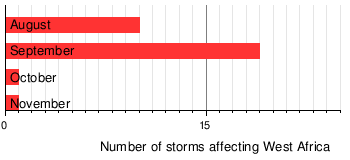
At least 31 tropical cyclones have affected Western Africa and its surrounding islands since records began in 1851. The majority of the storms affect West Africa and Cape Verde islands during the months of August and September which are the active months of a typical Atlantic hurricane season.[40]
Month Number of recorded storms
affecting West Africa
August 10
September 19
October 1
November 1


Deadliest storms

The following is a list of Atlantic tropical storms that caused fatalities in West Africa and its surrounding islands.
Name Year Number of deaths
Fran 1984 31
Delta 2005 19
Fred 2015 9
Beryl 1982 3
Helene 2018 3

See also

  • Tropical cyclones portal
  • Tropical cyclone
  • List of Atlantic hurricanes
  • List of notable tropical cyclones

References

  • Weather Underground (2007). "Weather Underground 1900 Archive". Retrieved 2007-01-11.
  • Weather Underground (2007). "Weather Underground 1901 Archive". Retrieved 2007-01-11.
  • Weather Underground (2007). "Weather Underground 1906 Archive". Retrieved 2007-01-11.
  • Weather Underground (2007). "Weather Underground 1927 Archive". Retrieved 2007-01-11.
  • Weather Underground (2007). "Weather Underground 1928 Archive". Retrieved 2007-01-11.
  • Weather Underground (2007). "Weather Underground 1938 Archive". Retrieved 2007-01-11.
  • Weather Underground (2007). "Weather Underground 1947 Archive". Retrieved 2007-01-10.
  • Weather Underground (2006). "Weather Underground 1948 Archive". Retrieved 2006-08-15.
  • Weather Underground (2006). "Weather Underground 1952 Archive". Retrieved 2006-08-02.
  • Weather Underground (2006). "Weather Underground 1953 Archive". Retrieved 2006-08-02.
  • Weather Underground (2006). "Weather Underground 1957 Archive". Retrieved 2006-08-02.
  • Weather Underground (2006). "Weather Underground 1958 Archive". Retrieved 2006-08-02.
  • Weather Underground (2006). "Weather Underground 1964 Archive". Retrieved 2006-08-02.
  • Weather Underground (2006). "Weather Underground 1967 Archive". Retrieved 2006-07-21.
  • Weather Underground (2006). "Weather Underground 1967 Archive". Retrieved 2006-07-24.
  • Arnold L. Sugg and Joseph M. Pelmisser (1968). "Hurricane Season of 1967" (PDF). NOAA. Retrieved 2006-07-24.
  • Weather Underground (2006). "Weather Underground 1968 Archive". Retrieved 2006-07-21.
  • Hurricane.com (2007). "Tropical Storm Christine (1973) best track data". Retrieved 2007-05-08.
  • Weather Underground (2006). "Weather Underground 1973 Archive". Retrieved 2006-07-21.
  • Weather Underground (2006). "Weather Underground 1979 Archive". Retrieved 2006-07-20.
  • Weather Underground (2006). "Weather Underground 1980 Archive". Retrieved 2006-07-21.
  • Gilbert C. Clark (1983). "Atlantic Hurricane Season of 1982" (PDF). NOAA. Archived from the original (PDF) on 2011-12-10. Retrieved 2006-07-17.
  • National Hurricane Center (2005). "The Deadliest Atlantic Tropical Cyclones, 1492-1996". NOAA. Retrieved 2006-07-17.
  • Weather Underground (2006). "Weather Underground 1984 Archive". Retrieved 2006-07-17.
  • Weather Underground (2006). "Weather Underground 1989 Archive". Retrieved 2006-07-17.
  • Weather Underground (2006). "Weather Underground 1998 Archive". Retrieved 2006-07-17.
  • Mayfield (1998). "Tropical Storm Jeanne Advisory #2". NOAA. Retrieved 2006-07-17.
  • Gary Paddget (2000). "Monthly Global Tropical Summary for June". Australian Severe Weather. Retrieved 2007-11-27.
  • Weather Underground (2006). "Weather Underground 2003 Archive". Retrieved 2006-07-17.
  • Alvia (2003). "Tropical Depression Fourteen Discussion #8". NOAA. Retrieved 2007-11-26.
  • Staff Writer (2005). "Delta force in the Canaries". Tenerife News. Archived from the original on September 28, 2007. Retrieved 2006-07-17.
  • Staff Writer (2005). "Delta: Aftermath and Impact". Tenerife News. Archived from the original on September 28, 2007. Retrieved 2006-07-17.
  • FORECASTER CANGIALOSI/BRENNAN (2010). "TROPICAL STORM IGOR ADVISORY NUMBER 5". NOAA. Retrieved 2010-09-10.
  • UNKNOWN (2010). "TROPICAL STORM IGOR CUMULATIVE WIND HISTORY". NOAA. Retrieved 2010-09-10.
  • Mohamed Moro Sacko (September 6, 2018). "Siguiri : Trois morts suite à des pluies duliviennnes à Doko" (in French). Guinea News. Retrieved September 8, 2018.
  • National Hurricane Center (2007). "NHC database". NOAA. Retrieved 2007-09-26.
  • National Hurricane Center (2007). "61641 Dakar, Senegal". NOAA. Retrieved 2007-09-26.
  • National Hurricane Center (2007). "61291 Bamako, Mali". NOAA. Retrieved 2007-09-26.
  • National Hurricane Center (2007). "61052 Niamey, Niger". NOAA. Retrieved 2007-09-26.
  • Chris Landsea (2007). "FAQ Subject: A2) What is a "Cape Verde" hurricane?". NOAA. Retrieved 2007-12-14.
  •  
    Categories:
    • Lists of tropical cy
    • clones by area
    • Tropical cyclones in Africa

    Navigation menu

    • Not logged in
    • Talk
    • Contributions
    • Create account
    • Log in
    • Article
    • Talk
    • Read
    • Edit
    • View history

    • Main page
    • Contents
    • Featured content
    • Current events
    • Random article
    • Donate to Wikipedia
    • Wikipedia store

    Interaction

    • Help
    • About Wikipedia
    • Community portal
    • Recent changes
    • Contact page

    Tools

    • What links here
    • Related changes
    • Upload file
    • Special pages
    • Permanent link
    • Page information
    • Wikidata item
    • Cite this page

    Print/export

    • Download as PDF
    • Printable version
    Αναρτήθηκε από ΝΕΚΡΟΣ ΓΙΑ ΤΟΝ ΚΟΣΜΟ στις 4:39 π.μ. Δεν υπάρχουν σχόλια:
    Αποστολή με μήνυμα ηλεκτρονικού ταχυδρομείου BlogThis!Κοινοποίηση στο XΜοιραστείτε το στο FacebookΚοινοποίηση στο Pinterest
    Ετικέτες Cabo Verde, Canary Islands, English, Guinea, Guinea-Bissau, History of Africa, Mali, Morocco, Natural Disasters, Niger, Senegal

    Παρασκευή 23 Αυγούστου 2019

    Ending AIDS as a public health threat by 2030: Scientific Developments from the 2016 INTEREST Conference in Yaoundé, Cameroon

    www.ncbi.nlm.nih.gov

    Abstract

    The underpinning theme of the 2016 INTEREST Conference held in Yaoundé, Cameroon, 3–6 May 2016 was ending AIDS as a public health threat by 2030. Focused primarily on HIV treatment, pathogenesis and prevention research in resource-limited settings, the conference attracted 369 active delegates from 34 countries, of which 22 were in Africa. Presentations on treatment optimization, acquired drug resistance, care of children and adolescents, laboratory monitoring and diagnostics, implementation challenges, HIV prevention, key populations, vaccine and cure, hepatitis C, mHealth, financing the HIV response and emerging pathogens, were accompanied by oral, mini-oral and poster presentations. Spirited plenary debates on the UNAIDS 90-90-90 treatment cascade goal and on antiretroviral pre-exposure prophylaxis took place. Joep Lange career guidance sessions and grantspersonship sessions attracted early career researchers. At the closing ceremony, the Yaoundé Declaration called on African governments; UNAIDS; development, bilateral, and multilateral partners; and civil society to adopt urgent and sustained approaches to end HIV by 2030.
     
    Introduction

    The goal to end AIDS as a public health threat by 2030 [1] was the underpinning theme of the 10th International Workshop on HIV Treatment, Pathogenesis, and Prevention Research in Resource-Limited Settings (2016 INTEREST Conference) held in Yaoundé, Cameroon, 3–6 May 2016. The meeting attracted 369 active delegates from 34 countries of which 22 were in Africa (Cameroon, South Africa, Nigeria, Cote D’Ivoire, Kenya, Uganda, Zambia, Zimbabwe, Botswana, Ghana, Senegal, Tanzania, Benin, Burkina Faso, Congo, Gabon, Guinea, Liberia, Malawi, Namibia, Rwanda and Swaziland). Spirited plenary debates on the UNAIDS 90-90-90 (90-90-90 refers to the targets of 90% of people living with HIV knowing their serostatus, 90% of those who know they are HIV-positive being on antiretroviral treatment [ART] and 90% of those on ART achieving viral suppression. This translates into 73% of all people living with HIV being virally suppressed) treatment cascade goal for 2020 [2] and on antiretroviral pre-exposure prophylaxis (PrEP) took place. There were presentations on treatment optimization, acquired drug resistance, care of children and adolescents, laboratory monitoring and diagnostics, implementation challenges, HIV prevention, key populations, vaccine and cure, hepatitis C, mHealth, financing the HIV response and emerging pathogens [3].
    In addition to oral, mini-oral and poster presentations, early morning Joep Lange research career guidance sessions saw mid-career and senior investigators explain how they got started on a research career and give advice on how to get funded, choose a mentor and get published. Parallel research grantspersonship sessions were presented by ANRS (France Recherche Nord & Sud Sidahepatites); Fogarty International Center, US National Institutes of Health; and EDCTP (European & Developing Countries Clinical Trials Partnership).
     
    HIV in Cameroon

    Cameroon’s Minister of Public Health, André Mama Fouda, opened the conference. Dr JB Elat, Permanent Secretary of the National AIDS Programme, presented an overview of HIV in Cameroon. HIV prevalence in 2011 was 4.3%, with urban populations and women disproportionately affected: 5.6% of women versus 2.9% of men. Compared to the general population, men who have sex with men (MSM) have 8–14× higher (24–44%), truck drivers have 5× higher (16%) and female sex workers (FSW) have 6× higher (36%) HIV prevalence. Clients of FSW account for 36% of new HIV infections annually. After Cameroon’s ART programme began in 2000, HIV prevalence fell by 20% between 2004 and 2011 from 5.5% to 4.3%. Prenatal consultations for prevention of mother-to-child transmission (PMTCT) increased steadily from 2009, with attendance reaching 74% in 2015. Between 2005 and 2015, the number of people on ART increased 10-fold and approximately 7,000 children now receive ART. In 2015, 882,639 Cameroonians were tested for HIV. Cameroon aims to increase access to HIV testing and treatment services, reduce stigma, strengthen supply chains, tailor HIV prevention for key populations and build civil society capacity. Poor retention in care remains a weak link in Cameroon’s progress towards 90-90-90 [4].
     
    Achieving 90-90-90

    Passionate debate presenting opposing viewpoints on 90-90-90 saw pessimists emphasize factors preventing achievement of the Fast-Track Initiative targets: insufficient resources (human, infrastructure, financial), inability to reach all people living with HIV (PLHIV) and retain them in care, risk of emerging drug resistance and international donor fatigue. Optimists highlighted the 17 million PLHIV on ART globally, opportunities to halt the HIV epidemic now and examples of countries close to achieving 73% viral suppression targets. Although achieving 90-90-90 is judged desirable, during the debate more conference participants became convinced the proposed time frame is too short.

    The first 90: HIV testing

    More than 150 million HIV tests are conducted in low- and middle-income countries annually and although the goal of diagnosing 90% of PLHIV is achievable, testing must be performed with 100% accuracy because of the profound consequences of misdiagnosis at both the individual and population level [5]. Outreach programmes are necessary for marginalized, stigmatized, often criminalized and hard to reach key populations. Community-based testing can reach healthy people early in their infection and link them to care [6]. Identifying all HIV+ children and adolescents requires case-finding approaches for chronic HIV survivors, intensified facility-based testing and decentralized and simplified HIV testing at point of care [7].

    The second 90: ART

    The World Health Organization recommends ART be offered immediately to everyone diagnosed with HIV infection, regardless of their CD4+ T-cell count measuring immune status [8]. Globally, 17 million people (46% of PLHIV) are on ART [9]. Voluntary licensing is enabling generic companies to provide antiretroviral (ARV) drugs in effective, well tolerated, and quality-assured individual or combination formulations for 100–130 USD per year. Voluntary licensing of drugs such as dolutegravir and tenofovir alafenamide may reduce this cost to 60 USD/year; however, more efficacy and safety data in pregnant women and HIV–TB-coinfected patients are needed [10]. Robust supply chains are essential to prevent stock-outs and ensure continuity of ART. Fulfilling high-income countries’ commitment to spend 0.7% of gross national income on overseas development assistance [11] can assist resource-limited countries but increasing domestic health-care funding in sub-Saharan Africa to reach the Abuja target of 15% of annual government expenditures being devoted to health will reduce donor dependency and facilitate sustainable programmes [12]. Building on the global success of generic ART, generic versions of drugs for tuberculosis, cancer and hepatitis B and C could facilitate drug access for people in resource-limited settings around the world at very affordable prices.

    The third 90: viral suppression

    Tracking viral suppression requires rapid scale-up of viral load monitoring, necessitating improved efficiencies in sample collection, transportation and laboratory performance; timely transmission of results to clinics and patients; and rapid appropriate action [13]. Treatment retention in Africa at 36 months is estimated at only 65% [14]. Poor adherence leads to drug resistance [15], requiring effective interventions, including mHealth and group delivery, to support retention in care and adherence. Innovations must be anchored in a comprehensive understanding of the multiple barriers facing people on ART, including adolescents who have important retention and adherence challenges.
    The WHO recommends that ART scale-up be accompanied by high-quality HIV drug resistance surveillance, achieved by investing in human and laboratory resources, innovative and efficient technical approaches, robust supply chains and quality assurance measures. Political and community commitment is needed to overcome limited laboratory capacity in sub-Saharan Africa and support studies identifying suitable ARV options. These include the ultra-deep pyrosequencing work showing that protease inhibitors and mara-viroc are likely to be effective in young Cameroonian children (the author of this abstract received the Joep Lange award for the top-scoring abstract by an African scientist at the 10th INTEREST Conference) [16], as are protease inhibitors in Ugandan children [17].
     
    HIV prevention

    More than 10 million voluntary medical male circumcisions (VMMC) have been performed, with high adult MC prevalence countries moving to establish sustainable VMMC HIV prevention programmes focused on early infant and early adolescent MC [18].
    PrEP with ARV drugs has achieved regulatory approval in South Africa and Kenya, following WHO guidance recommending PrEP when HIV incidence is 3% or more [8]. Follow-on studies and demonstration projects of oral PrEP among serodiscordant couples and MSM have shown higher adherence than in trial settings, possibly because people know that they are taking an effective product [19]. Novel products and delivery options under investigation include injectables that would be taken every 2 to 3 months, vaginal gel and ring formulations, and monoclonal antibodies. PrEP works for anyone experiencing a high risk of HIV exposure during a specific time of his or her life. A debate on whether Africa was ready for PrEP persuaded some who were sure it was ready to wonder whether regulatory, logistical, equity and other issues had all been adequately addressed. Importantly, PrEP implementation requires intensified investment in HIV testing strategies across Africa, which would result in the increased knowledge of serostatus that can improve entry into the 90-90-90 treatment cascade.
     
    Vaccine and cure

    The search for a vaccine, following the promising results of RV 144 [20], includes active and passive approaches to HIV prevention. Clade-specific trials in South Africa and elsewhere are part of the pox-protein public-private partnership (P5) evaluating pox-protein candidates. Hypothesis-generating Phase IIb trials are underway of passive immunisation strategies involving monoclonal antibodies using trivalent and tetravalent vectors to obtain broader coverage against HIV [21]. Research to understand differences in viral reservoirs with implications for cure strategies has found that Ugandans without HIV infection have increased immune activation and lymph node pathology that resembles early HIV infection among patients in Minnesota, USA [22]. If they acquire HIV in an environment where life-long exposure to various pathogens already predisposes them to high levels of T-cell activation, they may develop a larger HIV reservoir leading to persistent immune activation, subsequent lymph node fibrosis and reduced immune reconstitution. Pre-existing T-cell activation thus may account for population differences in responsiveness to immune therapy strategies, with fibrosis limiting diffusion of therapeutic agents into lymph nodes where the virus replicates.
     
    Key populations

    Success in bringing down HIV prevalence among sex workers in Rwanda, Burkina Faso, Kenya and Namibia highlights data gaps on successful interventions among men involved in sex work, regular partners of female sex workers and girls under 18 years who receive money or goods in exchange for sexual services. Exciting new developments include studies of PrEP use, integration of HIV and sexual and reproductive health services, and use of mobile technology, social media and biometric measures to assist in studying mobile sex work populations. Striking data on the use of heroin, tramadol and other opioids have led to the African Union Plan of Action on Drug Control that recognizes the burden of HIV and hepatitis C among people who inject drugs in Africa. Political barriers to holistic harm reduction remain for illicit drugs and for alcohol, a psychoactive substance with dependence-producing properties that has been strongly linked to HIV risk in Africa and around the world [23]. MSM have high HIV risks and continue to be criminalized in many African countries, making it difficult to reach them with services. In eight African countries, between 25 and 65% of these men aged 18–19 years are meeting male sexual partners online [24], suggesting that social media and mobile platforms could help increase their access to HIV prevention and treatment.
     
    Emerging pathogens – lessons learned for and from HIV

    The Ebola epidemic of 2014–2015 and epidemics of re-emerging pathogens, such as Zika and Lassa Fever, have shown that high-quality studies can run alongside the outbreak response, but health-care systems must be strengthened now before more epidemics occur. Designing and running Ebola clinical trials proved challenging in Guinea, Liberia and Sierra Leone. In Guinea, a ‘ring vaccination’ trial design was used to evaluate a vaccine candidate, with real-time modifications to take account of the rapidly changing epidemic and logistical issues [25]. The impact of favipiravir on Ebola virus disease was evaluated in a single arm, proof-of-concept trial that found it well-tolerated but could not draw firm conclusions about efficacy [26]. Ideally, outbreaks of emerging and re-emerging pathogens should be anticipated and potential drugs and vaccines for them investigated on an ongoing basis so that efficacy trials can be initiated quickly when an outbreak occurs. Engaging stakeholders, including community stakeholders, at all stages of a clinical trial contributes to robust trial design, facilitates trial conduct by addressing rumours and enhancing participant retention, and helps ensure ownership of the results for action [27]. Addressing ethical issues is key to ensuring that studies are conducted ethically, communities support them and post-trial legacies are assured [28]. Robust public health infrastructure, appropriate legislation and community involvement were key in containing an Ebola outbreak of 20 cases in Nigeria and subsequent health-care system investments have upgraded disease surveillance, research infrastructure and treatment facilities [29].
     
    Conclusions

    Although ART coverage in sub-Saharan Africa increased from 24% in 2010 to 54% in 2015, reaching a regional total of 10.3 million people [9], late diagnosis of HIV infection, loss to follow-up and poor ART adherence contributed to 790,000 people dying of AIDS-related causes in 2014. New adult HIV infections remain a concern: 25% are adolescent girls and young women and more than 20% are from key populations. An estimated 25.5 million people are living with HIV in sub-Saharan Africa, with women accounting for 56% [9]. There has been a 48% decline in new HIV infections among children in the 21 Global Plan priority countries [30], but 190,000 African children acquired HIV infection in 2014 [31].
    The 10th INTEREST Conference heard a call for leadership and activism among HIV investigators and physicians to show global solidarity with PLHIV worldwide and to ensure that resources are used effectively. Sub-Saharan Africa loses over 150 billion USD/year through illicit financial flows [32], corruption and money laundering [12]. This money could replace international donations and fund health care throughout the continent. At the closing ceremony, the Yaoundé Declaration [33] (Additional file 1) was read out, calling on African governments; UNAIDS; development, bilateral, and multilateral partners; and civil society to adopt urgent and sustained approaches to end HIV by 2030 [34,35].
     
    Acknowledgments

    The authors thank Wendy Smith (Wordsmiths International Ltd, Wells, UK) for providing meeting notes that were used as background materials for writing the manuscript. The INTEREST 2016 organizers acknowledge the support of the Ministry of Public Health, Cameroon; the National Institutes of Health and the Fogarty International Center, USA; the ANRS (France Recherche Nord & Sud Sidahepatites); and the following companies: Gilead Sciences, Janssen Pharmaceuticals, AbbVie, ViiV Healthcare, Roche and Mylan. 

    See also

    The History of AIDS in Africa

    AIDS (tag in our blog)
     
    Footnotes

    Additional file
    Additional file 1: The Yaoundé Declaration can be found at https://www.intmedpress.com/uploads/documents/3939_Hankins_Addfile1.pdf
    Disclosure statement
    All 12 authors reviewed previous drafts of the manuscript and approve its contents. None of the authors have a conflict of interest, with the exception of CABB of the company Virology Education that provided logistical support for the conference. 
     
    References
     
    1. Piot P, Abdool Karim SS, Hecht R, et al. Defeating AIDS–advancing global health. The Lancet. 2015;386:171–218. [PubMed] [Google Scholar]
    2. UNAIDS. [Accessed 30 March 2017];90-90-90. An ambitious treatment target to help end the AIDS epidemic. 2014 Available from http://www.unaids.org/sites/default/files/media_asset/90-90-90_en_0.pdf.
    3. [Accessed 30 March 2017];International Workshop on HIV Treatment, Pathogenesis, and Prevention Research in Resource-Limited Settings (INTEREST) Available from www.interestworkshop.org.
    4. Fokam J, Elat J-BN, Billong SC, et al. Monitoring HIV drug resistance early warning indicators in Cameroon: a study following the revised World Health Organization recommendations. PLOS ONE. 2015;10:e0129210. [PMC free article] [PubMed] [Google Scholar]
    5. Marum E. HIV testing strategies: how to reach 90% knowledge of serostatus (including the role of self-testing): achieving the first ‘90’– and doing it right. 10th INTEREST Conference; 4 May 2016; Yaounde, Cameroon. [Accessed 30 March 2017]. Available from http://regist2.virology-education.com/2016/10INTEREST/17_Marum.pdf. [Google Scholar]
    6. World Health Organization. [Accessed 2 April 2017];Consolidated guidelines on HIV testing. Available from http://apps.who.int/iris/bitstream/10665/179870/1/9789241508926_eng.pdf?ua=1&ua=1.
    7. Tsague L. Updates on status of the HIV/AIDS epidemic among children and adolescents in Africa region. 10th INTEREST Conference; 4 May 2016; Yaoundé, Cameroon. [Accessed 30 March 2017]. Available from http://regist2.virology-education.com/2016/10INTEREST/20_Tsague.pdf. [Google Scholar]
    8. WHO. Consolidated guidelines on the use of antiretroviral drugs for treating and preventing HIV infection recommendations for a public health approach. 2. World Health Organization; [Accessed 8 June 2016]. Available from http://apps.who.int/iris/bitstream/10665/208825/1/9789241549684_eng.pdf?ua=1. [Google Scholar]
    9. UNAIDS. [Accessed 30 March 2017];Global AIDS update 2016. Available from http://www.unaids.org/sites/default/files/media_asset/global-AIDS-update-2016_en.pdf.
    10. Hill A. Antiretroviral treatment optimisation: where do we stand in 2016?. 10th INTEREST Conference; 2 May 2016; Yaoundé, Cameroon. [Accessed 30 March 2017]. Available from http://regist2.virology-education.com/2016/10INTEREST/01_Hill.pdf. [Google Scholar]
    11. Development Assistance Committee. [Accessed 2 April 2017];Information note on the history of the 0.7% ODA target (revised March 2016) Available from http://www.oecd.org/dac/stats/the07odagnitarget-ahistory.htm.
    12. Zewdie D. HIV leadership and financing strategies for countries in sub-Saharan Africa. 10th INTEREST Conference; 6 May 2016; Yaoundé, Cameroon. [Accessed 2 April 2017]. Available from http://regist2.virology-education.com/2016/10INTEREST/73_Zewdie.pdf. [Google Scholar]
    13. Nkengasong J. Progress in HIV viral load testing and point of care tests. 10th INTEREST Conference; 3 May 2016; Yaoundé, Cameroon. [Accessed 2 April 2017]. Available from http://regist2.virology-education.com/2016/10INTEREST/06_Nkengasong.pdf. [Google Scholar]
    14. Rosen S, Fox MP. Retention in HIV care between testing and treatment in sub-Saharan Africa: a systematic review. PLoS Med. 2011;8:e1001056. [PMC free article] [PubMed] [Google Scholar]
    15. Touré Kane C. HIV acquired drug resistance: causes, patterns, and implications for sub-Saharan Africa. 10th INTEREST Conference; 3 May 2016; Yaoundé, Cameroon. [Accessed 2 April 2017]. Available from http://regist2.virology-education.com/2016/10INTEREST/03_Kane.pdf. [Google Scholar]
    16. Fokam J, Bellocchi M, Armenia D, et al. Ultra-deep pyrosequencing of paediatric HIV-1 drug resistance and coreceptor suggests possible suitability of protease inhibitors and maraviroc at younger ages in Cameroon. 10th INTEREST Conference; 3 May 2016; Yaoundé, Cameroon. [Accessed 2 April 2017]. Available from http://regist2.virology-education.com/Abstractbook/2016_2.pdf. [Google Scholar]
    17. Boerma R, Kityo C, Boender T, et al. Favorable outcomes of pediatric second-line protease inhibitor-based antiretroviral treatment in Uganda. 10th INTEREST Conference; 2 May 2016; Yaoundé Cameroon. [Accessed 2 April 2017]. Available from http://regist2.virology-education.com/Abstractbook/2016_2.pdf. [Google Scholar]
    18. Mwandi Z. VMMC landscape in eastern and southern Africa: past, present, and future. 10th INTEREST Conference; 5 May 2016; Yaoundé, Cameroon. [Accessed 2 April 2017]. Available from http://regist2.virology-education.com/2016/10INTEREST/45_Mwandi.pdf. [Google Scholar]
    19. Irungu E. Pre-exposure prophylaxis: state of the ART. 10th INTEREST Conference; 5 May 2016; Yaoundé, Cameroon. [Accessed 2 April 2017]. Available from http://regist2.virology-education.com/2016/10INTEREST/46_Irungu.pdf. [Google Scholar]
    20. Rerks-Ngarm S, Pitisuttithum P, Nitayaphan S, et al. Vaccination with ALVAC and AIDSVAX to prevent HIV-1 infection in Thailand. N Engl J Med. 2009;361:2209–2220. [PubMed] [Google Scholar]
    21. Kibuuka H. Active and passive immunization vaccine strategies for HIV. 10th INTEREST Conference; 5 May 2016; Yaoundé, Cameroon. [Accessed 2 April 2017]. Available from http://regist2.virology-education.com/2016/10INTEREST/57_Kibuuka.pdf. [Google Scholar]
    22. Kityo C, Schacker TW, Ssali F, et al. HIV reservoirs in developing countries: implication for HIV cure strategies. 10th INTEREST Conference; 5 May 2016; Yaoundé, Cameroon. [Accessed 2 April 2017]. Available from http://regist2.virology-education.com/2016/10INTEREST/56_Kityo.pdf. [Google Scholar]
    23. Abdool R. Drugs and HIV in Africa: challenges and opportunities. 10th INTEREST Conference; 5 May 2016; Yaoundé, Cameroon. [Accessed 2 April 2017]. Available from http://regist2.virology-education.com/2016/10INTEREST/59_Abdool.pdf. [Google Scholar]
    24. Njindam IM. Risks, vulnerabilities, and burden of HIV among men who have sex with men across sub-Saharan Africa. 10th INTEREST Conference; 5 May 2016; Yaoundé, Cameroon. [Accessed 2 April 2017]. Available from http://regist2.virology-education.com/2016/10INTEREST/60_Nijndam.pdf. [Google Scholar]
    25. Henao-Restrepo AM, Longini IM, Egger M, et al. Efficacy and effectiveness of an rVSV-vectored vaccine expressing Ebola surface glycoprotein: interim results from the Guinea ring vaccination cluster-randomised trial. The Lancet. 2015;386:857–66. [PubMed] [Google Scholar]
    26. Sissoko D, Laouenan C, Folkesson E, et al. Experimental treatment with favipiravir for Ebola virus disease (the JIKI Trial): a historically controlled, single-arm proof-of-concept trial in Guinea. PLOS Med. 2016;13:e1001967. [PMC free article] [PubMed] [Google Scholar]
    27. Mutengu NL. Good participatory practices: lessons learned from HIV prevention research to be applied to emerging pathogens. 10th INTEREST Conference; 3 May 2016; Yaoundé, Cameroon. [Accessed 2 April 2017]. Available from http://regist2.virology-education.com/2016/10INTEREST/09_Mutengu.pdf. [Google Scholar]
    28. Ukpong-Folayan M. Lessons learnt about ethics of trial conduct in emergency situations: the case study of Ebola. 10th INTEREST Conference; 3 May 2016; Yaoundé, Cameroon. [Accessed 2 April 2017]. Available from http://regist2.virology-education.com/2016/10INTEREST/10_Folayan.pdf. [Google Scholar]
    29. Abdus-Salam I. From Ebola to Lassa fever: lessons learnt (Nigeria). 10th INTEREST Conference; 3 May 2016; Yaoundé, Cameroon. [Accessed 2 April 2017]. Available from http://regist2.virology-education.com/2016/10INTEREST/11_Salam.pdf. [Google Scholar]
    30. UNAIDS. [Accessed 2 April 2017];2014 Progress report on the global plan towards the elimination of new HIV infections among children by 2015 and keeping their mothers alive. Available from http://www.unaids.org/en/resources/documents/2014/JC2681_2014-Global-Plan-progress.
    31. UNAIDS. [Accessed 2 April 2017];Fact sheet 2015. Available from http://www.unaids.org/sites/default/files/media_asset/20150901_FactSheet_2015_en.pdf.
    32. United Nations Economic Commission for Africa. [Accessed 2 April 2017];Illicit financial flows: why Africa needs to ‘track it, stop it and get it’ 2015 Available from http://www.uneca.org/sites/default/files/PublicationFiles/iff_main_report_26feb_en.pdf.
    33. [Accessed 24 May 2016];Yaoundé Declaration. Available from http://interestworkshop.org/yaounde-declaration/
    34. UNAIDS. [Accessed 2 April 2017];Fast track: ending the AIDS epidemic by 2030. 2014 Available from http://www.unaids.org/sites/default/files/media_asset/JC2686_WAD2014report_en.pdf.
    35. UNAIDS. [Accessed 2 April 2017];On the fast-track to end AIDS by 2030: focus on location and population (World AIDS Day Report 2015) 2015 Available from http://www.unaids.org/sites/default/files/media_asset/WAD2015_report_en_part01.pdf.
     
    Αναρτήθηκε από ΝΕΚΡΟΣ ΓΙΑ ΤΟΝ ΚΟΣΜΟ στις 5:15 π.μ. Δεν υπάρχουν σχόλια:
    Αποστολή με μήνυμα ηλεκτρονικού ταχυδρομείου BlogThis!Κοινοποίηση στο XΜοιραστείτε το στο FacebookΚοινοποίηση στο Pinterest
    Ετικέτες AIDS, Burkina Faso, Cameroon, Ebola, Guinea, Kenya, Liberia, Medical care, Namibia, Nigeria, Rwanda, Sierra Leone, Uganda, UNO
    Παλαιότερες αναρτήσεις Αρχική σελίδα
    Προβολή έκδοσης κινητού
    Εγγραφή σε: Αναρτήσεις (Atom)

    Online Bible Search

    Online Bible Search
    Click on the icon

    Mother of God, Virgin Mary, Our Lady of Mozambique

    Mother of God, Virgin Mary, Our Lady of Mozambique
    Orthodox icon, work of the Greek artist Dionysius Palma

    About Orthodox Church... click on the icon

    About Orthodox Church... click on the icon
    With the term “Orthodox Church” we mean what is usually referred to as the “Eastern Orthodox Church” and not any of the numerous other religious communities that are self-styled “orthodox”, such as “orthodox protestants” or “orthodox non-Chalcedonians” (Egyptian Copts, Ethiopians, Syrians, etc.), which in our opinion can be inadvertently confusing.

    Orthodox Missionary Fraternity

    Orthodox Missionary Fraternity

    Orthodox Patriarchate of Alexandria

    Orthodox Patriarchate of Alexandria

    Αρχειοθήκη ιστολογίου

    • ▼  2026 (12)
      • ▼  Ιουνίου (1)
        • The True Dignity of Human Beings – Saint Gregory o...
      • ►  Απριλίου (4)
      • ►  Μαρτίου (3)
      • ►  Φεβρουαρίου (2)
      • ►  Ιανουαρίου (2)
    • ►  2025 (29)
      • ►  Οκτωβρίου (2)
      • ►  Σεπτεμβρίου (4)
      • ►  Αυγούστου (3)
      • ►  Ιουνίου (4)
      • ►  Μαΐου (1)
      • ►  Απριλίου (9)
      • ►  Μαρτίου (3)
      • ►  Φεβρουαρίου (3)
    • ►  2024 (17)
      • ►  Δεκεμβρίου (3)
      • ►  Νοεμβρίου (1)
      • ►  Αυγούστου (2)
      • ►  Ιουλίου (2)
      • ►  Ιουνίου (2)
      • ►  Μαΐου (2)
      • ►  Απριλίου (2)
      • ►  Μαρτίου (3)
    • ►  2023 (35)
      • ►  Δεκεμβρίου (1)
      • ►  Σεπτεμβρίου (2)
      • ►  Αυγούστου (4)
      • ►  Ιουλίου (3)
      • ►  Ιουνίου (6)
      • ►  Μαΐου (2)
      • ►  Απριλίου (12)
      • ►  Μαρτίου (1)
      • ►  Φεβρουαρίου (2)
      • ►  Ιανουαρίου (2)
    • ►  2022 (88)
      • ►  Δεκεμβρίου (6)
      • ►  Νοεμβρίου (3)
      • ►  Οκτωβρίου (5)
      • ►  Σεπτεμβρίου (3)
      • ►  Αυγούστου (5)
      • ►  Ιουλίου (3)
      • ►  Ιουνίου (6)
      • ►  Μαΐου (4)
      • ►  Απριλίου (13)
      • ►  Μαρτίου (8)
      • ►  Φεβρουαρίου (15)
      • ►  Ιανουαρίου (17)
    • ►  2021 (143)
      • ►  Δεκεμβρίου (14)
      • ►  Νοεμβρίου (11)
      • ►  Οκτωβρίου (14)
      • ►  Σεπτεμβρίου (10)
      • ►  Αυγούστου (16)
      • ►  Ιουλίου (10)
      • ►  Ιουνίου (16)
      • ►  Μαΐου (23)
      • ►  Απριλίου (17)
      • ►  Μαρτίου (5)
      • ►  Φεβρουαρίου (6)
      • ►  Ιανουαρίου (1)
    • ►  2020 (149)
      • ►  Δεκεμβρίου (3)
      • ►  Νοεμβρίου (2)
      • ►  Οκτωβρίου (1)
      • ►  Σεπτεμβρίου (8)
      • ►  Αυγούστου (11)
      • ►  Ιουλίου (14)
      • ►  Ιουνίου (19)
      • ►  Μαΐου (14)
      • ►  Απριλίου (15)
      • ►  Μαρτίου (18)
      • ►  Φεβρουαρίου (22)
      • ►  Ιανουαρίου (22)
    • ►  2019 (202)
      • ►  Δεκεμβρίου (14)
      • ►  Νοεμβρίου (14)
      • ►  Οκτωβρίου (20)
      • ►  Σεπτεμβρίου (39)
      • ►  Αυγούστου (17)
      • ►  Ιουλίου (21)
      • ►  Ιουνίου (18)
      • ►  Μαΐου (12)
      • ►  Απριλίου (13)
      • ►  Μαρτίου (9)
      • ►  Φεβρουαρίου (6)
      • ►  Ιανουαρίου (19)
    • ►  2018 (315)
      • ►  Δεκεμβρίου (19)
      • ►  Νοεμβρίου (19)
      • ►  Οκτωβρίου (22)
      • ►  Σεπτεμβρίου (16)
      • ►  Αυγούστου (19)
      • ►  Ιουλίου (25)
      • ►  Ιουνίου (16)
      • ►  Μαΐου (30)
      • ►  Απριλίου (36)
      • ►  Μαρτίου (37)
      • ►  Φεβρουαρίου (34)
      • ►  Ιανουαρίου (42)
    • ►  2017 (368)
      • ►  Δεκεμβρίου (44)
      • ►  Νοεμβρίου (29)
      • ►  Οκτωβρίου (21)
      • ►  Σεπτεμβρίου (27)
      • ►  Αυγούστου (26)
      • ►  Ιουλίου (38)
      • ►  Ιουνίου (31)
      • ►  Μαΐου (51)
      • ►  Απριλίου (30)
      • ►  Μαρτίου (27)
      • ►  Φεβρουαρίου (23)
      • ►  Ιανουαρίου (21)
    • ►  2016 (397)
      • ►  Δεκεμβρίου (22)
      • ►  Νοεμβρίου (18)
      • ►  Οκτωβρίου (21)
      • ►  Σεπτεμβρίου (14)
      • ►  Αυγούστου (47)
      • ►  Ιουλίου (46)
      • ►  Ιουνίου (40)
      • ►  Μαΐου (41)
      • ►  Απριλίου (36)
      • ►  Μαρτίου (29)
      • ►  Φεβρουαρίου (33)
      • ►  Ιανουαρίου (50)
    • ►  2015 (281)
      • ►  Δεκεμβρίου (32)
      • ►  Νοεμβρίου (24)
      • ►  Οκτωβρίου (47)
      • ►  Σεπτεμβρίου (90)
      • ►  Αυγούστου (68)
      • ►  Ιουλίου (20)

    OODE - ኦርቶዶክሳዊ ትምህርተ ዶግማ መድረክ // Amharic Eastern Orthodox website (ምስሉ ላይ ጠቅ ያድርጉ)

    OODE - ኦርቶዶክሳዊ ትምህርተ ዶግማ መድረክ // Amharic Eastern Orthodox website (ምስሉ ላይ ጠቅ ያድርጉ)

    African Orthodox Saints

    African Orthodox Saints
    Click on the icon

    In the Orthodox Vineyard of Africa

    In the Orthodox Vineyard of Africa
    A Greek Orthodox Christian Site for the Africa (click on the photo)

    Which Orthodox Saints are celebrating today?

    Which Orthodox Saints are celebrating today?
    Look at some of the Orthodox Christian saints who are celebrating today by clicking on the icon of All Saints Sunday.

    An African Guide for Orthodox Christians!...

    An African Guide for Orthodox Christians!...
    Click on the photo (Bishop Neophytos of Nyeri & Mt Kenya)

    A Bulletin of Orthodox Christian Faith from South Africa

    A Bulletin of Orthodox Christian Faith from South Africa
    "Evangelion" is a weekly Bulletin of Orthodox Christian faith that is made available to the Churches of the Archbishopric of Good Hope, South Africa. PDF files of past issues are available here (click on the image).

    Ετικέτες

    • Εating ourselves (61)
    • Abortion (6)
    • about demons (1)
    • Africa Day (2)
    • Africa’s Wars (94)
    • African Children (121)
    • African Clerics (108)
    • African Initiated Church (18)
    • African Languages (25)
    • African Music (6)
    • African Religion (11)
    • African Saints (207)
    • African Tribes (47)
    • African Union (2)
    • African Women (144)
    • Afrikaans (30)
    • Afrikan talous (1)
    • Afrikanische Heilige (2)
    • Afrikanische Kinder (1)
    • Afro-Americans (95)
    • Agricultural economy (25)
    • AgroIndustrie (4)
    • AIDS (13)
    • Albinos (3)
    • Alcoholism (1)
    • Algeria (18)
    • Amharic (14)
    • Amnesty International (17)
    • Anarchy (15)
    • Ancient Church (275)
    • Angels (15)
    • Angola (32)
    • Apartheid (8)
    • Arianism (1)
    • Arms trade (1)
    • Armut (6)
    • Ascension (3)
    • Atheism (3)
    • Auf Deutsch (20)
    • Australia (2)
    • Banyore (1)
    • Benin (23)
    • Berber (11)
    • Biafra (2)
    • Bildung (1)
    • Blood diamonds (10)
    • Bodi (2)
    • Botswana (13)
    • Bulgaria (2)
    • Bulgarian (2)
    • Burkina Faso (24)
    • Burundi (34)
    • Byzantium (58)
    • Cabo Verde (10)
    • Cameroon (40)
    • Canary Islands (2)
    • Cannibalism (1)
    • Capitalism (63)
    • Central African Republic (20)
    • Chad (20)
    • Chechi Orthodox (8)
    • Chichewa (1)
    • Child soldiers (17)
    • Childrenmụaka (1)
    • China (12)
    • Cholera (2)
    • Chọọchị Ọtọdọks (2)
    • Christmas (51)
    • Články o Africe (1)
    • Cocoa child slavery (6)
    • Colonialism (41)
    • Communism (6)
    • Comoros (2)
    • Congo (76)
    • Coronavirus (21)
    • Corruption (6)
    • Côte d’Ivoire (4)
    • Counterfeit drugs (3)
    • Crianças (3)
    • Czech (1)
    • Daasanach (1)
    • Darfur (1)
    • Death (32)
    • Decolonization (16)
    • Deification (14)
    • Democratic Republic of Congo (82)
    • Dictators in Africa (25)
    • Die Frau in Afrika (5)
    • Die heiligen (2)
    • diktatorische regime (1)
    • Direitos humanos (2)
    • Djibouti (8)
    • Dream Team of the Desert (58)
    • Drogas (1)
    • Droits de l'homme (1)
    • Drugs (2)
    • Easter (133)
    • Ebola (7)
    • Economy (5)
    • Ecumenical Patriarchate (9)
    • Education (40)
    • Eglise Orthodoxe (94)
    • Église orthodoxe en Afrique (82)
    • Egypt (122)
    • em Português (50)
    • Emerging Church (1)
    • en (1)
    • En español (1)
    • En Français (171)
    • Enfants soldats (1)
    • English (1506)
    • Equatorial Guinea (10)
    • Eritrea (16)
    • Esclavage (6)
    • Escravidão (1)
    • Español (1)
    • Ethiopia (80)
    • Farsi (1)
    • Fathers of the Church (64)
    • Femmes Africaines (9)
    • FGM (6)
    • Fiangonana ortodoksa (3)
    • Fiangonana ortodoksa any Afrika (2)
    • Finnish (8)
    • Flüchtlinge (1)
    • Friends of Africa (175)
    • Fula (1)
    • Fulani (2)
    • Gabon (14)
    • Gambia (8)
    • Gbagyi (1)
    • Georgian (1)
    • Geschichte Afrikas (1)
    • Ghana (38)
    • Ghosts (1)
    • Great Green Wall (1)
    • Greece (73)
    • Greek (148)
    • Groot Vastyd (2)
    • Guerra (4)
    • Guerre (6)
    • Guinea (20)
    • Guinea Bissau (1)
    • Guinea-Bissau (13)
    • Hamar (1)
    • Haratin (1)
    • Hausa (1)
    • Heiliges (3)
    • Hell (5)
    • Herero (3)
    • Héritage orthodoxe (39)
    • History of Africa (65)
    • Holy and Great Council of the Orthodox Church (6)
    • Holy Bible (68)
    • Holy Communion (11)
    • Holy Cross (15)
    • Holy Fire (3)
    • Holy Icons (36)
    • Holy Trinity (8)
    • Homosexuality (1)
    • Human Rights (48)
    • Human Trafficking (5)
    • Hunger (9)
    • Hymns (15)
    • Igbo (5)
    • Igreja Ortodoxa (23)
    • Ikone (1)
    • Immigration (10)
    • In Romanian (4)
    • in Search of Orthodoxy (103)
    • India (6)
    • International Orthodox Christian Charities (2)
    • International politics (28)
    • Interparliamentary Assembly on Orthodoxy (4)
    • IOCC (1)
    • ISIL (14)
    • Islam (25)
    • Islamists (37)
    • Isoko (1)
    • Italian (5)
    • Ivory Coast (33)
    • Japan (1)
    • Jazz (1)
    • Jesus Christ (97)
    • Jesus Prayer (3)
    • Jeûne (1)
    • Jeune Africaine (2)
    • Kamba (1)
    • Kaniisadda Orthodox (3)
    • Kanisa Katoliki (2)
    • Kanisa la Orthodox (30)
    • Kapitalismus (2)
    • Kara (1)
    • Kenya (133)
    • Kikuyu (8)
    • Kinyarwanda (1)
    • Kościół prawosławny w Afryce (1)
    • Köyhyyden (1)
    • Kriege (1)
    • Kru (1)
    • Kwegu (2)
    • la pauvreté en Afrique (5)
    • Lent (49)
    • Lesotho (9)
    • Liberia (22)
    • Libya (31)
    • Liturghia (14)
    • LRA (1)
    • Luganda (3)
    • Luhya (2)
    • Luo (2)
    • Luyia (1)
    • Maasai (14)
    • Madagascar (41)
    • Malagasy (3)
    • Malawi (27)
    • Mali (32)
    • Marriage (14)
    • Martyrs (157)
    • Mascarene Islands (5)
    • Matatizo ya Afrika (12)
    • Mauritania (13)
    • Mauritius (8)
    • Mayotte (3)
    • Medical care (45)
    • Mère de Dieu (2)
    • Mifananidzo Mitsvene (2)
    • Migrants (14)
    • Miracles (8)
    • Missionaries (131)
    • Monasticism (125)
    • Mormons/LDS Church (1)
    • Morocco (15)
    • Movies (11)
    • Mozambique (30)
    • Mulheres africanas (2)
    • Multinational corporations (30)
    • Multinationales (8)
    • Mumbi (1)
    • Mursi (3)
    • Music (5)
    • Nama (3)
    • Namibia (15)
    • Nandi (5)
    • National Parks (1)
    • Nationalism (16)
    • Native Americans (8)
    • Natural Disasters (2)
    • Natural Environment (46)
    • Nazism (20)
    • Ndokutenda kwekereke yedu (3)
    • Negro (1)
    • Neocolonialism (66)
    • Neocolonialismo (2)
    • Neokolonialismus (2)
    • New Martyrs (51)
    • News from Africa (1)
    • Niger (30)
    • Nigeria (80)
    • Njaa barani Afrika (3)
    • Noël (1)
    • Noma (1)
    • non-Chalcedonians (19)
    • Norwegian (1)
    • Nupe (1)
    • Nyangatom (1)
    • OAU (1)
    • Oosters-Ortodokse Kerk (28)
    • Orthodox Algeria (8)
    • Orthodox Angola (13)
    • Orthodox Benin (6)
    • Orthodox Botswana (4)
    • Orthodox Burkina Faso (4)
    • Orthodox Burundi (36)
    • Orthodox Cabo Verde (1)
    • Orthodox Cameroon (27)
    • Orthodox Canary Islands (1)
    • Orthodox Central African Republic (2)
    • Orthodox Chad (3)
    • Orthodox Congo (54)
    • Orthodox Democratic Republic of Congo (76)
    • Orthodox Djibouti (2)
    • Orthodox Egypt (144)
    • Orthodox Equatorial Guinea (2)
    • Orthodox Eritrea (1)
    • Orthodox Ethiopia (28)
    • Orthodox Gabon (8)
    • Orthodox Gambia (1)
    • Orthodox Ghana (19)
    • Orthodox Guinea (5)
    • Orthodox Guinea-Bissau (1)
    • Orthodox Ivory Coast (19)
    • Orthodox Kenya (130)
    • Orthodox Legacy (331)
    • Orthodox Liberia (2)
    • Orthodox Libya (19)
    • Orthodox Madagascar (42)
    • Orthodox Malawi (80)
    • Orthodox Mascarene Islands (7)
    • Orthodox Mauritania (3)
    • Orthodox Mauritius (7)
    • Orthodox Mission (187)
    • Orthodox Morocco (4)
    • Orthodox Mozambique (25)
    • Orthodox Namibia (2)
    • Orthodox Niger (3)
    • Orthodox Nigeria (25)
    • Orthodox Nitria (6)
    • Orthodox Republic of Congo (27)
    • Orthodox Réunion (13)
    • Orthodox Rwanda (26)
    • Orthodox São Tomé e Príncipe (1)
    • Orthodox Senegal (1)
    • Orthodox Seychelles (2)
    • Orthodox Sierra Leone (44)
    • Orthodox Somalia (4)
    • Orthodox Somaliland (1)
    • Orthodox South Africa (74)
    • Orthodox South Sudan (6)
    • Orthodox Sudan (3)
    • Orthodox Swaziland (1)
    • Orthodox Tanzania (45)
    • Orthodox Teachers (194)
    • Orthodox Togo (11)
    • Orthodox Tunisia (31)
    • Orthodox Uganda (96)
    • Orthodox Zambia (96)
    • Orthodox Zimbabwe (49)
    • Orthodoxe Kirche (5)
    • Orthodoxe Kirche in Afrika (5)
    • Orthodoxes Erbe (1)
    • Orthodoxes Mönchtum (1)
    • Ortodoks kirke i Afrika (1)
    • Ortodokse Christene in Afrika (11)
    • Ortodokse geestelike erfenis (23)
    • Ortodokse Kirke (1)
    • Ortodoxia na África (11)
    • Out of Africa (318)
    • Pan-African Parliament (5)
    • Patriarcat orthodoxe d'Alexandrie (8)
    • Patriarchate of Alexandria (85)
    • Peace (14)
    • Pentecost (19)
    • Pentecostal (13)
    • Pères de l’Église (10)
    • Piracy in Africa (3)
    • Pobreza (8)
    • Pogoro (1)
    • Politics (22)
    • Polskie (1)
    • Polygamy (5)
    • Poverty (133)
    • Pregnancy (4)
    • Protestantism (48)
    • Puntland (1)
    • Pygmies (6)
    • Pyhät (1)
    • Racism (48)
    • Rastafari (2)
    • Red Cross and Red Crescent (2)
    • Refugees (16)
    • Religions (18)
    • Republic of Congo (17)
    • Réunion (6)
    • Roman Catholics (23)
    • Romania (8)
    • Russia (14)
    • Russian (4)
    • Rwanda (36)
    • Saints (447)
    • San / Bushmen (1)
    • Santé (22)
    • Santos (4)
    • São Tomé e Príncipe (10)
    • Senegal (21)
    • Sex Slavery (17)
    • Seychelles (7)
    • Shanty Towns (9)
    • Shona (10)
    • Sierra Leone (50)
    • Sin (46)
    • Sklaverei (2)
    • Slavery (41)
    • Slavery today (40)
    • Somalia (37)
    • Somaliland (2)
    • Soomaali (4)
    • Sota (1)
    • Sotho (1)
    • Soudan (2)
    • South Africa (83)
    • South Sudan (14)
    • Sudan (34)
    • Suomeksi (2)
    • Suri (1)
    • Svenska (1)
    • Swahili (60)
    • Swazi (1)
    • Swaziland (7)
    • Syria (2)
    • Tanzania (41)
    • Teologia Dogmática Ortodoxa (2)
    • Teotokos (3)
    • Theophany (8)
    • Theotokos (78)
    • Tigray (4)
    • Togo (18)
    • Tortures (11)
    • Triodion (26)
    • Tuareg (2)
    • Tunisia (28)
    • Turism (1)
    • Turkana (8)
    • Uganda (80)
    • Umaskini (4)
    • ụmụ nwanyị (1)
    • UNICEF (7)
    • UNO (17)
    • Urbanization (1)
    • Utatu Mtakatifu (1)
    • Vatsvene vechiKristu veOrthodox (3)
    • Violence (144)
    • Virgem Maria (3)
    • Wakristo Orthodox ya Afrika (22)
    • Wamisionari (2)
    • Wanawake wa Afrika (5)
    • Wasserprobleme (1)
    • Watakatifu (8)
    • Water scarcity (17)
    • WHO (3)
    • Wirtschaft (2)
    • Witchcraft (16)
    • Yemen (4)
    • Yesu Kristo (8)
    • Yoruba (2)
    • Zambia (31)
    • Zimbabwe (54)
    • Zulu (5)
    • Zwaziland (2)
    • Православная Церковь в Африке (1)
    • الأرثوذكسية (8)
    • التأله (8)
    • السيدة مريم العذراء (1)
    • الكنيسة الأرثوذكسية (36)
    • باللغه العربيه (43)
    • من هو (1)
    • من هو يسوع (16)
    • يسوع (1)
    • ሴት (5)
    • ቅዱሳን (7)
    • አማርኛ (14)
    • ጋብቻ (4)
    • ጥንታዊ የኦርቶዶክስ ቤተክርስትያን (14)

    Members

    Liturghia Takatifu

    Liturghia Takatifu
    Bonyeza picha

    St Mark's Academy, South Africa

    St Mark's Academy, South Africa
    Click on the icon

    HOLY FIRE - The Miracle of the Light of the Resurrection at the Tomb of Jesus

    HOLY FIRE - The Miracle of the Light of the Resurrection at the Tomb of Jesus
    Seventy authors —fourteen French, nine Englishmen, seven Byzantine Greeks, six Germans, five Armenians, five Muslim Arabs, four Italians, four Persians, three Russians, three Icelanders, two Egyptians, two Chaldeans, one Syrian, one Moldavian, one Ethiopian, one Belgian, one Austrian and one Swiss— describe the greatest miracle of the Christian world: the Holy Fire (i.e., the Light of the Resurrection of Christ) which appears every Holy Saturday at the tomb of Jesus, a few hours before the celebration of his resurrection. Furthermore, the scientific measurements that were taken in the tomb of Jesus on Holy Saturday in 2008 by Associate Professor Antrey Volkov, confirm the descent of the Holy Fire and reveal three phenomena, which he himself characterizes as “incredible and entirely inexplicable.” (Click on the image)

    The Orthodox Church in Uganda, an outgrowth of indigenous self discovery

    The Orthodox Church in Uganda, an outgrowth of indigenous self discovery
    e-book about the Orthodox Church in Uganda (click on the icon)

    Links

    • Liturghia Takatifu
    • "THE WAY" - An Introduction to the Orthodox Faith
    • A Reader's Guide to Orthodox Icons
    • Africa news (en Français)
    • Africa news (in English)
    • Africa Portal
    • Africa Renewal
    • AFRICA W - Africa and the World
    • Africa.gm
    • African Centre for the Constructive Resolution of Disputes (ACCORD)
    • African Guide for Orthodox Christians
    • African Holocaust
    • African Orthodox Church of Kenya
    • Afrikaans Ortodoks - Kerk van die Heilige Maria die Egiptenaar
    • Al Orthodoxiya Radio Station (orthodox christian radio in arabic)
    • Al Orthodoxiya Radio Station / Facebook
    • allAfrica.com (en Français)
    • allAfrica.com (in English)
    • Ancientfaith, radio & blogs
    • Anti-Slavery International
    • Atlas of Torture - Observing the Situation of Torture Worldwide
    • Bishop Innocentios Byakatonda of Rwanda & Burundi
    • Brotherhood of St. Moses the Black
    • Death to the World
    • EGLISE ORTHODOXE DANS LE MONDE : Primats & Eglises Autocéphales
    • Eglise Orthodoxe de Cote d' Ivoire (Orthodox Church in Ivory Coast)
    • Eliud Muthiru - St Irene Orthodox mission centre, Kenya
    • Free the Slaves
    • Greek Orthodox Arab Community in Egypt - Patriarchate of Alexandria & All Africa
    • Hey Africa! - a new site dedicated to African news and personalities
    • In the Orthodox Vineyard of Africa
    • Incommunion - Website for the Orthodox Peace Fellowship
    • Inter-Orthodox Centre “Porefthendes” (= "go and make disciples of all nations", Matthew 28:19)
    • International Commitee of Red Cross
    • International Orthodox Christian Charities
    • Interparliamentary Assembly on Orthodoxy (I.A.O.)
    • Khanya
    • MY RAFIKI - Friendship beyond frontiers (from Greece to Africa)
    • News from the Patriarchate of Alexandria & all Africa
    • NORTHERN UGANDA MEDICAL CENTER
    • Orthodox Africa - Orphanage, Charity, Charities For Children
    • Orthodox Africa / Facebook
    • Orthodox Archbishopric of Good Hop, Cape Town
    • Orthodox Archbishopric of Johannesburg and Pretoria
    • Orthodox Christian Mission Center
    • Orthodox Christian Youth Network - Uganda "ocynu"
    • Orthodox Christians in Gauteng, South Africa
    • ORTHODOX CHURCH DIOCESE OF KISUMU AND WESTERN KENYA / Facebook
    • Orthodox Church in Cameroon
    • Orthodox Church in Cameroon - Facebook
    • Orthodox Church in Ghana
    • Orthodox Church in Madagascar
    • Orthodox Church in Madagascar - Facebook
    • Orthodox Church in Maputo, Mozambique
    • Orthodox Church in Tanzania
    • Orthodox Church in Uganda
    • Orthodox Church in Zimbabwe
    • Orthodox Church in Zimbabwe - Facebook
    • Orthodox Church of Mozambique - Facebook
    • Orthodox College of Africa, Nairobi, Kenya
    • Orthodox Education, the blog of Elenie (Poulos) Grassos
    • Orthodox in Southern Africa
    • Orthodox Kisumu (Diocese of Kisumu and Western Kenya)
    • Orthodox Metropolis of Zambia and Malawi
    • Orthodox Mission in Kamuli - Eastern Uganda
    • Orthodox Mission Magazine
    • Orthodox Missionary Fraternity
    • Orthodox Pages from South Africa
    • Orthodox Patriarchate of Alexandria and All Africa
    • Orthodoxa Mozambique
    • Orthodoxie.com / Afrique
    • Orthodoxologie - Ecrits de la Tradition Chrétienne Orthodoxe
    • Ortodokse kerkdienste ~ die tekste vir Ortodokse eredienste in Afrikaans
    • Our Africa
    • Oxfam Horn, East and Cendral Africa Blog
    • PAGES DE LA FOI ORTHODOXE
    • pambazuka.net - Pan-african Voices for Freedom and Justice
    • Panafricaniki (news from Africa), English & Français
    • Paradise 4 kids
    • PEMPTOUSIA | Mount Athos – Wisdom – Holiness
    • Pentikostari (Kitabu cha Kanisa la Orthodox, kilichotumiwa kutoka Pasaka mpaka Pentekoste)
    • Pere Basile Bonane, Rwamagana
    • Pere Jeremie Behanzin (Cote d' Ivoir)
    • Slate Afrique
    • St Barnabas Orthodox Mission, Kenya (a child-advocacy ministry)
    • St Mary of Egypt, a multi-cultural orthodox community in Kansas City
    • St Nicholas of Japan, a multi-ethnic orthodox parish in Johannesburg
    • St Tabitha Community Centre, Kibera
    • St Tabitha Foundation, Kibera
    • St. George Orthodox Community Hospital Kibera | Facebook
    • St. Mary of Egypt Convent, Uganda
    • St. Mary of Egypt Convent, Uganda (new site)
    • St. Nickolas Uganda Children's Fund
    • St. Simon of Cyrene Orthodox Mission
    • Stop the Traffik
    • The Hope Project
    • The Modern Monastic Order Of Saint Simon of Cyrene (African-American)
    • The our main weblog (English version)
    • The Sparrow / Tusikilize (A woman's voice for Africa)
    • Timotheos Ntumba (Eglise Saint Nicolas Bunia)
    • Transcend Media Service / Africa
    • Travelers on the Way to the Light
    • Uganda Orthodox Medical Bureau
    • Ugandan People
    • Union of Orthodox Church Mothers in Uganda
    • Womafrika / Being a Woman in Africa
    • Womafrika / Frausein in Afrika
    • راديو الأرثوذكسية

    Πληροφορίες

    Η φωτογραφία μου
    ΝΕΚΡΟΣ ΓΙΑ ΤΟΝ ΚΟΣΜΟ
    Προβολή πλήρους προφίλ
    Θέμα Υδατογράφημα. Από το Blogger.