Εμφάνιση αναρτήσεων με ετικέτα Politics. Εμφάνιση όλων των αναρτήσεων

Τετάρτη 11 Μαρτίου 2026

Post-Liberalism: The West in Search of Romeosyne


Democratic Patriotic Popular Movement NIKI 

PhotosThe historic Orthodox Church of Saint George in Old Cairo (Patriarchate of Alexandria)

In the contemporary West, an interesting and revealing phenomenon is unfolding.
After decades of radical liberalism, individualism, and the dismantling of every tradition, a new current of thought is beginning to emerge — one described as “post-liberalism.” Among its principal exponents are Patrick Deneen, John Milbank, and Alasdair MacIntyre.

Western thinkers themselves now openly acknowledge that a society without moral bonds, without community, without a sacred center, collapses. When man deifies the individual, he loses all meaning. Freedom cannot survive in a society that has dissolved every moral tie, every tradition, and every sacred cell — such as the family. Liberalism, in attempting to liberate man from his roots, has left him defenseless, stranded in a life devoid of substantive meaning.

What the West (Europe and the broader Euro-descended world) today baptizes as “post-liberalism” is not a new wisdom. It is the awkward admission of its failure. Having dismantled community, family, and faith, it now seeks — even unconsciously — the very Romeike roots it lost through the centuries, primarily under the weight first of Frankish domination and subsequently of Papalism. It seeks the roots that we have known for centuries as Romeosyne.

Romeosyne is neither an ideology nor a political current. It is the living mode of existence of our Genos (sic) — our historic peoplehood.

For Romeosyne, freedom is not license but virtue and purification of the heart. It is liberation from the passions. It is the fruit of ascetic life and divine Grace. It is not the removal of every limit, but the voluntary self-binding of man to the good. What Western thinkers today rediscover as the need for a “moral framework” and self-restraint, our tradition has lived for centuries as philotimo — the inner impulse to do what is right not out of fear of the law, but out of love for God, for one’s neighbor, and for the Genos.

Romeosyne has never known the isolated individual, the autonomous self of modernity. It knows only the Person — and the Person exists only in relationship: in the family, the parish, the ecclesial community, the Genos. There, man does not merely “connect” sociologically; he communes existentially. What the West now calls “the search for community” is simply a belated discovery of a truth we have lived for centuries. The freedom of the Romeos is a freedom of love, service, and sacrifice — not of selfish isolation.


The economy must serve the needs of the community, not the reverse. What some Western thinkers today formulate as a “new principle,” the Romeike tradition always regarded as self-evident. Production and wealth exist to sustain the family, the parish, and the Genos — not to subjugate them. A contemporary, realistic patriotism must translate this principle into action. Thus, for example, the complete tax exemption of large families and the stable support of households with many children are not mere social policy; they are elementary justice. The Romeike tradition understands the family as the foundation of society, and the economy must protect it, not crush it. The economy exists to safeguard the hearth, not to liquidate it.

Our homeland [and the whole world] today needs a true return to its roots. It needs a Romeike rebirth — a spiritual and ecclesial awakening that will first free us ourselves from the dead ends of modernity’s ideology and, at the same time, illuminate the path for the West, which increasingly finds itself searching.

Romeosyne does not propose theories. It generates a way of life. From this way of life, the necessary political orientations naturally emerge, structured around four main axes:

a) Economy as service to need, grounded in the Gospel and in the example of our Saints — men and women who lived love and communion in practice. Not accumulation, but sharing. Not treasures on earth, but treasure in heaven.
“He who has two coats, let him share with him who has none…” and “Lay not up for yourselves treasures upon earth…”

b) Education with roots — not mere transmission of information, but initiation into truth, the cultivation of ethos, faith, and living historical memory.

c) Productive self-sufficiency — for a people is free only when it can feed itself, shelter itself, and create by its own labor, without dependence on foreign powers. The economy serves man and community, not the reverse.

d) Sovereignty and dignity — the protection of the homeland, of borders, and of strategic structures is not a technical administrative matter but a sacred trust and a duty toward both our ancestors and our children.

The West, exhausted by its spiritual and social decay, gropes awkwardly for a way out. Yet we have no new ideology to offer it. What we offer is the witness of our way of life — our Romeosyne: our faith, our philotimo, the love and the freedom born of communion with God, which unites the Genos.

This inheritance must once again become the ground upon which not only tomorrow’s Greece, but all those — personally or collectively — who seek truth already lived and embodied in practice, may stand.

Christodoulos Molyvas
Head of the Development and Investment Policy Department of NIKI
Ioannis Kon. Neonakis
Head of the Romeosyne Policy Department of NIKI

Articles on the tag Romeosyne 

Notes: (a) The term “Romeosyne” was preferred over “Romanitas”, as it better expresses the culture of the Roman Empire after the prevalence of Christianity.
(b) For reasons of more accurate phonological rendering and simplification, the term “Romeos” was preferred over “Rhomaios” and “Romeoi” over “Rhomaioi”
(c) romeike (adjective): of the Romeos/Romeoi

Δευτέρα 23 Φεβρουαρίου 2026

Σουδάν: Σταματήστε τον λιθοβολισμό δύο μητέρων!


secure.avaaz.org

Δύο μητέρες καταδικάστηκαν σε θάνατο με λιθοβολισμό στο Σουδάν. Χωρίς μαζική διεθνή πίεση, κινδυνεύουν να εκτελεστούν σύντομα. Μπορούμε να βοηθήσουμε, αλλά πρέπει να κινητοποιηθούμε γρήγορα! Λάβε τώρα μέρος για να ξεκινήσουμε παγκόσμια κατακραυγή, να παραδώσουμε μια εκκωφαντική έκκληση απευθείας σε ανώτατους αξιωματούχους του Σουδάν, και να βοηθήσουμε τους δικηγόρους να ασκήσουν έφεση. 
 
Η μία απ’ τις γυναίκες είναι μητέρα 9 παιδιών. Ο σύζυγός της υποστηρίζει ότι ένα απ’ τα παιδιά δεν είναι δικό του.
Ο σύζυγος της άλλης γυναίκας την εγκατέλειψε μετά τη γέννηση του πρώτου τους παιδιού (πριν 7 χρόνια). Τώρα επέστρεψε και την κατηγορεί για μοιχεία.

Αυτά είναι τα «εγκλήματα» για τα οποία το δικαστήριο τις καταδίκασε σε φρικτό θάνατο με λιθοβολισμό, μετά από μια άδικη δίκη στην οποία οι γυναίκες δεν είχαν καν δικηγόρους υπεράσπισης.
Αλλά μπορούμε ακόμη να το σταματήσουμε: Πλέον έχουν δικηγόρους για να ασκήσουν έφεση, κι η διεθνής προσοχή μπορεί να βοηθήσει ώστε να έχουν μια δίκαιη δίκη.

Τα έχουμε καταφέρει και στο παρελθόν! Σε μια πολύ παρόμοια υπόθεση πριν λίγα χρόνια, το Avaaz κινητοποίησε πάνω από 1 εκατομμύριο πολίτες σ’ όλο τον κόσμο, με αποτέλεσμα ένα ανώτερο δικαστήριο να ανατρέψει την καταδίκη.
Τώρα πρέπει να το επαναλάβουμε. Ένωσε τη φωνή σου για να στείλουμε στη νομική τους ομάδα την υποστήριξη που χρειάζονται. Επίσης θα δημιουργήσουμε μια ενωτική έκκληση από μέλη του Avaaz, ομάδες του Σουδάν και διεθνείς οργανώσεις για τα ανθρώπινα δικαιώματα!


Υπογράψτε το ψήφισμα (εδώ)

Προς τις αρχές του Σουδάν: 

Σας ζητάμε επειγόντως να ανατρέψετε τις θανατικές ποινές με λιθοβολισμό των δύο μητέρων, να τις αποφυλακίσετε άμεσα λόγω των σοβαρών παρατυπιών στις υποθέσεις τους και να αναθεωρήσετε τον νόμο που επιτρέπει την επιβολή τέτοιων ποινών. Το Σουδάν πρέπει να διασφαλίσει ότι το ποινικό του σύστημα συμμορφώνεται με το διεθνές δίκαιο, συμπεριλαμβανομένης της Σύμβασης κατά των Βασανιστηρίων.


Αυτή η εκστρατεία υποστηρίζεται από:


Τετάρτη 30 Αυγούστου 2023

Συναγερμός στην Ευρώπη για την «αφρικανικό ξεσηκωμό»! Οι υπουργοί Άμυνας της ΕΕ συζητούν την κατάσταση


militaire.gr

Οι υπουργοί Άμυνας της ΕΕ θα συζητήσουν την κατάσταση στην Γκαμπόν στην σύνοδό τους στο Τολέδο, στην Ισπανία, δήλωσε σήμερα ο επικεφαλής της εξωτερικής πολιτικής της ΕΕ Ζοζέπ Μπορέλ, σημειώνοντας ότι, αν επιβεβαιωθεί ότι έγινε πραξικόπημα στην χώρα αυτή, θα πρόκειται για ένα γεγονός που θα προκαλέσει μεγαλύτερη αστάθεια στην περιοχή.

“Αν αυτό επιβεβαιωθεί, θα πρόκειται για άλλο ένα στρατιωτικό πραξικόπημα που αυξάνει την αστάθεια σε όλη την περιοχή”, σημείωσε ο Μπορέλ μιλώντας στη σύνοδο των υπουργών Άμυνας της ΕΕ στο Τολέδο.

Ομάδα υψηλόβαθμων αξιωματικών των ενόπλων δυνάμεων της Γκαμπόν παρουσιάστηκε στην κρατική τηλεόραση νωρίς σήμερα το πρωί και ανακοίνωσε ότι κατέλαβε την εξουσία, μετά την ανακοίνωση από την κρατική εκλογική επιτροπή ότι ο πρόεδρος Αλί Μπονγκό εξασφάλισε τρίτη θητεία στην προεδρία.

Η Γαλλία παρακολουθεί με την μέγιστη προσοχή την κατάσταση στην Γκαμπόν, δήλωσε παράλληλα σήμερα η Γαλλίδα πρωθυπουργός Ελιζαμπέτ Μπορν.

Απευθυνόμενη στους Γάλλους πρεσβευτές που έχουν συγκεντρωθεί στο Παρίσι για την ετήσια σύνοδό τους, η Μπορν απαρίθμησε αρκετές πρόσφατες κρίσεις που αντιμετώπισε η γαλλική διπλωματία “και εφεξής την κατάσταση στην Γκαμπόν την οποία παρακολουθούμε με τη μέγιστη προσοχή”.

Ο γαλλικός μεταλλευτικός όμιλος Eramet, ο μεγαλύτερος παραγωγός μεταλλεύματος μαγγανίου υψηλής ποιότητας στον κόσμο χάρη στο ορυχείο του Moanda στην Γκαμπόν, ανακοίνωσε σήμερα ότι αναστέλλει όλες τις δραστηριότητές του στη χώρα μετά τα γεγονότα που σημειώθηκαν τη νύχτα, κάτι το οποίο οδήγησε στην πτώση των μετοχών του κατά 18%.

“Μετά τα τελευταία γεγονότα”, ο όμιλος “διέκοψε” τις δραστηριότητές του στην Γκαμπόν και “παρακολουθεί” την κατάσταση για να “προστατεύσει την ασφάλεια του προσωπικού (του) και την ακεραιότητα των εγκαταστάσεών (του)”, διευκρίνισε ο όμιλος σε ανακοίνωσή του στο AFP.

Ο Eramet απασχολεί περίπου 8.000 ανθρώπους στην Γκαμπόν, στην πλειονότητά τους πολίτες της χώρας.

Η Κίνα παράλληλα κάλεσε “τις εμπλεκόμενες πλευρές” στην Γκαμπόν “να εγγυηθούν την ασφάλεια” του προέδρου Αλί Μπονγκό, μετά το στρατιωτικό πραξικόπημα στην πλούσια σε κοιτάσματα πετρελαίου χώρα της Αφρικής.

“Η Κίνα παρακολουθεί στενά την εξέλιξη της κατάστασης στην Γκαμπόν και ζητεί από τις εμπλεκόμενες πλευρές να ενεργήσουν για το συμφέρον του λαού της Γκαμπόν (…) για την άμεση επιστροφή στην φυσιολογική τάξη, όπως και να εγγυηθούν την προσωπική ασφάλεια του Αλί Μπονγκό”, δήλωσε ο εκπρόσωπος της κινεζικής διπλωματίας Ουάνγκ Ουενμπίν.


Τρίτη 18 Απριλίου 2023

Sudan fighting: RSF and army clash in Khartoum for third day


Hospitals have been shelled in Sudan as fighting between rival armed factions continues for a third day, doctors say.

Patients in the capital, Khartoum, have appealed for safe passage as gun battles rage in the city.

Violence between the army and a paramilitary group called the Rapid Support Forces (RSF) has left around 100 people dead, a doctors' union said.

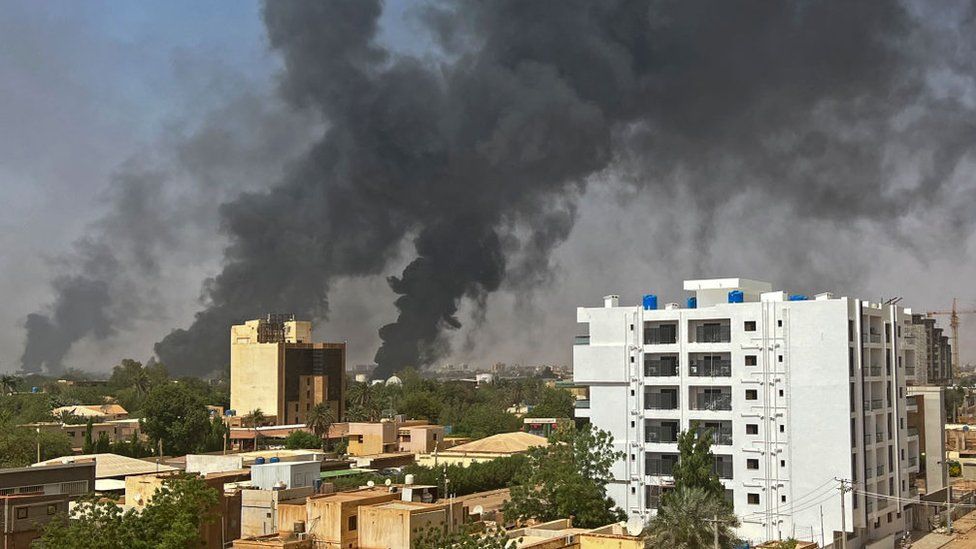
Both sides claimed to control key sites in Khartoum, where residents sheltered from explosions.

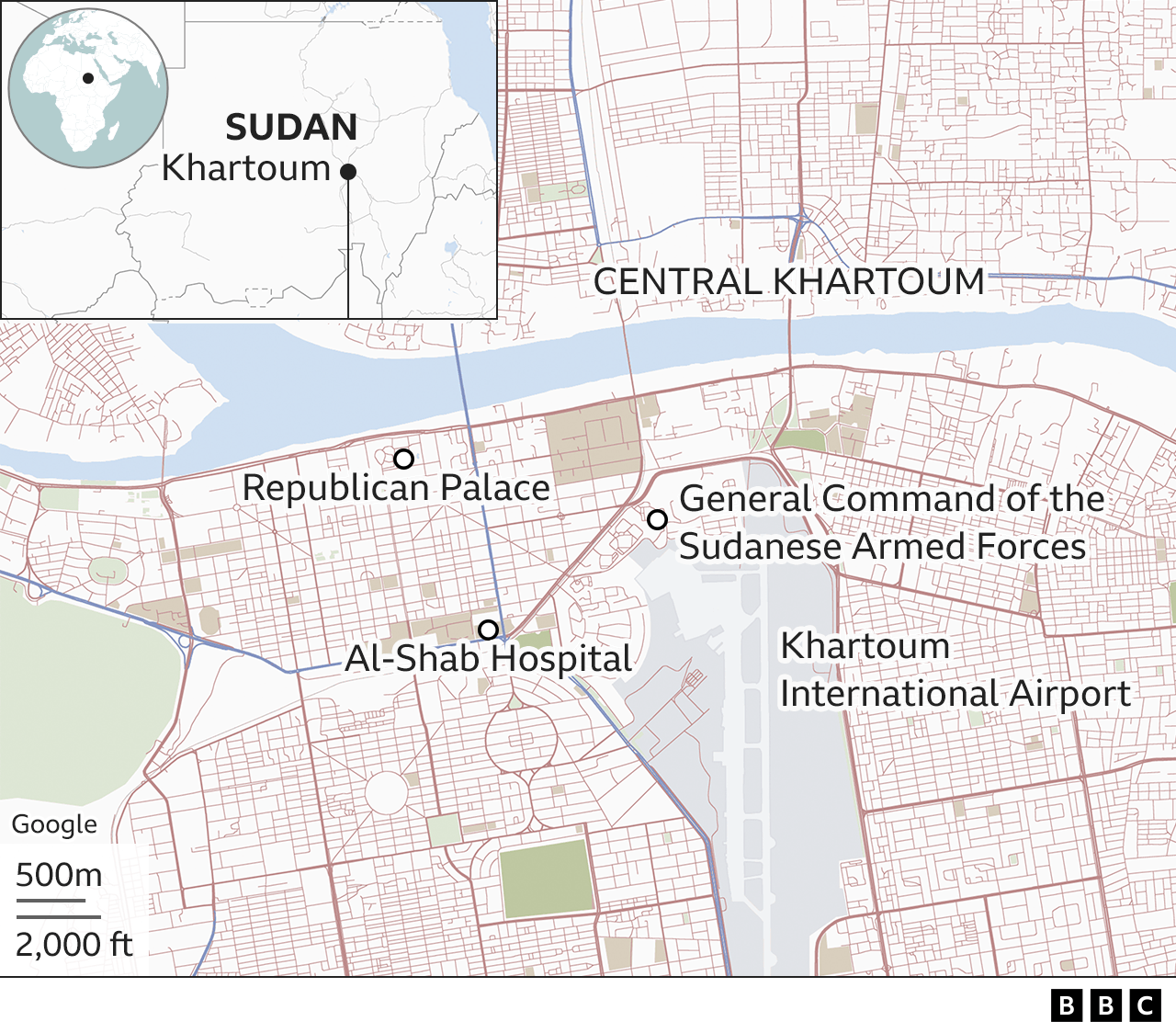
The Sudan Doctors' Trade Union says there has been severe damage to al-Shab Teaching Hospital in Khartoum, along with two other hospitals, caused by clashes and "mutual shelling".

It called the attacks a violation of international law.

More than 1,800 civilians and fighters have been injured according to Volker Perthes, the UN envoy for Sudan. He also put the death toll at 185 people on Monday, higher than the doctors' union.

The two sides held a brief ceasefire on Sunday to allow the wounded to be evacuated, although it was not clear how strictly they stuck to it.

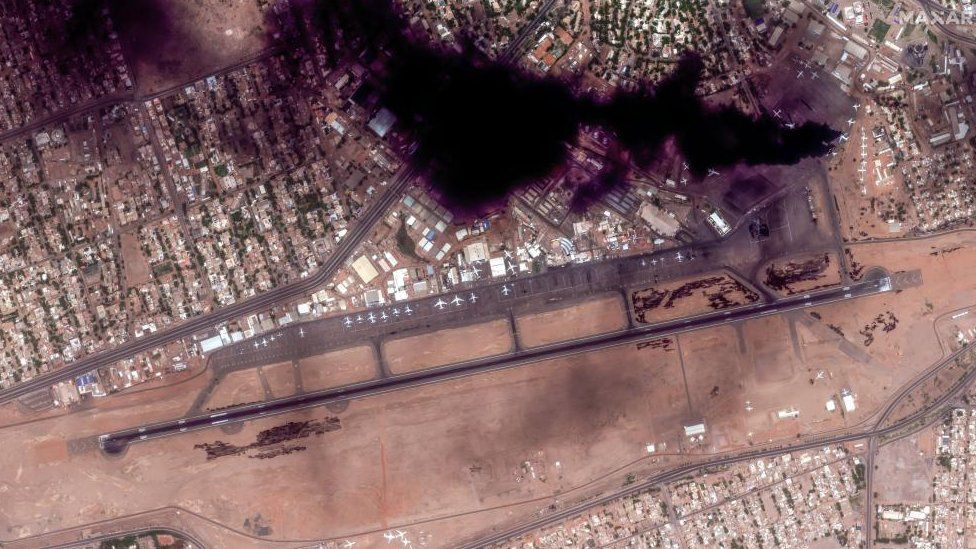
On Monday, clouds of smoke were visible above Khartoum's main airport, with TV showing images of fires and explosions. Army air strikes targeted RSF bases, some of which are embedded in residential areas.

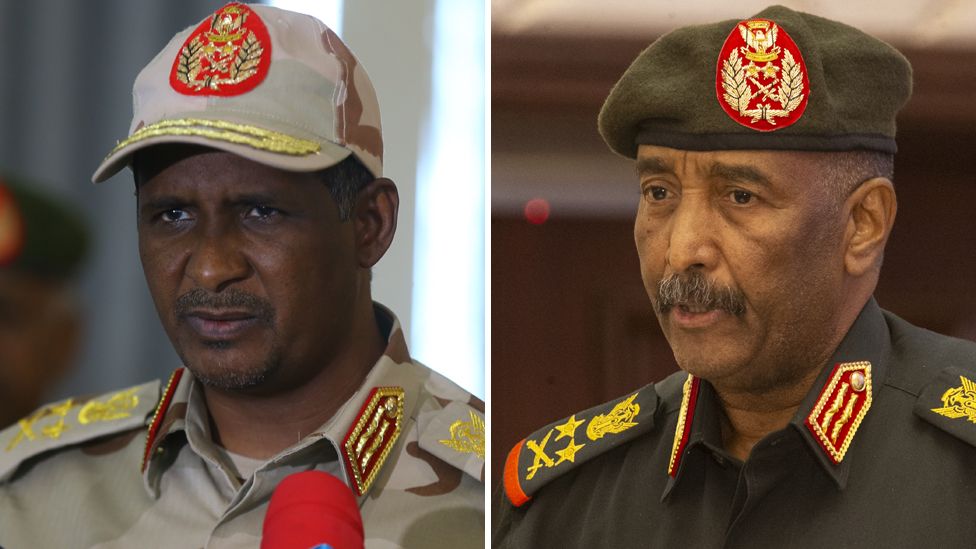
The fighting is between army units loyal to the de facto leader, Gen Abdel Fattah al-Burhan, and the RSF, a notorious paramilitary force commanded by Sudan's deputy leader, Mohamed Hamdan Dagalo, better known as Hemedti.

He said on Monday that the international community must intervene, and branded Gen Burhan "a radical Islamist who is bombing civilians from the air". Gen Burhan has said he is willing to negotiate.

Alarmed neighbours Kenya, South Sudan and Djibouti are planning to send their presidents to help mediate in the crisis, however this is not currently possible because the airport is closed.

The US, EU and UK have called for an immediate end to the fighting.

There has been fierce fighting around the country's seat of power, the Republican Palace. The army says it remains in control of all its bases, including its Khartoum headquarters, where heavy weapons have been used during intense clashes.

The sound of gunfire and explosions has hardly stopped since Saturday morning. One estimate put the number of injured at 1,100.

Beyond the capital, the army says it is in control of eastern parts of the country and the key Red Sea port of Port Sudan. But fighting is continuing in Darfur, where the RSF is strong, and also in Kordofan in the south.

line

Sudan: The basics

  • Sudan is in north-east Africa and has a history of instability: The military toppled long-time leader Omar al-Bashir in 2019 after mass protests
  • It then overthrew a power-sharing government in 2021, putting two men at the helm: The head of the army and his deputy, who is also the head of a paramilitary group called the RSF
  • They disagree on how to restore civilian rule to Sudan: The RSF leader claims to represent marginalised groups against the country's elites but his forces were accused of ethnic cleansing
line

Sudan state TV is now back on air and broadcasting pro-army songs and anthems, after many hours without transmission.

The internet is still up and running - no doubt because the military wants to make sure their version of events and their propaganda narrative out, suggests BBC Sudan analyst James Copnall.

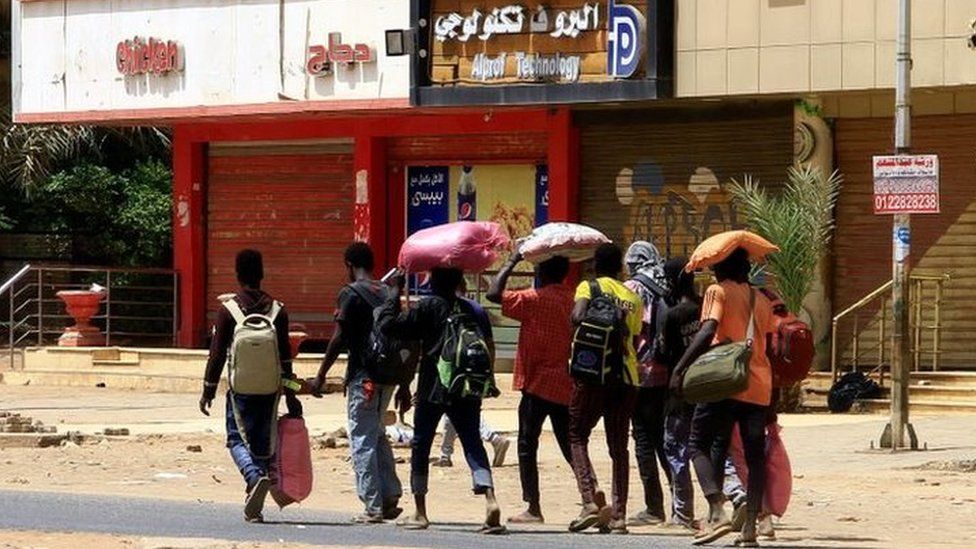
But electricity is down in many places and water supplies to homes have been cut, leaving terrified residents no choice but to venture onto Khartoum's streets in search of drinking water.

One group of students trapped inside the headquarters of an oil company in Khartoum by heavy fighting told the BBC that they has not had food or water in three days.

Speaking on Monday, one student said the group were trapped "in the middle of a heavy firefight", while another said air force jets were constantly bombing the area and "flying strikes from above".

Sudan is a majority-Muslim country and the fighting has brought an abrupt end to the kind of outdoor socialising that usually happens during Ramadan after the day-time fast is broken.

On Sunday and early Monday, the RSF claimed to occupy sites in Khartoum such as the presidential palace.

But some accounts indicated that the army had regained control of the airport, with the military saying they were dealing with "small pockets of rebels".

The army previously denied that the RSF had seized key sites in the capital, and witnesses in the country told Reuters news agency that the army appeared to be making gains after blasting RSF bases with air strikes.

Residents of Khartoum have spoken of fear and panic, and reported gunfire and explosions.

"We live on a rooftop on the third floor and the airplanes fly really close to the roofs and its terrifying," Duaa Tariq told the BBC. She said she was running out of food and water.

Another Khartoum resident, Kholood Khair, said residents could not be sure of safety anywhere. "All civilians have been urged to stay at home, but that has not kept everyone safe."

The major sticking points between the army and RSF are over the plans to incorporate the 100,000-strong RSF into the army, and over who would then lead the new force.

A chorus of international voices has called for a permanent end to the violence.

Leading Arab states and the US have also urged a resumption of talks aimed at restoring a civilian government, while the African Union has announced that it is sending its top diplomat, Moussa Faki Mahamat, to try to negotiate a ceasefire.

Egypt and South Sudan also offered to mediate between the warring factions, according to a statement by the Egyptian presidency.

Satellite image showing smoke over Khartoum 
Image source, Maxar Technologies
Image caption,
Thick black smoke was seen over Khartoum (satellite image ©2023 Maxar Technologies)

Death toll estimates have varied.

The Central Committee of Sudan Doctors reported 97 civilians killed and dozens among security forces dead, as well as 942 people injured.

Meanwhile, the World Health Organization says more than 83 people have been killed and more than 1,100 people injured across the country since Thursday, when the RSF began mobilising its forces. It does not specify how many civilians have died in the fighting.

Among the dead are three staff members of the UN World Food Programme (WFP), which has suspended its operations in the country.

In a statement, the WFP said it was "horrified" by the news of the deaths, adding that one of its aircraft had been damaged at Khartoum airport during an exchange of gunfire on Saturday, which it says impacted its ability to provide aid.

Map of key sites in Khartoum

Additional reporting by Robert Plummer and Mattea Bubalo

Related Topics

More on this story

Κυριακή 7 Αυγούστου 2022

Christianity, Nationalism and Racism


Photo: Bishop Innocentios of Burundi and Rwanda (of Africa) during a pilgrimage by Orthodox African Christians to the mountains of the Caucasus to honour Saint Nina who, during the 4th century had brought Christianity to the land of Georgia (from here)

Ελληνικά: Χριστιανισμός, εθνικισμός και ρατσισμός

By Theodore J. Rigniotes, Theologian

Translate A.N.

Ours is an age of panic:  with an economic crisis that increasingly impacts the weakest... with mental stress intensified by the (with or without quotation marks) pandemic... with a serious deficit in the State’s presence in support of the citizen... with various external threats (for example, even from neighbouring lands) and a host of other thorny issues... all test our patience and our endurance by shredding people’s dignity and jeopardizing the sense of security that they should be feeling - not only within their own country, but even as an immigrant in any “free” (whatever that may imply) and well-governed country.

No-one can even be sure that tomorrow it will be possible to switch on the light, have water in our glass and food on our plate... not to mention free healthcare and education, permanent jobs, etc. (these are becoming increasingly forgotten items).  There is also no certainty if people are actually being tracked by technology every minute, or being “sprayed” with unknown materials, or if humans have already been turned into faceless numbers of an electronic hyper-system, which can imminently direct their daily lives upon the decisions made by certain powerful individuals and in disregard if such things were desired or approved.

Of course there are thousands of fellow human beings who have already been deprived of all these basic needs (even potable water and daily nourishment!), which we, the “many”, have for decades taken for granted. But, being increasingly informed by the mass media and the bills that are sent to consumers every month, these important commodities are no longer self-evident.

As in every time of panic, so today, conditions have favoured the emergence of extreme political tendencies that promise the people liberation from their painful shackles. This is the reason one sees Nazist groups and extreme-right parties infiltrating Parliament and their ideas finding followers - even among people who do not vote for them.

Among other things, Christianity is also being turned into an element of political ideology. This can be expected, inasmuch as Christianity also possesses a social message (which is automatically a political message as well), but also because in the past, the Christian faith has often inspired the liberating revolutions – not only by the Greek populace, but also by other peoples of the world.

So, it looks like we are becoming politicized as Christians.  However, one must never forget that Christianity is primarily a spiritual matter.  Regrettably, in the recent past it had been misused as the (governing) dictatorship’s crutch... Likewise, during the Middle Ages it was twisted into a means of terrorizing and oppressing the Western European peoples by the so-called “Roman Catholic Church”, as well as by the kings of Europe. This is why care and awareness are imperative, that Christianity cannot be turned into a political faction, but rather should be inspiring a political stance for the benefit of the people. The viewpoint that Christianity should not be expressed publicly is not only erroneous; it is also suspicious, because the underpinning of Christianity is both revolutionary and liberating.

The political stance inspired by authentic Christianity is characterized by justice, charity towards all people (even criminals), respect towards every person, selflessness, and willingness for self-sacrifice and self-offering.

Most certainly a Christian (whether politicized or not) cannot remain apathetic towards issues such as social injustice, economic impoverishment, the exploitation of workers (even the major Fathers of the Church, such as the Three Hierarchs who had openly expressed a vehement critique against the authorities of their time, had risked their very lives in doing so!), but also towards issues which at first sight do not seem political - such as the humiliation of the human body by transforming it into a sexual object, and the bombardment with messages of violence and frenzy festering especially within the generation of teenagers (but also of children) through “entertainment” mediums that include scenes of murder and torture, stories of horror and cannibalism, monstrous and demonic “heroes”, etc. These items – and many others unfortunately! – have already shown their bitter fruits, both in the lives of young people but also in entire families and in society as a whole.

Reprehensible extremes

Reprehensible extremes incompatible with the Christian faith, which are nevertheless often muddled when ideologically labelled as “Christianity” (causing confusion and aberrations), are ideas such as nationalism, racism, conditional acceptance of violence (against a guilty party for example) - even the acceptance of fascism of varying hues.

Nationalism and racism, under the inclusive term “ethno-phyletism”, have been explicitly condemned by the Orthodox Church in 1872, by decision of the Great Local Synod in Constantinople, on account of the Bulgarian nationalism at the time, which had turned the Orthodox Church of Bulgaria into a weapon of domination of the peoples living in northern Greece’s Turk-occupied Macedonia and Thrace - which had triggered the Macedonian Struggle around 1900, with the participation of many Cretans also. This was of course preceded by the Greek nationalist movement by the Bavarians who ruled Greece in 1833 and had excised the Church of Greece from the Ecumenical Patriarchate - which finally recognized it by making it an Autocephalous (self-governing) Church.

Nowadays similar trends have been observed in certain places (i.e. newly pronounced, pseudo “States”), where an approving stance of the Ecumenical Patriarchate towards groups such as the nationalist charactered “Churches” of the Ukraine and the “Macedonian Church” in Skopje, which, from their non-canonical and marginal (schismatic) status were arbitrarily declared as canonical, legal Churches of those regions, AND autocephalous (=not dependent on any Patriarchate or any other, local Orthodox Church). Only God knows what the long-term consequences of this practice will be: therapeutic, or traumatic?

It would be useful to mention here the condemnation of negro slavery in the USA by the Ecumenical Patriarch Joachim II in 1862 (with an article of his in the Ecumenical Patriarchate’s magazine “Eastern Star”, republished in America), as well as the move by the Orthodox Archbishop Iakovos of America who had gone to Selma, Alabama and had stood by Martin Luther King for the second black rights demonstration march in March of 1965.

Apart from the above, it should be stressed that Greeks who embrace their cultural tradition should not be nationalists. “Philopatrids” – that is, patriots with a love for their homeland – yes; but not nationalists. 

Nationalism is the fruit of the efforts by Western European peoples to liberate themselves from the feudalism and the oppressive empires that were robbing them of their very lives.  The people of Greece had faced this problem too, during the centuries-long Turkish occupation; but until that time (or even during that time) they had belonged uninterruptedly for entire centuries to a multinational society that preserved individual and particular cultures and Histories, but whose members were united by common moral values ​​and common ideals. This society was the Christian Romaic Empire (or “Romania” as it was called during the last centuries of its history) – whose general description came to prevail as “Byzantium”.

Because of the name “Romania” (from which is also derived the name of the country of Romania), all the descendants of the “Byzantines” are characterized as “Romans”, while the totality of all the peoples who were once “Byzantines” is characterized as “Romanity”. (Note: “Romanity” is also the title of the much-sung rendition of the poem by Yannis Ritsos and the music by Mikis Theodorakis). Its message is Christian, but not nationalist.  “Roman” refers to every Orthodox Christian - not only of the Balkans, but also of Turkey (for example Saint Ahmed the Calligrapher, who was martyred by the Ottoman state for converting to Christianity), also Saint John of Damascus of Syria, Saint Makarios of Egypt, Martyrs of Palestine and of many other peoples. This had also been the aim of the major, exceptionally important Greek idealist, Rigas Feraios.

All Orthodox Christians are one with these - just as they are one with every Orthodox Christian of all peoples, wherever on earth (from Uganda for example to Alaska - and of course even to Russia, Ukraine, etc. – hence our grief being double over the current Russo-Ukrainian conflict), as they are all united by the Common Chalice of Holy Communion, which no-one is allowed to deprive us of - regardless if it is attempted in the name of fear, say, of a certain pandemic or for any other reason...

Although not united by the Common Chalice with other Christian groups and the faithful of other religions, we are however united in the teachings of Jesus Christ about love towards all people – and this is something that should never, ever be forgotten.

Romanity is “ecumenical” – inasmuch as it aspires to embrace all peoples in the world - but at the same time is opposed to the orientation of contemporary Globalization, which primarily aspires to self-interest (=looking out for one’s own interests) and is in the hands of powerful economic and political factors, who are anything but concerned with bringing man closer to God, which is the most important element and the most desirable aim in the life of Christians.

In political terms, Globalization is by nature colonialist. Romanity is its exact opposite.

As for conditional violence (with slogans such as “hang them in the public square!” as a reaction to criminals such as paedophiles, rapists, drug dealers etc. - even politicians), it seems quite clear that such behaviour does not befit people who simultaneously wish to be proper Orthodox Christians. Of course convictions, restraints and imprisonments of criminals are necessary – especially those guilty of heinous crimes!  However such condemnations should not be vindictive while simultaneously claiming to be proper Christians!. They should aspire to protect society and to rehabilitate – that is, to correct (if and where possible) the guilty parties.

It is understandably very difficult – even superhuman! – for one to defeat the natural human tendency towards hatred and revenge. However, a Christian should not be a “natural” person, but a “supernatural” one. We must all be human beings that rise above the earth heavenward to become angels... indeed more than angels – and become “children of God”.  It is the reason that Christ Himself (the only-begotten Son of God) had taught us to recite the Lord’s Prayer:  “Our Father...” as if we too are like Christ: as sons and daughters of God.  We should pay careful attention to this detail and at least strive to honour it.


Πέμπτη 23 Ιουνίου 2022

URGENT! Tanzania: Stop the Maasai evictions!

 
URGENT: Maasai people are at risk of being violently evicted from their lands to make way for trophy hunting and elite tourism - this cannot be allowed to happen.
Join the call on President Samia Suluhu Hassan to end the violence and stop all evictions now!
Help us spread the word - Share this video!

We are Maasai elders from Northern Tanzania. Right now tens of thousands of our community could be forced off our ancestral lands to make way for elite tourism and trophy hunting.

We urgently need your support.

When we faced these threats in 2014, more than 2 million Avaaz members rallied behind our call! Together, we created such a storm that the President promised never to evict us from our lands.

But now, there’s a new head of state and plans are being revived! President Samia Suluhu Hassan may not listen to us, but we know she’ll respond to media and public pressure – to all of you! With two key high-level meetings in the region next week we only have days to deliver our global call again. Join us now – and show her the world is standing with the Maasai!

- The Maasai elders of Ngorongoro District in Northern Tanzania 
 
To the President of Tanzania Samia Suluhu Hassan:
As citizens from around the world, we call on you to oppose any attempt to evict Maasai from their traditional land or require them to relocate to make way for foreign hunters. We are counting on you to be a champion for your people and stop any attempt to change their land rights against their will.

Click here!

Δευτέρα 11 Οκτωβρίου 2021

Social media blackout, violent crackdown on opposition ahead of presidential elections in Uganda

With just hours ahead of the highly anticipated January 14 presidential election in Uganda, the Ugandan Communication Commission (UCC) directed telecommunications service providers to switch off all social networks and messaging applications.  

UPDATE: A total internet shutdown was registered across Uganda by 7 pm EST on Wednesday, January 13, reports Netblocks.

This election could potentially see an end to President Yoweri Museveni’s 35-year, 5-term rule — or extend it for another five years. Musician turned politician, Robert Ssentamu, 38, widely known by his stage name, Bobi Wine, is the major opposition contender against the 76-year-old Museveni in this election. 

Internet monitor Netblocks confirmed that “a lengthy list of pre-selected social websites” like Twitter, Facebook, WhatsApp, Instagram, Snapchat, Skype, Viber, Google Play Store, were affected by the digital blackout. 

The digital blackout has left Ugandans grappling with virtual private networks (VPNs) as the only option to remain online. 

However, the government's blockingmore than 100 (VPNs)” in the country, makes it more arduous for citizens to circumvent the internet shut down, says Access Now, an international advocacy group. 

On January 12, Facebook shut down several accounts belonging to the Citizens Interaction Center of the Ugandan Information Ministry for using “fake and duplicate accounts” to promote the National Resistance Movement (NRM) ruling party, the BBC reports. President Museveni criticized the “arrogance” of Facebook for “deciding who is good or bad” in Uganda. 

This is not the first time Museveni’s government has yanked away the internet or repressed online freedom of expression. 

During the 2016 general elections, the government shutdown social media platforms with reasons related to curtailing propaganda and security. In 2017, the government introduced a monthly $2 USD “over the top”(OTT) communication social media tax to curtail people from gossiping on social networks. The 2016 digital blackout introduced many people to the use of VPN networks in order to access the service.

Violent intimidation of opposition’s campaign 


Bobi Wine (right) talking with a lawyer. Image by Mbowasport, August 8, 2019, released to Wikimedia (CC BY-SA 4.0) license.

Bobi Wine, Uganda’s main opposition presidential contender, rose to political fame following his election to parliament in 2017. Wine played an instrumental role in resisting the lifting of the constitutional presidential age limit that paved the way for Museveni’s tenure elongation. 

For the past two months, political campaigns have been rife with violence exacerbated by the Ugandan army and police, who weaponized COVID-19 to repress the opposition.  Opposition politicians were prevented access to districts and campaign venues on the pretense of violating the Health Ministry’s COVID-19 protocols that barred any gathering with more than 200 people. 

The opposition continuously argued that the time allocated to the campaigns would not enable them to traverse all four administrative regions of the country. They also argued that they abided by the restrictions but could not control the actions of citizens who are “hungry for change” and came out to rally in large numbers. On November 18, Bobi Wine and Patrick Amuriat, of the Forum For Democratic Change (FDC) party, were arrested, which sparked riots that left more than 50 people dead. Both politicians, charged for violating anti-coronavirus measures while campaigning, were released on November 25, 2020. 

With just hours before the election, most members of Bobi Wine’s campaign team, including his singing partner, Nubian Li, are still remanded in a military barracks jail following their arrest on January 4, in the Lake Victoria islands of Kalangala, a venue of a scheduled campaign. 

On December 26, 2020, the Electoral Commission also banned campaigns in 13 districts, including the capital Kampala, and its buffer districts of Wakiso and Mukono, making it hard for opposition politicians to access the citizens in those areas. They criticized the president for continuing to launch development projects like road and hospital construction in the same districts where opposition members were not allowed to carry out their activities. 

In a statement issued on Facebook, Bobi Wine said: 

They have been surprised and scared to the teeth by the massive support we have received everywhere, including Museveni's backyard in Kiruhura and Kazo…Now, they have suspended campaigns in districts where they think people will show up in tens of thousands! Of course they had to add some other districts in order to sanitize their panicky actions.

Barred from access to voters in those districts, Bobi Wine turned to digital media to reach out to citizens by recording a song entitled, “Tulonde” which means “Let’s Vote” in the Luganda language. In the same song, he narrates the campaign journey that has been characterized by bullets, teargas, deaths and arrests, including his arrest immediately after nomination. 

The Electoral Commission also failed to confirm Bobi Wine’s final week’s campaign schedule hence stopping him from accessing the electorate. 

On January 12, Bobi Wine tweeted that Ugandan security operatives raided his home, arrested his personal assistant and security guards: 

The violence was not only reserved for opposition politicians. 

Journalists covering the campaigns have also been brutalized by the police. But Police Chief Martin Okoth Ochola was unapologetic, stating that “when we tell a journalist, don't go there and you insist on going where there is danger, we shall beat you for your own safety. I have no apology,” reports the Monitor, a Ugandan daily.     

The US Embassy in Uganda, on January 13, canceled their election observer missions because the Uganda electoral umpire denied accreditation for “more than 75 percent” of their election observers. Similarly, only journalists in “good working terms with the government” have been accredited to cover the elections. 

There was visible heavy deployment of the soldiers in most parts of the country on January 12, with Museveni saying that the opposition wants to create chaos after the elections. 

The three opposition parties — Bobi Wine’s National Unity Platform (NUP), Patrick Amuriat’s Forum For Democratic Change and General Mugisha Muntu’s Alliance for National Transformation —had, on January 12, made a joint commitment to push against voter fraud and election-rigging. 

The prevailing evidence points to unequal contests between “millions of young people demanding reform and a say in their future” and “a small cadre of tyrants committed to retaining power at all costs,” asserts Wine in an op-ed in Foreign Affairs.  

But “government crackdowns on the opposition in many cases violently or through arbitrary arrests may help tilt the scales in Museveni’s favor,” says the United States Institute for Peace. 

Consequently, a lot depends on the international community to impress on Museveni to hold free, fair and credible elections.