Εμφάνιση αναρτήσεων με ετικέτα Orthodox Burundi. Εμφάνιση όλων των αναρτήσεων

Τετάρτη 29 Ιουνίου 2022

Pourquoi Pierre et Paul sont fêtés le même jour ?

Icône sainte des saints Pierre et Paul du Burundi

The metropolitan of Burundi and Rwanda wishes many years those who are celebrating their name day of Saints Peter and Paul

Pere Basile Bonane

fr.aleteia.org

La solennité des saints Pierre et Paul, le 29 juin, permet de faire mémoire des martyrs de deux des apôtres parmi les plus importants du christianisme, dont les destins hors du commun ont été liés par une finalité commune.

« Rappelez-vous la parole que je vous ai dite : un serviteur n’est pas plus grand que son maître. Si l’on m’a persécuté, on vous persécutera, vous aussi. Si l’on a gardé ma parole, on gardera aussi la vôtre ». C’est avec ces paroles rapportées par l’Évangile de Jean (Jn 15, 20) que Jésus annonce à ses disciples l’importance du martyr des premiers chrétiens. Parmi les douze présents, seuls deux ne le connaîtront pas : Judas Iscariote (Mt 27, 5), et Jean, « le disciple bien-aimé », à qui Dieu permet de vivre longtemps et de mourir sur l’île de Patmos, après la rédaction de l’Apocalypse. Parmi ces morts, l’une devait rendre particulièrement gloire à Dieu, celle de Pierre (Jn 21, 19). Les Évangiles ne précisent néanmoins pas que l’une des raisons à cela est que l’apôtre a partagé son destin avec Paul, à Rome. 

Deux piliers de l’Église

Pour rappel, simple pêcheur, Simon rebaptisé « Kephas » ou Pierre par Jésus, est appelé avec son frère André à suivre le Seigneur sur le bord du lac de Tibériade. Un événement qui provoque un complet bouleversement en lui. Jésus ira jusqu’à lui dire : « Tu es Pierre, et sur cette pierre je bâtirai mon Église ; et la puissance de la Mort ne l’emportera pas sur elle » (Mt 16, 18). Persécuteur des premiers chrétiens et citoyen romain, Saul, devenu Paul, se convertit sur la route de Damas, grâce à une apparition de Jésus (Ac 9, 3-18). Il se consacre alors à l’évangélisation et se fait connaître comme « apôtre des gentils » (des non-juifs) ou « des Nations ». Tous les deux jouent un rôle décisif dans la fondation de l’Église.

En l’an 50 se tient le fameux « concile de Jérusalem ». Rapporté par le quinzième chapitre des Actes des Apôtres, il porte sur l’ouverture des juifs chrétiens aux païens. La discussion a lieu en réalité entre trois hommes : Jacques le juste, surnommé « le frère du Seigneur » (Ga 1, 19), qui dirige l’assemblée, Pierre et Paul. Cet événement, qui fixe le rôle de la loi et celui du Christ dans le salut, est essentiel dans la fondation de l’Église universelle, qui dépasse les simples juifs. Leurs destins vont alors se séparer pour se recroiser une dizaine d’années plus tard.En 64, Rome est incendié. L’empereur Néron, souvent soupçonné d’en être l’auteur, profite de la tragédie pour persécuter les chrétiens, déclarés coupables. « On livra aux supplices les chrétiens, sorte de gens adonnés à une superstition nouvelle et dangereuse », explique-t-il. 

L’évêque de Rome, Pierre, et Paul, qui se trouvent alors à Éphèse, sont arrêtés. Si la tradition chrétienne relie cet épisode à celui du Grand incendie, d’autres sources, comme la lettre de Clément de Rome, s’y opposent. Qu’importe, les deux apôtres comparaissent devant Néron, qui les condamne. Les deux hommes sont enfermés au Carcer Tullianum, légendaire prison qui a déjà neuf siècles, et qui a vu passer de célèbres prisonniers, comme Vercingétorix, après la prise des Gaules. Pierre et Paul périssent tous deux vers l’an 67. Selon un apocryphe, les Actes de Pierre, l’évêque de Rome refuse par humilité de mourir comme le Christ ; il est alors crucifié la tête à l’envers. Paul, lui, est décapité. Deux morts différentes, pour une même finalité : l’avènement de l’Église.

Πέμπτη 21 Απριλίου 2022

Bujumbura 2022, Burundi – Accra, Ghana : Sacrement de l'huile sainte – la trahison de Judas, la manifestation de l’humilité du Seigneur et la Cène mystique (Jeudi Saint)


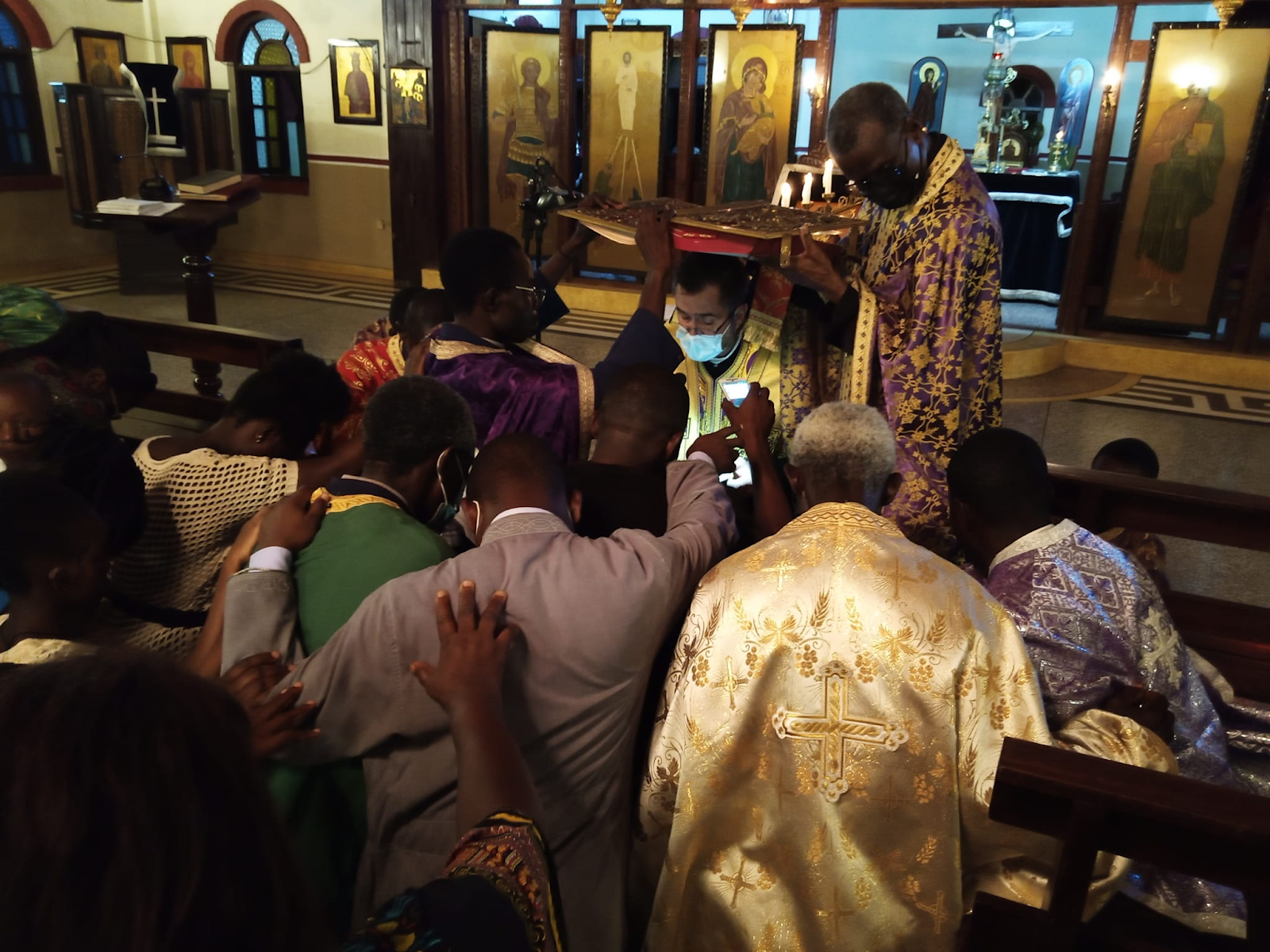
Aujourd'hui Mercredi soir sous la bénédiction de notre Père Spirituel Innocentios Byakatonda , nous avons une prière pour bénir l'huile pour les diverses maladies. Bujumbura 2022.
OFFICE ET SACREMENT DE L’HUILE SAINTE
Maître et Seigneur qui, dans ta miséricorde et ton amour, guéris les meurtrissures de nos âmes et de nos corps, sanctifie cette huile pour qu’elle serve de remède à ceux qui en seront oints et qu’elle les délivre de toute souffrance, de toute souillure de la chair et de l’esprit, et de tout mal ; afin qu’en cela aussi soit glorifié ton nom très-saint, Père, Fils et Saint Esprit, maintenant et toujours, et dans les siècles des siècles.
Amen.

https://www.facebook.com/PereBasileBonane


Sacrement de l'huile sainte, Accra, Ghana (d'ici)

Jeudi Saint, la Cène mystique du Seigneur
 

Parlons d'orthodoxie
La liturgie du Jeudi Saint se compose, dans la tradition byzantine, de trois grands offices : les matines, le rite du lavement des pieds – réservé au rituel pontifical – et les vêpres avec la liturgie de Saint-Basile.
Trois événements sont au centre de la liturgie de ce jour : la trahison de Judas, la manifestation de l’humilité du Seigneur et la Cène avec les disciples, appelée dans la tradition orthodoxe « repas mystique ».
Aucune autre fête, pas même celle de la Nativité, n’est dotée de prières aussi riches sur le plan christologique que le Jeudi Saint. C’est au soir de la Pâque juive, au cours du repas rituel commémorant la sortie d’Égypte du peuple hébreu, que le Roi d’Israël se fait connaître à ses disciples et découvre la nature véritable de son alliance avec l’humanité.
Ainsi, le dernier dîner du Seigneur avec les apôtres est non seulement mystique, mais aussi mystagogique.
« Lors de ce dîner, tu as révélé aux initiés l’immense mystère de ton incarnation » : l’incarnation de Dieu est l’alliance éternelle que Dieu promettait à Abraham et qu’il a enfin accomplie à la fin des temps.
 

Τετάρτη 23 Φεβρουαρίου 2022

Preot burundez: Am găsit în Biserica ortodoxă tot ceea ce aveam nevoie - Despre sistemul educațional


"Burundian priest: I found in the Orthodox Church everything I needed..."

Pr. Prof. Epifanie predă franceză și kirundi și mai rar, engleză. Împreună cu dna. preoteasă, părintele are 4 copii și un prunc înfiat de la fratele său mai mic. Cum a ajuns să fie profesor, să studieze seminarul și cum s-a convertit de la catolicism la ortodoxie. Când a vrut să studieze mai multe în biblioteca seminarului catolic, a fost refuzat pe motiv că nu are studii teologice. De aici a început o căutare pe cont propriu care a dus către credința cea adevărată. A refuzat postul de director al școlii pentru a se dedica mai mult misiunii de preot.

Στον Ορθόδοξο Αμπελώνα της Αφρικής


Παρασκευή 7 Ιανουαρίου 2022

"The Holy Epiphany. The day that Light defeated Erebus!"


Egypt (Cairo)

The Hymns from  

Prokimenon (Tone 4)
The sea beheld it and fled; the Jordan flowed back to its source.

What was it, O sea, that made you flee; and you, Jordan, that made you to reverse your flow?

Matins Gospel - Mark 1:9-11
"At that time, it happened in those days that Jesus came from Nazareth of Galilee and was baptized in the Jordan by John. On coming up out of the water He saw the heavens being torn open and the Spirit, like a dove, descending upon him. And a voice came from the heavens, 'You are My beloved Son; and with You I am well pleased."

Today let all the things greatly rejoice: Christ has appeared in the Jordan!

#Hypacoi (Tone 2)
When You enlightened all things at the time of Your manifestation, the sea of unbelief ebbed away and the Jordan River reversed its course, flowing uphill and carrying us to Heaven. Through the prayers of Your Mother, O Christ God, keep us in the loftiness of Your divine commands and save us.


Orthodox Diocese of Gulu and Eastern Uganda


Uganda Orthodox Church - Holy Metropolis of Kampala


#Kontakion of #Epiphany (Tone 3)
Today You have appeared, O Lord, to the universe, and your light, O Christ our God, has been impressed upon us who sing to You with full knowledge. You came and appeared, O Inaccessible Light!

#Exapostilarion (Tone 3)
In the streams of the Jordan, the Savior has appeared to us, full of grace and truth. He enlightens those who sleep in darkness and the shadow of death; for the Light that no man can approach has come and is made manifest. (3 times)

Neo K Neofitos


#Troparion of Epiphany (Tone 1)

At Your Baptism in the Jordan, O Lord, the worship of the Trinity was revealed. For the Father's voice bore witness to You by calling You His beloved Son; and the Spirit in the form of a dove confirmed the truth of these words. O Christ God who have appeared to us and enlightened the world, glory to You!

Epistle Reading - Titus 2:11-14;3:4-7
Gospel Reading - Matthew 3:13-17


The Baptism of Jesus (icon from here)

13 Then Jesus came from Galilee to the Jordan to be baptized by John. 14 But John tried to deter him, saying, “I need to be baptized by you, and do you come to me?”

15 Jesus replied, “Let it be so now; it is proper for us to do this to fulfill all righteousness.” Then John consented.

16 As soon as Jesus was baptized, he went up out of the water. At that moment heaven was opened, and he saw the Spirit of God descending like a dove and alighting on him. 17 And a voice from heaven said, “This is my Son, whom I love; with him I am well pleased.”

January 7, Synaxis of the Holy Glorious Prophet, Forerunner and Baptist John

John 1:29-34


John Testifies About Jesus (icon from here)

29 The next day John saw Jesus coming toward him and said, “Look, the Lamb of God, who takes away the sin of the world! 30 This is the one I meant when I said, ‘A man who comes after me has surpassed me because he was before me.’ 31 I myself did not know him, but the reason I came baptizing with water was that he might be revealed to Israel.”

32 Then John gave this testimony: “I saw the Spirit come down from heaven as a dove and remain on him. 33 And I myself did not know him, but the one who sent me to baptize with water told me, ‘The man on whom you see the Spirit come down and remain is the one who will baptize with the Holy Spirit.’ 34 I have seen and I testify that this is God’s Chosen One.

*****

Eglise Orthodoxe de Côte d'ivoire

 Bonne Fête de la Theophanie de notre Seigneur Dieu et Sauveur Jésus
Καλή εορτή των Θεοφανίων του Κυρίου Θεού και Σωτήρος ημών Ιησού
Happy Feast of Theophany of our Lord God and Savior Jesus
С праздником Богоявления Господа нашего Бога и Спасителя Иисуса
عيد ميلاد سعيد لظهور الرب إلهنا ومخلصنا يسوع
გილოცავთ უფლისა ჩვენისა ღმერთისა და მაცხოვრისა იესოს ნათლისღების დღესასწაულს
Sărbătoare fericită a Teofaniei Domnului nostru Dumnezeu și Mântuitorului Isus

*****

Synaxis of the Holy Glorious Prophet, Forerunner and Baptist John 


In the Orthodox Church it is customary, on the day following the Great Feasts of the Lord and the Mother of God, to remember those saints who participated directly in the sacred event. So, on the day following the Theophany of the Lord, the Church honors the one who participated directly in the Baptism of Christ, placing his own hand upon the head of the Savior.

Saint John, the holy Forerunner and Baptist of the Lord, whom the Lord called the greatest of the prophets, concludes the history of the Old Testament and opens the era of the New Testament. The holy Prophet John bore witness to the Only-Begotten Son of God, incarnate in the flesh. Saint John was accounted worthy to baptize Him in the waters of the Jordan, and he was a witness of the Theophany of the Most Holy Trinity on the day of the Savior’s Baptism.

The holy Prophet John, the son of the Priest Zachariah and Righteous Elizabeth, was related to the Lord on His mother’s side. The holy Forerunner, John, was born six months before Christ. The Archangel Gabriel announced his birth in the Temple at Jerusalem, revealing to Zachariah that a son was to be born to him.

Through the prayers offered beforehand, the child was filled with the Holy Spirit. Saint John prepared himself in the wilds of the desert for his great service by a strict life, by fasting, prayer and sympathy for the fate of God’s people.

At the age of thirty, he came forth preaching repentance. He appeared on the banks of the Jordan, to prepare the people by his preaching to accept the Savior of the world. In church hymnology, Saint John is called a “bright morning star,” whose gleaming outshone the brilliance of all the other stars, announcing the coming dawn of the day of grace, illumined with the light of the spiritual Sun, our Lord Jesus Christ.

Having baptized the sinless Lamb of God, Saint John soon died a martyr’s death, beheaded by the sword on orders of King Herod at the request of his daughter Salome. (On Saint John the Baptist, see Mt.3:1-16, 11:1-19, 14:1-12; Mark 1:2-8, 6:14-29; Luke 1:5-25, 39-80, 3:1-20, 7:18-35, 9:7-9; John 1:19-34, 3:22-26).

The Transfer of the Right Hand of the holy Forerunner from Antioch to Constantinople (956) and the Miracle of Saint John the Forerunner against the Hagarenes (Moslems) at Chios:

The body of Saint John the Baptist was buried in the Samaritan city of Sebaste. The holy Evangelist Luke, who went preaching Christ in various cities and towns, came to Sebaste, where they gave him the right hand of the holy Prophet John, the very hand with which he had baptized the Savior. The Evangelist Luke took it with him to his native city of Antioch.

When the Moslems seized Antioch centuries later, a deacon named Job brought the holy hand of the Forerunner from Antioch to Chalcedon. From there, on the eve of the Theophany of the Lord, it was transferred to Constantinople (956) and kept thereafter.

In the year 1200, the Russian pilgrim Dobrynya, who later became Saint Anthony, Archbishop of Novgorod (February 10), saw the right hand of the Forerunner in the imperial palace. From the Lives of the Saints we learn that in the year 1263, during the capture of Constantinople by the Crusaders, the emperor Baldwin gave one bone from the wrist of Saint John the Baptist to Ottonus de Cichon, who then gave it to a Cistercian abbey in France.

The right hand continued to be kept in Constantinople. And at the end of the fourteenth to the beginning of the fifteenth centuries, the holy relic was seen at Constantinople in the Peribleptos monastery by the Russian pilgrims Stephen of Novgorod, the deacon Ignatius, the cantor Alexander and the deacon Zosimus. When Constantinople fell to the Turks in 1453, sacred objects were gathered up at the the conqueror’s orders and kept under lock in the imperial treasury.

In the Lives of the Saints is clear testimony that in the year 1484 the right hand of the holy Forerunner was given away by the son of the Moslem sultan Bayazet to the knights of Rhodes to gain their good will, since a dangerous rival for Bayazet, his own brother, had allied himself with them. A contemporary participant, the vice-chancellor of Rhodes, Wilhelm Gaorsan Gallo, also speaks of this event. The knights of Rhodes, having established their base on the island of Malta (in the Mediterranean Sea), then transferred the sacred relic they had received to Malta.

When the Russian Tsar Paul I (1796-1801) became Grand Master of the Maltese Order in honor of the holy Prophet John, the right hand of the Baptist, part of the Life-Creating Cross and the Philermos Icon (October 12) of the Mother of God (from Mt Philermos on the island of Rhodes) were transferred in 1799 from the island of Malta to Russia [because of the Napoleonic threat], to the chapel at Gatchina (October 12). In the same year these sacred items were transferred into the church dedicated to the Icon of the Savior Not Made by Hands at the Winter Palace. A special service was composed for this Feast.

Besides the Synaxis of the honorable, glorious Prophet, Forerunner and Baptist John, the Russian Orthodox Church celebrates his memory on the following days: September 23, his Conception; June 24, his Nativity; August 29, his Beheading; February 24, the First and Second Finding of his Head; May 25, the Third Finding of his Head; October 12, the Transfer of his Right Hand from Malta to Gatchina (1799). 


Please, see also

Theophany 2018 in the Orthodox Diocese of Rwanda & Burundi (from here)
 

 Theophany, The Baptism of Jesus Christ - When the Holy Trinity appeared clearly for the first time  

Theophany – The Waters Were Afraid
 

“Theophany”, a manifestation of God to the world

God the Holy Trinity: ‘The Lover of Mankind’ (& the "depiction of God" in Orthodox Church)
 
God in Trinity - A Communion of Persons

Saint Syncletika of Alexandria, the First Great Holy Mother of the Egyprian Desert (Feast Day January 5) 

The Mystery of the Forerunner


Oxford Historians Find The Bones of St John the Baptist


Δευτέρα 3 Μαΐου 2021

Orthodox Easter 2021 in Africa!...


Icon from here
 
In the Orthodox Vineyard of Africa

Paraskevi Namuyanja


Ουγκάντα (Uganda)

Ιερά Μητρόπολη Αξώμης Αιθιοπίας - Holy Archdiocese of Aksum Ethiopia


Αιθιοπία (Ethiopia)

St Barnabas Orthodox Orphanage & School


Κένυα (Kenya)

Rev Themi & Friends

 
Σιέρρα Λεόνε (Sierra Leone)

Orthodox Metropolis of Zambia


Ζάμπια (Zambia)

Uganda Orthodox Church - Holy Metropolis of Kampala

 
Ουγκάντα (Uganda)

Orthodox Cathedral of The Resurrection of The Lord, Lagos


Νιγηρία (Nigeria)

Orthodox Metropolis Of Good Hope - Cape Town

 
Ν. Αφρική (South Africa)

Ελληνική Κοινότητα Καΐρου


Αίγυπτος (Egypt)

Ιεραποστολή στην Επισκοπή Τολιάρας και Νοτίου Μαδαγασκάρης


Μαδαγασκάρη (Madagascar)

Orthodox Diocese of Gulu and Eastern Uganda

 
Ουγκάντα (Uganda)

Neo K Neofitos


Κένυα (Kenya)

Innocentios Byakatonda

 
Μπουρούντι (Burundi)

Φίλοι Ιεραποστολής Μπουκόμπα Τανζανίας

 
Τανζανία (Tanzania)

Uganda Orthodox Church - Holy Metropolis of Kampala


Ουγκάντα (Uganda)

IMKanangas

 
Κονγκό (

Democratic Republic of the Congo)

Yieronda Makarios Tillyrides Kenyas

 
Κένυα (Kenya)

Randrianaivo Vacilios Frederic

 
Μαδαγασκάρη (Madagascar)

Uganda Orthodox Church - Holy Metropolis of Kampala

 
Ουγκάντα (Uganda)


XΡΙΣΤΟΣ ΑΝΕΣΤΗ! ΑΛΗΘΩΣ ΑΝΕΣΤΗ!
 

English - Christ is Risen! Indeed, He is Risen!
Old English (Anglo-Saxon) - Crist aras! Crist sodhlice aras! (Lit: Christ arose! Christ surely arose!)
Middle English - Crist is arisen! Arisen he sothe!
Iyaric Patwa - Krestos a uprisin! Seen, him a uprisin fe tru!
Frisian - Kristus is opstien! Wis is er opstien!
High German
German - Christus ist auferstanden! Er ist wahrhaftig auferstanden!
Yiddish - Der Meschiache undzer iz geshtanen! Avade er iz ufgeshtanen!
Low German
Dutch - Christus is opgestaan! Hij is waarlijk opgestaan!
Afrikaans - Kristus het opgestaan! Hom het waarlik opgestaan!
North Germanic languages
Danish - Kristus er opstanden! Sandelig Han er Opstanden!
Icelandic - Kristur er upprisinn! Hann er vissulega upprisinn!
Norwegian - Kristus er oppstanden! Han er sannelig oppstanden!
Swedish - Kristus är uppstånden! Ja, Han är verkligen uppstånden!
Italic languages
Latin - Christus resurrexit! Resurrexit vere!
Romance languages
Italian - Cristo è risorto! È veramente risorto!
Catalan - Crist ha ressuscitat! Veritablement ha ressuscitat!
French - Le Christ est ressuscité! Vraiment Il est ressuscité!
Portuguese - Cristo ressuscitou! Verdadeiramente ressuscitou!
Romanian - Hristos a înviat! Adevărat a înviat!
Spanish - Cristo ha resucitado! Verdaderamente, ha resucitado!
Slavic languages
Church Slavonic - (Christos Voskrese! Voistinu Voskrese!)
East
Russian - Христос Воскресе! Воистину Воскресе! (Christos Voskrese! Voistinu Voskrese!)
Belarusian - Хрыстос уваскрос! Сапраўды ўваскрос! (Khrystos Uvaskros! Saprawdy Wvaskros!)
Ukrainian - Христос Воскрес! Воістину Воскрес! (Christos Voskres! Voistinu Voskres!)
South
Bulgarian - Христос Возкресе! Воистина Возкресе! (Christos Vozkrese! Voistina Vozkrese!)
Serbian - Христос Воскресе! Ваистину Воскресе! (Christos Voskrese! Vaistinu Voskrese!)
West
Czech - Kristus Vstal A Mrtvych! Opravdi Vstoupil!
Slovak - Kristus vstal zmŕtvych! Skutočne vstal!
Polish - Chrystus Zmartwychwstał! Prawdziwie Zmartwychwstał!
Baltic languages
Lithuanian - Kristus prisikėlė! Tikrai prisikėlė!
Celtic languages
Goidelic languages
Old Irish - Asréracht Críst! Asréracht Hé-som co dearb!
Irish - Tá Críost éirithe! Go deimhin, tá sé éirithe!
Manx - Taw Creest Ereen! Taw Shay Ereen Guhdyne!
Scots Gaelic - Tha Crìosd air èiridh! Gu dearbh, tha e air èiridh!
Brythonic languages
Breton - Dassoret eo Krist! E wirionez dassoret eo!
Welsh - Atgyfododd Crist! Yn wir atgyfododd!
Indo-Iranian languages
Indic languages
Sanskrit - (Kristo’pastitaha! Satvam Upastitaha!)
Southern Zone
Marathi - (Yeshu Khrist uthla ahe! Kharokhar uthla ahe!)
Albanian (Tosk) - Krishti u ngjall! Vërtet u ngjall!
Armenian - Քրիստոս յարեաւ ի մեռելոց՜ Օրհնեալ է յայտնութիւնն Քրիստոսի՜ (Christos harjav i merelotz! Orhniale harutjun Christosi! — Christ is risen! Blessed is the resurrection of Christ!)
Greek - Χριστος Aνεστη! Aληθως Aνεστη! (Christos Anesti! Aleithos Anesti!)
Altaic languages
Turkish - Hristós diril-Dí! Hakíkatén diril-Dí!
Austronesian languages
Malayo-Polynesian
Western
Chamorro - La’la’i i Kristo! Magahet na luma’la’ i Kristo!
Filipino (Tagalog) - Si Cristo ay nabuhay! Siya nga ay nabuhay!
Indonesian - KrÍstus tÉlah Bangkit! Benár día têlah Bángkit!
Central-Eastern
Carolinian - Lios a melau sefal! Meipung, a mahan sefal!
Hawaiian - Ua ala hou ´o kristo! Ua ala ´i ´o no ´oia!
Basque - Cristo Berbistua! Benatan Berbistua!
Dravidian languages
Malayalam - (Christu uyirthezhunnettu! Theerchayayum uyirthezhunnettu!)
Eskimo-Aleut languages
Aleut - Kristus aq ungwektaq! Pichinuq ungwektaq!
Yupik - Xris-tusaq Ung-uixtuq! Iluumun Ung-uixtuq!
Japanese - ハリストス復活!実に復活! (Harisutosu fukkatsu! Jitsu ni fukkatsu!)
Korean - (Kristo Gesso! Buhar ha sho Nay!)
Na-Dené languages
Athabaskan languages
Navajo - Christ daaztsáádéé’ náádiidzáá! T’áá aaníí, daaztsáádéé’ náádiidzáá!
Tlingit - Xristos Kuxwoo-digoot! Xegaa-kux Kuxwoo-digoot!
Niger-Congo languages
Luganda Kristo Ajukkide! Kweli Ajukkide!
Swahili - Kristo Amefufukka! Kweli Amefufukka!
Quechuan Languages
Quechua - Cristo causarimpunña! Ciertopuni causarimpunña!
Afro-Asiatic languages
Semitic languages
Central Semitic languages
Aramaic languages
Syriac - (Meshiha qam! Bashrira qam!)
South Central Semitic languages
Arabic languages
Arabic (Fus’hah, i.e., “standard” ) - (Al-Masih-Qam! Hakkan Qam!)
Maltese - Kristu qam! Huwa qam tassew!
Canaanite languages
Hebrew (modern) - (Ha Masheeha houh kam! A ken kam!)
South Semitic languages
Ethiopian languages
North Ethiopian languages
Tigrigna - (Christos tensiou! Bahake tensiou!)
South Ethiopian languages
Amharic - (Kristos Tenestwal! Bergit Tenestwal!)
Sino-Tibetan languages
Mandarin - 基督復活了 他確實復活了 (Jidu fuhuo-le! Ta queshi fuhuo-le!)
South Caucasian languages
Georgian - ქრისტე აღსდგა! ჭეშმარიტად აღსდგა!(Kriste aghsdga! Cheshmaritad aghsdga!)
Uralic languages
Estonian - Kristus on ülestõusnud! Tõesti on ülestõusnud!
Finnish - Kristus nousi kuolleista! Totisesti nousi!
Hungarian - Krisztus feltámadt! Valóban feltámadt!
Unclassified
A Nigerian language (of many spoken there) - Jésu Krísti Ébilíwõ! Ézia õ´ Bilíwõ!
Constructed languages
Esperanto - Kristo leviĝis! Vere Li leviĝis!
Quenya - (Ortanne Laivino! Anwa ortanne Laivino!)


Τετάρτη 26 Δεκεμβρίου 2018

Orthodox Christmas 2018 in Africa


The Meaning of Christmas


“The Source of life and of Salvation from despair and the condition for the existence of the whole world is contained in only these three words: ‘The Word became Flesh’ [John 1:14]” (Feodor Dostoevsky, The Possessed drafts)
“Heaven and earth join in celebration…Wise men and shepherds welcome Him…Angels and humans sing with joy…” 
The question, “What does Christmas mean?” has as many answers as people in our society. Opportunity for merchants, vacation days for school children, parties and exchange of gifts even for non-Christians, since it has become a national holiday even in a nation that forbids official recognition. All including Christians, even Orthodox Christians, define the event by their own understanding, and by doing so limit the meaning of Christmas. There can be no definition, because the birth of the Son of God transcends every attempt to explain the inexplicable or comprehend the incomprehensible. We can only thank the Holy Trinity for the nativity of the Messiah and celebrate His life on earth.

Christmas is a mystery, a glorious event in history, the awesome phenomenon when “Christ Jesus Who, being in the very nature of God, did not consider it robbery to be equal with God, but made Himself of no reputation, taking the form of a bond-servant and coming in the likeness of men…” (Philippians 2:5). The kenotic condescension of the Holy Trinity expressed by the evangelist John, “The Word became flesh,” can only be explained by the word “love.” 
Such a divine love for human beings transcends the ability to grasp with our limited capacity, which is why the Orthodox Church services for this season, filled with joy, wonder and gratitude, point to the inexplicable event without even trying to elucidate the wonder. 
“Heaven and earth join in celebration…Wise men and shepherds welcome Him…Angels and humans sing with joy…” The glorious hymn of laudation: “God is with us!” requires an explanation, because that phrase has been misused, wrongly applied and abused by some Christians through the ages. 
What it does not mean is that God endorses a nation or purpose against His other children. "Gott mit uns", for example, was a battle cry of Nazi Germany equal to the present day war shout of radical Muslims: "Allahu akhbar!" as those flying into the Twin Towers yelled. “With us” is the joyous awareness of the awesome mystery that Creator became Creature, the Eternal condescended to human limits including death, love beyond all human comprehension has manifested itself in Christ Jesus the Son of God Who became the Son of Man for our sake.
 
 
 Christ appears on earth as the most precious Gift that we cannot hope to recompense, certainly never earn or comprehend. Why does God love us so much, and how can we repay Him? Nobody, not even the Lord Almighty, offers gifts without expecting something in return. We know there is nothing we have as our own except the present of freedom. We are not robots, and even if “our days are like grass…” (Psalm 103:15), nevertheless, in our brief life span we have time to consider the gift of life and the Source of life. We can come to the realization that this lifetime may be short, but the promise of the gift of eternity is part of the reason for the incarnation of the Son of God. Salvation is Christ’s purpose for His birth. 
Christ is life, and yet He died so that we might share eternal life with Him. Yet another mystery.
He offers us life everlasting, but He does not insist we accept it—or Him. He “stands at the door and knocks,” but it is for us to open to Him or leave Him outside. Such respect is almost too much; however, He treats us with a freedom that we feel we do not deserve or that we may not appreciate. We throw away our freedom with excess of passions, with some form of addiction to drugs, alcohol, overindulgence, wallowing in despair or foolish behavior—and Jesus remains standing outside the door of our heart, patiently waiting to be invited inside. How can He love us that much?
 
Christmas 2018 in Cameroon (from here & here)


Christmas Message 2018 by Metropolitan Jonah of Uganda

Uganda Orthodox Church (photo from here)
 

Beloved brethren,
Christ the Word of God the Father is born from the Holy Spirit and the Virgin Mary! Mt 1:20, 21. Lk 2:6,7. For the salvation of human race with all creation, from the destruction of sins. Ac 4:12. 1 Th 5:9. This fact, of incarnation of the Word of God for the economy (dispensation) of the whole creation, is the first perspective of the gospel in the New Testament. But the entire gospel, in its completion, is fulfilled by the good news of resurrection of the Son of Man. Ro 1: 3,4. Therefore, the incarnation of the Word in Jesus Christ, Jn 1:14, 29, the removal of destructive sin, 1 Cor 15: 26, and the defeat of death in the glory of resurrection, is the complete gospel towards all people, for the harmony of all creatures, Uganda not being exempted. 2 Cor 6:16.
Since we are creature of God, supposed to live by performing His will, the situation we desire or search as moral persons, and the situation we would like all of us to reach on, it is not besides of the work of Christ the Word, but within itself. What is that work? That work is of building the kingdom of God in the souls of men and in the whole world, in their life and civilization. For that is the chief will of God the Father, by which we live as moral persons. Mt 4:16, 17. Mk 1:14, 15. Lk 4:16-19. In Christ Jesus, as the Word of God, all creatures were made, and through Him all things made by men are understood and realized for establishment. Jn 1: 3-5. Col 1:15-17. And the same is the situation we seek all of us to live with, the situation of the will of God the Father, to make man in His image. Gn 1:26.

"Panagia Mirtidiotissa (the holy icon of the Mother of God "in the Myrtle Tree"), St Porfyrios and St Paisios parish in Rubaare Ntungamo (Uganda) wishes u a Merry Christmas" (from here)

From this perspective, if it is true that, the incarnation of our Lord Jesus Christ has as purpose to integrate our life and culture with the Kingdom of God the Father, as His chief will is in all the divine Scriptures, then it becomes clear that, here in Africa and especially here in Uganda, we live still in thick darkness with our Christianity. Jn 1:4-5. Because, this truth is not yet recognized by most of the people, not only on the lower level, but also on the highest level. That is the reason why, all our politics, businesses, economy, associations and education systems contradict themselves and are in rivalry to each other. All these cannot be rectified without the Word of God the creative, the king of our life and civilization. Col 1:19-20. This problem brought Jesus Christ, as Son of Man, Dan 7:13. Mt 12:8, to establish the foundation of men who live as image and likeness of God, men who participate in the internal Kingdom of God.
Therefore brethren, during this Christmas, let us seek the situation of an appropriate joy from the incarnation of the Word Son of God the Father. Such is the joy of finding, recognition and living the salvation that brought by Jesus Christ on earth, in its complete form, but not in its least piece. Because, even if it is so good to receive salvation individually, myself to become a savedee for myself, and you as yourself for yourself, that is not the only purpose of the birth of the Word as Son of Man in the person of Jesus Christ. To clear out completely the sins and evils from the world Jn 1:29, to combat against Satan the evil-one with all his works that distort the will of God Jn 8:41,44, Gn 3:5; to trample on death Is 25:8,9; 2 Tim 1:10; and to wear immortality by dressing in the nature of Christ Jesus and the Holy spirit; Ro 2:7. 1 Cor 15:53,54; as well as to rectify the development and civilization of mankind in the world (may not cause the destruction of creation); Ro 8:20-23. Col 1:19-23; all this is salvation brought by the Word Son of God towards the people. All these parts of salvation, when are not considered by us, and we remain only on the praise of our individual salvation, then we exist having not understood the gospel of incarnation of the Son of God, and we live not fully this gospel, except that minimum part, which can not cause any change in the world.
As we conclude this message, we wish His Excellence, the President Yoweri Kaguta Museveni and his family, His Excellence, the Vice President, Edward Kiwanuka Ssekandi, the Judiciary, the Ministers, the Members of Parliament; His Highness the Kabaka of Buganda, Ronald Muwenda Mutebi II, Nabagereka Sylivia Nnaginda, Cultural leaders, Leaders of Faith and all Ugandans, the incarnation of the Word of God in our Lord Jesus Christ, that is to say, His Nativity as the righteous Son of Man for the salvation of human race and all creation from destruction; may be a Feast that enables us all the Christian believers to celebrate joyfully, understanding fully even the cause that made the Word of God to appear on earth. Amen.

Christmas 2018 in Burundi (from here)


Christmas greetings from Nyeri and Mount Kenya (from here)

"May the birth of Christ our Lord and savior bring renewal Of our hearts, create a new spirit of love, joy and healing in us and lead us into a future of Hope. Blessed Nativity of Christ to all."