Εμφάνιση αναρτήσεων με ετικέτα Sudan. Εμφάνιση όλων των αναρτήσεων

Δευτέρα 23 Φεβρουαρίου 2026

Σουδάν: Σταματήστε τον λιθοβολισμό δύο μητέρων!


secure.avaaz.org

Δύο μητέρες καταδικάστηκαν σε θάνατο με λιθοβολισμό στο Σουδάν. Χωρίς μαζική διεθνή πίεση, κινδυνεύουν να εκτελεστούν σύντομα. Μπορούμε να βοηθήσουμε, αλλά πρέπει να κινητοποιηθούμε γρήγορα! Λάβε τώρα μέρος για να ξεκινήσουμε παγκόσμια κατακραυγή, να παραδώσουμε μια εκκωφαντική έκκληση απευθείας σε ανώτατους αξιωματούχους του Σουδάν, και να βοηθήσουμε τους δικηγόρους να ασκήσουν έφεση. 
 
Η μία απ’ τις γυναίκες είναι μητέρα 9 παιδιών. Ο σύζυγός της υποστηρίζει ότι ένα απ’ τα παιδιά δεν είναι δικό του.
Ο σύζυγος της άλλης γυναίκας την εγκατέλειψε μετά τη γέννηση του πρώτου τους παιδιού (πριν 7 χρόνια). Τώρα επέστρεψε και την κατηγορεί για μοιχεία.

Αυτά είναι τα «εγκλήματα» για τα οποία το δικαστήριο τις καταδίκασε σε φρικτό θάνατο με λιθοβολισμό, μετά από μια άδικη δίκη στην οποία οι γυναίκες δεν είχαν καν δικηγόρους υπεράσπισης.
Αλλά μπορούμε ακόμη να το σταματήσουμε: Πλέον έχουν δικηγόρους για να ασκήσουν έφεση, κι η διεθνής προσοχή μπορεί να βοηθήσει ώστε να έχουν μια δίκαιη δίκη.

Τα έχουμε καταφέρει και στο παρελθόν! Σε μια πολύ παρόμοια υπόθεση πριν λίγα χρόνια, το Avaaz κινητοποίησε πάνω από 1 εκατομμύριο πολίτες σ’ όλο τον κόσμο, με αποτέλεσμα ένα ανώτερο δικαστήριο να ανατρέψει την καταδίκη.
Τώρα πρέπει να το επαναλάβουμε. Ένωσε τη φωνή σου για να στείλουμε στη νομική τους ομάδα την υποστήριξη που χρειάζονται. Επίσης θα δημιουργήσουμε μια ενωτική έκκληση από μέλη του Avaaz, ομάδες του Σουδάν και διεθνείς οργανώσεις για τα ανθρώπινα δικαιώματα!


Υπογράψτε το ψήφισμα (εδώ)

Προς τις αρχές του Σουδάν: 

Σας ζητάμε επειγόντως να ανατρέψετε τις θανατικές ποινές με λιθοβολισμό των δύο μητέρων, να τις αποφυλακίσετε άμεσα λόγω των σοβαρών παρατυπιών στις υποθέσεις τους και να αναθεωρήσετε τον νόμο που επιτρέπει την επιβολή τέτοιων ποινών. Το Σουδάν πρέπει να διασφαλίσει ότι το ποινικό του σύστημα συμμορφώνεται με το διεθνές δίκαιο, συμπεριλαμβανομένης της Σύμβασης κατά των Βασανιστηρίων.


Αυτή η εκστρατεία υποστηρίζεται από:


Κυριακή 28 Σεπτεμβρίου 2025

«Δε συμβαίνει εδώ, όμως συμβαίνει τώρα»: Η συγκλονιστική καμπάνια της Διεθνούς Αμνηστίας


Η καμπάνια είχε ξεκινήσει κάποια χρόνια πριν (το βίντεο έχει μεταφορτωθεί το 2007) αλλά εξακολουθεί να είναι σοκαριστική!!! Κοίτα λίγα δευτερόλεπτα την κάθε εικόνα και σκέψου ακριβώς αυτό: μπορεί να μην συμβαίνει ακριβώς δίπλα σου...όμως.... ΣΥΜΒΑΙΝΕΙ και δυστυχώς καθημερινά συμβαίνουν πολύ χειρότερα πράγματα....
Κι εμείς....??? Τι κάνουμε...?


Θρησκευτικά... αλλιώς!!
 
Σοκάρει και συγκλονίζει η καμπάνια της Διεθνούς Αμνηστίας που έχει κατακλύσει την πόλη της Ζυρίχης. Με σλόγκαν «Δε συμβαίνει εδώ, αλλά συμβαίνει τώρα» οι αφίσες έχουν σκοπό να ευαισθητοποιήσουν το κοινό για τι συμβαίνει στον κόσμο.
Η καμπάνια είναι μία έμπνευση του γραφείου Walker Werbeagentur Zuerich και χρησιμοποιώντας διάφανες πινακίδες και το σλόγκαν «Δε συμβαίνει εδώ, αλλά συμβαίνει τώρα» διάφορες γλώσσες, όπως Γαλλικά και Γερμανικά, δείχνουν συγκλονιστικά στιγμιότυπα από το Ιράκ, την Κίνα και το Σουδάν, ανοίγοντας ένα παράθυρο στον κόσμο και παρουσιάζοντας στο κοινό τι συμβαίνει στον πλανήτη εκείνη τη στιγμή, ακόμα κι αν δε συμβαίνει μπροστά τους στη στάση του λεωφορείου.


Τρίτη 26 Σεπτεμβρίου 2023

Σουδάν: οδεύοντας προς γενοκτονία!...


Σημείωση: Η φωτογραφία δείχνει τον Άνταμ Άμπντελ, ένα νεαρό αγόρι απ’ το κέντρο του Νταρφούρ. Κάηκε σοβαρά όταν η σουδανική κυβέρνηση έριξε βόμβα έξω απ’ το σπίτι του, στο Μπούργκου του Σουδάν, στις 12 Φεβρουαρίου του 2015. Αυτές οι βιαιοπραγίες συνεχίζονται κι όλα τα σημάδια δείχνουν τώρα προς η κατάσταση φαίνεται να οδεύει προς τη γενοκτονία. Όμως, λόγω του ακραίου κινδύνου και των περιορισμών που αντιμετωπίζουν οι δημοσιογράφοι, βασιζόμαστε σε παλαιότερες εικόνες για να απεικονίσουμε τη βία που εκτυλίσσεται σήμερα. Καθώς το Νταρφούρ οδεύει ξανά προς τη γενοκτονία, οι δημοσιογράφοι πρέπει να μπορούν να καταγράφουν τη φρίκη, ώστε να σταματήσει η αιματοχυσία, και να λογοδοτήσουν οι υπεύθυνοι. Εικόνα: Adriane Ohanesian

Από το Avaaz

Αγγλικά:


Τρίτη 18 Απριλίου 2023

Sudan fighting: RSF and army clash in Khartoum for third day


Hospitals have been shelled in Sudan as fighting between rival armed factions continues for a third day, doctors say.

Patients in the capital, Khartoum, have appealed for safe passage as gun battles rage in the city.

Violence between the army and a paramilitary group called the Rapid Support Forces (RSF) has left around 100 people dead, a doctors' union said.

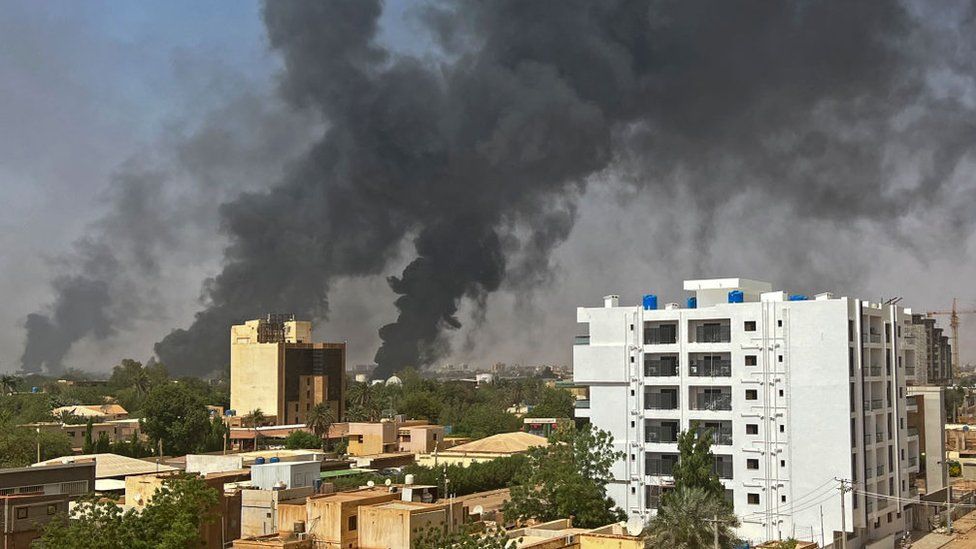
Both sides claimed to control key sites in Khartoum, where residents sheltered from explosions.

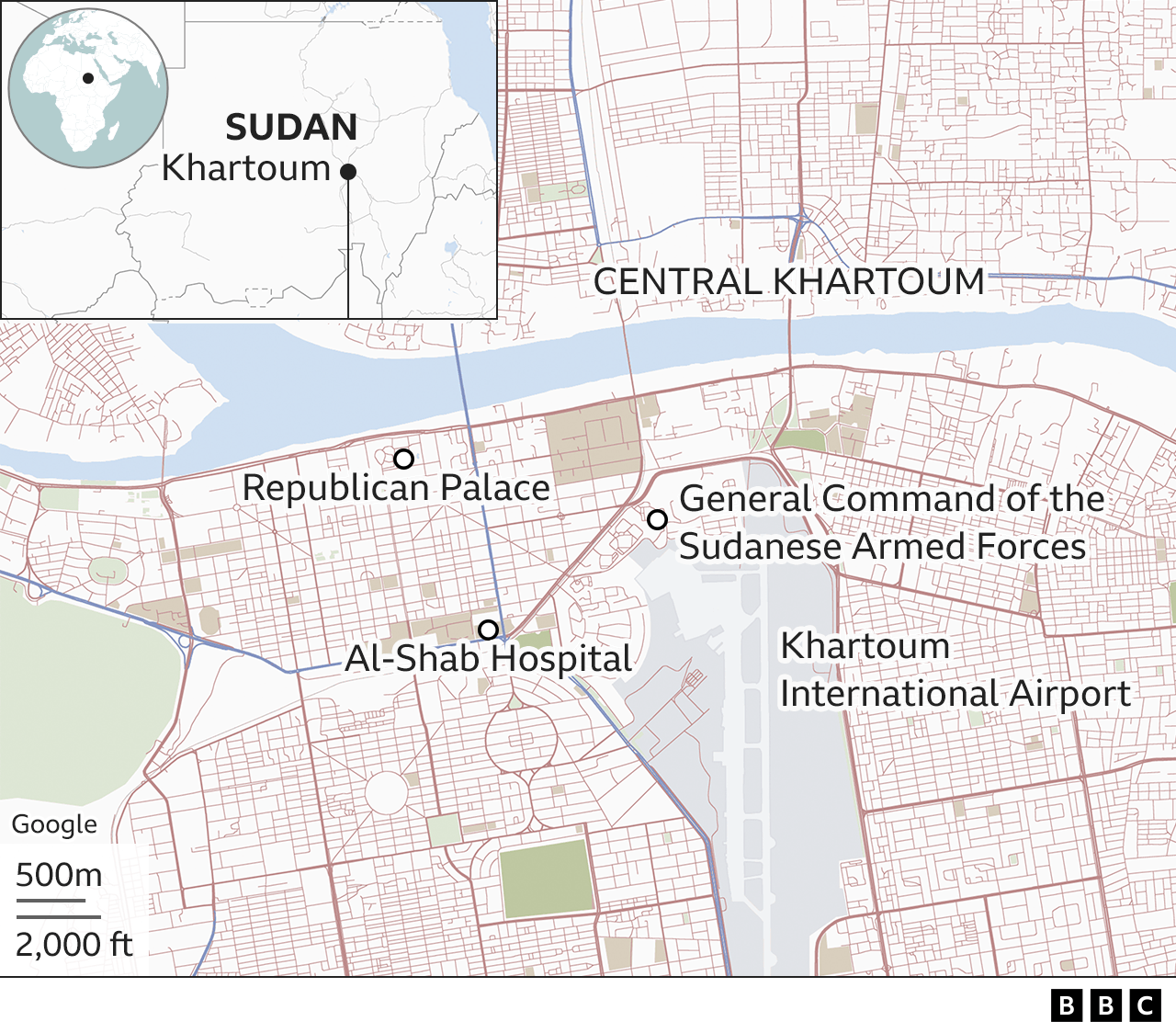
The Sudan Doctors' Trade Union says there has been severe damage to al-Shab Teaching Hospital in Khartoum, along with two other hospitals, caused by clashes and "mutual shelling".

It called the attacks a violation of international law.

More than 1,800 civilians and fighters have been injured according to Volker Perthes, the UN envoy for Sudan. He also put the death toll at 185 people on Monday, higher than the doctors' union.

The two sides held a brief ceasefire on Sunday to allow the wounded to be evacuated, although it was not clear how strictly they stuck to it.

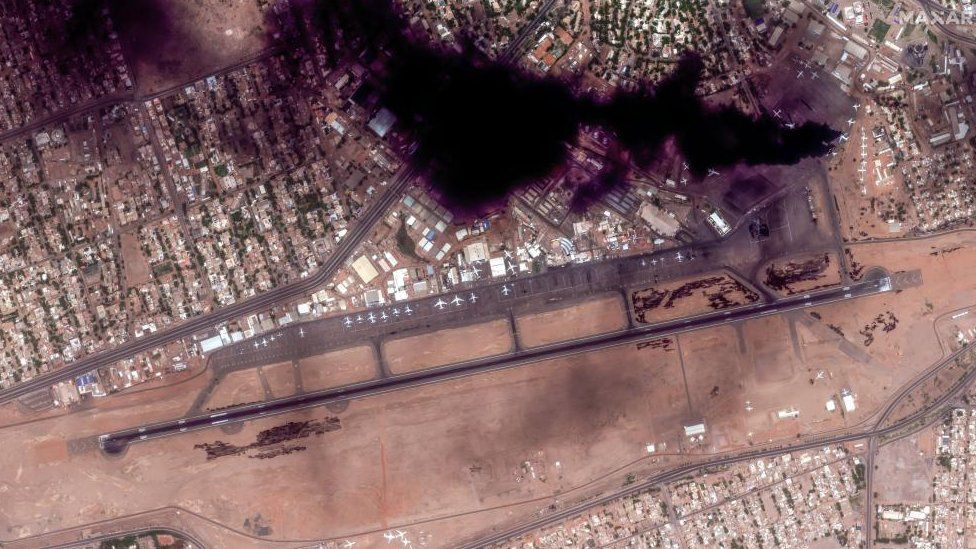
On Monday, clouds of smoke were visible above Khartoum's main airport, with TV showing images of fires and explosions. Army air strikes targeted RSF bases, some of which are embedded in residential areas.

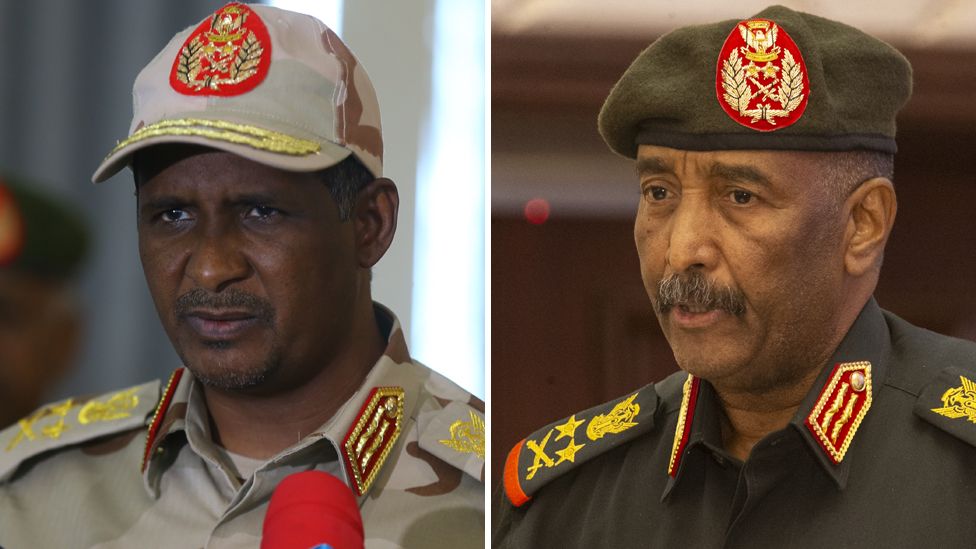
The fighting is between army units loyal to the de facto leader, Gen Abdel Fattah al-Burhan, and the RSF, a notorious paramilitary force commanded by Sudan's deputy leader, Mohamed Hamdan Dagalo, better known as Hemedti.

He said on Monday that the international community must intervene, and branded Gen Burhan "a radical Islamist who is bombing civilians from the air". Gen Burhan has said he is willing to negotiate.

Alarmed neighbours Kenya, South Sudan and Djibouti are planning to send their presidents to help mediate in the crisis, however this is not currently possible because the airport is closed.

The US, EU and UK have called for an immediate end to the fighting.

There has been fierce fighting around the country's seat of power, the Republican Palace. The army says it remains in control of all its bases, including its Khartoum headquarters, where heavy weapons have been used during intense clashes.

The sound of gunfire and explosions has hardly stopped since Saturday morning. One estimate put the number of injured at 1,100.

Beyond the capital, the army says it is in control of eastern parts of the country and the key Red Sea port of Port Sudan. But fighting is continuing in Darfur, where the RSF is strong, and also in Kordofan in the south.

line

Sudan: The basics

  • Sudan is in north-east Africa and has a history of instability: The military toppled long-time leader Omar al-Bashir in 2019 after mass protests
  • It then overthrew a power-sharing government in 2021, putting two men at the helm: The head of the army and his deputy, who is also the head of a paramilitary group called the RSF
  • They disagree on how to restore civilian rule to Sudan: The RSF leader claims to represent marginalised groups against the country's elites but his forces were accused of ethnic cleansing
line

Sudan state TV is now back on air and broadcasting pro-army songs and anthems, after many hours without transmission.

The internet is still up and running - no doubt because the military wants to make sure their version of events and their propaganda narrative out, suggests BBC Sudan analyst James Copnall.

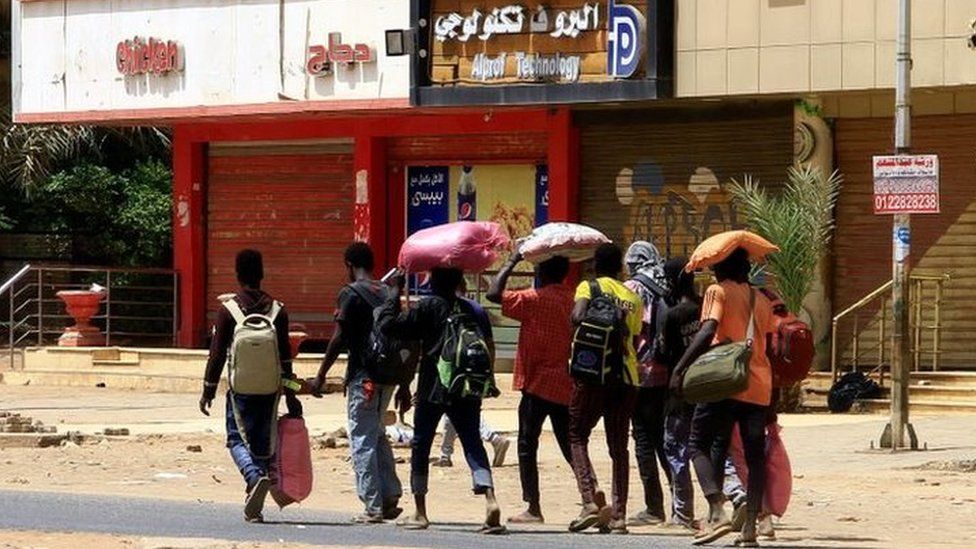
But electricity is down in many places and water supplies to homes have been cut, leaving terrified residents no choice but to venture onto Khartoum's streets in search of drinking water.

One group of students trapped inside the headquarters of an oil company in Khartoum by heavy fighting told the BBC that they has not had food or water in three days.

Speaking on Monday, one student said the group were trapped "in the middle of a heavy firefight", while another said air force jets were constantly bombing the area and "flying strikes from above".

Sudan is a majority-Muslim country and the fighting has brought an abrupt end to the kind of outdoor socialising that usually happens during Ramadan after the day-time fast is broken.

On Sunday and early Monday, the RSF claimed to occupy sites in Khartoum such as the presidential palace.

But some accounts indicated that the army had regained control of the airport, with the military saying they were dealing with "small pockets of rebels".

The army previously denied that the RSF had seized key sites in the capital, and witnesses in the country told Reuters news agency that the army appeared to be making gains after blasting RSF bases with air strikes.

Residents of Khartoum have spoken of fear and panic, and reported gunfire and explosions.

"We live on a rooftop on the third floor and the airplanes fly really close to the roofs and its terrifying," Duaa Tariq told the BBC. She said she was running out of food and water.

Another Khartoum resident, Kholood Khair, said residents could not be sure of safety anywhere. "All civilians have been urged to stay at home, but that has not kept everyone safe."

The major sticking points between the army and RSF are over the plans to incorporate the 100,000-strong RSF into the army, and over who would then lead the new force.

A chorus of international voices has called for a permanent end to the violence.

Leading Arab states and the US have also urged a resumption of talks aimed at restoring a civilian government, while the African Union has announced that it is sending its top diplomat, Moussa Faki Mahamat, to try to negotiate a ceasefire.

Egypt and South Sudan also offered to mediate between the warring factions, according to a statement by the Egyptian presidency.

Satellite image showing smoke over Khartoum 
Image source, Maxar Technologies
Image caption,
Thick black smoke was seen over Khartoum (satellite image ©2023 Maxar Technologies)

Death toll estimates have varied.

The Central Committee of Sudan Doctors reported 97 civilians killed and dozens among security forces dead, as well as 942 people injured.

Meanwhile, the World Health Organization says more than 83 people have been killed and more than 1,100 people injured across the country since Thursday, when the RSF began mobilising its forces. It does not specify how many civilians have died in the fighting.

Among the dead are three staff members of the UN World Food Programme (WFP), which has suspended its operations in the country.

In a statement, the WFP said it was "horrified" by the news of the deaths, adding that one of its aircraft had been damaged at Khartoum airport during an exchange of gunfire on Saturday, which it says impacted its ability to provide aid.

Map of key sites in Khartoum

Additional reporting by Robert Plummer and Mattea Bubalo

Related Topics

More on this story

Πατριαρχείο Αλεξανδρείας: Πάσχα με προσευχές για τους Έλληνες του Σουδάν

Το ΒΗΜΑ της Εκκλησίας

Με λαμπρότητα και θρησκευτική μεγαλοπρέπεια εόρτασαν οι Ορθόδοξοι Χριστιανοί την Ανάσταση του Κυρίου στον Ιερό Καθεδρικό Ναό Ευαγγελισμού της Θεοτόκου Αλεξάνδρειας.

Η ΑΘΜ ο Πάπας και Πατριάρχης Αλεξανδρείας και πάσης Αφρικής κ.κ. Θεόδωρος Β΄, συμπαραστατούμενος από τον Σεβ. Μητροπολίτη Ναυκράτιδος κ. Παντελεήμονα, Αρχιγραμματέα της Αγίας και Ιεράς Συνόδου, προέστη της τελετής της Αναστάσεως και προεξήρχε της Αναστάσιμης Θείας Λειτουργίας, μεταφέροντας προς όλους το χαρμόσυνο μήνυμα «Χριστός Ανέστη!».

Παρέστησαν, επίσης, ο Γενικός Πρόξενος της Ελλάδος στην Αλεξάνδρεια, κ. Αθανάσιος Κοτσιώνης, ο Πρόεδρος της Ελληνικής Κοινότητος Αλεξανδρείας κ. Ανδρέας Βαφειάδης και εκπρόσωποι ελληνικών Συλλόγων και Οργανισμών της Πόλεως.

Την Κυριακή του Πάσχα, 16 Απριλίου, τελέστηκε στην Ιερά Πατριαρχική Μονή Οσίου Σάββα του Ηγιασμένου στην Αλεξάνδρεια ο πανηγυρικός Εσπερινός της Αναστάσεως.

Ο Μακαριώτατος Πάπας και Πατριάρχης κ.κ. Θεόδωρος Β΄ κατήλθε εν πομπή από την Αίθουσα Θρόνου της Μονής στον Ιερό Πατριαρχικό Ναό του Οσίου Σάββα, όπου προεξήρχε του Εσπερινού της Αγάπης, συγχοροστατούντων των Αρχιερέων του Θρόνου, Σεβ. Μητροπολίτου Ναυκράτιδος κ. Παντελεήμονος και Πανιερ. Μητροπολίτου Ταμιάθεως κ. Γερμανού.

Μέσα σε κλίμα χαρμόσυνο, ανεγνώσθη το Ιερό Ευαγγέλιο από τον Μακαριώτατο στην ελληνική, ενώ ακολούθησαν οι Αρχιερείς και ο ιερός κλήρος, σε διάφορες γλώσσες.

Ο Αλεξανδρινός Προκαθήμενος, αφού ευχαρίστησε όλους για την παρουσία τους, είπε: 

«Η σκέψη και η προσευχή μου στρέφονται προς τους εμπερίστατους αδελφούς της Αφρικής και όπου γης. Η σκέψη και η προσευχή μου στρέφονται προς τους χαροκαμένους γονείς των νέων των Τεμπών. Στρέφεται προς τους δοκιμαζομένους σήμερα Έλληνες του Σουδάν και τον Μητροπολίτη, μας Σάββα… Κουράγιο παιδιά μου, κουράγιο!

Αυτή θα είναι η ευχή μου για το φετινό Πάσχα. Η χαρά της Αναστάσεως να είναι ελπίδα, παρηγορία και δύναμη ακατάβλητη. Έχουμε Χριστό στην καρδιά μας; Έχουμε την Ανάσταση! Έχουμε Χριστό στη ψυχή μας; Έχουμε την υπομονή! Έχουμε Χριστό στη ζωή μας; Έχουμε ειρήνη και αγάπη!».

Ακολούθως, ο Μακαριώτατος επισκέφθηκε τον Οίκο Ευγηρίας της Ελληνικής Κοινότητος, όπου αντάλλαξε τον Αναστάσιμο χαιρετισμό με τους περιθαλπομένους γέροντες και τους εργαζομένους, προσφέροντας δώρα και ευλογίες σε όλους.

Τέλος, παρεκάθησε στο Πασχάλιο γεύμα που παρέθεσε η Ελληνική Κοινότητα Αλεξανδρείας στο εντευκτήριό της προς όλους τους παροίκους της Μ.Πόλεως.


Διαρκής επικοινωνία του Αλεξανδρινού Προκαθήμενου με τον Μητροπολίτη Νουβίας κ. Σάββα

Εξάλλου, από την πρώτη στιγμή της ενάρξεως των αιματηρών εχθροπραξιών στην πρωτεύουσα Χαρτούμ του Σουδάν, τη 15η Απριλίου, η ΑΘΜ ο Πάπας και Πατριάρχης Αλεξανδρείας και πάσης Αφρικής κ.κ. Θεόδωρος Β’ ευρίσκεται σε διαρκή τηλεφωνική επικοινωνία με τον επιχώριο Ποιμενάρχη, Σεβασμιώτατο Μητροπολίτη Νουβίας κ. Σάββα, ο οποίος θυσιαστικώς στέκεται δίπλα στο ποίμνιό του και περιθάλπει αυτό στο Μητροπολιτικό οίκημα, και δι’ αυτού με τους Έλληνες που διαβιούν στη χώρα.

Επίσης, ο Μακαριώτατος συνεργάζεται επί του θέματος με τον Πρέσβη της Ελλάδος στο Κάϊρο κ. Νικόλαο Παπαγεωργίου, στις διπλωματικές αρμοδιότητες του οποίου υπάγεται και το κράτος του Σουδάν.

Σήμερα, 18 Απριλίου, ο Προκαθήμενος της πρεσβυγενούς Αλεξανδρινής Εκκλησίας, σε προγραμματισμένη συνάντηση που θα έχει στο Κάϊρο με τον Πρόεδρο της Αραβικής Δημοκρατίας της Αιγύπτου κ. Αμπντέλ Φατάχ Αλ Σίσι, θα συζητήσει σχετικώς μαζί του, με σκοπό την προστασία των Ελλήνων παροίκων και την επίλυση του ανακύψαντος προβλήματος, αφού η Αίγυπτος εμπλέκεται ενεργά στην διαδικασία απεμπλοκής και ειρηνεύσεως στη γειτονική χώρα του Σουδάν.

Ο Μακαριώτατος εκζητεί πατρικώς την προσευχή όλων, ώστε να πρυτανεύσει η λογική και ειρήνη μεταξύ των εμπλεκομένων στην σύρραξη μερών.

Για Τρίτη ημέρα εγκλωβισμένοι στη Μητρόπολη ο Μητροπολίτης Νουβίας και 15 πιστοί

 
Φωτο από εδώ

Την ίδια ώρα, στο Σουδάν παραμένει έκρυθμη η κατάσταση, με τον Μητροπολίτη Νουβίας και παντός Σουδάν κ. Σάββα, που βρίσκεται από το Μ. Σάββατο εντός της Μητρόπολης στο Χαρτούμ μαζί με 15 ακόμα άτομα, να δηλώνει στην ΕΡΤ: «Είμαστε σήμερα στο επίκεντρο της διαμάχης. Χρησιμοποιούν βαρύ οπλισμό σήμερα. Δεν μπορεί κανείς να βγει έξω, ούτε τις πόρτες να ανοίξει. Υπάρχουν αδέσποτες σφαίρες, οπότε είμαστε ιδιαίτερα προσεκτικοί και σε σημεία που δεν μπορούν να χτυπήσουν σφαίρες, γιατί τις προηγούμενες ημέρες χτύπησαν και τις πόρτες και τα παράθυρα, οπότε είμαστε σε σημεία τέτοια που να μην κινδυνεύουμε».

Αναφερόμενος στο θέμα των προμηθειών και τις ανάγκες που υπάρχουν, τόνισε ότι «Δόξα τω Θεώ, έχουμε επάρκεια σε τρόφιμα και σε νερό. Δεν έχει ρεύμα και νερό, χρησιμοποιούμε τη γεννήτρια μία ώρα την ημέρα, μιάμιση περίπου, για να μπορέσουμε να φορτίσουμε τα κινητά και να προμηθευτούμε νερό από τα φίλτρα γιατί δεν μπορούμε να προμηθευθούμε ούτε πετρέλαιο για να έχουμε τη γεννήτρια σε συνεχή λειτουργία. Είναι δύσκολη κατάσταση […] Περιμένουμε και ελπίζουμε σε ένα θαύμα».

Για την κατάσταση της υγείας των δυο Ελλήνων τραυματιών, ο Σεβασμιώτατος δήλωσε ότι «Είναι καλά. Είναι σε νοσοκομείο στο Χαρτούμ και περιμένουν απλά το χειρουργείο, διότι δεν μπορούν τα νοσοκομεία εξαιτίας της κατάστασης να προμηθευτούν τα απαραίτητα χειρουργικά υλικά από τα ιατρικά καταστήματα».

Σημειώνεται ότι σύμφωνα με τον τελευταίο απολογισμό, κατά τη διάρκεια των τριών ημερών των μεταξύ του στρατού του στρατηγού Αμπντέλ Φατάχ Αλ-Μπουρχάν και των ισχυρών παραστρατιωτικών δυνάμεων του στρατηγού Μοχάμεντ Χαμντάν Ντάγκλο, έχουν σκοτωθεί περισσότεροι από 185 άνθρωποι και έχουν τραυματιστεί 1.800 άμαχοι και μαχητές. Τα παραπάνω στοιχεία γνωστοποίησε το βράδυ της Δευτέρας ο επικεφαλής της αποστολής του ΟΗΕ στο Σουδάν, Φόλκερ Πέρτες.


Παρασκευή 21 Οκτωβρίου 2022

Help save Amal from death by stoning (Sudan)


secure.avaaz.org

This is the cruel fate that Amal is facing in Sudan. She’s only 20 years old, and a judge decided she deserved to be tortured to death for adultery in the first stoning sentence in a decade.

But there is still hope: Amal has appealed the verdict, and the court could overturn the sentence and save her life.

There’s no time to waste: Amal is stuck in jail until the court decides her fate -- so let’s shine a bright spotlight on her case with a global show of solidarity and outrage. Add your name now and when it’s massive, we’ll take our call directly to key governments Sudan is trying to court, so they demand Amal's release. Sign now and share with everyone. 

To the authorities of Sudan:

As citizens from around the world, we urgently call on you to overturn Amal’s cruel stoning death sentence, and to release her immediately in light of the deep irregularities in her trial. Sudan must ensure its criminal justice abides by international law, including the Convention against Torture.

Click here!

Παρασκευή 27 Αυγούστου 2021

Bread in Africa

clovegarden.com


While domestication of grains for easy harvesting may have originated in Anatolia and Caucasus, about 10,000 years ago, the Horn of Africa was certainly not far behind. Grinding of grains into flour with sliding stones, and the baking of flat breads, is far older. Today, the main breads of Africa are still made under very primitive conditions. in a manner possibly in place before the dawn of history.   Photo by Lelaw Wondimu distributed under license Creative Commons.

More on Bread.


North Africa

  -   The Maghreb (Algeria, Morocco, Tunisia, Libya, Mauritania), Egypt, Sudan


Baghrir

  -   [Beghrir] 

This is a popular bread in the Maghreb region, often eaten for breakfast with a mix of butter and honey, but also with jams. It is made from semolina or wheat flour.   Photo by Tamorlan distributed under license Creative Commons Attribution-ShareAlike v3.0 Unported.


Pita Bread


-   [Pita (Greek); Pocket Bread; Pide (Turkey); Khubz Arabi (Arabic)] 

This lightly leavened wheat bread is very popular throughout North Africa, and far beyond. The ethnic markets here in the Los Angeles region are piled high with pita, in both white (photo) and whole wheat versions, in the 7 inch and larger sizes.

The earliest Arabic recipes (10th century) have these baked in a Tandoor, but today they are usually made in continuous industrial ovens so as to meet the high demand. Pita is baked in a very hot oven at 450°F/232°C or higher, causing the disk to puff up dramatically. When removed from the oven the disk collapses, but the two sides remain separated, so the bread can be opened into a pocket. Throughout the region, street foods of all kinds are packed into pita pockets.

The photo specimen was a 7 inch diameter disk 0.15 inch thick. Half the top layer was removed to show the inside. Enriched wheat flour, water, yeast, salt, calcium propionate.

Kisra Rhaheeefa 


Kisra Rhaheeefa is much like Ethiopia's Injera and used similarly, but is made from Sorghum Flour or Wheat Flour rather than Teff. The "Kisra Rhaheeefa" name differentiates it from "Kisra Aseeda", which is a Sorghum Porridge.   Photo by Mohammed Elfatih Hamadien distributed under license Creative Commons Attribution-ShareAlike v4.0 International.

The Horn of Africa

  -   Ethiopia, Djibouti, Eritrea, Somalia


Injera

  -   [Injera (Amharic); (Bidenaa (Oromo)] 

This is the bread of Ethiopia and Eritrea, usually made from Teff. It was traditionally, and is often still today, made very large, to fit the table for which it would be the tablecloth. Scoops of stews and other recipes are placed directly on it. Diners tear off pieces of the "tablecloth" and use them to pick up the food. Today, especially in restaurants it is often made smaller and served on an Indian thali, or a very large plate.   Photo by PhoTom distributed under license Creative Commons Attribution-ShareAlike v4.0 International.

This is a sour dough bread, made with a leavened batter similar to thin pancake batter. The batter is baked on a large clay or metal tray, over moderate heat, and on one side only. Bubbles on the top side burst, giving the bread a spongy texture, almost like honeycomb tripe, which is very good at holding sauces. Temperature is regulated so it sets through, but does not brown on the bottom (see the rolled examples in the photo at the top of the page). It can be made using white or brown Teff, or a mix. Farmers say the white Teff is preferred to the brown by most of their customers.

Lahoh

  -   [Luhuh (Somali), Laxoox, Lahooh, Canjeero, Canjeelo, Anjeero]

This bread is popular in Somalia, Djibouti and Yemen, but now also popular in Israel, introduced by Yemenite Jews. It is a fermented sour dough bread usually made of Sorghum Flour or Corn Flour and cooked on circular metal stove called a taawa or daawo. In Yemen, it is often served by street vendors.   Photo by Gilabrand at en.wikipedia distributed under license Creative Commons Attribution-ShareAlike v3.0 Unported attribution required.

East Africa

  -   Tanzania, Kenya, Uganda, Rwanda, Burundi and South Sudan


Chapati

Long influenced by India, East Africa has adopted the Indian Chapati as their main form of bread - but they use white flour instead of the whole wheat Atta flour used in India. As it is very inconvenient for me to produce Chipatis, I use Flour Tortillas, easily available here in Southern California. I prefer the small 5 inch diameter ones. Incidentally, Whole Wheat Flour Tortillas make an excellent substitute for Indian Chapatis


Kisra Rhaheeefa


South Sudan (Christian and Native Religion) is now a separate country from Sudan (all Muslim) and is moving strongly into the East African community. One thing they still have in common with Sudan is Sudan's Kisra Rhaheeefa.
bk_africae 131129   -   www.clovegarden.com
©Andrew Grygus - agryg@clovegarden.com - Photos on this page not otherwise credited are © cg1 - Linking to and non-commercial use of this page permitted


Bread and Bread-Baking Technologies in Africa

Bread is a dietary staple in North Africa, Northeastern Africa, and the Horn of Africa, and it is important in the diet of many Saharan and sub-Saharan people. African breads are made from the flours of a variety of cereals, tubers, and corms that are baked, steamed, and sometimes fried to produce pancake, flat bread, leavened or slightly leavened loaves, or cakes using ovens, hearths, griddles, pots, and molds. Technical choice in bread baking is associated with the baking properties of bread ingredients and social group’s culinary practices and preferences and does not represent evolutionary stages.

The Bread/Oven Porridge/Pot Bread/Griddle Traditions

Research of Africa’s culinary practices includes the history of bread consumption and its associated technologies, an investigation that is far from exhaustive. Several researchers observe a general (but not absolute) culinary divide between bread-based cuisines that use ovens and griddles...

This is a preview of subscription content, log in to check access. 
 
References
  1. Abdullahi, M. D. (2001). Culture and customs of Somalia. London: Greenwood Press.Google Scholar
  2. Anderson, J. R., & Salah (El-Din) Mohamed Ahmed. (2006a). Bread moulds and throne halls: Recent discoveries in the Amun Temple Precinct at Dangeil. Sudan & Nubia, 10, 95–101.Google Scholar
  3. Anderson, J., & Salah (El-Din) Mohamed Ahmed. (2006b). Revealing terra incognita: Dangeil, Sudan. Current World Archaeology, 19, 23–30.Google Scholar
  4. Anderson, J. R., D’Andrea, A. C., Logan, A., & Ahmed, S. M. (2007). Bread moulds from the Amun Temple at Dangeil, Nile state – an addendum. Sudan & Nubia, 11, 89–93.Google Scholar
  5. Apentiik, R. (1997). Bulsa technologies and systems of thought. Unpublished M.A. thesis, Department of Archaeology, University of Calgary.Google Scholar
  6. Arthur, J. W. (2014). Culinary crafts and foods in southwestern Ethiopia: An ethnoarchaeological study of Gamo Groundstones and pottery. African Archaeological Review, 31(2), 131–168.Google Scholar
  7. Baldados, A., & Constantini, L. (2011). Sorghum exploitation at the Kassala and its environs, northeastern Sudan in the second and first millennia BC. Nyame Akuma, 75, 33–39.Google Scholar
  8. Balfet, H. (1975). Bread in some regions of the Mediterranean area. In M. L. Arnott (Ed.), Gastronomy: The anthropology of good habits (pp. 305–314). The Hague: Mouton Publishers.Google Scholar
  9. Bruneton, A. (1975). Bread in the region of the Moroccan High Atlas. In M. L. Arnott (Ed.), Gastronomy: The anthropology of food habits (pp. 275–285). The Hague: Mouton Publishers.Google Scholar
  10. Chittick, N. (1984). Manda. London: British Institute in Eastern Africa.Google Scholar
  11. Close, A. (1995). Few and far between. In W. K. Barnett & J. W. Hoopes (Eds.), The emergence of pottery technology and innovation in ancient. Societies (pp. 23–37). Washington, DC: Smithsonian Institution Press.Google Scholar
  12. D’Andrea, A. C. (2008). T’ef (eragrostis tef) in ancient agricultural systems of Ethiopia. Economic Botany, 62(4), 547–566.CrossRefGoogle Scholar
  13. D’Andrea, A. C., Schmidt, P. R., & Matthew, C. C. (2008). Paleoethnobotanical analysis and agricultural economy in early first millennium BCE sites around Asmara. In P. R. Schmidt, M. C. Curtis, & R. Zelalem Teka (Eds.), The archaeology of ancient Eritrea (pp. 207–216). Asmara: Red Sea Press.Google Scholar
  14. Deacon, J. (1984). Later Stone Age people and their descendants in southern Africa. In R. G. Klein (Ed.), Southern African prehistory and paleoenvironments (pp. 221–228). Rotterdam: A.A. Balkema Publishers.Google Scholar
  15. Dirar, H. A. (1993). The indigenous fermented foods of the Sudan. Wallingford, UK: CAB.Google Scholar
  16. Dombrowski, J. C. (1971). Excavations in Ethiopia: Lalibela and Natchabiet Caves, Begemeder Province. Ph.D. dissertation, Department of Anthropology, Boston University.Google Scholar
  17. Dufton, H. (1970 [1867]). Narrative of a journey through Abyssinia in 1862–3. Westport, CT: Negro Universities Press.Google Scholar
  18. Edwards, D. N. (1996). Sorghum, beer and Kushite society. Norwegian Archaeological Review, 29, 65–77.CrossRefGoogle Scholar
  19. Edwards, D. N. (2004). Nubian past. An archaeology of Sudan. London: Routledge.Google Scholar
  20. Fuller, D. (2004). Kawa. Sudan and Nubia, 6, 70–74.Google Scholar
  21. Gast, M., & Adrian, J. (1965). Mils et sorgho en Ahaggar etude ethnologique et nutritionelle. Paris: Arts et Métiers Graphiques.Google Scholar
  22. Haaland, R. (2007). Porridge and pot, bread and oven: Food ways and symbolism in Africa and the near east from the Neolithic to the present. Cambridge Archaeological Journal, 17(2), 165–182.CrossRefGoogle Scholar
  23. Haaland, R. (2012). Changing food ways as indicators of emerging complexity in Sudanese Nubia: From Neolithic agropastoralists to the Meroitic civilization. Azania , 47(3), 327–342.CrossRefGoogle Scholar
  24. Hard, N. F., Odunfa, S. A., Cheri-Ho Lee, Quintero-Ramírez, R., Argelia Lorence-Quinoñes, & Carmen Wacher-Radarte. (1999). Fermented cereals a global perspective. FAO Agricultural Services Bulletin. http://www.fao.org/docrep/x2184E/x2184E00.htm.
  25. Hillman, G. C. (1989). Late Palaeolithic plant foods from Wadi Kubbaniya in upper Egypt: Dietary diversity, infant weaning, and seasonality in a riverine environment. In D. R. Harris & G. C. Hillman (Eds.), Foraging and farming (pp. 207–239). London: Unwin Hyman.Google Scholar
  26. Hobbs, J. (1989). Bedouin life in the Egyptian wilderness. Austin: University of Texas Press.Google Scholar
  27. Horton, M. (1996). Shanga. London: British Institute in Eastern Africa.Google Scholar
  28. Huysecom, E., Rasse, M., Lespez, L., Neumann, K., Fahmy, A., Ballouche, A., et al. (2009). The emergence of pottery in Africa during the tenth millennium cal BC: New evidence from Ounjougou (Mali). Antiquity, 83, 905–917.CrossRefGoogle Scholar
  29. Jacquet-Gordon, H. (1981). A tentative typology of Egyptian bread moulds. In D. Arnold (Ed.), Studien zur altägyptischen Kerami (pp. 11–24). Mainze am Rhein: Verlag.Google Scholar
  30. Keenleyside, A., Schwarcz, H., Stirling, L., & Lazreg, N. B. (2009). Stable isotopic evidence for diet in a Roman and Late Roman population from Leptiminus, Tunisia. Journal of Archaeological Science, 36, 51–63.CrossRefGoogle Scholar
  31. Kimmage, K. (1991). The evolution of the ‘wheat trap’: The Nigerian wheat boom. Africa, 60(4), 471–501.CrossRefGoogle Scholar
  32. Kobischanov, Y. M. (1979). Axum. London: Pennsylvania State University Press.Google Scholar
  33. Leek, F. F. (1972). Teeth and bread in ancient Egypt. Journal of Egyptian Archaeology, 58, 126–132.CrossRefGoogle Scholar
  34. Lehner, M. (1997). The complete pyramids. London: Thames and Hudson Ltd.Google Scholar
  35. Lewicki, T. (1974). West African food in the middle ages. Cambridge: Cambridge University Press.CrossRefGoogle Scholar
  36. Lyons, D. (2007). Cuisine and identity: An ethnoarchaeological example from eastern Tigray, Ethiopia. Journal of Social Archaeology, 7(3), 346–371.CrossRefGoogle Scholar
  37. Lyons, D., & D’Andrea, A. C. (2003). Griddles, ovens, and agricultural origins: An ethnoarchaeological study of bread baking in highland Ethiopia. American Anthropologist, 105(3), 515–530.CrossRefGoogle Scholar
  38. Mattingly, D. (2003). Fortifications, settlement and domestic architecture. In D. Mattingly (Ed.), The archaeology of Fazzan (Synthesis, Vol. 1, pp. 136–176). London: Society for Libyan Studies.Google Scholar
  39. McIntosh, S. K. (1995). Pottery. In S. K. McIntosh (Ed.), Excavations at Jenne-Jeno, Hambarketolo, and Kaniana (Inland Niger Delta, Mali), the 1981 Season (pp. 130–213). Berkeley: University of California Press.Google Scholar
  40. Mosley, D. (2004). Breaking bread. The roles of taste in colonialism. Food Culture and Society , 7(2), 49–62.Google Scholar
  41. Murray, M. A. (2000). Cereal production and processing. In P. T. Nicholson & I. Shaw (Eds.), Ancient Egyptian materials and technology (pp. 505–536). Cambridge: Cambridge University Press.Google Scholar
  42. National Research Council. (1996). Lost crops of Africa, volume 1: Grains. Washington, DC: National Academy Press.Google Scholar
  43. Neumann, K. (2005). The romance of farming: Plant cultivation and domestication in Africa. In A. B. Stahl (Ed.), African archaeology (pp. 249–275). Oxford: Blackwell Publishing.Google Scholar
  44. Nicholaisen, J. (1963). Ecology and culture of the pastoral Tuareg. Copenhagen: National Museum.Google Scholar
  45. Pankhurst, R. (1968). Economic history of Ethiopia 1800–1935. Addis Ababa: Haile Selassie I University Press.Google Scholar
  46. Pelling, R. (2003). Medieval and early modern agriculture and crop dispersal in the Wadi el-Agial, Fezzan, Libya. In K. Neumann, A. Butler, & S. Kahlheber (Eds.), Food, fuel and fields progress in African archaeobotany (pp. 129–138). Köln: Heinrich Barth Institut.Google Scholar
  47. Peña, L. Z., Peña -Chocarro, L., Estévez, J. J. I., & Urquijo, J. E. G. (2003). Ethnoarchaeology in the Moroccan Jebala (Western Rif): Wood and dung as fuel. In K. Neumann, A. Butler, & S. Kahlheber (Eds.), Food, fuel and fields progress in African archaeobotany (pp. 163–176). Köln: Heinrich Barth Institut.Google Scholar
  48. Phillipson, D. (2012). Foundations of an African civilisation Aksum and the northern horn 1000BC–AD1300. Rochester, NY: James Currey.Google Scholar
  49. Pope, J. W. (2014). Epigraphic evidence for a “porridge-and-pot” tradition on the ancient middle Nile. Azania, 48(4), 473–497.CrossRefGoogle Scholar
  50. Samuel, D. (1999). Bread making and social interactions at the Amarna workmen’s village, Egypt. World Archaeology, 31(1), 121–144.CrossRefGoogle Scholar
  51. Samuel, D. (2000). Brewing and baking. In P. T. Nicholson & I. Shaw (Eds.), Ancient Egyptian materials and technology (pp. 537–576). Cambridge: Cambridge University Press.Google Scholar
  52. Schmidt, P. R., & Curtis, M., with a contribution from Ascunce, M.S., Kitchen, A., Schimdt, P. R., Miyamoto, M. M., & Mulligan, C. J. (2008). The Second Millennium CE: Settlement, Economy and Ritual Life. In P. R. Schmidt, M.C. Curtis, & Zelalem Teka (Eds.), The archaeology of ancient Eritrea (pp. 265–284). Asmara: Red Sea Press.Google Scholar
  53. Shack, W. (1974). The central Ethiopians. London: International African Institute.Google Scholar
  54. Smeds, H. (1955). The ensete planting culture of eastern Sidamo. Acta Geographica, 13(4), 1–39.Google Scholar
  55. Van de Mieroop, M. (1997). The ancient mesopotamian city. Oxford: Clarendon Press.Google Scholar
  56. Wilson, H. (1988). Egyptian food and drink. Aylesbury, UK: Shire Publications Ltd.Google Scholar 
     
    Additional Reading
  1. Chazan, M., & Lehner, M. (1990). An ancient analogy: Pot baked bread in ancient Egypt and Mesopotamia. Paléorient, 16(2), 21–35.CrossRefGoogle Scholar
  2. Food and Agriculture Organization (1995). Sorghum and Millets in Human Nutrition (Food and Nutrition Series, No. 27). Rome: Food and Agriculture Organization.Google Scholar
  3. Gebrekidan, B., & Gebrehiwot, B. (1982). Sorghum injera preparations and quality parameters. In L. W. Rooney & D. S. Murty (Eds.), Proceedings of the international symposium on sorghum grain quality (pp. 55–66). Patancheru, India: ICRISAT.Google Scholar
  4. Larsen, H. (1936). On baking in Egypt during the Middle Kingdom. Acta Archaeologica, 7, 51–57.Google Scholar
  5. Pomeranz, Y., & Shellenberger, J. A. (1971). Bread science and technology. Westport, CT: Avi Publishing Company.Google Scholar
  6. Samuel, D. (1989). Their staff of life: Initial investigations on ancient Egyptian bread baking. In B. J. Kemp (Ed.), Amarna reports V (pp. 253–290). London: Egypt Exploration Society.Google Scholar 
     
    Egyptian Bread Websites
  1. Hilary Stewart on Ancient Egyptian bread baking. http://ancientfoods.wordpress.com/2011/08/12/ancient-egypt-bread/
  2. Sally Grainger and Roman bread, British Museum. http://blog.britishmuseum.org/2013/07/19/a-very-versatile-roman-oven/