Εμφάνιση αναρτήσεων με ετικέτα Marriage. Εμφάνιση όλων των αναρτήσεων

Σάββατο 23 Σεπτεμβρίου 2023

Tidar (Marriage) - International Trailer

Tidar (Marriage) - International Trailer from Project dldl/ድልድል on Vimeo.

Based on real people's stories and testimonies collected through research in Ethiopia, docudrama Tidar (Marriage) tells the story of Genet, who is experiencing domestic violence, and presents her search for a moral and practical solution to her situation within the village community. It shows how the community responds to Genet’s predicament and how personal faith, religious mediation and theological teaching influence how she thinks through her situation. The aim of the film is to raise awareness about the complex role that religion can have in situations of domestic violence in the Ethiopian Orthodox community, influencing both victim and perpetrator rationalisations and behaviour.

The film is re-enacted by Amharic-speaking actors in Ethiopia, with subtitles being produced in Tigrigna, Afaan Oromo and English. The current trailer is the English international version.

The film was written and directed by Dr Romina Istratii and produced by Hermon Hailay and Max Conil of Exile Pictures and Yidnekachew Shumete of Kurat Pictures.

The production was funded by UK Research and Innovation (UKRI) under the Future Leaders Fellowship grant 'Bridging religious studies, gender & development and public health to address domestic violence” (Grant Ref: MR/T043350/1) and is part of project dldl/ድልድል, a research and innovation project dedicated to the development and strengthening of religio-culturally sensitive domestic violence alleviation systems in East Africa and the UK: projectdldl.org

The film trailer is made available under a CC BY-NC-ND license.

Παρασκευή 28 Ιουλίου 2023

The feast-day of St. Markella of Chios (July 22) & a shocking message regarding child abuse


This article was written on the occasion of the feast of the holy Virgin Martyr Markella of Chios (the 'Chiopolitis' - a native of Chios, Greece), whose memory is commemorated on July 22nd.

Orthodox Outlet for Dogmatic Enquiries

Source: euxh.gr (Translation:  K.N.)

Saint Markella was murdered with unprecedented ferocity by her own father, who was obsessed with sexual lust for her! The girl resisted his wishes to the death – literally - but he finally chased her to the shore and slaughtered her when she became trapped among the rocks! The people of Chios confirm that every year, on the day of her memory, the waters at the site of her slaughter turn red by themselves, as if they too want to honour the pure, virgin blood that was so unjustly and tragically spilled there.

The saint is characterized as 'Virgin-Martyr', because 'virgin' in the ancient Greek language (parthenos) does not only mean a person who is sexually untouched and pure; it is also used when referring to a girl (a young woman, mainly a teenager - unmarried of course). A Christian girl who has not been married is taken for granted to be physically (sexually) unmolested, which is why the Greek terms for 'daughter' and 'virgin' have become synonymous. This is why young and unmarried women who had martyred for their faith in Christ and His teaching are called 'Virgin Martyrs'.  Examples of Virgin Martyrs are Saint Marina, Saint Kyriake, Saint Paraskeve, Saint Christina, Saint Barbara, Saint Ekaterina, e.a.. The first four mentioned here are commemorated in July.

The feast-day of St. Markella marks the commemoration of her exceptionally brutal martyrdom (by an abhorrent example of a father who had lost his senses with carnal lust for his daughter to such a degree that he finally hunted her down and slaughtered her far more viciously than the slaughtering of a lamb); a martyrdom that conveys through the centuries a profoundly shocking message regarding child abuse. The element underlying her story that has left a deep impression in people more than any other is precisely the shocking manner of her death and the natural perpetrator of her murder.
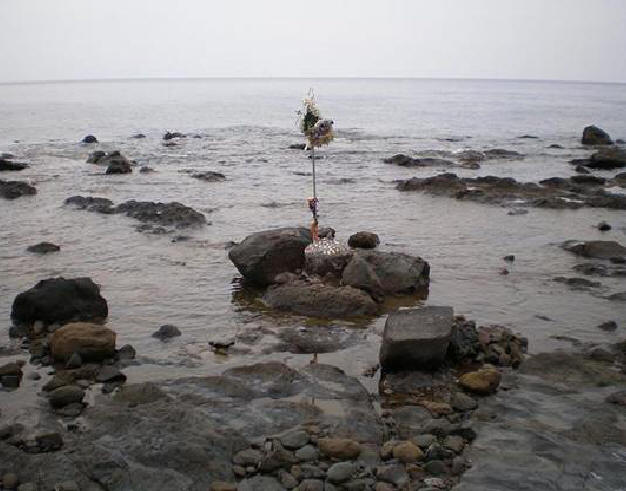
 

Location marking where the martyr was slaughtered and the water turns blood-red annually on her feast-day.
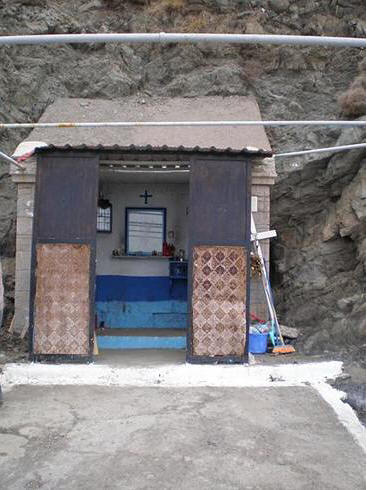
Shrine on the coast - facing the martyr's place of martyrdom
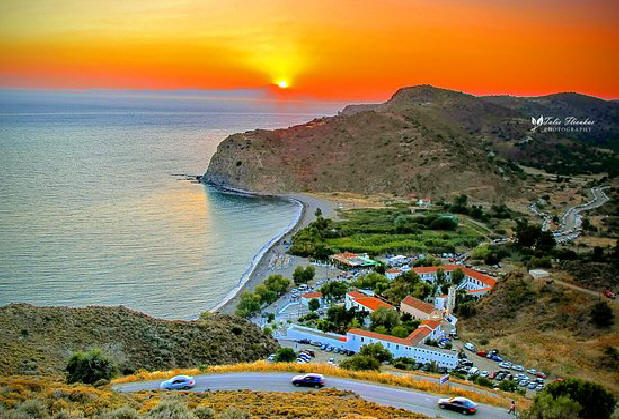
The Monastery of Saint Markella on Chios Island, Greece

The same is true for the feast day of the Holy Great Martyr Barbara (December 4th), where the predominant element of her life that has impressed people is the fact that her own father betrayed her to the Romans as a Christian, allowing her to be subjected to gruesome torture and finally, upon his personal insistence, to be decapitated by his own hand (only to be struck and killed by a bolt of lightning a few days later).  This detail is the reason Saint Barbara has been established in Greece as the patron saint of the Military Division of Heavy Artillery.
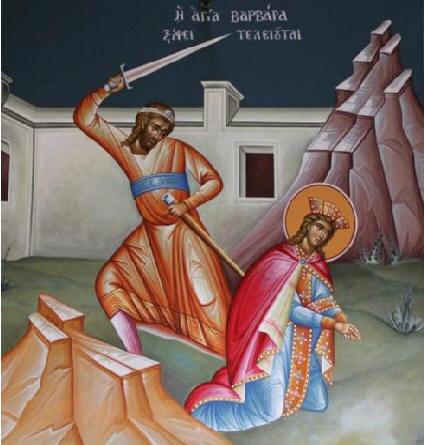
Saint Barbara being decapitated by her father

Two other (but less well-known) saints who were murdered by their father are the Great Martyr Christina, horrifically tortured for being a Christian (commemorated July 24th)
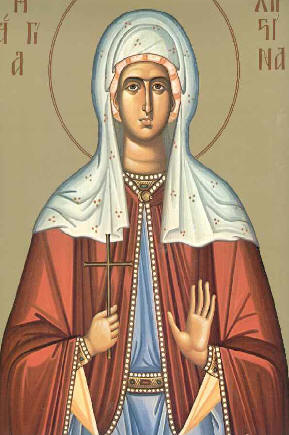
 

Saint Christina

and Saint Philothea of Arges, Romania, (commemorated December 7th). Orphaned on the mother’s side and with an abusive stepmother, the saint was mortally wounded by her father (possibly not intending to kill her) because she was giving away to the poor most of the food her stepmother would give her to take to her father working in the fields. She was only 12 years old!
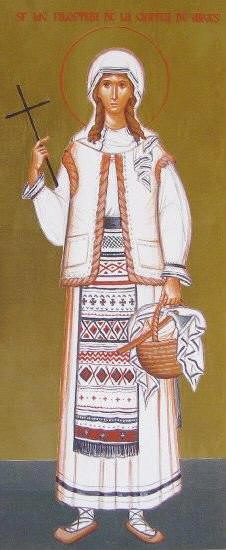
 

Saint Philothea of Arges, Romania

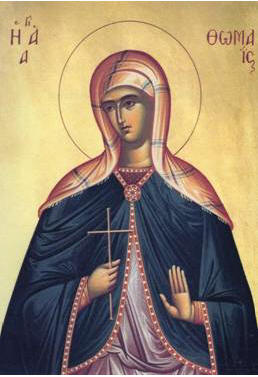
We might also mention two married Christian women who were victims of domestic violence and are also honoured by the Church as martyrs: they are the Saints both named Thomais: Saint Thomais of Lesvos Islqnd, Greece (commemorated January 3rd) who was beaten to death by her husband, and Saint Thomais of Alexandria, Egypt (commemorated April 14th), who was murdered by her father-in-law for resisting his sexual desires!
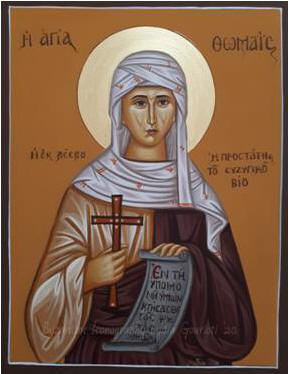


Saint Thomais of Lesvos Island (Greece) & Saint Thomais of Alexandria Egypt

The conclusion one reaches from all the above instances is that domestic violence and child abuse was brought to light by Christians and openly denounced through the Christian Synaxarions (Books of Saints’ biographies) mentioning women victims of such violence who are commemorated annually by the Church as saints and martyrs.

It must be emphasized that a person is deified (recognized by the Church as a saint), through evidence of their unyielding faith and love for Christ. They have also been recognized as saints for steadfastly defending their moral Christian principles to their dying breath - and not merely because they happened to have fallen victims to a certain kind of criminal behaviour. The same applies to all the martyrs who had preferred torture and death rather than betray their faith and their moral principles. Most of them would have attained sainthood anyway, for having lived holy lives; although a holy life was also understood as an occasion for them to be tested unto death, even sacrificing their very lives and - according to Orthodox Christianity – anticipating they have earned Eternity.


Πέμπτη 9 Δεκεμβρίου 2021

Saint Anna breastfeeds the Virgin Mary (orthodox holy icon)


Byzantine fresco from the sanctuary of St. Stephen in Kastoria, Greece. Photo from the blog of Proskynitis (Pilgrim)

Orthodox Holy Church of Transfiguration of Lord, Baltimore, USA

On December 9th (or 22nd = the 9th by the old calendar) the Church commemorates the conception of the Most-holy Theotokos by the righteous Saint Anna.

In the land of Galilee, in the city of Nazareth, there lived the righteous couple Joachim and Anna, who were descendants of kings and high priests. This couple so pleased God with their pious life, that He chose them to become the parents of the Holy Virgin, the fore-chosen Mother of God. But just as the Lord Himself was to become incarnate from a Most-holy Mother, so the Mother of God was to be born of holy and pure parents. By the will of God Joachim and Anna remained childless until a very old age, so that in the conception and birth of their Daughter from barren and aged parents the power of God’s grace would be manifest, and a divine sign would be given to mankind.

For a long time the righteous Joachim and Anna sorrowed and wept over their childlessness, and were subjected to mockery and scorn from those around them, because the Jews of those times, who awaited the coming of the Messiah from the ancestry of David, looked upon barrenness as a sign of God’s punishment. The pious spouses, however, never lost hope in God’s mercy, and for their patience and unfailing faith in God their grief finally turned into joy, and their disgrace – into great honor and dignity.

Once, when Saint Anna in great sorrow prayed to God in her garden, the Lord sent an Angel who foretold her of the forthcoming conception and birth of a Maiden, which soon came to pass. The Church commemorates the conception of the Holy Virgin as being in accordance with God’s pledge, but at the same time springing from a physical union, thus pointing out that the Virgin Mary was born under natural human laws, and that in His incarnation the Lord Jesus Christ fully inherited from His Most-holy Mother the essence of mankind. The conception of the Holy Virgin Mary brought joy not only to Her parents, but to the entire world, because it was the first harbinger of God’s promise of mankind’s redemption through the coming of the Saviour down to earth.

The Conception by Righteous Anna of the Most Holy Mother of God (December 9)

Orthodox Church in America

[...] The Orthodox Church does not accept the teaching that the Mother of God was exempted from the consequences of ancestral sin (death, corruption, sin, etc.) at the moment of her conception by virtue of the future merits of Her Son. Only Christ was born perfectly holy and sinless, as Saint Ambrose of Milan teaches in Chapter Two of his Commentary on Luke. The Holy Virgin was like everyone else in Her mortality, and in being subject to temptation, although She committed no personal sins. She was not a deified creature removed from the rest of humanity. If this were the case, She would not have been truly human, and the nature that Christ took from Her would not have been truly human either. If Christ does not truly share our human nature, then the possibility of our salvation is in doubt.

The Conception of the Virgin Mary by Saint Anna took place at Jerusalem. The many icons depicting the Conception by Saint Anna show the Most Holy Theotokos trampling the serpent underfoot.

“In the icon Saints Joachim and Anna are usually depicted with hands folded in prayer; their eyes are also directed upward and they contemplate the Mother of God, Who stands in the air with outstretched hands; under Her feet is an orb encircled by a serpent (symbolizing the devil), which strives to conquer all the universe by its power.”

There are also icons in which Saint Anna holds the Most Holy Virgin on her left arm as an infant. On Saint Anna’s face is a look of reverence. A large ancient icon, painted on canvas, is located in the village of Minkovetsa in the Dubensk district of Volhynia diocese. From ancient times this Feast was especially venerated by pregnant women in Russia. 

Icon from here

Troparion — Tone 4

Today the bonds of barrenness are broken, / God has heard Joachim and Anna. / He has clearly promised them that beyond hope, they would bear a divine child, / by whom the uncircumscribable One was born as a mortal Man, / Who commanded the angel to cry to her: / “Hail, O full of grace, / the Lord is with you!”

Τετάρτη 28 Απριλίου 2021

Orthodox Church in Tanzania: "may we remember that even though God will always provide, he has also chosen us to help one another"...


Orthodox Mission of Madagascar


Tanzania, orthodox christian marriage

"The Greek Orthodox Archdiocese of Australia Committee for Foreign Mission has kindly donated $5,000 towards the building of the Greek Orthodox Church in Tanzania which is under the spiritual guidance of Father Ermolaos.

Παρασκευή 13 Απριλίου 2018

The Holy Martyr Thomais from Alexandria


Orthodox Church in America
 
The Holy martyr Thomais was born into a Christian family in the city of Alexandria. She was raised in piety, and loved to read spiritual books.
When she was fifteen, the girl married a fisherman, who was also a Christian. The young couple lived in the house of her husband’s family, where Saint Thomais was loved for her mild and gentle disposition, and for other good traits.
Saint Thomais’ father-in-law, at the prompting of the devil, was captivated by her beauty. One night, when his son went out fishing, he attempted to lead his daughter-in-law into sin. Horrified, Saint Thomais admonished the senseless old man, reminding him of the Last Judgment and the penalty for sin. Infuriated by her steadfastness, he seized a sword and threatened to cut off her head. Saint Thomais answered resolutely, “Even if you cut me to pieces, I shall not stray from the commandments of the Lord.” Overcome with passion, the old man cut Saint Thomais in two with the sword. The saint received the crown of martyrdom in the year 476. 

Divine punishment overtook the murderer. He became blind and could not find the door in order to escape. In the morning, the companions of the saint’s husband came to the door. They saw the body of the saint, and the blind old man covered with blood. The murderer confessed his evil deed and asked to be taken to the judge for punishment. He was beheaded for his crime.
At this time, Saint Daniel of Skete (June 7) happened to be in Alexandria. He told the monks of the Oktodekadian monastery (at the eighteenth mile on the road leading west from Alexandria) to bring the body of the martyr to the monastery and bury her in the cemetery with the departed fathers. Some of the monks were scandalized because he wanted to bury a woman’s body with the monks. Saint Daniel replied, “She is a mother to me and to you, because she died for her chastity.” 

After the funeral Saint Daniel returned to his own skete. Soon one of the young monks began to complain to him that he was tormented by fleshly passions. Saint Daniel ordered him to go and pray at the grave of the holy martyr Thomais. The monk did the bidding of the Elder. While he prayed at the grave, he fell into a light sleep. Saint Thomais appeared to him and said, “Father, accept my blessing and go in peace.”
When he awakened, the monk felt joy and peace in his soul. After this, he told Saint Daniel that he was no longer bothered by the temptations of the flesh. Abba Daniel exclaimed, “Great is the boldness of those who have struggled for chastity.”
Many found both spiritual joy and release from their passions at the grave of Saint Thomais. Her holy relics were transferred to Constantinople to one of the women’s monasteries. The Russian pilgrim Archdeacon Zosimas venerated them in 1420.
Saint Thomais is invoked by those seeking deliverance from sexual impurity. Other saints whose intercession we seek for this purpose are: Saint John the Much-Suffering (July 18) and Saint Moses the Hungarian (July 26). 

Παρασκευή 23 Ιουνίου 2017

Ndoa, Mitara na Kanisa la Orthodox


Ndoa ya Waorthodoksi Tanzania (kutoka hapa)

Sw.wikipedia
 
Kiongozi wa kabila la Toba 
na wake zake, 1892.
Mitara (au Upoli au Upali) ni hali ya watu zaidi ya wawili kuishi katika uhusiano wa kindoa.
Hali hiyo ilikuwa ya kawaida barani Afrika, ambapo mwanamume mmoja aliweza kuwa na wanawake zaidi ya mmoja, lakini kwa sasa inazidi kupungua.
Ya nadra zaidi ni hali ya wanaume kadhaa kuchanga mwanamke mmoja.
Baadhi ya nchi zinakubali hali hiyo, lakini nyingi zinaikataza.
Vilevile baadhi ya dini zinakubali mitara, hususan Uislamu, lakini nyingine zinaikataza, hususan Ukristo.
Katika Biblia tunakuta maendeleo ya ufunuo kuhusu hali hiyo kati ya Agano la Kale na Agano Jipya. 

Marejeo hapa.

Ndoa ya Wakristo ("kama Kristo naye alivyolipenda Kanisa")

Sw.wikipedia / Ndoa (sakramenti)
 
“Siku ya tatu palikuwa na arusi huko Kana, mji wa Galilaya; naye mama yake Yesu alikuwepo. Yesu naye alikuwa amealikwa arusini pamoja na wanafunzi wake” (Picha kutoka hapa)

Ndoa kati ya wabatizwa wawili inahesabiwa na Kanisa Katoliki na Waorthodoksi kama mojawapo kati ya sakramenti saba zilizowekwa na Yesu Kristo.


Pamoja na Daraja takatifu ni kati ya sakramenti mbili za kuhudumia ushirika.

Fumbo la ndoa

Kadiri ya mpango wa Muumba, ndoa halisi ina sifa tatu: umoja, uimara na utayari wa kuzaa. “Hamkusoma ya kwamba yeye aliyewaumba mwanzo, aliwaumba mtu mume na mtu mke, akasema, ‘Kwa sababu hiyo, mtu atamwacha babaye na mamaye, ataambatana na mkewe, na hao wawili watakuwa mwili mmoja?’ Hata wamekuwa si wawili tena, bali mwili mmoja. Basi aliowaunganisha Mungu, mwanadamu asiwatenganishe” (Injili ya Mathayo 19:4-6). “Mungu akawabarikia, Mungu akawaambia, ‘Zaeni, mkaongezeke, mkaijaze nchi, na kuitiisha’” (Mwanzo 1:28). Mitara, uzinifu, talaka, ushoga na kukataa uzazi ni kinyume cha mpango huo.
Muungano usiovunjika mpaka kufa kati ya mwanamume mmoja na mwanamke mmoja waliobatizwa, ambao unafanyika kwa makubaliano yao ya hiari ambayo yanathibitishwa na Mungu anayewatia neema zinazohitajika waweze kutimiza malengo ya ndoa, ni ishara ya muungano wa kiarusi wa Yesu na Kanisa.
Yesu aliweka sakramenti ya ndoa kwa sababu ya umuhimu wa familia kwa ustawi wa mume na mke, watoto, jamii na ufalme wa Mungu, na kwa sababu ya uzito wa majukumu yanayohusika. “Siku ya tatu palikuwa na arusi huko Kana, mji wa Galilaya; naye mama yake Yesu alikuwepo. Yesu naye alikuwa amealikwa arusini pamoja na wanafunzi wake” (Injili ya Yohane 2:1-2), akaleta divai bora ya ndoa sakramenti badala ya ndoa ya kimaumbile. Hivyo ametuandalia neema tuweze kushinda “ugumu wa mioyo” (Mathayo 19:8) unaohatarisha daima uzuri wa mpango wa Mungu kuhusu upendo mwaminifu katika ndoa. “Mungu aliona kila kitu alichokifanya, na tazama, ni chema sana” (Mwanzo 1:31).


Ndoa ya Waorthodoksi Bujumbura (kutoka hapa)

Adhimisho la sakramenti ya ndoa

Ndoa ya Wakristo ni sakramenti ya Yesu na Kanisa lake. “Njoo huku, nami nitakuonyesha yule Bibi arusi, mke wa Mwanakondoo” (Ufu 21:9). Wakiwa na ndoa halisi, mume na mke waliobatizwa ni ishara wazi ya hao wanaarusi wawili wasioonekana. “Kama vile Kanisa limtiivyo Kristo, vivyo hivyo wake nao wawatii waume zao katika kila jambo. Enyi waume, wapendeni wake zenu, kama Kristo naye alivyolipenda Kanisa, akajitoa kwa ajili yake” (Ef 5:24-25). Ndiyo sababu Mkatoliki hawezi kufunga ndoa bila ya kuhusisha Kanisa na kufuata taratibu zake.
Kwa kawaida Wakatoliki wanaiadhimisha wakati wa Misa, karamu ya arusi ya Mwanakondoo na Kanisa, lakini wanakubali katika mazingira ya pekee iweze kufungwa na wanaarusi mbele ya mashahidi wawili hata bila ya kuwepo padri .
Kumbe Waorthodoksi wanahesabu baraka ya padri kuwa sehemu ya lazima ya sakramenti, ambayo wanaarusi wanapewa.

Kubariki ndoa kwa Waprotestanti

Martin Luther aliona sakramenti sharti iwe alama iliyowekwa na Yesu Kristo mwenyewe, lakini ndoa ni sehemu ya utaratibu wa uumbaji uliotangulia kuja kwa Yesu.
Kwa sababu hiyohiyo Waprotestanti wengi hawakubali ndoa kuwa sakramenti na wanabariki tu ndoa iliyofungwa kufuatana na sheria za dola.


Ndoa ya Waorthodoksi Madagascar (kutoka hapa)
 
Tunaelewa kuwa mtu wa Kiafrika na wake wengi anaweza kuwapenda wote. Tunaheshimu hii. Lakini katika Agano la Kale, Mungu aliumba jozi la kwanza la watu, mtu mmoja na mwanamke mmoja tu, Adamu na Hawa. Hii inathibitisha kwamba mwanamume na mwanamke ni wa thamani sawa. Pia inathibitisha kuwa ndoa pekee ambayo Mungu anapenda kweli, ni ndoa kati ya mtu mmoja na mwanamke mmoja.
Kwa hiyo, katika Kanisa la Orthodox, ambalo anakupenda mwanadamu (mwanamume na mwanamke) sana, mitara haiwezi kukubalika.


Bibi na arusi wakati wa harusi Waorthodoksi (hapa)
Ona pia

Polygamy in Africa and Orthodox Church
Orthodox Women Saints (picha)
Orthodoxes chrétiens Mariages en Afrique 
Which One Should I Deny? / "Leave, you who loves him more..." - A True Story from the Years of the Missionary Fr. Cosmas Grigoriatis
Theotokos

Wanawake wa Afrika 
Femmes Africaines

African Women

Male and Female Created He Them  
Wakristo Orthodox ya Afrika 
Kanisa la Orthodox na Kanisa Katoliki  
KUTAFUTA IMANI LAKUNYOLOKA – AMA KI ORTHODOKSI  

 Ndoa ya Waorthodoksi Pwani ya Pembe (kutoka hapa - video hapa)

Πέμπτη 22 Ιουνίου 2017

Polygamy in Africa and Orthodox Church


Polygamy In Africa


Polygamy.com

The polygamy has existed in all over the African continent thanks to the fact that it represents an aspect of their culture and religion. These types of marriages have been more present in the whole history of Africa like no other continent in the world. One of the reasons why this has happened is because the African societies have managed to see that children were a form of wealth and this way a family with more children was considered to be more powerful. Under these circumstances the polygamy in Africa was considered to be part of the way you could build an empire.
Only after the colonial era in Africa has appeared the polygamy has started to be perceived as a taboo, as this was one of the things imported along with the colonists that took over some regions of Africa. Some people are saying that there was also an economic reason why this has happened: there were many issues of property ownership that conflicted a lot with the European colonial interest.
At first the polygamy was very popular in the west part of Africa, but as the Islam has started to diffuse in this region, the prevalence of polygamy has started to continuously reduce due to the restrictions that appeared to the number of wives.
For example polygamy is very widespread across Kenya and right now one of the most prominent single individual that is popularizing this practice is Akuku Danger who as managed to become famous thanks to the fact that he is married with over 100 wives.

Even if people are thinking about the fact that South Africa is by far one of the most developed countries in the region, there are still many traditionalists out there that are constantly practicing polygamy. Even the president of South Africa: Jacob Zuma is declaring openly that he agrees with plural marriages and he is currently married to 3 wives. And at the same time he has 20 children with these and the two previous wives that he had in the past.
Another country where the polygamy is accepted is Sudan. Under these circumstances the Sudanese president: Omar Hassan al-Bashir has always sustained polygamy and he says that these multiple marriages are one of the options available for Sudan in order to increase its population.
Overall the polygamy in Africa is a very common practice that you are going to find all over Africa, but it tends to be more popular especially in the West African countries. This practice is very common among the animist and the Muslim communities. For example in Senegal there are almost 47% of the marriages where they feature more than one woman. In the Arab nations the percentages are even higher and there is also the Bedouin population that you can find in Israel, where around 30% of them are part of multiple marriages. And along with all that there are also the Mormon fundamentalists who also live in polygamous families.

Orthodox Christian Marriage & Polygamy

The Wedding at Cana (from here)

"Anyone married in the Orthodox Church knows that the prescribed Gospel reading for the service is John 2:1-11, the Marriage at Cana of Galilee.  This reading captures the joy of the Sacrament of Matrimony, for we believe that as Christ was present in Cana, He is now present at every marriage within the Church, blessing and sanctifying this new union between a man and a woman.  (The Church has never known or recognized – and never will know or recognize as “marriage”—any other kind of “union” besides that of a man and a woman).  Only that which is “according to nature” is blessed within the Church.  The celebrant of the service makes the connection between the marriage at Cana and every marriage within the Church by the following prayer after the crowns are removed:  “O God, our God, Who didst come to Cana of Galilee, and didst bless there the marriage feast:  Bless also these Thy servants, who through Thy good providence now are united in wedlock.  Bless their goings out and their comings in.  Fill their life with good things.  Receive their crowns into Thy Kingdom, preserving them spotless, blameless, and without reproach, unto ages of ages..." (from here)

Note of our blog:
We understand that an African man with many wives might love them all. We respect this. But in the Old Testament, God created a first pair of people, one man and only one woman, Adam and Eve. This proves that the man and the woman are of equal value. It also proves that the only marriage that God truly loves, is the marriage between one man and one woman.
That is why, in the Orthodox Church, which loves human (man and woman) very much, polygamy can not be accepted.

A part from the article Orthodox Christian Marriage

Orthodox Christianity is a way of life, not merely something we do on Sunday mornings and quickly forget when we leave church. A way of life is a whole coming together of habits and attitudes, ideas and actions: a style of life, a way to live. For us Orthodox, Christianity is our daily bread. Like a fish in water, we must swim in our Faith. As followers of Christ, we take our whole direction from Christ and His Church, and not from the standards of today's world. This seems clearest when we visit a monastery, where the environment, the atmosphere, the focus of life—everything is clearly and deliberately Orthodox.
Most of us Orthodox Christians do not live in monasteries; we are married; we have homes, children, jobs. Among many married Orthodox there exists the mistaken idea that their following Christ does not require the same dedication required of the Orthodox monastic. But of course all Christians, whether monastic or not, are equally called by Christ to repentance and eternal salvation. There are no "classes" of Orthodox Christians—all are equal and all are expected to be followers of Christ, regardless of their position in the Church.
It is, however, very difficult for us non-monastic Christians to live an Orthodox life-style from day to day and year to year because we are constantly exposed to and live within a society that is not only not Christian but even at times, and increasingly, hostile to Orthodox Christian beliefs. But this should not discourage us, for Christ Himself understood this situation when He said: Behold, I send you out as sheep in the midst of wolves; be wise as serpents and innocent as doves (Matt. 10:16).
A tremendous bastion of strength for Orthodox lay people in our circumstances is marriage and family life, a state that has been blessed by God for the salvation of each individual member of the family. In order fully to understand this, we must look at the doctrinal foundations of marriage found in Scripture and Sacred Tradition—which are the on-going conscience of the Church. 

Orthodox Marriage in Madagascar (from here)

The Old Testament and the New Testament Views of Marriage

When we look at the practice of marriage, family life, and multiplication of the human race as described in the Old Testament, we are immediately aware of the fact that great emphasis was placed on the continuation of the Hebrew race. We have endless family trees given to us in the Old Testament.
But marriage was not the only way by which the race was continued at that time. Children were also begotten through the custom of concubinage and the practice of having a man marry the widow of his brother, even though he might already have a wife. We read that Solomon, for example, "had seven hundred wives, princesses, and three hundred concubines," and the Old Testament records that King David "took more concubines and wives from Jerusalem after he came from Hebron; and more sons and daughters were born to him." Many of the great personages of the Old Testament had multiple wives and concubines. This emphasis on perpetuating the race seems to us extreme, and the methods of doing so seem almost bizarre. However, the primary reason for all of this mating was not the gratification of lust, but the desire for descendants. Sexual promiscuity was in no wise condoned by God in Old Testament times any more than He condones it in our own times.
But during Old Testament times, God began to reveal to man what His expectations were. Gradually we see that God condemned polygamous marriages, concubines, and the practice of marrying one's brother's widow. He began to shift the focus of marriage from procreation to a higher, spiritual level. Finally, God made His intentions very clear by the way He dealt with people who were involved in illicit sex. To us, who consider ourselves so "cultured" and "educated," and "sophisticated," God's actions might seem to be very harsh. But He was trying to make plain that He was the ultimate source of life, not the physical union of a man and a woman. And where God is, there can be only holiness, and mystery. What procreates and perpetuates life cannot be anything but a mystery. And holiness and mystery must be protected, guarded, and preserved against blasphemy, uncleanness, and irreverence. The way in which God dealt with sexual transgressions and perversions in the Old Testament makes it very clear that marriage is an extremely wonderful and holy mystery—so holy and mysterious, that any kind of sexual transgressions is an abomination in God's sight, and to be avoided at all costs. But the sexual aspects of marriage will be considered later.

Orthodox Marriage in Dolisie, Republic of Congo (from here)

With the coming of Christ, marriage no longer had as its primary goal the reproduction of human beings and the perpetuation of a family line, although procreation was still regarded as an important part of marriage. But Christ had come to the world and brought with Him the proof and guarantee of the resurrection of the dead, therefore giving to Christian marriage a new primary goal—the attainment of eternal life by husband, wife, and all children.
The marriage service in the Orthodox Church begins with the words, "Blessed is the Kingdom, of the Father and of the Son and of the Holy Spirit, now and ever and unto the ages of ages. Amen." This exclamation emphasizes the seriousness of marriage, and also the goal of marriage. According to the church canons, those Orthodox Christians who marry outside the Church are deprived of the sacraments of the Church. Some people find this shocking; they feel the Church is being too harsh. But the question is: What gives validity to marriage? From a spiritual standpoint, what gives meaning to a marriage? Unlike the wedding ceremonies in most non-Orthodox churches, marriage in the Orthodox Church is not a contract—a legal agreement with the exchange of vows or promises— between two people. Rather, marriage is the setting up, by two people, of a miniature church, a family church, wherein people may worship the true God and struggle to save their souls. It is also a family church that is in obedience to Christ's Church. As Saint Basil the Great says, it is natural to marry, but it must be more than natural; it must be a yoke, borne by two people under the Church.
Thus we see that in New Testament times the focus of marriage was switched from a primary purpose of producing children, to a primary purpose of providing a way for human beings to save their souls. The wedding ceremony itself is filled with rich symbolism that makes this whole aspect of marriage very clear.

The Great Sacrament of Marriage in the Orthodox Church

OrthodoxWiki

Marriage (also matrimony) is one of the holy mysteries or sacraments in the Orthodox Church, as well as many other Christian traditions. It serves to unite a woman and a man in eternal union before God with the purpose of following Christ and His Gospel and raising up a faithful, holy family through their holy union. It is referred to extensively in both the Old and New Testaments. Christ declared the essential indissolvibility of marriage in the Gospel. 


Orthodox Marriage in Uganda (from here)
  
Holy Matrimony

Married life, no less than monastic life, is a special vocation, requiring a particular gift or charisma from the Holy Spirit, a gift bestowed in the sacrament of Holy Matrimony. The same Trinitarian mystery of unity in diversity applies to the doctrine of marriage as it does to the Church. The family created by this sacrament is a small church.

The Orthodox Church teaches that man is made in the image of the Trinity, and he is not intended by God to live alone, but in a family, except in special cases. And just as God blessed the first family, commanding Adam and Eve to be fruitful and multiply, so the Church now gives its blessing to the union of man and woman. The mystery of marriage, in the Church, gives a man and a woman the possibility to become one spirit and one flesh in a way which no human love can provide by itself. The Holy Spirit is given so that what has begun on earth is fulfilled and continues most perfectly in the Kingdom of God.


*** 
Orthodox Marriage in Burundi (from here)  

All Saints Orthodox Church
Excerpt from "The Orthodox Faith" by Protopresbyter Thomas Hopko:

In the sacrament of marriage, a man and a woman are given the possibility to become one spirit and one flesh in a way which no human love can provide by itself. In Christian marriage the Holy Spirit is given so that what is begun on earth does not “part in death” but is fulfilled and continues most perfectly in the Kingdom of God.
For centuries there was no particular ritual for marriage in the Church. The two Christians expressed their mutual love in the Church and received the blessing of God upon their union which was sealed in the holy eucharist of Christ. Through the Church’s formal recognition of the couple’s unity, and its incorporation into the Body of Christ, the marriage became Christian; that is, it became the created image of the divine love of God which is eternal, unique, indivisible and unending.
When a special ritual was developed in the Church for the sacrament of marriage, it was patterned after the sacrament of baptism-chrismation. The couple is addressed in a way similar to that of the individual in baptism. They confess their faith and their love of God. They are led into the Church in procession.
They are prayed over and blessed. They listen to God’s Word. They are crowned with the crowns of God’s glory to be his children and witnesses (martyrs) in this world, and heirs of the everlasting life of his Kingdom. They fulfill their marriage, as all sacraments are fulfilled, by their reception together of holy communion in the Church.
There is no “legalism” in the Orthodox sacrament of marriage. It is not a juridical contract. It contains no vows or oaths. It is, in essence, the “baptizing and confirming” of human love in God by Christ in the Holy Spirit. It is the deification of human love in the divine perfection and unity of the eternal Kingdom of God as revealed and given to man in the Church.

Orthodox Marriage in Guatemala (from here)

Marriage As a Path to Holiness: Lives of Married Saints, 20th Anniversary Edition: Revised and Expanded Paperback – 2013

by David Ford & Mary Ford 
This new expanded and revised 20th anniversary edition includes the lives of over 180 married saints. Also of interest is the extensive Introduction, in which the authors present a summary of the consensus understanding of marriage in the Orthodox Tradition, using many quotations from various saints. This 20th anniversary edition is further enhanced by twenty-four illustrations, sixteen of which were expressly commissioned for this book and which include saints not commonly depicted.
"Drawing on that rich but often neglected source, the Lives of the Saints, this book provides us with a representative selection of models, of icons in words, to encourage us on our own journey to the kingdom, whether we are married or not... What is striking first of all about the examples chosen is their diversity. They are spread in time across nearly four thousand years, from the Old Testament era up to our own day. In space they extend no less widely: from Persia in the east to Alaska in the west, from Egypt in the south to England in the north.... In each case the story has been told in a simple but vivid style, with frequent quotations from the original sources and from the liturgical texts.... And, whether we are married, monastics or single, as we look at the living icons of the Holy Trinity on the pages that follow, may we all of us be brought to a deeper appreciation of this 'great mystery' (Ephesians 5:32)."

Married Saints of the Church

Married saints in the Orthodox Church are too many, since the foundation of Christianity. Few of them are: