Orthodox Christian Initiative for Africa

We are Orthodox Christian Greeks. Because we are Orthodox Christians, we love our country, our people and all the peoples of the earth; this of course includes our African brothers and sisters.

Εμφάνιση αναρτήσεων με ετικέτα Niger. Εμφάνιση όλων των αναρτήσεων

Τρίτη 8 Αυγούστου 2023

Πραξικόπημα στο Νίγηρα: οι εξελίξεις τρομάζουν τη δύση - ποιοι ετοιμάζονται να εμπλακούν...

 Κλικ εδώ παρακαλώ!


Αναρτήθηκε από ΝΕΚΡΟΣ ΓΙΑ ΤΟΝ ΚΟΣΜΟ στις 5:13 π.μ. Δεν υπάρχουν σχόλια:
Αποστολή με μήνυμα ηλεκτρονικού ταχυδρομείου BlogThis!Κοινοποίηση στο XΜοιραστείτε το στο FacebookΚοινοποίηση στο Pinterest
Ετικέτες Greek, International politics, Niger, Politics, Russia

Δευτέρα 14 Ιουνίου 2021

Το «Πράσινο Τείχος» της Αφρικής. Φιλοδοξεί να ενώσει τις δύο άκρες της Ηπείρου και να «σταματήσει» την ερημοποίηση και την Σαχάρα...


Η ΜΗΧΑΝΗ ΤΟΥ ΧΡΟΝΟΥ

Δημιουργήθηκε για να ανακόψει την ερημοποίηση της γης νότια της Σαχάρα, εκτείνεται από τη μία άκρη της Αφρικανικής ηπείρου στην άλλη και όταν ολοκληρωθεί θα αποτελεί το μεγαλύτερο οικοσύστημα χλωρίδας στον πλανήτη. Ο λόγος για το Μεγάλο Πράσινο Τείχος της Αφρικής. 

Πώς γεννήθηκε η ιδέα του Πράσινου Τείχους;

Τη δεκαετία του 1970, η στεπική λωρίδα γης νότια της ερήμου Σαχάρα στην Αφρική, το Σαχέλ, όπως ονομάζεται, άρχισε να απειλείται από την ξηρασία. Η κάποτε καταπράσινη και πλούσια σε βλάστηση περιοχή, που για χρόνια αποτελούσε τον «πνεύμονα» της Δυτικής Αφρικής και έπαιζε καθοριστικό ρόλο στη γεωργία και τις καλλιέργειες ολόκληρης της ηπείρου, ξεκίνησε να μετατρέπεται σε άγονη ζώνη. 


Το πράσινο τείχος της Αφρικής, όπως φαίνεται την περίοδο της άνοιξης (Πηγή:
Great Green Wall - ιστοσελίδα για το Μεγάλο Πράσινο Τείχος)

Τόσο η κλιματική αλλαγή όσο η δραματική αύξηση του πληθυσμού και οι κακές πρακτικές διαχείρισης του εδάφους, οδήγησαν σταδιακά σ’ αυτή την επικίνδυνη «μεταμόρφωση». Χωρίς επαρκή εύφορη γη για την καλλιέργεια τροφής και με διαρκή έλλειψη νερού, η επιβίωση του ντόπιου πληθυσμού κλονίστηκε. Η πείνα θέριζε, αφήνοντας ανά περιόδους εκατοντάδες νεκρούς, η ανεργία και η οικονομική ύφεση έγιναν καθημερινότητα και η μετανάστευση μονόδρομος. 

Έτσι, τις επόμενες δεκαετίες, γεννήθηκε η ιδέα του «Μεγάλου Πράσινου Τείχους» από μια ομάδα ηγετών της Αφρικανικής ηπείρου, στην προσπάθειά τους να βρουν μια μακροπρόθεσμη λύση στο πρόβλημα. Ενός τείχους ζωντανού, που θα εκτείνεται από τη μία άκρη της Αφρικής στην άλλη και, σε αντίθεση με τα προηγούμενα τείχη που γνώρισε η ανθρωπότητα, θα πρόσφερε ειρήνη και ζωή. 

Το «Μεγάλο Πράσινο Τείχος» 

Το «Μεγάλο Πράσινο Τείχος» θα αποτελούσαν εκατοντάδες χιλιάδες δέντρα ανθεκτικά στην ξηρασία, που θα εκτείνονταν από τις δυτικές παραλίες της Σενεγάλης στο ανατολικό Τζιμπουτί, σε μία γραμμή μήκους σχεδόν 8.000 χιλιομέτρων και πλάτους 15 χιλιομέτρων. Η φιλόδοξη πρωτοβουλία περιβαλλοντικής αποκατάστασης ξεκίνησε να παίρνει σάρκα και οστά το 2008, υπό την αιγίδα της Αφρικανικής Ένωσης, όταν υπογράφηκε και η αντίστοιχη συμφωνία μεταξύ 11 χωρών. 

Το Πράσινο Τείχος αναμένεται να ολοκληρωθεί το 2030, ωστόσο από τα πρώτα χρόνια δημιουργίας του, άρχισε να αποδίδει καρπούς. Στη Νιγηρία, 5 εκατομμύρια εκτάρια γης έχουν ήδη αποκατασταθεί και βρίθουν από πλούσια βλάστηση, ενώ στη Σενεγάλη, μία από τις φτωχότερες χώρες της Αφρικής, τα 120 εκατομμύρια στρέμματα δενδρυλλίων που φυτεύτηκαν, προσφέρουν πλέον γόνιμο έδαφος στην περιοχή. Στην Αιθιοπία αποκαταστάθηκαν 15 εκατ. εκτάρια γης. Η δενδροφύτευση και η συντήρηση δένδρων άνοιξαν χιλιάδες νέες θέσεις εργασίας, που βοήθησαν τους φτωχούς κατοίκους της έρημης περιοχής να βελτιώσουν το βιοτικό τους επίπεδο. Στον Νίγηρα, τα 5 εκατ. εκτάρια γης που αποκαταστάθηκαν, βοήθησαν στην καλλιέργεια πεντακοσίων χιλιάδων τόνων σιτηρών το χρόνο, ποσότητα ικανή να θρέψει τουλάχιστον 2,5 εκατομμύρια κόσμο. 

Μέχρι την ολοκλήρωσή του, το πρόγραμμα αναμένεται να κοστίσει γύρω στα 8 δισεκατομμύρια δολάρια. Για τη χρηματοδότησή του έχουν συνεισφέρει η Παγκόσμια Τράπεζα, η Αφρικανική Ένωση, τα Ηνωμένα Έθνη και οι Βοτανικοί Κήποι του Ηνωμένου Βασιλείου. Από τις αρχικές 11 χώρες που υπέγραψαν την πρωτοβουλία, σήμερα υπάρχει μια συνεχώς διευρυνόμενη ομάδα περισσότερων από 20 χωρών σε ολόκληρη την Αφρική που έχουν ενταχθεί σε αυτό το παναφρικανικό όραμα. 

Αρχική φωτογραφία: To «Μεγάλο Πράσινο Τείχος» της Αφρικής (Πηγή: Great Green Wall)

In English: The Great Green Wall in Africa – Growing a world wonder

Δημιουργήθηκε για να ανακόψει την ερημοποίηση της γης νότια της Σαχάρα, εκτείνεται από τη μία άκρη της Αφρικανικής ηπείρου στην άλλη και όταν ολοκληρωθεί θα αποτελεί το μεγαλύτερο οικοσύστημα χλωρίδας στον πλανήτη. powered by Rubicon Project Ο λόγος για το Μεγάλο Πράσινο Τείχος της Αφρικής. Πως γεννήθηκε η ιδέα του Πράσινου Τείχους Τη δεκαετία του 1970, η στεπική λωρίδα γης νότια της ερήμου Σαχάρα στην Αφρική, το Σαχέλ, όπως ονομάζεται, άρχισε να απειλείται από την ξηρασία. Η κάποτε καταπράσινη και πλούσια σε βλάστηση περιοχή, που για χρόνια αποτελούσε τον «πνεύμονα» της Δυτικής Αφρικής και έπαιζε καθοριστικό ρόλο στη γεωργία και τις καλλιέργειες ολόκληρης της ηπείρου, ξεκίνησε να μετατρέπεται σε άγονη ζώνη. Το πράσινο τείχος της Αφρικής, όπως φαίνεται την περίοδο της άνοιξης (Πηγή: GreatGreenWall) Τόσο η κλιματική αλλαγή όσο η δραματική αύξηση του πληθυσμού και οι κακές πρακτικές διαχείρισης του εδάφους, οδήγησαν σταδιακά σ’ αυτή την επικίνδυνη «μεταμόρφωση». Χωρίς επαρκή εύφορη γη για την καλλιέργεια τροφής και με διαρκή έλλειψη νερού, η επιβίωση του ντόπιου πληθυσμού κλονίστηκε. Η πείνα θέριζε, αφήνοντας ανά περιόδους εκατοντάδες νεκρούς, η ανεργία και η οικονομική ύφεση έγιναν καθημερινότητα και η μετανάστευση μονόδρομος. Διαβάστε ακόμα: Τα εκατομμύρια σκλάβων που πέθαναν κατά τη διάρκεια της μεταφοράς τους. Τους απήγαγαν από τα χωριά τους για να καλλιεργήσουν τις τεράστιες εκτάσεις των θεοσεβούμενων Ευρωπαίων αποικιοκρατών Έτσι, τις επόμενες δεκαετίες, γεννήθηκε η ιδέα του «Μεγάλου Πράσινου Τείχους» από μια ομάδα ηγετών της Αφρικανικής ηπείρου, στην προσπάθειά τους να βρουν μια μακροπρόθεσμη λύση στο πρόβλημα. Ενός τείχους ζωντανού, που θα εκτείνεται από τη μία άκρη της Αφρικής στην άλλη και, σε αντίθεση με τα προηγούμενα τείχη που γνώρισε η ανθρωπότητα, θα πρόσφερε ειρήνη και ζωή. Το «Μεγάλο Πράσινο Τείχος» Το «Μεγάλο Πράσινο Τείχος» θα αποτελούσαν εκατοντάδες χιλιάδες δέντρα ανθεκτικά στην ξηρασία, που θα εκτείνονταν από τις δυτικές παραλίες της Σενεγάλης στο ανατολικό Τζιμπουτί, σε μία γραμμή μήκους σχεδόν 8.000 χιλιομέτρων και πλάτους 15 χιλιομέτρων. Η φιλόδοξη πρωτοβουλία περιβαλλοντικής αποκατάστασης ξεκίνησε να παίρνει σάρκα και οστά το 2008, υπό την αιγίδα της Αφρικανικής Ένωσης, όταν υπογράφηκε και η αντίστοιχη συμφωνία μεταξύ 11 χωρών. Το Πράσινο Τείχος αναμένεται να ολοκληρωθεί το 2030, ωστόσο από τα πρώτα χρόνια δημιουργίας του, άρχισε να αποδίδει καρπούς. Στη Νιγηρία, 5 εκατομμύρια εκτάρια γης έχουν ήδη αποκατασταθεί και βρίθουν από πλούσια βλάστηση, ενώ στη Σενεγάλη, μία από τις φτωχότερες χώρες της Αφρικής, τα 120 εκατομμύρια στρέμματα δενδρυλλίων που φυτεύτηκαν, προσφέρουν πλέον γόνιμο έδαφος στην περιοχή. Στην Αιθιοπία αποκαταστάθηκαν 15 εκατ. εκτάρια γης. Η δενδροφύτευση και η συντήρηση δένδρων άνοιξαν χιλιάδες νέες θέσεις εργασίας, που βοήθησαν τους φτωχούς κατοίκους της έρημης περιοχής να βελτιώσουν το βιοτικό τους επίπεδο. Στον Νίγηρα, τα 5 εκατ. εκτάρια γης που αποκαταστάθηκαν, βοήθησαν στην καλλιέργεια πεντακοσίων χιλιάδων τόνων σιτηρών το χρόνο, ποσότητα ικανή να θρέψει τουλάχιστον 2,5 εκατομμύρια κόσμο. Μέχρι την ολοκλήρωσή του, το πρόγραμμα αναμένεται να κοστίσει γύρω στα 8 δισεκατομμύρια δολάρια. Για τη χρηματοδότησή του έχουν συνεισφέρει η Παγκόσμια Τράπεζα, η Αφρικανική Ένωση, τα Ηνωμένα Έθνη και οι Βοτανικοί Κήποι του Ηνωμένου Βασιλείου. Από τις αρχικές 11 χώρες που υπέγραψαν την πρωτοβουλία, σήμερα υπάρχει μια συνεχώς διευρυνόμενη ομάδα περισσότερων από 20 χωρών σε ολόκληρη την Αφρική που έχουν ενταχθεί σε αυτό το παναφρικανικό όραμα. Αρχική φωτογραφία: To «Μεγάλο Πράσινο Τείχος» της Αφρικής (Πηγή: GraetGreenWall)...

Διαβάστε όλο το άρθρο: http://www.mixanitouxronou.gr/to-quot-prasino-teichos-quot-tis-afrikis/
Δημιουργήθηκε για να ανακόψει την ερημοποίηση της γης νότια της Σαχάρα, εκτείνεται από τη μία άκρη της Αφρικανικής ηπείρου στην άλλη και όταν ολοκληρωθεί θα αποτελεί το μεγαλύτερο οικοσύστημα χλωρίδας στον πλανήτη. powered by Rubicon Project Ο λόγος για το Μεγάλο Πράσινο Τείχος της Αφρικής. Πως γεννήθηκε η ιδέα του Πράσινου Τείχους Τη δεκαετία του 1970, η στεπική λωρίδα γης νότια της ερήμου Σαχάρα στην Αφρική, το Σαχέλ, όπως ονομάζεται, άρχισε να απειλείται από την ξηρασία. Η κάποτε καταπράσινη και πλούσια σε βλάστηση περιοχή, που για χρόνια αποτελούσε τον «πνεύμονα» της Δυτικής Αφρικής και έπαιζε καθοριστικό ρόλο στη γεωργία και τις καλλιέργειες ολόκληρης της ηπείρου, ξεκίνησε να μετατρέπεται σε άγονη ζώνη. Το πράσινο τείχος της Αφρικής, όπως φαίνεται την περίοδο της άνοιξης (Πηγή: GreatGreenWall) Τόσο η κλιματική αλλαγή όσο η δραματική αύξηση του πληθυσμού και οι κακές πρακτικές διαχείρισης του εδάφους, οδήγησαν σταδιακά σ’ αυτή την επικίνδυνη «μεταμόρφωση». Χωρίς επαρκή εύφορη γη για την καλλιέργεια τροφής και με διαρκή έλλειψη νερού, η επιβίωση του ντόπιου πληθυσμού κλονίστηκε. Η πείνα θέριζε, αφήνοντας ανά περιόδους εκατοντάδες νεκρούς, η ανεργία και η οικονομική ύφεση έγιναν καθημερινότητα και η μετανάστευση μονόδρομος. Διαβάστε ακόμα: Τα εκατομμύρια σκλάβων που πέθαναν κατά τη διάρκεια της μεταφοράς τους. Τους απήγαγαν από τα χωριά τους για να καλλιεργήσουν τις τεράστιες εκτάσεις των θεοσεβούμενων Ευρωπαίων αποικιοκρατών Έτσι, τις επόμενες δεκαετίες, γεννήθηκε η ιδέα του «Μεγάλου Πράσινου Τείχους» από μια ομάδα ηγετών της Αφρικανικής ηπείρου, στην προσπάθειά τους να βρουν μια μακροπρόθεσμη λύση στο πρόβλημα. Ενός τείχους ζωντανού, που θα εκτείνεται από τη μία άκρη της Αφρικής στην άλλη και, σε αντίθεση με τα προηγούμενα τείχη που γνώρισε η ανθρωπότητα, θα πρόσφερε ειρήνη και ζωή. Το «Μεγάλο Πράσινο Τείχος» Το «Μεγάλο Πράσινο Τείχος» θα αποτελούσαν εκατοντάδες χιλιάδες δέντρα ανθεκτικά στην ξηρασία, που θα εκτείνονταν από τις δυτικές παραλίες της Σενεγάλης στο ανατολικό Τζιμπουτί, σε μία γραμμή μήκους σχεδόν 8.000 χιλιομέτρων και πλάτους 15 χιλιομέτρων. Η φιλόδοξη πρωτοβουλία περιβαλλοντικής αποκατάστασης ξεκίνησε να παίρνει σάρκα και οστά το 2008, υπό την αιγίδα της Αφρικανικής Ένωσης, όταν υπογράφηκε και η αντίστοιχη συμφωνία μεταξύ 11 χωρών. Το Πράσινο Τείχος αναμένεται να ολοκληρωθεί το 2030, ωστόσο από τα πρώτα χρόνια δημιουργίας του, άρχισε να αποδίδει καρπούς. Στη Νιγηρία, 5 εκατομμύρια εκτάρια γης έχουν ήδη αποκατασταθεί και βρίθουν από πλούσια βλάστηση, ενώ στη Σενεγάλη, μία από τις φτωχότερες χώρες της Αφρικής, τα 120 εκατομμύρια στρέμματα δενδρυλλίων που φυτεύτηκαν, προσφέρουν πλέον γόνιμο έδαφος στην περιοχή. Στην Αιθιοπία αποκαταστάθηκαν 15 εκατ. εκτάρια γης. Η δενδροφύτευση και η συντήρηση δένδρων άνοιξαν χιλιάδες νέες θέσεις εργασίας, που βοήθησαν τους φτωχούς κατοίκους της έρημης περιοχής να βελτιώσουν το βιοτικό τους επίπεδο. Στον Νίγηρα, τα 5 εκατ. εκτάρια γης που αποκαταστάθηκαν, βοήθησαν στην καλλιέργεια πεντακοσίων χιλιάδων τόνων σιτηρών το χρόνο, ποσότητα ικανή να θρέψει τουλάχιστον 2,5 εκατομμύρια κόσμο. Μέχρι την ολοκλήρωσή του, το πρόγραμμα αναμένεται να κοστίσει γύρω στα 8 δισεκατομμύρια δολάρια. Για τη χρηματοδότησή του έχουν συνεισφέρει η Παγκόσμια Τράπεζα, η Αφρικανική Ένωση, τα Ηνωμένα Έθνη και οι Βοτανικοί Κήποι του Ηνωμένου Βασιλείου. Από τις αρχικές 11 χώρες που υπέγραψαν την πρωτοβουλία, σήμερα υπάρχει μια συνεχώς διευρυνόμενη ομάδα περισσότερων από 20 χωρών σε ολόκληρη την Αφρική που έχουν ενταχθεί σε αυτό το παναφρικανικό όραμα. Αρχική φωτογραφία: To «Μεγάλο Πράσινο Τείχος» της Αφρικής (Πηγή: GraetGreenWall)...

Διαβάστε όλο το άρθρο: http://www.mixanitouxronou.gr/to-quot-prasino-teichos-quot-tis-afrikis/
Αναρτήθηκε από ΝΕΚΡΟΣ ΓΙΑ ΤΟΝ ΚΟΣΜΟ στις 2:00 μ.μ. Δεν υπάρχουν σχόλια:
Αποστολή με μήνυμα ηλεκτρονικού ταχυδρομείου BlogThis!Κοινοποίηση στο XΜοιραστείτε το στο FacebookΚοινοποίηση στο Pinterest
Ετικέτες Agricultural economy, Djibouti, Ethiopia, Greek, Natural Environment, Niger, Nigeria, Senegal

Σάββατο 12 Ιουνίου 2021

The Great Green Wall in Africa – Growing a world wonder


Great Green Wall

The Great Green Wall is an African-led movement with an epic ambition to grow an 8,000km natural wonder of the world across the entire width of Africa.
A decade in and roughly 15% underway, the initiative is already bringing life back to Africa’s degraded landscapes at an unprecedented scale, providing food security, jobs and a reason to stay for the millions who live along its path.
The Wall promises to be a compelling solution to the many urgent threats not only facing the African Continent, but the global community as a whole – notably climate change, drought, famine, conflict and migration.
Once complete, the Great Green Wall will be the largest living structure on the planet, 3 times the size of the Great Barrier Reef.

Improving millions of lives

The Great Green Wall is taking root in Africa's Sahel region, at the southern edge of the Sahara desert - one of the poorest places on the planet.
More than anywhere else on Earth, the Sahel is on the frontline of climate change and millions of locals are already facing its devastating impact. Persistent droughts, lack of food, conflicts over dwindling natural resources, and mass migration to Europe are just some of the many consequences.
Yet, communities from Senegal in the West to Djibouti in the East are fighting back.
Since the birth of the initiative in 2007, life has started coming back to the land, bringing improved food security, jobs and stability to people’s lives.

A global symbol

The Great Green Wall isn’t just for the Sahel. It is a global symbol for humanity overcoming its biggest threat – our rapidly degrading environment. It shows that if we can work with nature, even in challenging places like the Sahel, we can overcome adversity, and build a better world for generations to come.
More than just growing trees and plants, the Great Green Wall is transforming the lives of millions of people in the Sahel region.


Learn More
 
By 2030, the Wall aims to restore 100 million hectares of currently degraded land, sequester 250 million tonnes of carbon and create 10 million jobs in rural areas.
The Great Green Wall contributes directly to the 2030 UN Sustainable Development Goals. These 17 Goals adopted by world leaders aim to end poverty, promote prosperity and well-being for all, and protect the planet.
In 2015, world leaders agreed to 17 goals for a better world by 2030. These goals have the power to end poverty, fight inequality and stop climate change. Guided by these goals, it is now up to all of us, governments, businesses, civil society and the general public to work together to build a better future for everyone.
The Great Green Wall strikes right at the heart of the fight against poverty and contributes directly to the 2030 global agenda of the UN Sustainable Development Goals.
The Great Green Wall supports an astonishing 15 of the 17 Sustainable Development Goals. Growing a green wall across the Sahel does much more than just restore degraded land. This extraordinary initiative fights poverty and hunger, builds local resilience to climate change, improves health and well-being, creates jobs, boosts economic opportunities and much much more.
It’s up to us all to become leaders and support communities along the Wall in achieving this urgent and epic dream. Join a growing movement of people around the world who are working to help grow the Great Green Wall.
 
TAKE ACTION 
 
Ελληνικά: Το «Πράσινο Τείχος» της Αφρικής φιλοδοξεί να ενώσει τις δύο άκρες της ηπείρου και να «σταματήσει» την ερημοποίηση (από εδώ)
 
Το «Πράσινο Τείχος» της Αφρικής. Φιλοδοξεί να ενώσει τις δύο άκρες της Ηπείρου και να «σταματήσει» την ερημοποίηση και την Σαχάρα...

Διαβάστε όλο το άρθρο: http://www.mixanitouxronou.gr/to-quot-prasino-teichos-quot-tis-afrikis/
Το «Πράσινο Τείχος» της Αφρικής. Φιλοδοξεί να ενώσει τις δύο άκρες της Ηπείρου και να «σταματήσει» την ερημοποίηση και την Σαχάρα...

Διαβάστε όλο το άρθρο: http://www.mixanitouxronou.gr/to-quot-prasino-teichos-quot-tis-afrikis/

Αναρτήθηκε από ΝΕΚΡΟΣ ΓΙΑ ΤΟΝ ΚΟΣΜΟ στις 4:29 π.μ. Δεν υπάρχουν σχόλια:
Αποστολή με μήνυμα ηλεκτρονικού ταχυδρομείου BlogThis!Κοινοποίηση στο XΜοιραστείτε το στο FacebookΚοινοποίηση στο Pinterest
Ετικέτες Agricultural economy, Djibouti, English, Ethiopia, Great Green Wall, Natural Environment, Niger, Nigeria, Senegal

Τετάρτη 12 Φεβρουαρίου 2020

List of West Africa hurricanes

From Wikipedia

This list of West Africa hurricanes includes all tropical cyclones which originated in the Atlantic and directly or indirectly affected the west coast of Africa or its surrounding islands, or both. Atlantic hurricanes seldom directly affect West Africa, the Cape Verde Islands, or the Canary Islands, since easterly winds carry the storms away from land, and most Atlantic storms that move off the African coast tend to be weak.
 
Tropical Storm Delta before hitting the Canary Islands on November 28, 2005

List of tropical cyclones

This is a list of tropical cyclones that have either made direct landfall in Western Africa and its surrounding islands or have come close to making landfall. 

Before 1950

  • September 10, 1900: A tropical storm formed on September 8, 1900, at 10°N-18.5°W and moved northwestward. The storm rapidly gained strength as it reached hurricane on September 9. The hurricane continued moving northwestward as it bypassed the Cape Verde Islands to the west at Category 1 strength. The storm later reached Category 2 status after passing the islands. Despite its close proximity to the islands, it's unclear if any watches or warnings were issued nor were any reports of damage or fatalities reported from the storm.[1]
  • August 29, 1901: A tropical depression formed on August 29 and moved westward where it became a tropical storm. The storm brushed the Cape Verde's before continuing on westward and becoming a hurricane. The storm caused no damage on the islands.[2]
  • August 25, 1906: A tropical storm brushed the Cape Verde Islands as a 40 mph (64 km/h) tropical storm causing no damage. Days later, the storm strengthened into a Category 4 hurricane.[3]
  • September 2, 1927 : A weak tropical storm passed through the Cape Verde Islands before becoming a category 2 hurricane. There was no recorded damage after the storm's passing through the islands.[4]
  • September 6, 1928: The 1928 Lake Okeechobee Hurricane passed through the Cape Verde Islands as a weak tropical storm.[5]
  • September 10, 1938: Before becoming a hurricane, the 1938 New England Hurricane passed through the Cape Verde Islands as a 40 mph (64 km/h) tropical storm.[6]
  • September 5, 1947: The Fort Lauderdale Hurricane brushed the Cape Verde Islands as a Category 1 hurricane at 0000 UTC. There were no reports of damage or injuries from the hurricane.[7]
  • September 5, 1948: A mid season hurricane brushed the Cape Verde Islands as a Category 1 storm. There were no reports of damage or injuries from that storm.[8]

1950-1979

  • August 19, 1952: Tropical Depression Two struck the Cape Verde Islands before becoming a hurricane.[9]
  • August 28, 1953: Tropical Depression Four passed through the Cape Verde Islands before becoming a hurricane.[10]
  • September 3, 1957: While transitioning to a tropical storm, Tropical Depression Four passed south of the Cape Verde Islands causing no damage.[11]
  • August 8, 1958: Tropical Depression Two passed through the Cape Verde Islands before reaching tropical storm strength. There were no reports of damage.[12]
  • September 5, 1964: Tropical Depression Eight brushed the Cape Verde Islands before reaching tropical storm strength. The storm caused no known damage.[13]
  • September 5, 1967: Tropical Depression Three passed through the Cape Verde Islands before becoming a hurricane.[14]
  • October 5, 1967: Tropical Storm Ginger formed east of the Cape Verde Islands on October 5. The storm reached a peak intensity of 50 mph before dissipating two days later. Ginger's formation was the farthest east on record for an Atlantic tropical cyclone.[15][16]
  • September 12, 1968: Tropical Depression Seven brushed the Cape Verde Islands before reaching tropical storm strength.[17]
  • August 25, 1973: Tropical Depression Nine formed over western Africa at 10°N-15°W before reaching tropical storm strength.[18]
  • September 15, 1973: Tropical Storm Ellen brushed the Cape Verde Islands as a 45 mph (72 km/h) tropical storm,[19] before becoming a hurricane.
  • September 4, 1979: Tropical Depression Eleven brushed the northern Cape Verde Islands before becoming a hurricane.[20]

1980-1999


Tropical Storm Beryl
  • September 4, 1980: Tropical Depression Nine brushed the northern Cape Verde Islands hours before becoming a hurricane.[21]
  • August 29, 1982: Tropical Storm Beryl of 1982 passed south of the Cape Verde Islands, killing 3 people and injuring 112 people.[22][23]
  • September 16, 1984: Tropical Depression Nine bypassed the Cape Verde Islands to the south before reaching tropical storm strength.[24] The storm killed 31 people, mainly from landslides and flooding.[23]
  • September 8, 1988: Tropical Storm Thirteen formed extremely close to western Africa on September 6 where it moved slightly northwestward and dissipated. It was not named because of its extreme location at the time, and it was originally thought to be a tropical depression. However, post storm analysis revealed that the system had maintained tropical storm strength for at least 48 hours. The storm produced heavy rain but caused no reported damage.
  • September 18, 1989: Before reaching hurricane status, Hurricane Erin passed through the Cape Verde Islands as a tropical depression, causing no damage.[25]
  • September 21, 1998: Hurricane Jeanne of 1998 passed south of the Cape Verde Islands as a Category 1 hurricane.[26] Because of Jeanne's rapid formation, forecasters predicted that the storm will bring tropical storm conditions to the Cape Verde Islands. However, the storm's center stayed off shore and there were no reports of damage.[27]

2000-present


Hurricane Fred at Category 1 strength over Cape Verde on August 31, 2015.
 
  • August 4, 2000: The tropical wave that later became Hurricane Alberto dropped 1 inch (25 mm) of rain across Dakar, Senegal and produced winds of 40 mph (64 km/h) off the West African coastline.[28]
  • September 9, 2003: Tropical Depression Fourteen brushed the Cape Verde Islands after reaching peak intensity of 35 mph (56 km/h).[29] The depression produced heavy rainfall and gusty winds to the islands.[30]
  • November 23, 2005: Tropical Storm Delta, after meandering eastward in the Atlantic Ocean for several days, struck the Canary Islands shortly after becoming extratropical, and 70 mph (110 km/h) winds with 90 mph (150 km/h) gusts caused over $360 million (2005 USD) in damage and nineteen deaths.[31][32] The remnants of Delta then struck Morocco, where no damage was reported.
  • August 21, 2006: Tropical Storm Debby passed south of the Cape Verde Islands as a tropical depression. A tropical storm warning was issued for the Cape Verde Islands, but was discontinued when Debby turned further westward and away from the islands.
  • September 9, 2010: Tropical Storm Igor passed about 30 miles (48 km) to the south of the southernmost Cape Verde Islands,[33] bringing tropical storm force winds to Brava & Fogo,[34] before reaching hurricane strength.
  • August 31, 2015: Hurricane Fred reached Category 1 strength as it hit Cape Verde, resulting in hurricane conditions across many of the islands. Seven people died when their fishing boat capsized off the coast of Guinea-Bissau, and another two fishermen were presumed dead after never returning to Boa Vista.
  • September 8, 2018: Tropical Storm Helene dropped heavy rainfall in Guinea, triggering flooding that claimed three lives in Doko.[35]

Monitoring stations

The Cape Verde Islands has only one tropical cyclone monitoring station in Sal.[36] In Western Africa, there are three tropical cyclone monitoring stations in Dakar, Senegal,[37] Bamako, Mali[38] and Niamey, Niger[39]

Climatological statistics

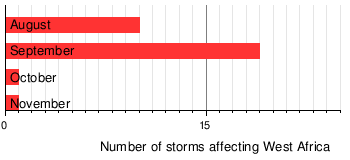
At least 31 tropical cyclones have affected Western Africa and its surrounding islands since records began in 1851. The majority of the storms affect West Africa and Cape Verde islands during the months of August and September which are the active months of a typical Atlantic hurricane season.[40]
Month Number of recorded storms
affecting West Africa
August 10
September 19
October 1
November 1


Deadliest storms

The following is a list of Atlantic tropical storms that caused fatalities in West Africa and its surrounding islands.
Name Year Number of deaths
Fran 1984 31
Delta 2005 19
Fred 2015 9
Beryl 1982 3
Helene 2018 3

See also

  • Tropical cyclones portal
  • Tropical cyclone
  • List of Atlantic hurricanes
  • List of notable tropical cyclones

References

  • Weather Underground (2007). "Weather Underground 1900 Archive". Retrieved 2007-01-11.
  • Weather Underground (2007). "Weather Underground 1901 Archive". Retrieved 2007-01-11.
  • Weather Underground (2007). "Weather Underground 1906 Archive". Retrieved 2007-01-11.
  • Weather Underground (2007). "Weather Underground 1927 Archive". Retrieved 2007-01-11.
  • Weather Underground (2007). "Weather Underground 1928 Archive". Retrieved 2007-01-11.
  • Weather Underground (2007). "Weather Underground 1938 Archive". Retrieved 2007-01-11.
  • Weather Underground (2007). "Weather Underground 1947 Archive". Retrieved 2007-01-10.
  • Weather Underground (2006). "Weather Underground 1948 Archive". Retrieved 2006-08-15.
  • Weather Underground (2006). "Weather Underground 1952 Archive". Retrieved 2006-08-02.
  • Weather Underground (2006). "Weather Underground 1953 Archive". Retrieved 2006-08-02.
  • Weather Underground (2006). "Weather Underground 1957 Archive". Retrieved 2006-08-02.
  • Weather Underground (2006). "Weather Underground 1958 Archive". Retrieved 2006-08-02.
  • Weather Underground (2006). "Weather Underground 1964 Archive". Retrieved 2006-08-02.
  • Weather Underground (2006). "Weather Underground 1967 Archive". Retrieved 2006-07-21.
  • Weather Underground (2006). "Weather Underground 1967 Archive". Retrieved 2006-07-24.
  • Arnold L. Sugg and Joseph M. Pelmisser (1968). "Hurricane Season of 1967" (PDF). NOAA. Retrieved 2006-07-24.
  • Weather Underground (2006). "Weather Underground 1968 Archive". Retrieved 2006-07-21.
  • Hurricane.com (2007). "Tropical Storm Christine (1973) best track data". Retrieved 2007-05-08.
  • Weather Underground (2006). "Weather Underground 1973 Archive". Retrieved 2006-07-21.
  • Weather Underground (2006). "Weather Underground 1979 Archive". Retrieved 2006-07-20.
  • Weather Underground (2006). "Weather Underground 1980 Archive". Retrieved 2006-07-21.
  • Gilbert C. Clark (1983). "Atlantic Hurricane Season of 1982" (PDF). NOAA. Archived from the original (PDF) on 2011-12-10. Retrieved 2006-07-17.
  • National Hurricane Center (2005). "The Deadliest Atlantic Tropical Cyclones, 1492-1996". NOAA. Retrieved 2006-07-17.
  • Weather Underground (2006). "Weather Underground 1984 Archive". Retrieved 2006-07-17.
  • Weather Underground (2006). "Weather Underground 1989 Archive". Retrieved 2006-07-17.
  • Weather Underground (2006). "Weather Underground 1998 Archive". Retrieved 2006-07-17.
  • Mayfield (1998). "Tropical Storm Jeanne Advisory #2". NOAA. Retrieved 2006-07-17.
  • Gary Paddget (2000). "Monthly Global Tropical Summary for June". Australian Severe Weather. Retrieved 2007-11-27.
  • Weather Underground (2006). "Weather Underground 2003 Archive". Retrieved 2006-07-17.
  • Alvia (2003). "Tropical Depression Fourteen Discussion #8". NOAA. Retrieved 2007-11-26.
  • Staff Writer (2005). "Delta force in the Canaries". Tenerife News. Archived from the original on September 28, 2007. Retrieved 2006-07-17.
  • Staff Writer (2005). "Delta: Aftermath and Impact". Tenerife News. Archived from the original on September 28, 2007. Retrieved 2006-07-17.
  • FORECASTER CANGIALOSI/BRENNAN (2010). "TROPICAL STORM IGOR ADVISORY NUMBER 5". NOAA. Retrieved 2010-09-10.
  • UNKNOWN (2010). "TROPICAL STORM IGOR CUMULATIVE WIND HISTORY". NOAA. Retrieved 2010-09-10.
  • Mohamed Moro Sacko (September 6, 2018). "Siguiri : Trois morts suite à des pluies duliviennnes à Doko" (in French). Guinea News. Retrieved September 8, 2018.
  • National Hurricane Center (2007). "NHC database". NOAA. Retrieved 2007-09-26.
  • National Hurricane Center (2007). "61641 Dakar, Senegal". NOAA. Retrieved 2007-09-26.
  • National Hurricane Center (2007). "61291 Bamako, Mali". NOAA. Retrieved 2007-09-26.
  • National Hurricane Center (2007). "61052 Niamey, Niger". NOAA. Retrieved 2007-09-26.
  • Chris Landsea (2007). "FAQ Subject: A2) What is a "Cape Verde" hurricane?". NOAA. Retrieved 2007-12-14.
  •  
    Categories:
    • Lists of tropical cy
    • clones by area
    • Tropical cyclones in Africa

    Navigation menu

    • Not logged in
    • Talk
    • Contributions
    • Create account
    • Log in
    • Article
    • Talk
    • Read
    • Edit
    • View history

    • Main page
    • Contents
    • Featured content
    • Current events
    • Random article
    • Donate to Wikipedia
    • Wikipedia store

    Interaction

    • Help
    • About Wikipedia
    • Community portal
    • Recent changes
    • Contact page

    Tools

    • What links here
    • Related changes
    • Upload file
    • Special pages
    • Permanent link
    • Page information
    • Wikidata item
    • Cite this page

    Print/export

    • Download as PDF
    • Printable version
    Αναρτήθηκε από ΝΕΚΡΟΣ ΓΙΑ ΤΟΝ ΚΟΣΜΟ στις 4:39 π.μ. Δεν υπάρχουν σχόλια:
    Αποστολή με μήνυμα ηλεκτρονικού ταχυδρομείου BlogThis!Κοινοποίηση στο XΜοιραστείτε το στο FacebookΚοινοποίηση στο Pinterest
    Ετικέτες Cabo Verde, Canary Islands, English, Guinea, Guinea-Bissau, History of Africa, Mali, Morocco, Natural Disasters, Niger, Senegal
    Παλαιότερες αναρτήσεις Αρχική σελίδα
    Προβολή έκδοσης κινητού
    Εγγραφή σε: Αναρτήσεις (Atom)

    Online Bible Search

    Online Bible Search
    Click on the icon

    Mother of God, Virgin Mary, Our Lady of Mozambique

    Mother of God, Virgin Mary, Our Lady of Mozambique
    Orthodox icon, work of the Greek artist Dionysius Palma

    About Orthodox Church... click on the icon

    About Orthodox Church... click on the icon
    With the term “Orthodox Church” we mean what is usually referred to as the “Eastern Orthodox Church” and not any of the numerous other religious communities that are self-styled “orthodox”, such as “orthodox protestants” or “orthodox non-Chalcedonians” (Egyptian Copts, Ethiopians, Syrians, etc.), which in our opinion can be inadvertently confusing.

    Orthodox Missionary Fraternity

    Orthodox Missionary Fraternity

    Orthodox Patriarchate of Alexandria

    Orthodox Patriarchate of Alexandria

    Αρχειοθήκη ιστολογίου

    • ▼  2026 (12)
      • ▼  Ιουνίου (1)
        • The True Dignity of Human Beings – Saint Gregory o...
      • ►  Απριλίου (4)
      • ►  Μαρτίου (3)
      • ►  Φεβρουαρίου (2)
      • ►  Ιανουαρίου (2)
    • ►  2025 (29)
      • ►  Οκτωβρίου (2)
      • ►  Σεπτεμβρίου (4)
      • ►  Αυγούστου (3)
      • ►  Ιουνίου (4)
      • ►  Μαΐου (1)
      • ►  Απριλίου (9)
      • ►  Μαρτίου (3)
      • ►  Φεβρουαρίου (3)
    • ►  2024 (17)
      • ►  Δεκεμβρίου (3)
      • ►  Νοεμβρίου (1)
      • ►  Αυγούστου (2)
      • ►  Ιουλίου (2)
      • ►  Ιουνίου (2)
      • ►  Μαΐου (2)
      • ►  Απριλίου (2)
      • ►  Μαρτίου (3)
    • ►  2023 (35)
      • ►  Δεκεμβρίου (1)
      • ►  Σεπτεμβρίου (2)
      • ►  Αυγούστου (4)
      • ►  Ιουλίου (3)
      • ►  Ιουνίου (6)
      • ►  Μαΐου (2)
      • ►  Απριλίου (12)
      • ►  Μαρτίου (1)
      • ►  Φεβρουαρίου (2)
      • ►  Ιανουαρίου (2)
    • ►  2022 (88)
      • ►  Δεκεμβρίου (6)
      • ►  Νοεμβρίου (3)
      • ►  Οκτωβρίου (5)
      • ►  Σεπτεμβρίου (3)
      • ►  Αυγούστου (5)
      • ►  Ιουλίου (3)
      • ►  Ιουνίου (6)
      • ►  Μαΐου (4)
      • ►  Απριλίου (13)
      • ►  Μαρτίου (8)
      • ►  Φεβρουαρίου (15)
      • ►  Ιανουαρίου (17)
    • ►  2021 (143)
      • ►  Δεκεμβρίου (14)
      • ►  Νοεμβρίου (11)
      • ►  Οκτωβρίου (14)
      • ►  Σεπτεμβρίου (10)
      • ►  Αυγούστου (16)
      • ►  Ιουλίου (10)
      • ►  Ιουνίου (16)
      • ►  Μαΐου (23)
      • ►  Απριλίου (17)
      • ►  Μαρτίου (5)
      • ►  Φεβρουαρίου (6)
      • ►  Ιανουαρίου (1)
    • ►  2020 (149)
      • ►  Δεκεμβρίου (3)
      • ►  Νοεμβρίου (2)
      • ►  Οκτωβρίου (1)
      • ►  Σεπτεμβρίου (8)
      • ►  Αυγούστου (11)
      • ►  Ιουλίου (14)
      • ►  Ιουνίου (19)
      • ►  Μαΐου (14)
      • ►  Απριλίου (15)
      • ►  Μαρτίου (18)
      • ►  Φεβρουαρίου (22)
      • ►  Ιανουαρίου (22)
    • ►  2019 (202)
      • ►  Δεκεμβρίου (14)
      • ►  Νοεμβρίου (14)
      • ►  Οκτωβρίου (20)
      • ►  Σεπτεμβρίου (39)
      • ►  Αυγούστου (17)
      • ►  Ιουλίου (21)
      • ►  Ιουνίου (18)
      • ►  Μαΐου (12)
      • ►  Απριλίου (13)
      • ►  Μαρτίου (9)
      • ►  Φεβρουαρίου (6)
      • ►  Ιανουαρίου (19)
    • ►  2018 (315)
      • ►  Δεκεμβρίου (19)
      • ►  Νοεμβρίου (19)
      • ►  Οκτωβρίου (22)
      • ►  Σεπτεμβρίου (16)
      • ►  Αυγούστου (19)
      • ►  Ιουλίου (25)
      • ►  Ιουνίου (16)
      • ►  Μαΐου (30)
      • ►  Απριλίου (36)
      • ►  Μαρτίου (37)
      • ►  Φεβρουαρίου (34)
      • ►  Ιανουαρίου (42)
    • ►  2017 (368)
      • ►  Δεκεμβρίου (44)
      • ►  Νοεμβρίου (29)
      • ►  Οκτωβρίου (21)
      • ►  Σεπτεμβρίου (27)
      • ►  Αυγούστου (26)
      • ►  Ιουλίου (38)
      • ►  Ιουνίου (31)
      • ►  Μαΐου (51)
      • ►  Απριλίου (30)
      • ►  Μαρτίου (27)
      • ►  Φεβρουαρίου (23)
      • ►  Ιανουαρίου (21)
    • ►  2016 (397)
      • ►  Δεκεμβρίου (22)
      • ►  Νοεμβρίου (18)
      • ►  Οκτωβρίου (21)
      • ►  Σεπτεμβρίου (14)
      • ►  Αυγούστου (47)
      • ►  Ιουλίου (46)
      • ►  Ιουνίου (40)
      • ►  Μαΐου (41)
      • ►  Απριλίου (36)
      • ►  Μαρτίου (29)
      • ►  Φεβρουαρίου (33)
      • ►  Ιανουαρίου (50)
    • ►  2015 (281)
      • ►  Δεκεμβρίου (32)
      • ►  Νοεμβρίου (24)
      • ►  Οκτωβρίου (47)
      • ►  Σεπτεμβρίου (90)
      • ►  Αυγούστου (68)
      • ►  Ιουλίου (20)

    OODE - ኦርቶዶክሳዊ ትምህርተ ዶግማ መድረክ // Amharic Eastern Orthodox website (ምስሉ ላይ ጠቅ ያድርጉ)

    OODE - ኦርቶዶክሳዊ ትምህርተ ዶግማ መድረክ // Amharic Eastern Orthodox website (ምስሉ ላይ ጠቅ ያድርጉ)

    African Orthodox Saints

    African Orthodox Saints
    Click on the icon

    In the Orthodox Vineyard of Africa

    In the Orthodox Vineyard of Africa
    A Greek Orthodox Christian Site for the Africa (click on the photo)

    Which Orthodox Saints are celebrating today?

    Which Orthodox Saints are celebrating today?
    Look at some of the Orthodox Christian saints who are celebrating today by clicking on the icon of All Saints Sunday.

    An African Guide for Orthodox Christians!...

    An African Guide for Orthodox Christians!...
    Click on the photo (Bishop Neophytos of Nyeri & Mt Kenya)

    A Bulletin of Orthodox Christian Faith from South Africa

    A Bulletin of Orthodox Christian Faith from South Africa
    "Evangelion" is a weekly Bulletin of Orthodox Christian faith that is made available to the Churches of the Archbishopric of Good Hope, South Africa. PDF files of past issues are available here (click on the image).

    Ετικέτες

    • Εating ourselves (61)
    • Abortion (6)
    • about demons (1)
    • Africa Day (2)
    • Africa’s Wars (94)
    • African Children (121)
    • African Clerics (108)
    • African Initiated Church (18)
    • African Languages (25)
    • African Music (6)
    • African Religion (11)
    • African Saints (207)
    • African Tribes (47)
    • African Union (2)
    • African Women (144)
    • Afrikaans (30)
    • Afrikan talous (1)
    • Afrikanische Heilige (2)
    • Afrikanische Kinder (1)
    • Afro-Americans (95)
    • Agricultural economy (25)
    • AgroIndustrie (4)
    • AIDS (13)
    • Albinos (3)
    • Alcoholism (1)
    • Algeria (18)
    • Amharic (14)
    • Amnesty International (17)
    • Anarchy (15)
    • Ancient Church (275)
    • Angels (15)
    • Angola (32)
    • Apartheid (8)
    • Arianism (1)
    • Arms trade (1)
    • Armut (6)
    • Ascension (3)
    • Atheism (3)
    • Auf Deutsch (20)
    • Australia (2)
    • Banyore (1)
    • Benin (23)
    • Berber (11)
    • Biafra (2)
    • Bildung (1)
    • Blood diamonds (10)
    • Bodi (2)
    • Botswana (13)
    • Bulgaria (2)
    • Bulgarian (2)
    • Burkina Faso (24)
    • Burundi (34)
    • Byzantium (58)
    • Cabo Verde (10)
    • Cameroon (40)
    • Canary Islands (2)
    • Cannibalism (1)
    • Capitalism (63)
    • Central African Republic (20)
    • Chad (20)
    • Chechi Orthodox (8)
    • Chichewa (1)
    • Child soldiers (17)
    • Childrenmụaka (1)
    • China (12)
    • Cholera (2)
    • Chọọchị Ọtọdọks (2)
    • Christmas (51)
    • Články o Africe (1)
    • Cocoa child slavery (6)
    • Colonialism (41)
    • Communism (6)
    • Comoros (2)
    • Congo (76)
    • Coronavirus (21)
    • Corruption (6)
    • Côte d’Ivoire (4)
    • Counterfeit drugs (3)
    • Crianças (3)
    • Czech (1)
    • Daasanach (1)
    • Darfur (1)
    • Death (32)
    • Decolonization (16)
    • Deification (14)
    • Democratic Republic of Congo (82)
    • Dictators in Africa (25)
    • Die Frau in Afrika (5)
    • Die heiligen (2)
    • diktatorische regime (1)
    • Direitos humanos (2)
    • Djibouti (8)
    • Dream Team of the Desert (58)
    • Drogas (1)
    • Droits de l'homme (1)
    • Drugs (2)
    • Easter (133)
    • Ebola (7)
    • Economy (5)
    • Ecumenical Patriarchate (9)
    • Education (40)
    • Eglise Orthodoxe (94)
    • Église orthodoxe en Afrique (82)
    • Egypt (122)
    • em Português (50)
    • Emerging Church (1)
    • en (1)
    • En español (1)
    • En Français (171)
    • Enfants soldats (1)
    • English (1506)
    • Equatorial Guinea (10)
    • Eritrea (16)
    • Esclavage (6)
    • Escravidão (1)
    • Español (1)
    • Ethiopia (80)
    • Farsi (1)
    • Fathers of the Church (64)
    • Femmes Africaines (9)
    • FGM (6)
    • Fiangonana ortodoksa (3)
    • Fiangonana ortodoksa any Afrika (2)
    • Finnish (8)
    • Flüchtlinge (1)
    • Friends of Africa (175)
    • Fula (1)
    • Fulani (2)
    • Gabon (14)
    • Gambia (8)
    • Gbagyi (1)
    • Georgian (1)
    • Geschichte Afrikas (1)
    • Ghana (38)
    • Ghosts (1)
    • Great Green Wall (1)
    • Greece (73)
    • Greek (148)
    • Groot Vastyd (2)
    • Guerra (4)
    • Guerre (6)
    • Guinea (20)
    • Guinea Bissau (1)
    • Guinea-Bissau (13)
    • Hamar (1)
    • Haratin (1)
    • Hausa (1)
    • Heiliges (3)
    • Hell (5)
    • Herero (3)
    • Héritage orthodoxe (39)
    • History of Africa (65)
    • Holy and Great Council of the Orthodox Church (6)
    • Holy Bible (68)
    • Holy Communion (11)
    • Holy Cross (15)
    • Holy Fire (3)
    • Holy Icons (36)
    • Holy Trinity (8)
    • Homosexuality (1)
    • Human Rights (48)
    • Human Trafficking (5)
    • Hunger (9)
    • Hymns (15)
    • Igbo (5)
    • Igreja Ortodoxa (23)
    • Ikone (1)
    • Immigration (10)
    • In Romanian (4)
    • in Search of Orthodoxy (103)
    • India (6)
    • International Orthodox Christian Charities (2)
    • International politics (28)
    • Interparliamentary Assembly on Orthodoxy (4)
    • IOCC (1)
    • ISIL (14)
    • Islam (25)
    • Islamists (37)
    • Isoko (1)
    • Italian (5)
    • Ivory Coast (33)
    • Japan (1)
    • Jazz (1)
    • Jesus Christ (97)
    • Jesus Prayer (3)
    • Jeûne (1)
    • Jeune Africaine (2)
    • Kamba (1)
    • Kaniisadda Orthodox (3)
    • Kanisa Katoliki (2)
    • Kanisa la Orthodox (30)
    • Kapitalismus (2)
    • Kara (1)
    • Kenya (133)
    • Kikuyu (8)
    • Kinyarwanda (1)
    • Kościół prawosławny w Afryce (1)
    • Köyhyyden (1)
    • Kriege (1)
    • Kru (1)
    • Kwegu (2)
    • la pauvreté en Afrique (5)
    • Lent (49)
    • Lesotho (9)
    • Liberia (22)
    • Libya (31)
    • Liturghia (14)
    • LRA (1)
    • Luganda (3)
    • Luhya (2)
    • Luo (2)
    • Luyia (1)
    • Maasai (14)
    • Madagascar (41)
    • Malagasy (3)
    • Malawi (27)
    • Mali (32)
    • Marriage (14)
    • Martyrs (157)
    • Mascarene Islands (5)
    • Matatizo ya Afrika (12)
    • Mauritania (13)
    • Mauritius (8)
    • Mayotte (3)
    • Medical care (45)
    • Mère de Dieu (2)
    • Mifananidzo Mitsvene (2)
    • Migrants (14)
    • Miracles (8)
    • Missionaries (131)
    • Monasticism (125)
    • Mormons/LDS Church (1)
    • Morocco (15)
    • Movies (11)
    • Mozambique (30)
    • Mulheres africanas (2)
    • Multinational corporations (30)
    • Multinationales (8)
    • Mumbi (1)
    • Mursi (3)
    • Music (5)
    • Nama (3)
    • Namibia (15)
    • Nandi (5)
    • National Parks (1)
    • Nationalism (16)
    • Native Americans (8)
    • Natural Disasters (2)
    • Natural Environment (46)
    • Nazism (20)
    • Ndokutenda kwekereke yedu (3)
    • Negro (1)
    • Neocolonialism (66)
    • Neocolonialismo (2)
    • Neokolonialismus (2)
    • New Martyrs (51)
    • News from Africa (1)
    • Niger (30)
    • Nigeria (80)
    • Njaa barani Afrika (3)
    • Noël (1)
    • Noma (1)
    • non-Chalcedonians (19)
    • Norwegian (1)
    • Nupe (1)
    • Nyangatom (1)
    • OAU (1)
    • Oosters-Ortodokse Kerk (28)
    • Orthodox Algeria (8)
    • Orthodox Angola (13)
    • Orthodox Benin (6)
    • Orthodox Botswana (4)
    • Orthodox Burkina Faso (4)
    • Orthodox Burundi (36)
    • Orthodox Cabo Verde (1)
    • Orthodox Cameroon (27)
    • Orthodox Canary Islands (1)
    • Orthodox Central African Republic (2)
    • Orthodox Chad (3)
    • Orthodox Congo (54)
    • Orthodox Democratic Republic of Congo (76)
    • Orthodox Djibouti (2)
    • Orthodox Egypt (144)
    • Orthodox Equatorial Guinea (2)
    • Orthodox Eritrea (1)
    • Orthodox Ethiopia (28)
    • Orthodox Gabon (8)
    • Orthodox Gambia (1)
    • Orthodox Ghana (19)
    • Orthodox Guinea (5)
    • Orthodox Guinea-Bissau (1)
    • Orthodox Ivory Coast (19)
    • Orthodox Kenya (130)
    • Orthodox Legacy (331)
    • Orthodox Liberia (2)
    • Orthodox Libya (19)
    • Orthodox Madagascar (42)
    • Orthodox Malawi (80)
    • Orthodox Mascarene Islands (7)
    • Orthodox Mauritania (3)
    • Orthodox Mauritius (7)
    • Orthodox Mission (187)
    • Orthodox Morocco (4)
    • Orthodox Mozambique (25)
    • Orthodox Namibia (2)
    • Orthodox Niger (3)
    • Orthodox Nigeria (25)
    • Orthodox Nitria (6)
    • Orthodox Republic of Congo (27)
    • Orthodox Réunion (13)
    • Orthodox Rwanda (26)
    • Orthodox São Tomé e Príncipe (1)
    • Orthodox Senegal (1)
    • Orthodox Seychelles (2)
    • Orthodox Sierra Leone (44)
    • Orthodox Somalia (4)
    • Orthodox Somaliland (1)
    • Orthodox South Africa (74)
    • Orthodox South Sudan (6)
    • Orthodox Sudan (3)
    • Orthodox Swaziland (1)
    • Orthodox Tanzania (45)
    • Orthodox Teachers (194)
    • Orthodox Togo (11)
    • Orthodox Tunisia (31)
    • Orthodox Uganda (96)
    • Orthodox Zambia (96)
    • Orthodox Zimbabwe (49)
    • Orthodoxe Kirche (5)
    • Orthodoxe Kirche in Afrika (5)
    • Orthodoxes Erbe (1)
    • Orthodoxes Mönchtum (1)
    • Ortodoks kirke i Afrika (1)
    • Ortodokse Christene in Afrika (11)
    • Ortodokse geestelike erfenis (23)
    • Ortodokse Kirke (1)
    • Ortodoxia na África (11)
    • Out of Africa (318)
    • Pan-African Parliament (5)
    • Patriarcat orthodoxe d'Alexandrie (8)
    • Patriarchate of Alexandria (85)
    • Peace (14)
    • Pentecost (19)
    • Pentecostal (13)
    • Pères de l’Église (10)
    • Piracy in Africa (3)
    • Pobreza (8)
    • Pogoro (1)
    • Politics (22)
    • Polskie (1)
    • Polygamy (5)
    • Poverty (133)
    • Pregnancy (4)
    • Protestantism (48)
    • Puntland (1)
    • Pygmies (6)
    • Pyhät (1)
    • Racism (48)
    • Rastafari (2)
    • Red Cross and Red Crescent (2)
    • Refugees (16)
    • Religions (18)
    • Republic of Congo (17)
    • Réunion (6)
    • Roman Catholics (23)
    • Romania (8)
    • Russia (14)
    • Russian (4)
    • Rwanda (36)
    • Saints (447)
    • San / Bushmen (1)
    • Santé (22)
    • Santos (4)
    • São Tomé e Príncipe (10)
    • Senegal (21)
    • Sex Slavery (17)
    • Seychelles (7)
    • Shanty Towns (9)
    • Shona (10)
    • Sierra Leone (50)
    • Sin (46)
    • Sklaverei (2)
    • Slavery (41)
    • Slavery today (40)
    • Somalia (37)
    • Somaliland (2)
    • Soomaali (4)
    • Sota (1)
    • Sotho (1)
    • Soudan (2)
    • South Africa (83)
    • South Sudan (14)
    • Sudan (34)
    • Suomeksi (2)
    • Suri (1)
    • Svenska (1)
    • Swahili (60)
    • Swazi (1)
    • Swaziland (7)
    • Syria (2)
    • Tanzania (41)
    • Teologia Dogmática Ortodoxa (2)
    • Teotokos (3)
    • Theophany (8)
    • Theotokos (78)
    • Tigray (4)
    • Togo (18)
    • Tortures (11)
    • Triodion (26)
    • Tuareg (2)
    • Tunisia (28)
    • Turism (1)
    • Turkana (8)
    • Uganda (80)
    • Umaskini (4)
    • ụmụ nwanyị (1)
    • UNICEF (7)
    • UNO (17)
    • Urbanization (1)
    • Utatu Mtakatifu (1)
    • Vatsvene vechiKristu veOrthodox (3)
    • Violence (144)
    • Virgem Maria (3)
    • Wakristo Orthodox ya Afrika (22)
    • Wamisionari (2)
    • Wanawake wa Afrika (5)
    • Wasserprobleme (1)
    • Watakatifu (8)
    • Water scarcity (17)
    • WHO (3)
    • Wirtschaft (2)
    • Witchcraft (16)
    • Yemen (4)
    • Yesu Kristo (8)
    • Yoruba (2)
    • Zambia (31)
    • Zimbabwe (54)
    • Zulu (5)
    • Zwaziland (2)
    • Православная Церковь в Африке (1)
    • الأرثوذكسية (8)
    • التأله (8)
    • السيدة مريم العذراء (1)
    • الكنيسة الأرثوذكسية (36)
    • باللغه العربيه (43)
    • من هو (1)
    • من هو يسوع (16)
    • يسوع (1)
    • ሴት (5)
    • ቅዱሳን (7)
    • አማርኛ (14)
    • ጋብቻ (4)
    • ጥንታዊ የኦርቶዶክስ ቤተክርስትያን (14)

    Members

    Liturghia Takatifu

    Liturghia Takatifu
    Bonyeza picha

    St Mark's Academy, South Africa

    St Mark's Academy, South Africa
    Click on the icon

    HOLY FIRE - The Miracle of the Light of the Resurrection at the Tomb of Jesus

    HOLY FIRE - The Miracle of the Light of the Resurrection at the Tomb of Jesus
    Seventy authors —fourteen French, nine Englishmen, seven Byzantine Greeks, six Germans, five Armenians, five Muslim Arabs, four Italians, four Persians, three Russians, three Icelanders, two Egyptians, two Chaldeans, one Syrian, one Moldavian, one Ethiopian, one Belgian, one Austrian and one Swiss— describe the greatest miracle of the Christian world: the Holy Fire (i.e., the Light of the Resurrection of Christ) which appears every Holy Saturday at the tomb of Jesus, a few hours before the celebration of his resurrection. Furthermore, the scientific measurements that were taken in the tomb of Jesus on Holy Saturday in 2008 by Associate Professor Antrey Volkov, confirm the descent of the Holy Fire and reveal three phenomena, which he himself characterizes as “incredible and entirely inexplicable.” (Click on the image)

    The Orthodox Church in Uganda, an outgrowth of indigenous self discovery

    The Orthodox Church in Uganda, an outgrowth of indigenous self discovery
    e-book about the Orthodox Church in Uganda (click on the icon)

    Links

    • Liturghia Takatifu
    • "THE WAY" - An Introduction to the Orthodox Faith
    • A Reader's Guide to Orthodox Icons
    • Africa news (en Français)
    • Africa news (in English)
    • Africa Portal
    • Africa Renewal
    • AFRICA W - Africa and the World
    • Africa.gm
    • African Centre for the Constructive Resolution of Disputes (ACCORD)
    • African Guide for Orthodox Christians
    • African Holocaust
    • African Orthodox Church of Kenya
    • Afrikaans Ortodoks - Kerk van die Heilige Maria die Egiptenaar
    • Al Orthodoxiya Radio Station (orthodox christian radio in arabic)
    • Al Orthodoxiya Radio Station / Facebook
    • allAfrica.com (en Français)
    • allAfrica.com (in English)
    • Ancientfaith, radio & blogs
    • Anti-Slavery International
    • Atlas of Torture - Observing the Situation of Torture Worldwide
    • Bishop Innocentios Byakatonda of Rwanda & Burundi
    • Brotherhood of St. Moses the Black
    • Death to the World
    • EGLISE ORTHODOXE DANS LE MONDE : Primats & Eglises Autocéphales
    • Eglise Orthodoxe de Cote d' Ivoire (Orthodox Church in Ivory Coast)
    • Eliud Muthiru - St Irene Orthodox mission centre, Kenya
    • Free the Slaves
    • Greek Orthodox Arab Community in Egypt - Patriarchate of Alexandria & All Africa
    • Hey Africa! - a new site dedicated to African news and personalities
    • In the Orthodox Vineyard of Africa
    • Incommunion - Website for the Orthodox Peace Fellowship
    • Inter-Orthodox Centre “Porefthendes” (= "go and make disciples of all nations", Matthew 28:19)
    • International Commitee of Red Cross
    • International Orthodox Christian Charities
    • Interparliamentary Assembly on Orthodoxy (I.A.O.)
    • Khanya
    • MY RAFIKI - Friendship beyond frontiers (from Greece to Africa)
    • News from the Patriarchate of Alexandria & all Africa
    • NORTHERN UGANDA MEDICAL CENTER
    • Orthodox Africa - Orphanage, Charity, Charities For Children
    • Orthodox Africa / Facebook
    • Orthodox Archbishopric of Good Hop, Cape Town
    • Orthodox Archbishopric of Johannesburg and Pretoria
    • Orthodox Christian Mission Center
    • Orthodox Christian Youth Network - Uganda "ocynu"
    • Orthodox Christians in Gauteng, South Africa
    • ORTHODOX CHURCH DIOCESE OF KISUMU AND WESTERN KENYA / Facebook
    • Orthodox Church in Cameroon
    • Orthodox Church in Cameroon - Facebook
    • Orthodox Church in Ghana
    • Orthodox Church in Madagascar
    • Orthodox Church in Madagascar - Facebook
    • Orthodox Church in Maputo, Mozambique
    • Orthodox Church in Tanzania
    • Orthodox Church in Uganda
    • Orthodox Church in Zimbabwe
    • Orthodox Church in Zimbabwe - Facebook
    • Orthodox Church of Mozambique - Facebook
    • Orthodox College of Africa, Nairobi, Kenya
    • Orthodox Education, the blog of Elenie (Poulos) Grassos
    • Orthodox in Southern Africa
    • Orthodox Kisumu (Diocese of Kisumu and Western Kenya)
    • Orthodox Metropolis of Zambia and Malawi
    • Orthodox Mission in Kamuli - Eastern Uganda
    • Orthodox Mission Magazine
    • Orthodox Missionary Fraternity
    • Orthodox Pages from South Africa
    • Orthodox Patriarchate of Alexandria and All Africa
    • Orthodoxa Mozambique
    • Orthodoxie.com / Afrique
    • Orthodoxologie - Ecrits de la Tradition Chrétienne Orthodoxe
    • Ortodokse kerkdienste ~ die tekste vir Ortodokse eredienste in Afrikaans
    • Our Africa
    • Oxfam Horn, East and Cendral Africa Blog
    • PAGES DE LA FOI ORTHODOXE
    • pambazuka.net - Pan-african Voices for Freedom and Justice
    • Panafricaniki (news from Africa), English & Français
    • Paradise 4 kids
    • PEMPTOUSIA | Mount Athos – Wisdom – Holiness
    • Pentikostari (Kitabu cha Kanisa la Orthodox, kilichotumiwa kutoka Pasaka mpaka Pentekoste)
    • Pere Basile Bonane, Rwamagana
    • Pere Jeremie Behanzin (Cote d' Ivoir)
    • Slate Afrique
    • St Barnabas Orthodox Mission, Kenya (a child-advocacy ministry)
    • St Mary of Egypt, a multi-cultural orthodox community in Kansas City
    • St Nicholas of Japan, a multi-ethnic orthodox parish in Johannesburg
    • St Tabitha Community Centre, Kibera
    • St Tabitha Foundation, Kibera
    • St. George Orthodox Community Hospital Kibera | Facebook
    • St. Mary of Egypt Convent, Uganda
    • St. Mary of Egypt Convent, Uganda (new site)
    • St. Nickolas Uganda Children's Fund
    • St. Simon of Cyrene Orthodox Mission
    • Stop the Traffik
    • The Hope Project
    • The Modern Monastic Order Of Saint Simon of Cyrene (African-American)
    • The our main weblog (English version)
    • The Sparrow / Tusikilize (A woman's voice for Africa)
    • Timotheos Ntumba (Eglise Saint Nicolas Bunia)
    • Transcend Media Service / Africa
    • Travelers on the Way to the Light
    • Uganda Orthodox Medical Bureau
    • Ugandan People
    • Union of Orthodox Church Mothers in Uganda
    • Womafrika / Being a Woman in Africa
    • Womafrika / Frausein in Afrika
    • راديو الأرثوذكسية

    Πληροφορίες

    Η φωτογραφία μου
    ΝΕΚΡΟΣ ΓΙΑ ΤΟΝ ΚΟΣΜΟ
    Προβολή πλήρους προφίλ
    Θέμα Υδατογράφημα. Από το Blogger.