We are Orthodox Christian Greeks.
Because we are Orthodox Christians, we love our country, our people and all the peoples of the earth; this of course includes our African brothers and sisters.
Τις ευχαριστίες του προς όλους τους μετέχοντες στη Διεθνή
Πρωτοβουλία για τη διαφύλαξη του Διεθνούς Status Quo της UNESCO, της
Ιεράς Μονής του Θεοβαδίστου Όρους Σινά, της Αγίας Αικατερίνης, εκφράζει
με επίστολή του ο Αρχιεπίσκοπος Σινά, Φαράν και Ραϊθώ και Ηγούμενος της
Ιεράς Μονής Αγίας Αικατερίνης Όρους Σινά κ. Δαμιανός.
Στην επιστολή ο Αρχιεπίσκοπος Σινά απευθύνει έκκληση για συστράτευση
στον τίμιο δίκαιο και ανυποχώρητο αγώνα για την πίστη και την αλήθεια.
“Ως Ηγούμενος της Ιεράς Μονής του Θεοβαδίστου Όρους Σινά και
Αγίας Αικατερίνης, με όλους τους Πατέρες της από κοινού, ευχαριστούμε
και επευλογούμε όλους για την συγκίνησι που μας έφερε το άκουσμα της
διεθνούς πρωτοβουλίας γιασυλλογή υπογραφών με αίτημα να μην αλλάξη η επί τουλάχιστον 1800 έτη αδιάκοπη παράδοσι του ασκητικού μας βίου∙
της προσευχής και της διακονίας μας στους πρόποδες της Θεοβαδίστου
Αγίας Κορυφής του όρους Χωρήβ, εδώ που ιστορείται ότι από τις αρχές του
3ου μ.Χ. αιώνος προσέφευγαν από τους διωγμούς οι πρώτοι μοναχοί γύρω από
τους χώρους της Αγίας Βάτου και του Φρέατος του Μωυσέως”, αναφέρει μεταξύ άλλων στην επιστολή του.
Σημειώνεται ότι σήμερα οΠρόεδρος της Δημοκρατίας Κωνσταντίνος
Αν. Τασούλας δέχθηκε τον Αρχιεπίσκοπο Σινά. Ο Σεβασμιώτατος απηύθυνε
πρόσκληση στον Πρόεδρο της Δημοκρατίας να παραστεί στο πανηγύρι της
Ιεράς Μονής Αγίας Αικατερίνης Σινά, το οποίο θα πραγματοποιηθεί στο
τέλος του χρόνου.
Παρακάτω η επιστολή:
Πρὸς τοὺς μετέχοντες στὴν Διεθνῆ Πρωτοβουλία γιὰ τὴν διαφύλαξι τοῦ Διεθνοῦς Status Quo τῆς UNESCO,
Σημειώνεται ότι η διεθνής πρωτοβουλία συλλογής υπογραφών φέρει τον τίτλο “Η κρίσιμη
ευθύνη της UNESCO όσον αφορά στην προστασία της Μονής Αγίας Αικατερίνης
στο Σινά” και δημοσιεύτηκε με μορφή επιστολής – έκκλησης προς την
εκτελεστική διευθύντρια της UNESCO κα Audrey Azoulay, στην πλατφόρμα AVAAZ- Ψηφίσματα πολιτών σε πέντε γλώσσες (ελληνικά, αγγλικά, γαλλικά, αραβικά και ρωσικά), όπου και γίνεται συλλογή υπογραφών.
Alexandria, in Northern Africa, became the most important centre of
research and study of the ancient world, due to the policies applied by
the Ptolemaic kings after the conquest of Egypt by Alexander the
Great. King Ptolemy established in 280 B.C. a museum in the south-west
part of the palace which housed foreign visitors, poets, scholars and
researchers. There he founded the Serapeion Temple, honouring the God
Serapis.
When Ptolemy II took power he established next to the Temple the
Serapeion Library. The Egyptian priest Manetho helped significantly in
this project. According to historical sources found in libraries and
temples of Memphis in Ain Shams, Manetho created replicas of Egyptian
texts in Greek, which were placed in the Serapeion Temple in Alexandria.
Manetho achieved three important goals, first he gave an overview of
ancient Egyptian history until the rule of the Ptolemies, secondly he
gave a collection of hieroglyphic writings containing philosophical and
theological explanations of the world and thirdly he gave numerous
references to the natural laws of science.
The library was comprised of general knowledge and philosophical texts
of the era form the ancient civilizations of Egypt, Babylon, Syria,
Persia and Greece. Also one could find scrolls from difference
disciplines, including language, rhetoric, jurisprudence, law,
geography, history, philosophy, logic, sport, engineering, medicine,
chemistry and physics. This was the first time in history, where human
heritage of many civilizations was accumulated into a single place and
in a language widely known to countless people, i.e. Greek, making it
possible for students from all around the known world to be able to
study at this school of thought and science. The Serapeion was hence the
first university in the world and it is due to this establishment that
countless students studied there from the 3rd century B.C. until the 4th
century A.D.
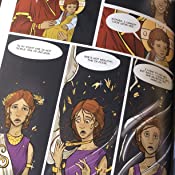
Gabriel
has done an excellent job of adapting the story of the Great and Holy
Martyr Katherine (305-313) into a gorgeously illustrated graphic novel
for ages 10 and up.
What a role model we find in this saint,
especially for girls! This young heroine loves learning. A governor's
daughter, she is intelligent, brave, and beautiful, but also very
confident. She tells her parents that she will enter into marriage only
with someone who has surpassed her in nobility, wealth, beauty, and
wisdom.
With the help of her secretly Christian mother, an elder monk,
and a miraculous dream, Katherine does find this Bridegroom, as she
ultimately chooses a Prince (of Peace) and puts her trust and hope in
Him.
Later,
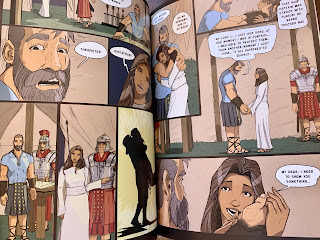
Katherine's city is visited by the emperor Maximian. He comes to
Alexandria for a pagan festival and Katherine is horrified that
Christians are being burned alive and sacrificed because of their
refusal to deny Christ. She is compelled to speak with the emperor and
tell him about the True God, asking him to stop the human sacrifices.
Katherine
is cast into the dungeon and is visited by St. Michael the Archangel.
After the emperor sends 50 of his most renowned philosophers to debate
Katherine, they not only believe in Christ, but bravely face death for
their belief.
Now comes the part of the story that really sounds
like it was made for a graphic novel: The Wheel. Katherine, our brave
heroine, will not deny Christ and voluntarily walks up to her declared
method of cruel torture. Suddenly, St. Michael appears and blows the
dreaded wheel to smithereens!
Witnessing Katherine's bravery and
faith, Maximian's wife also comes to believe, along with the emperor's
military commander and 200 soldiers, who are beheaded.
And
that's not all...though St. Katherine herself is ultimately is
beheaded, angels miraculously transport her body to Mt. Sinai, where it
was discovered years later. To this day, her relics are still on Mt.
Sinai, at St. Katherine's Monastery.
At the end of the book is a historical note, along with several icons and the Troparion and Kontakion to St. Katherine.
From Ancient Faith Publishing:
Young
Katherine, born into noble wealth with an insatiable hunger for
knowledge, surpasses even her tutors when it comes to learning. But her
learning counts for nothing when she meets the only man worthy of her -
her heavenly Bridegroom. Trading worldly knowledge for eternal wisdom,
Katherine challenges even the emperor himself - and he prepares a cruel
invention to break her. Meet this great bride of Christ in the second
graphic novel in the Among the Saints series - written to inspire both
children and adults.
About the Author: Gabriel Wilson lives near his childhood home in
rural Indiana with his wife Emily and their three daughters. Their home
is over 100 years old - a true fixer-upper - and the subject of many of
his woodworking projects. In his free time, he pursues carpentry and
music and enjoys making homemade tacos with his wife and sketching with
his daughters. Graphic novels are his favorite form of artwork, and
aside from his comics based on the lives of saints, he has other secular
novels in the works. His first graphic novel was The Cross and the
Stag. (read my review, here)
Blessed
first day of Advent (if you're an Orthodox Christian). St.
Katherine/Catherine is commemorated in the Orthodox Church on November
24 or 25, depending on the tradition. The Broken Wheel
is a nice sized soft cover book, 7 x 10 inches, with 104 pages. It
would make a wonderful gift for any Katherine/Catherine in your life.
A comment from here:
"This book is
an Orthodox graphic novel. Yes, you read that right.... a graphic novel
for Orthodox youth and it is BEAUTIFUL. The artwork leaps off the page
with vibrant colors, expressive characters, and page-turning drama. I
found myself engrossed in Katherine's story, as I watched her come to
know the faith at age thirteen and then valiantly defend that faith at
the age of 16.
This novel covers so many important moments of the life
of St. Katherine in a way that is appealing and enthralling for young
readers. Her martyrdom is beautifully handled in the novel as a moment
of triumphant and peaceful resolve with the Archangel Michael by
Katherine's side. As much as I loved reading this book as an adult, this
book would have been so meaningful for me as an Orthodox teen,
especially a female Orthodox teen. St. Katherine exemplifies all the
qualities we strive to achieve with her unshakeable faith, unyielding
strength, and ever-flowing grace. Her young age and the artistry of the
author, Gabriel Wilson, in bringing her story to life in a relatable
format for Orthodox youth is strikingly effective. This is a "must-have"
for every Orthodox teen! (I'll have to order a second copy to gift
because I love it so much I am keeping my first copy!)".
*****
The Cross and the Stag; the Incredible Adventures of Saint Eustathius
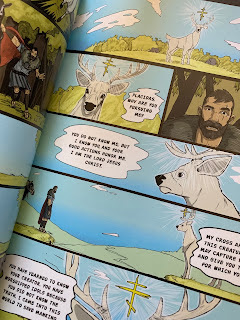
Today I'd like to introduce you to an inspiring new graphic novel for kids - The Cross and the Stag;the Incredible Adventures of Saint Eustathius, by Gabriel Wilson. It is Ancient Faith Publishing's
inaugural book into the graphic novel format, the first in their new
"Among the Saints" series written to inspire both children and adults. I am so excited about this book! Gabriel
Wilson's illustrations are striking, and graphic novels are a great way
to introduce kids to stories of the saints!
For those unfamiliar with graphic
novels, they are like comics, but the format is longer and the
self-contained story has a definite beginning, middle, and end. Wondering if graphic novels are a good fit for your child? Click on the link to explore this article from scholastic: A Guide to Using Graphic Novels with Children and Teens. Now, on to The Cross and the Stag...
This is one incredible adventure story,
about a very godly man and his brave family. Not all saint stories
would work well as graphic novels, but this one was practically begging
to for it! (As are many others - I can't wait to see what more will come
from Ancient Faith Publishing). In art school, author/artist Gabriel
Wilson became very interested in graphic design, animation, and comics
and was inspired to switch out super heroes for saints in his
comic-format stories! Drama, action, love, adventure, death, and hope -
they are all in this heroic tale.
Book description from AFP: He lost his wealth. He lost his family. He lost his station. He endured it all, to gain everything. Roman Commander Placidas was a man of
great power and influence. He and his family wanted for little, yet he
knew there had to be more to life. Once baptized into the Christian
faith as Eustathius, he faced trials beyond anything he had ever
experienced on the battlefield. His faith was challenged, but that same
faith gained him eternal life. Meet this great man in Ancient Faith
Publishing's first graphic novel.
Age Range: 7 years and up
Author/Illustrator: Gabriel Wilson
Format: Paperback
Dimensions: 7 x 10 inches
Page Length: 56 pages
Publisher: Ancient Faith Publishing
Listen to Bobby Maddex interview the author here, on Ancient Faith's podcast Ex Libris. And then order this book, available here.
"The
St Theodore the Tyro Orthodox Mission Church is the second
Afrikaans-speaking parish in the Archdiocese of Johannesburg and
Pretoria (the first one was in Eldorado Park, in Johannesburg). On the
lawn in front to the church is a statue of a stag with a cross between
its antlers. It represente the vision of St Eustathius, who once when
out hunting, saw a vision of such a stag. The statue was created by a Zimbabwean artist" (from our post about theNew Afrikaans Orthodox parish in South Africa).
Gleanings from a Book: “The Cross and the Stag” by Gabriel Wilson
Author’s note: Because I happened to
be in the right place at the right time, I was privileged to see a few
spreads of this book more than a year before its publication. Although
they were but sketches when I saw them, I was struck by their quality
and the images gripped me. And my first reading of the (now full-color)
book has confirmed what I suspected even then: this book is a treasure.
“The Cross and the Stag” by Gabriel Wilson
tells the true story of Placidas the soldier, who, amidst his worldly
successes and earthly means, was lovingly faithful to his wife and sons,
while also being very generous to those in need outside of his home.
Perhaps you have never heard of Placidas the Soldier? He was given the
name Eustathius at baptism. If you are not familiar with St. Eustathius,
either, his story is one that you will do well to learn. There is much
that each of us can learn from this saint: through his responses to both
misfortunes and pleasant experiences, and through his faithfulness to
God. Eustathius already had a good life when he first met Christ, and he
served Our Lord fervently after his conversion.
Just like many saints who had gone on
before him, Eustathius’ life did not continue to be “good” – well, at
least by worldly standards. However, also like those saints, he remained
faithful to Christ for his entire life. Like St. Paul, Eustathius had a
powerful visitation from Christ which became a conversion experience
for him and his household (although his wife had been mysteriously
forewarned in a dream, so she was ready!). Like Righteous Job the
Longsuffering, bit by bit Eustathius’ status, wealth, and finally even
his family were taken from him. Like Righteous Joseph the Patriarch, his
faithfulness in his work eventually brought Eustathius honor (and
miraculously his loved ones were restored to him once again, as well).
And finally, like the Three Holy Youths, the family faced a fiery
entrapment with faith and grace.
Throughout the book, Gabriel Wilson has
thoughtfully paired his images and text in a way which seamlessly tells
the story while also allowing the reader to read between the lines when
necessary. The illustrations are masterfully created, simultaneously
communicating actions and emotions in a way that is both tasteful and
effective. What a gift it is to have an artist of this caliber offer his
work to the Orthodox Christian world in a way that makes a saint’s
story so appealingly accessible to people of all ages!
Following St. Eustathius’ story in the
book, readers will find the troparion and kontakion for St. Eustathius.
There is also a spread featuring a variety of icons of him which have
been written. The book concludes with a few historical notes from the
author.
St. Eustathius’ story is gripping! I sat
down to just begin the book but ended up reading the whole thing in one
great gulp. Mystery, suspense, loss, love: all are found on the pages of
this beautiful work of art. I know that I’ll read it again, and I
suspect that I will not be the only one. There’s something here for
everyone. St. Eustathius’ story and the lessons that his life teaches us
will be treasured by each individual who reads this book.
Here are a few gleanings from the book
(this time, we are sharing the quotes in the context of their images),
as well as additional information about St. Eustathius:;
There’s even more of the story of St. Eustathius (including backstory of
his family’s experiences) in this detailed description of his life: https://pravoslavie.ru/74099.html
In the historical notes at the end of “The Cross and the Stag,” we
read that “St. Eustathius is the patron saint of hunters, firefighters,
and those who face adversity.” Author Gabriel Wilson also notes that
people request St. Eustathius’ prayers when they’re traveling over
rivers and seas. Readers facing adverse times (or traveling, hunting, or
firefighting) may be glad to learn this, and ask for his prayers.
*****
Theophano: A Byzantine Tale, the MUST read comic with the most beautiful illustrations
Images Credit: Chrysavgi Sakellaropoulou and Spyros Theocharis
A beautifully illustrated story by Chrysavgi Sakellaropoulou and
Spyros Theocharis has brought the East Roman Empire, or more commonly
known as the Byzantine Empire, to life with vivid imagery that captures
the imagination.
Theophano: A Byzantine Tale, is the story of a common girl who managed to become one of the most powerful women of 10th century medieval Europe.
Greek City Times spoke with both Sakellaropoulou, who prefers the
name Chrysa Sakel, and Theocharis, the two who brought this amazing
story to life.
Although Chrsa Sakel studied Chemistry, she told Greek City Times
that “my passion has always been art. I have been taking painting
lessons since childhood and I have created many classical artworks. Some
years ago, I began experimenting with digital art. This is how I got
involved in the project about Theophano.”
As for Theocharis, he said that he has always been a big fan of
historical fan fiction and a comic book fan, but studied English and
literature at university.
“For both of us, Theophano is a debut effort on the graphic novel scene,” they said.
Theocharis told Greek City Times that writing the comic book was not
so difficult, but the most challenging part was all the hours of
historical research “behind every page.” This has ensured that the story
is as authentic as can be to 10th century medieval East Rome.
For Chrysa, her greatest challenge was the “transition from classical
arts to digital art and comic book art” as it took a while for her to
develop her own style. “But, having the basic skills from the many years
of drawing in traditional medium, it only required a little research
and experimentation to manage to finish a project like that.”
The two said they always enjoyed watching medieval themed movies and
series like Game of Thrones, Vikings and The Lord of the Rings, but
Theocharis “always wondered why the Byzantine East never features in
fictional shows.”
“Byzantine history is full of stories which could easily become a series
or movies. So, having read a lot of books about Byzantium, I was
determined to create a story for a genre which could visually depict the
Byzantine world. Details such as the clothes, the architecture, the
lavish style of the Byzantine court can now be actually seen in the
pages of our graphic novel as we depict them according to our history
research. One example is the famous Cathedral of Hagia Sophia. Many
people would think that its interior resembled that of a typical
Orthodox church’s. From our research we found out that there were major
differences according to the descriptions in the primary sources,” he
explained.
Chrysa also added in her thoughts, saying that “series like Game of
Thrones gave us the motivation to start thinking about our own medieval
story, since some parts in the series reminded us a lot of what happened
in Byzantine history. We watched kings being poisoned, rebel generals
raising the banners to claim the throne, noble families allying and
betraying each other, eunuchs plotting according to their own interests
and ambitious women using unconventional means to climb the ladder of
power. Spyros already knew these things, but for me it was something
unexpected to read about the story of Theophano and the period she lived
in, and find out that it has so many exciting elements that are
movie-worthy.”
When asked whether Theophano was loosely based on a true story,
Theocharis said “the story is mostly based on historical facts with some
fictional additions to serve the cohesion of the narration.”
“Theophano, the protagonist of the story was a real historical
personality who may not feature as one of the highlighted personalities
of the Byzantine era, but her actions affected the course of Byzantine
history. In the primary sources, I found a lot of contradictory accounts
about her deeds and about her family background. This was actually
beneficial for me since I had the flexibility to alter the story without
the need to stray from the historical facts,” he told Greek City Times,
adding that “within the plot, the reader will stumble upon more
recognizable historical characters such as Nikephoros Phokas or John
Tzimiskes. There is also a character beyond the Byzantine world who
features in the second chapter and is known in countries like Ukraine
and Russia. I am speaking of Olga of Kiev, the famous saint. There has
been hours of historical research involved, combined with some parts
where I took the initiative to improvise a little bit so as to create a
narrative that could balance an interesting story combined with actual
historical events.”
Theocharis also explained that they chose this particularly time
period because it’s the point where the Byzantine Empire reaches its
medieval peak in terms of wealth, territorial expansion and culture.
“Many Byzantine artifacts which are hosted around museums all over
the world, were made during the 10th century. Many ancient Greek
manuscripts were saved from oblivion during that time. We must remember
that there was no printing press during that time and books were rare.
They had to be copied constantly in order to survive the test of time.,”
he said.
He also gave a vivid recount on just how rich and powerful the East Roman Empire was during this period.
“The Imperial palace was adorned with golden mosaics, there were at
least two throne rooms and the emperors did not have only one crown, but
many crowns which they used according to each ceremonial occasion. All
these indicate the splendor and the extravagance of an empire which
collectively has become known for its decline and backwardness. We
wanted to change that view and show how advanced the Byzantine world was
in the 10th century,” he added.
Chrysa also revealed to Greek City Times that they have plans to produce more graphic novels set in the Byzantine world.
“Right now we focus on Theophano and if this project is successful
then we are planning to produce a sequel. My dream is to someday have
enough time and produce a comic book script about the Alexiad. It’s a
catchy story which involves the crusaders and it is more familiar to a
western audience. I hope that the readers embrace this effort so that we
can have the means to continue with future project,” she said.
With such beautiful illustrations and untold hours of research, why would you not want to read Theophano?
Available now through Amazon (hardcover & digital format)
A fairytale marriage that goes terribly wrong, a ruling dynasty
struggling to keep everything together by having overly ambitious
eunuchs do the dirty work, and prominent Roman generals who dream of
taking the throne for themselves.
This explosive mixture of occurrences takes place in the 10th century
Medieval Roman Empire (aka The Byzantine Empire). An era of territorial
resurgence and massive Imperial extravagance, but also an era of
dynastic intrigues and endless plotting for the ultimate prize. The
Byzantine throne.
During that time, Anastasia, a common girl, marries the heir to the
throne, enters the palace and becomes Theophano an ambitious woman ready
to climb the ladder of power and sacrifice herself for her children.
Based on real historical events, this epic graphic novel offers an
immersion into a forgotten world. The world of the medieval Romans who
survived up until the Middle Ages with their capital, Constantinople
“the Queen of all cities” serving as a second Rome.
About the author:Spyros Theocharis was born in
Athens, Greece. He is a Graduate of the English language and literature
department of the university of Athens. He has been a Efl teacher for 10
years. He has lived in different countries experiencing life in both
urban and rural settings. Since childhood, he developed an interest in
mythology and history. It all began when he was six years old and came
across a book about the Ancient Greek gods. Tolkien’s books are his
“holy scriptures” and Byzantine history is his passion.
Chrysa
Sakel started taking classes on traditional painting when she was five years
old and has never stopped creating art ever since. After years of
working with traditional media, she began experimenting with digital
art. Her first project as a comic illustrator is the graphic novel
“Theophano: a Byzantine tale”. She plans to carry out many future
projects as a digital artist. (from here)
Saint Karion lived in Scetis in Egypt during the fourth century. He
became a monk and left his wife and two children behind in the world.
When a famine struck Egypt, Saint Karion’s wife brought the children to
the monastery and complained of their poverty and difficulties. The
saint took his son, Zachariah, and the daughter remained with the
mother.
He raised his son at the skete, and everyone knew that
Zachariah was his son. When the lad grew up, the brethren began to
grumble. The father and his son then went into the Thebaid, but
complaints about them arose there, too. Then Saint Zachariah went to
Lake Nitria, immersing himself in the foul-smelling water up to his
nostrils and he stayed there for an hour. His face and his body were
covered with welts, and he looked like a leper. Even his own father
hardly recognized him.
The next time Saint Zachariah came for Holy
Communion, it was revealed to the Saint Isidore the Presbyter what
Zachariah had done. The holy priest said to him, “Child, last Sunday you
communed as a man, but now you receive as an angel.”
After the
death of his father, Saint Zachariah began to struggle together with
Saint Moses the Black (August 28). “What must I do, to be saved?” asked
Saint Moses. Hearing this, Saint Zachariah fell to his knees and said:
“Why do you ask this of me, Father?”
“Believe me, my child, Zachariah,” Saint Moses continued, “I saw the Holy Spirit come down upon you, and that is why I ask you.”
Saint
Zachariah then took the koukoulion (cowl) from his head, trampling it
under his feet. After putting it on again he said, “If a man is not
willing to be treated this way, he cannot be a monk.”
Saint Moses asked Zachariah just before his death, “What do you see, brother?”
“Isn’t it better if I keep silent, Father?” Saint Zachariah replied.
“Yes, child, remain silent”, agreed Saint Moses.
When
the soul of Saint Zachariah was leaving his body, Abba Isidore lifted
his gaze toward the heavens and said, “Rejoice, Zachariah my child, for
the gates of the Kingdom of Heaven are opened to you.”
Saint Zachariah died towards the end of the fourth century and was buried in Skete with the Fathers.
By a flood of tears you made the desert fertile, / and your longing
for God brought forth fruits in abundance. / By the radiance of
miracles you illumined the whole universe! / O our holy fathers Karion
and Zachariah, pray to Christ our God to save our souls!
St John was Patriarch of Alexandria in the seventh century. When he was elected Patriarch he immediately asked that a list be drawn up of “all my masters, down to the least of them.” When asked what he meant by this strange request, St John replied “The people whom you call poor and beggars are my masters and helpers, for it is only they who can really help us and bring us to the Kingdom of Heaven.” The list ended up contains 7000 names, and to each one St John allotted a daily allowance of money.
St John then issued decrees about commerce, imposing penalties for those who cheated others in the markets, and then built seven hospitals, each with forty beds. To women who came to give birth in these hospitals, he gave a ‘maternity benefit’ upon leaving. He also built homes for the aged and infirm, and houses of hospitality for strangers.
He cared particularly for Syrian refugees when, in 614 the Persians invaded Syria. Many came to Alexandria, where he provided generously for them. The Persians also sacked Jerusalem, leading the saint to send large amounts of money and food to the city, and ransomed captives there.
St John was also a peacemaker. Twice a week he would sit outside his cathedral and would settle disagreements and advocate for justice for the oppressed. At one point, St John was stopped by a woman who was seeking a mediator for a conflict with her son-in-law, and the other religious officials tried to dismiss her and hurry St John along, no doubt to do what they considered important ecclesial work. St John rebuked them and said “How can I expect God to listen to my prayers if I do not listen to what this woman wants?”
St John loved to get money from the wealthy to give to the poor. One time a certain wealthy person tried to ingratiate the saint by buying him a lavish gift. St John sold it and gave the money to the poor, so another gift was given. This kept happening and St. John said “We shall see who gets tired of this first!” He would also say “If in order to help the needy one is able, without ill-will, to strip the rich down to their shirts, one is not doing wrong, especially if they are heartless skinflints.”
St John's compassion, mercy, and peaceability made him immensely popular with his people. Before him, Christianity in Alexandria was remarkably conflicted and at times violent, but through his peaceful mercy he was reportedly able to increase the number of churches tenfold.