Εμφάνιση αναρτήσεων με ετικέτα South Africa. Εμφάνιση όλων των αναρτήσεων

Παρασκευή 31 Ιουλίου 2020

African women: asserting their rights


From Africa Renewal: 

Michelle Bachelet, executive director of UN Women, the world body’s new agency on gender equality issues. 
Michelle Bachelet, executive director of UN Women, the world body’s new agency on gender equality issues.
Photograph: UN Photo / Paulo Filgueiras

As elsewhere in the world, women in Africa are struggling for their fair share of political power and economic opportunity. In recent decades — thanks in great measure to their own organization and energetic efforts — they have made important strides. As Africa shakes off its legacies of autocratic rule, social marginalization and economic disarray, women are staking their claim to participate fully in their continent’s promising future.
But progress has been halting and uneven, and each step forward has been won against difficult obstacles and stubborn resistance. As in many parts of the world, gender inequalities remain deeply entrenched. Women suffer violence and discrimination across the continent. They lack access to decent work and face occupational segregation and wage gaps. They are still too often denied access to education and health care. Few women are represented in key political and economic decision-making positions.
Accelerating women’s empowerment is obviously critical for women themselves. But as the UN’s global agency for women, UN Women, emphasizes, gender equality is more than just a basic human right: “Its achievement has enormous socio-economic ramifications. Empowering women fuels thriving economies, spurring productivity and growth.” When UN Secretary-General Ban Ki-moon launched UN Women in 2010, he observed: “Where women are educated and empowered, economies are more productive and strong. Where women are fully represented, societies are more peaceful and stable.”
Over the years, Africa Renewal has frequently reported on and analyzed many different aspects of the struggles of African women for political, economic and social advancement. This special edition of the magazine – with the generous support of UN Women — brings together a number of those articles, most of them with new and updated material.


The Africa Renewal articles highlight important developments at the summit of political power, such as the adoption by the African Union (AU) of a legally binding protocol to the African Charter on Human and Peoples’ Rights on the rights of women. The AU has also declared the current decade, 2010-2020, as the “African Women’s Decade.” A few countries, such as Angola, Mozambique and South Africa have exceeded the 30 per cent benchmark for women legislators, while Rwanda has the highest percentage in the world. But in all African countries women still have a long way to go.
In some areas gender gaps have narrowed noticeably, as in primary schools, where nearly as many girls as boys are now enrolled. But completion rates remain low, and many girls still are unable to go on to secondary or tertiary education. Meanwhile, health care for women and girls has scarcely improved, while HIV/AIDS continues to exact a deadly toll on Africa’s women.
Repeatedly, the articles in Africa Renewal have noted that it is the hard work and commitment of women at the grassroots that can make the difference: the women farmers, traders, entrepreneurs and activists who struggle day-in and day-out to better their lives and improve the prospects for their families, communities and nations. If Africa is to have a brighter future, gender equality must be achieved. 

African women’s long walk to freedom
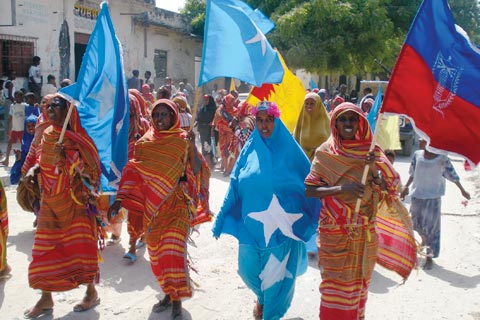
Across Africa, women’s movements are now putting more emphasis on decision-making power 
Across Africa, women’s movements are now putting more emphasis on decision-making power.
Photograph: Reuters / Mowliid Ibdi

Africa’s political independence was accompanied by a clarion call to eradicate poverty, illiteracy and disease. Fifty years after the end of colonialism, the question is: To what extent has the promise of that call been realized for African women? There is no doubt that African women’s long walk to freedom has yielded some results, however painfully and slowly.
The African Union (AU) now has a legally binding protocol to the African Charter on Human and Peoples’ Rights on the rights of women. The protocol spells out clearly women’s rights to equality and non-discrimination in a number of areas. It has been ratified by a growing number of African states, can be used in civil law proceedings and is being codified into domestic common law. The AU has also issued a Declaration on Gender Equality in Africa, under which member states are supposed to regularly report on progress.
The protocol and declaration both reflect and reinforce developments at the national level. Many African states have moved to enhance constitutional protections for African women — particularly in the area of women’s rights and equality. And the last two decades have seen the emergence of legislation to address violence against women, including sexual violence.
 
Political representation

These developments have been accompanied by improvements in African women’s political representation. The AU adopted, from its inception, a 50 per cent quota for women’s representation, which is reflected in the composition of the AU Commission.
Again, this standard reflects and reinforces efforts to enhance women’s representation at the national level. Angola, Mozambique and South Africa have exceeded the 30 per cent benchmark for their legislatures. Rwanda made history in 2008 when 56 per cent of legislators elected to parliament were women, the highest in the world. A few countries, including Nigeria, have seen women assume non-traditional ministerial portfolios, in defence and finance, for example. And Liberia also made history (“herstory”) by becoming the first African country to elect into office a female head of state, Ellen Johnson-Sirleaf.
Progress is evident, particularly in countries that have electoral systems based on or incorporating proportional representation. However, enhanced women’s representation has been harder to achieve in first-past-the-post electoral systems.
Even where there has been progress, the question is whether increased representation of women is catalyzing action by the executives and legislatures in favour of gender equality. That question arises because the battle for women’s representation is not only demographic (with political representation as an end) but also for gender equality (with political representation as a means).
Put another way, there has been a shift in the focus and strategy of the African women’s movement over the last two decades, from emphasizing capacity-building to improve African women’s access to resources to emphasizing decision making to enhance African women’s control over resources. This shift was made possible by real gains resulting from the capacity-building approach.
 
Education, poverty, health

These gains are most evident in African women’s education. Girls and boys are now at par with respect to primary school enrolment. Efforts to get girls into school have been accompanied by efforts to keep them in school and to promote role models by developing gender-responsive curricula. Gender gaps are also narrowing in secondary education. The real challenge now lies at the university level, both in the enrolment figures and in curricula to benefit young women. So much for the “illiteracy” element of the African independence clarion call.
Gains for women are harder to see in that call’s “poverty” element, however. It is true that since independence investments in micro-credit and micro-enterprises for women have improved their individual livelihoods — and therefore those of their families. Since African women have proved that they are good lending risks, micro-credit is now being offered not just by development and micro-finance institutions, but also by commercial financial institutions.
Yet there was a critique of such investments, especially in the decade of the 1980s when governments withdrew from social service delivery as a result of structural adjustment programmes. Under those circumstances, such investments essentially enabled redistribution among the impoverished, rather than at a larger level from the rich to the poor.
The end of that era thus saw a new focus on gender budgeting: looking at where national budget allocations and expenditures could enhance women’s status in the economy. Unsurprisingly, this approach has led African governments back towards public investments in social services.
It is now agreed, for example, that the benchmark for public investments in health in Africa is 15 per cent. The African women’s movement has called in particular for more to be directed towards reproductive and sexual health and rights. These areas are of critical concern to women, given the impact of HIV/AIDS, maternal mortality and violence against women, particularly in conflict areas. They are also of concern since African women’s continued lack of autonomy and choice over reproduction and sexuality lie at the heart of so much suffering. So much for the “disease” element of the independence call.
 
Where next?

Where to over the next 50 years, then? In light of the experience so far, the African women’s movement will be focusing not just on political representation, but also on the meaning of that representation for advancing gender equality and women’s human rights. And given recent retreats in Africa (such as the rise of the constitutional coup and “negotiated democracy”), the women’s movement will also be focusing on democracy, peace and security more broadly — that is, on the nature of the political system itself and not just on the means of getting into that system.
Economically, women will continue to focus on the macro-level, but in a deeper sense. What has emerged from gender budgeting efforts is the need to actually track budgetary expenditures, not just getting information about allocations.
It is also necessary to concentrate on the macro-economic framework for fiscal and monetary policies, especially in the context of stabilization programmes in response to the recent economic shocks. Previously that framework was assumed to be gender-neutral, but it clearly can have gendered consequences. This problem must be addressed to ensure that Africa’s growth will enhance women’s livelihoods.
Finally, the women’s movement will be focusing on reproductive and sexual health and rights. The battle over choice (including over gender identity and sexual orientation) is now an open one in many African countries. It is no longer couched politely in demographic or health terms.
The upsurge of conservative identity politics (in both ethnic and religious terms) is fuelling conflict on the continent. It constrains and dangerously limits women’s human rights, including reproductive and sexual rights. Such notions are not harmless — they have grave consequences for women’s autonomy, choice and bodily integrity. They therefore must be challenged.
African women’s long walk to freedom has only just begun.  

L. Muthoni Wanyeki is a former executive director of the Kenya Human Rights Commission.


Πέμπτη 25 Ιουνίου 2020

ST. MARK’S: A THEOLOGICAL ACADEMY WITH A DIFFERENCE (in South Africa)


stmarks
by Metropolitan Petros of Accra
Orthodoxy in dialogue
 
The Venerable and Ancient Patriarchate of Alexandria and All Africa has surprised us with its courage and initiative in the past. We need only recall the appointment of deaconesses by His Beatitude, Pope and Patriarch Theodoros II. While there was debate whether it constituted a true “ordination” (cheirotonia), rather than a blessing (cheirothesia), the fact remains that the Patriarchate took an initiative in such matters. The same can be said regarding the establishment of St. Mark’s Academy, offering theological education through distance learning. Other such Academies exist, but St. Mark’s promises a quality, contemporary, and challenging curriculum. Situated in Johannesburg, South Africa, by making use of electronic media it makes learning available to all, regardless of distance and location. In addition, due to favourable exchange rates for foreign students, tuition is affordable to many.
The faculty presently consists of a group of five highly qualified academics and an external independent moderator. Between them, there are five with doctorates and one with a master’s degree. More academics will be sourced as the need arises. The staff also consists of persons responsible for administration and financial issues.
St. Mark’s pilot course is the three-year Programme in Orthodox Christian Studies. It is not yet an accredited diploma, but is recognized by the Church. The Academy has been working together with the South African Department for Higher Education for accreditation. Presently, they require that students be present in Johannesburg for a formal written examination. This would greatly add to the cost. The Academy is exploring other possibilities.
The Programme covers the necessary subjects of Scripture, doctrine, liturgics, and church history, but also brings the faith to life as “theory becomes practice” in personal and social ethics, spiritual life, and pastoral care. Students are challenged to consider the relationship between the Church and the churches, their differences in beliefs and outlook, and the dialogues and meetings aiming at mutual understanding and greater unity. Contemporary theologies—liberation, feminist, African, alternative, etc.—are explored, as well as the Church’s response to these.  
Finally, a concise view of World Religions is offered, together with modules in missiology—the mission of the Church to the world and proclaiming the Gospel to all nations, something very dear to the heart of this Patriarchate.
It is possible that students may want to take single modules from the Programme, but St Mark’s cannot guarantee that, should the student be registered elsewhere, the credits would be recognised.
Each module includes an intensive reading programme. The Academy is presently developing an online library that contains the required and recommended set works. This is a substantial savings in costs of books that would otherwise need to be ordered. Students receive the syllabus, bibliography, and course objectives. They are guided in their reading and are given a series of questions and an essay topic to work on and submit within the allocated time. The final semester requires a longer assignment or research project on a topic of the student’s choice. After a successful three years, the student receives a Certificate in Orthodox Christian Theology.
Short courses on various topics are offered at various times, but tend, for the moment, to require physical presence.
Exciting prospects are open in the field of post-graduate studies (master’s and doctorates) as the Academy explores the prospect of “twinning” with a local, accredited college that would offer the degrees the recognition that students deserve. St. Mark’s will keep students and prospective students informed of developments.  
Under the auspices of the Patriarchate and the direction of Metropolitan Petros (Parginos) of Accra, who recently attained his doctorate, the Academy already has numerous students from such diverse places all over the world as Egypt, Italy, Belgium, Portugal, Zambia, and South Africa.
Registration may take place on one of two occasions, in time for the semester beginning in January or the one beginning in July.
Additional information can be found on the website of St. Mark’s Academy under Academic Programmes and Student Information, or by writing directly to info@stmarksacademy.co.za. 
Follow St. Mark’s Academy on Facebook.
Metropolitan Petros (Parginos) of Accra was born in Johannesburg, South Africa. After matriculating from SAHETI School he studied English and Greek Literature at the Universities of the Witwatersrand and of Johannesburg. He taught Greek language and culture at Saheti and was appointed head of the Greek Department for the high school.
In 1998 he was ordained to the diaconate and to the priesthood, and later obtained an MA in theology from Balamand, focusing on ecclesiology, and a second MA from the Catholic College of St Augustine in Johannesburg, focusing on spirituality and the Orthodox neptic tradition. He attended courses in Christian ethics, education, ecumenical and interreligious dialogue, pastoral care, and psychology. He holds a Licentiate in Logotherapy (existential psychology).
In 2019 he completed a Doctorate through the University of the North West, focusing on the dialogue of the Orthodox Church with the Roman Catholic Church.
In 2017, with the blessings of His Beatitude, the Pope and Patriarch of Alexandria and All Africa, Theodoros II and of the Holy Synod, he founded, organised, and administers St. Mark’s Academy, which offers theological education by means of distance learning, using electronic and online means of communication.
His Eminence was ordained to the episcopate as Metropolitan of Accra on December 6, 2019. In his episcopal ordination speech (full text here), he called for a Church “that is not afraid to debate, not only with other churches, confessions, and religions, but with the contemporary world and the sciences,” a Church “that is the voice and the harbour of the underprivileged, the persecuted, the forgotten, the marginalized, those that have need of compassion and humanity.”
 
See also

Orthodox South Africa
The Orthodox Church in the Republic of South Africa
St Nicholas of Japan, a multi-ethnic orthodox parish in Johannesburg
Afrikaans Ortodoks
 
 
Orthodox Mission in Tropical Africa (& the Decolonization of Africa)
How “White” is the Orthodox Church?

Orthodoxy and culture
 

Κυριακή 24 Μαΐου 2020

News from Africa


PanAfrikaniki
 

Τετάρτη 13 Μαΐου 2020

Stephen Hayes, "The Year of the Dragon", a novel from South Africa


In the 1950s, when Lovecraft Country is set, black American fans of such literature were on the outside looking in, but what about Africa? African culture is different from American culture, and most of the literature of that kind that we have to read is from overseas somewhere. I was once reading The Lion, the Witch and the Wardrobe to some black South African children, and there were many foreign cultural references that needed to be explained. The only African literature that seems to me to be comparable is Amos Tutuola's My life in the bush of ghosts, but I think that is more for adults than for children. (from here)

I tried to write a children’s book with a South African setting, Of Wheels and Witches, and David was about to say something about the use of these tropes in that, but we moved quickly on to discussing other books. But, perhaps rather weirdly, in the light of Boneland, my recently-published The Year of the Dragon features some of the same characters as adults. (from here)

The Year of the Dragon
Smashwords

The year is 1988.
For 40 years the world has been in the grip of the Cold War, and South Africa has been in the grip of apartheid. For 71 years Russia has been under Bolshevik tyranny. Though few suspect it, this is about to change for ever.
On a farm in the picturesque southern Drakensberg of South Africa a woman dies, and a young lawyer, Richard Rutherford, and his friend Denis Walters combine business with a pleasure weekend in the mountains. They will visit the farm to take the first steps in settling the estate. They soon discover that others also have an interest in the estate, or at least some items in it, and that they are prepared to kill for them.
The contentious items seem to be some old Russian ikons, but how they got to a remote farm and why others are so anxious to get hold of them is a mystery. The search for answers leads them to a strange hermit and an even stranger priest, and a drive of a thousand miles in search of King Lobengula’s legendary treasure. 

Σάββατο 28 Μαρτίου 2020

Coronavirus (COVID-19) in Africa


Panafrikaniki.com/english/

Africa: The World Before This Coronavirus and After Cannot Be the Same


As COVID-19 Pandemic Rages, Women and Girls Are Even More At Risk

East Africa: EA Health Ministers Draw Covid – 19 Mitigation Plan 

Africa: Aid Organizations Scramble to Plan for COVID-19 Shutdowns
 

Nigeria: ‘Lagos’ COVID-19 Cases May Rise to 39,000′
 

Cameroon: Nation Should Protect Prison Population From COVID-19 

Ghana: Summary of the Restrictions Imposed on Selected Areas by Govt for Two Weeks

Coronavirus: 150 Tunisians self-isolate in factory to make masks
 

Morocco allocates cash for 100 000 coronavirus test kits
 

Nigeria struggles towards shutdown as virus fears grow
 

Central African Republic steps up measures after virus case
 

Coronavirus in Cameroon: Can the virus be a catalyst for peace?
 

WHO warns of ‘dramatic evolution’ of virus in Africa
 

Congo-Kinshasa: Lawyers Oppose Contacting Victims Before Setting Ntaganda Reparations Award 

Kenya: Dozens Injured As Police Brutality Marks Start of Curfew 

Uganda police shoot 2 for violating movement ban

Senegal: 10-minute coronavirus test may be on its way – for $1

Virus fears prompt Zimbabwe to let citizens pay in US dollars

Africa: MSF Calls For No Patents or Profiteering on COVID-19 Drugs, Tests, Vaccines


COVID-10 in Africa

Mozambique: Number of COVID-19 Cases Rises to Seven

Namibia: Lodge Locked Down After French Tourist Tests Positive For COVID-19

South Africa: COVID-19 – Testing to Be Ramped Up and New Tests in Pipeline

South Africa: The First Two Coronavirus Deaths – This Is What We Know

Seychelles: China, Abu Dhabi Donate Tonnes of Medical Supplies to Seychelles to Fight COVID-19


Δευτέρα 16 Μαρτίου 2020

Africa in 2019: regime change, a Peace Prize, cutting ties with the franc

 Maintaining progress is very hard, but always possible

Ethiopia - Planting Avocado Trees. Prime Minister Abiy Ahmed wants 4 billion trees planted.  Photo: Flickr

Mathew Otieno  
Mercatornet

At the beginning of each year since 2017 I have written an article looking back on how Africa, this dear old continent, fared in the year just-ended, and to outline its prospects in the year ahead. I find it more difficult to do this year than ever before. Last year was one of the most nuanced I have ever seen.
However, I will begin by summarising what I believe to be the most important stories of 2019, at the same time providing updates on some of the big stories of 2018, which you can read about here.
A year ago I speculated on the direction of South Africa after the fall of Jacob Zuma. Well, the South African parliament went on to elect Cyril Ramaphosa, who had taken over as interim president, to a definitive five-year presidential term. He was sworn in in May. It is still too early to evaluate his administration, but he has not been spared trouble since his ascendancy.
In Kenya, the “Handshake,” a 2018 pact between Uhuru Kenyatta and Raila Odinga which calmed nerves following the contested presidential election of 2017, and whose official name is the Building Bridges Initiative (BBI), delivered its long-awaited baby. It came in the form of a 156-page report, launched at a raucous convention in November.
The document has divided opinion. It is seen through the lens of the upcoming 2022 general elections more than as a means to its stated goal. Which stated goal is to unite the country around a core of shared values and forestall the possibility of chaotic future elections by addressing historical injustices and economic equality.
It has been sent to a second-round of public participation, ostensibly as a means to further legitimise it, but it won’t lose its tag as a cog in succession politics ahead of the next elections. This means its usefulness will be short-lived and it likely will not contribute a thing to the achievement of its stated goals.
In Sudan, Omar al Bashir got kicked out of the presidency almost exactly three months after my article, in which I speculated that he would be overthrown. But then the military, which had changed sides and helped topple him, tried to take his place with a two-year transitional government, ignoring calls by protesters for a civilian government.
In response, the people of Sudan went back onto the streets and did not desist until the military gave in. In August, an agreement for a hybrid transitional government – made up of the military and civilian representatives – was reached. In September a new cabinet was sworn in. The new government set itself an ambitious target of getting a handle on two major issues – peace and the economy – in 200 days. Now it has less than 100.
Further north, Algeria handed Bouteflika his exit card in April, just before Bashir. After ruling Algeria for over 20 years and surviving the 2011 Arab Spring, he resigned in response to unrelenting popular protests. The problems which contributed to the protests are far from being solved, but getting rid of Bouteflika was a good beginning. The country gained another victory by beating Senegal to win the Africa Cup of Nations three months later.
In Zimbabwe, former president Robert Mugabe passed on in September. He died in disgrace, having been forced out of power by a coup barely two years earlier. But the disgrace was, thankfully, tempered by his legacy as an African independence hero. For this, he got a well-deserved state funeral.
Mugabe’s reputation is also tempered by the failure of those who took over from him to bring Zimbabwe back from the ruin to which he led it. Things seem to have taken a turn for the worse. The economy is headed for collapse, and political freedoms are in retreat. To encourage the people of Zimbabwe, I can only refer them to Martin Luther King’s “arc of the moral universe” quote – a favourite of Obama.
Speaking of moral matters, population controllers did not relent in their efforts to bring Africa into the fold of the culture of death. Luckily, resistance was not lacking. For instance, when they locked out pro-life participants from the Nairobi Summit on ICPD25, held to mark the 25th anniversary of the 1994 United Nations “International Conference on Population and Development,” a parallel conference championing family values was convened. It also helped that the United States led a coalition of countries to oppose the summit, further denying it legitimacy.
If only these birth control crusaders could leave us alone. We had enough problems to contend with in 2019. In March, Ethiopia witnessed its deadliest plane crash ever, in which all 157 passengers and crew passed on. This accident touched close home, not just because Ethiopia neighbours Kenya, where I live, but also because the flight was headed for Nairobi, so that a large number of the casualties were Kenyan.
Then there were Idai and Kenneth, two hurricanes which hit south-eastern Africa around the same time, claiming hundreds of lives and leaving millions of people vulnerable. Hurricanes rarely visit us, and many African countries are not prepared for them. The year ended with another freak weather event when extra heavy rains brought with them devastating floods, especially to eastern and central Africa.
Good news, of course, was not lacking. In October, Eliud Kipchoge, Kenyan marathoner extraordinaire, ran a marathon in under two hours, 20 seconds under two hours, to be precise, so that it would be patently foolish to doubt that he did it. In the same month Abiy Ahmed, the Prime Minister of Ethiopia, won the Nobel Peace Prize.
I didn’t see that one coming, even though I sang his praises in my January 2019 review article. Earlier, in July, Abiy had led his country to plant a record 350 million tree seedlings in a single day, as part of a campaign to plant 4 billion trees in the year to combat deforestation and desertification.
For me, the end-of-year surprise for 2019 came from the CFA (Financial Community of Africa) bloc, which pledged to replace the CFA franc with a new one currency called the “Eco”. The CFA Franc, which is currently used by eight African countries, was instituted by France for its African colonies in 1945. It (alongside the structures that support it) has been seen as an instrument of neo-colonial domination, and calls for its removal have grown in recent times.
This is not the right time to launch into a polemic against France’s colonial legacy in Africa. It is enough to say that the allusion of the Italian deputy prime minister, in January, to France’s constant and detrimental meddling in Africa, which set off a diplomatic row between his country and France, had the flavour of truth.
The announcement of the impending overhaul of the CFA franc, together with the fact that practically all African countries have now ratified the African Continental Free Trade Area (AfCFTA), are, to me, the most consequential structural developments for the continent’s future. With enough goodwill on the part of those tasked with implementing them, the boundless potential of this continent will be much sooner unleashed.
I summarised 2019 as one of hope. I do not know how to characterise the year we have just started. In many ways, the stories we tell this year will be more particular to the struggles of each country and each people. But they will also be more African, because we ride from the same past and face the same future.
Before I close, I wish to leave you with this beautiful selection of photos, compiled by the BBC, depicting some of the stories of Africa from 2019.

Mathew Otieno writes from Nairobi, Kenya.

Σάββατο 14 Μαρτίου 2020

Why has coronavirus largely spared Africa?


The continent was much better prepared than many thought
 

January 2019 at Beni in DRC Congo, the frontline of the fight against Ebola. 

mercatornet.com

When it became clear that the novel coronavirus coming out of China was destined to be a pandemic, international concern quickly zeroed in on how countries with weak health systems, most of which are in Africa, would be affected. It was feared that they would be quickly overwhelmed by the virus and left reeling.
The continent’s exposure to China, occasioned by its deep commercial ties with the country, was the main source of concern, as shown by a brilliant modelling study analysing this risk, which came out on The Lancet. The World Health Organization and other international health agencies scrambled to provide technical assistance, and helped procure test kits and laboratory trainings for various African countries.
I do not discount the concern, and I appreciate the effort that was put into making sure African countries had a fighting chance. In fact, the apprehension was not limited to international quarters. Locally, many were worried that our governments were taking this too lightly. Even I took pot-shots at the Kenyan government for its apparent laxity.
The only problem is that the virus has largely spared Africa so far. It is true that several countries, from Egypt to South Africa, have recorded cases, and more are cropping up each day. Egypt seems to be having the roughest time of it, with a Nile cruise ship at the centre of a recent spike in cases. But much of the rest of the continent still has no cases.
This curiously low incidence rate has left many puzzled. Of the more than 100,000 cases worldwide, only a handful are in Africa, and more than half of those are in Egypt. Initially, it was feared that the disease might have already landed on the continent, unflagged by faulty detection mechanisms, and was festering, ready to burst forth when it was beyond control.
It is possible that this is the case, but the fear still hasn’t panned out. Instead, it is starting to emerge that in the midst of all the hand-wringing over how Africa would fare, some crucial information was overlooked. I have been able to identify two particularly important ones. In tandem, they may have placed a crucial role in shielding Africa from this outbreak.
The first is that Africa is not as exposed to China as many initially thought. China’s ties with Africa, though deep and significant for the continent, do not measure up to its relations with North America and Europe. It may be the biggest trading partner of many African countries but, in absolute terms, this is dwarfed by its trade with the rest of the world.
The case may be made that more Chinese travel to Europe and North America each year than have ever come to Africa. Chinese travellers made a total of 130 million foreign trips in 2017. Of these, only about 0.8 million (0.62%) were to Africa, and the total number of Chinese on the continent is estimated at about 2 million. In short, the rest of the world is way more exposed than Africa to China.
That study in The Lancet that I referred to earlier actually compared these different exposure levels, but it is deep inside the discussion section. For a real-life illustration, one need only look at the infection pattern of the virus. For most of its brief history, it has behaved as if Africa didn’t exist. And when it finally showed up, it came from everywhere except China. In fact, most cases so far have been of European origin, with a few cases originating elsewhere.
The second overlooked factor is that African countries might have the widest field experience in tackling outbreaks of viral diseases. From Ebola to Lasso fever to Zika, African countries have dealt with multiple outbreaks in recent memory. Thanks to this, they have developed extensive experience and capacity. Even the main drug being trialled for the new virus, remdesivir, has already been put  through its paces in African Ebola hotspots.
This experience has come in handy. For instance, the first coronavirus case in Sub-Saharan Africa was recorded in Nigeria, a country that eradicated Ebola in just three months during the 2013-2016 West African outbreak, and was already handling an outbreak of Lasso fever, a deadlier viral disease, when Covid-19 broke. The patient, an Italian, was put in quarantine, and all traceable contacts were isolated. One of them is now Nigeria’s second confirmed case.
While reporters note [tweet and article] that they could still enter the US without being screened, African countries (including the small, relatively un-exposed ones) have become fortresses against the virus. All entry points, for all they are worth, are heavily monitored, with masked officials taking temperatures and flagging suspicious cases.
From the outset, many countries already had the infrastructure in place for this exercise. I can personally attest to it; while re-entering Kenya from Uganda back in December 2019, I was screened for Ebola. Since the primary screening method for both viruses, taking temperatures at entry points, is the same, all that was needed was to beef up the operation, rather than starting from scratch.
This level of unwitting preparedness, combined with our lower exposure to China, is possibly the main reason Africa’s coronavirus incidence rates have remained low for so long. Thanks to it, our governments have had more time than the rest of the world to build specific capacity to tackle the new virus. I may yet be proven wrong, but it seems our fragile health systems were better prepared than those of most advanced countries.
Just to underscore this, on March 3, the last Ebola patient left the treatment centre in Beni, the scene of the latest outbreak of the disease in the Democratic Republic of the Congo. It took over a year to stamp out the outbreak, and the victory was celebrated with song and dance. But the world didn’t notice, because everyone was freaking out about the new virus.
On March 10, the DRC recorded its first Covid-19 case. The world had better watch how the country handles this new challenge. There might be a thing or two to be learnt.

Note: It should be obvious, but this is an article about a fast-moving story, so things may have changed by the time you read it.

Also, I am not an expert in disease management. My treatment of this issue is entirely from a layman’s perspective.

Mathew Otieno writes from Nairobi, Kenya.

See also
Coronavirus (COVID-19) in Africa