We are Orthodox Christian Greeks.
Because we are Orthodox Christians, we love our country, our people and all the peoples of the earth; this of course includes our African brothers and sisters.
Η καμπάνια είχε ξεκινήσει κάποια χρόνια πριν (το βίντεο έχει
μεταφορτωθεί το 2007) αλλά εξακολουθεί να είναι σοκαριστική!!! Κοίτα λίγα
δευτερόλεπτα την κάθε εικόνα και σκέψου ακριβώς αυτό: μπορεί να μην
συμβαίνει ακριβώς δίπλα σου...όμως.... ΣΥΜΒΑΙΝΕΙ και δυστυχώς καθημερινά
συμβαίνουν πολύ χειρότερα πράγματα....
Σοκάρει και συγκλονίζει η καμπάνια της Διεθνούς Αμνηστίας που έχει
κατακλύσει την πόλη της Ζυρίχης. Με σλόγκαν «Δε συμβαίνει εδώ, αλλά
συμβαίνει τώρα» οι αφίσες έχουν σκοπό να ευαισθητοποιήσουν το κοινό για
τι συμβαίνει στον κόσμο.
Η καμπάνια είναι μία έμπνευση του γραφείου Walker Werbeagentur Zuerich
και χρησιμοποιώντας διάφανες πινακίδες και το σλόγκαν «Δε συμβαίνει εδώ,
αλλά συμβαίνει τώρα» διάφορες γλώσσες, όπως Γαλλικά και Γερμανικά,
δείχνουν συγκλονιστικά στιγμιότυπα από το Ιράκ, την Κίνα και το Σουδάν,
ανοίγοντας ένα παράθυρο στον κόσμο και παρουσιάζοντας στο κοινό τι
συμβαίνει στον πλανήτη εκείνη τη στιγμή, ακόμα κι αν δε συμβαίνει
μπροστά τους στη στάση του λεωφορείου.
Τις ευχαριστίες του προς όλους τους μετέχοντες στη Διεθνή
Πρωτοβουλία για τη διαφύλαξη του Διεθνούς Status Quo της UNESCO, της
Ιεράς Μονής του Θεοβαδίστου Όρους Σινά, της Αγίας Αικατερίνης, εκφράζει
με επίστολή του ο Αρχιεπίσκοπος Σινά, Φαράν και Ραϊθώ και Ηγούμενος της
Ιεράς Μονής Αγίας Αικατερίνης Όρους Σινά κ. Δαμιανός.
Στην επιστολή ο Αρχιεπίσκοπος Σινά απευθύνει έκκληση για συστράτευση
στον τίμιο δίκαιο και ανυποχώρητο αγώνα για την πίστη και την αλήθεια.
“Ως Ηγούμενος της Ιεράς Μονής του Θεοβαδίστου Όρους Σινά και
Αγίας Αικατερίνης, με όλους τους Πατέρες της από κοινού, ευχαριστούμε
και επευλογούμε όλους για την συγκίνησι που μας έφερε το άκουσμα της
διεθνούς πρωτοβουλίας γιασυλλογή υπογραφών με αίτημα να μην αλλάξη η επί τουλάχιστον 1800 έτη αδιάκοπη παράδοσι του ασκητικού μας βίου∙
της προσευχής και της διακονίας μας στους πρόποδες της Θεοβαδίστου
Αγίας Κορυφής του όρους Χωρήβ, εδώ που ιστορείται ότι από τις αρχές του
3ου μ.Χ. αιώνος προσέφευγαν από τους διωγμούς οι πρώτοι μοναχοί γύρω από
τους χώρους της Αγίας Βάτου και του Φρέατος του Μωυσέως”, αναφέρει μεταξύ άλλων στην επιστολή του.
Σημειώνεται ότι σήμερα οΠρόεδρος της Δημοκρατίας Κωνσταντίνος
Αν. Τασούλας δέχθηκε τον Αρχιεπίσκοπο Σινά. Ο Σεβασμιώτατος απηύθυνε
πρόσκληση στον Πρόεδρο της Δημοκρατίας να παραστεί στο πανηγύρι της
Ιεράς Μονής Αγίας Αικατερίνης Σινά, το οποίο θα πραγματοποιηθεί στο
τέλος του χρόνου.
Παρακάτω η επιστολή:
Πρὸς τοὺς μετέχοντες στὴν Διεθνῆ Πρωτοβουλία γιὰ τὴν διαφύλαξι τοῦ Διεθνοῦς Status Quo τῆς UNESCO,
Σημειώνεται ότι η διεθνής πρωτοβουλία συλλογής υπογραφών φέρει τον τίτλο “Η κρίσιμη
ευθύνη της UNESCO όσον αφορά στην προστασία της Μονής Αγίας Αικατερίνης
στο Σινά” και δημοσιεύτηκε με μορφή επιστολής – έκκλησης προς την
εκτελεστική διευθύντρια της UNESCO κα Audrey Azoulay, στην πλατφόρμα AVAAZ- Ψηφίσματα πολιτών σε πέντε γλώσσες (ελληνικά, αγγλικά, γαλλικά, αραβικά και ρωσικά), όπου και γίνεται συλλογή υπογραφών.
Μετάφραση
από τα αγγλικά. Εισαγωγή: Ένα γκρουπ προτεσταντών, κατά βάσιν πρώην
φυλακισμένων και άστεγων, με τον πάστορα της κοινότητάς τους,
επισκέπτονται διάφορες χριστιανικές εκκλησίες άλλων κοινοτήτων και
καταλήγουν σε μια ελληνορθόδοξη εκκλησία, μέρος πρωτόγνωρο γι' αυτούς.
Εκεί απορούν γιατί υπάρχουν εικόνες, αφού οι προτεστάντες δεν
αποδέχονται τις εικόνες λόγω της Παλαιάς Διαθήκης.
... Ακούγοντας αυτή την ερώτηση, με υπομονή και
ευγένεια, ο ιερέας εξήγησε ότι τη συγκεκριμένη ημέρα οι Ορθόδοξες
Εκκλησίες γιορτάζουν την Αγία Αγάθη.
Τότε ο Ιερέας άρχισε να περιγράφει στην ομάδα μας τη ζωή της Αγίας
Αγάθης. Δήλωσε ότι η Αγία Αγάθη έζησε στην Ιταλία τον τρίτο αιώνα και
ότι ήταν οπαδός του Χριστού. Η Αγάθη ήταν μια όμορφη νεαρή γυναίκα, την
οποία πολλοί άντρες ήθελαν να παντρευτούν. Όμως η Αγκάθα, ως οπαδός του
Χριστού, ήθελε να διατηρήσει την αγνότητά της και να ζήσει ως παρθένος για χάρη του Σωτήρα της και επέλεξε να μην παντρευτεί.
Ένας πλούσιος
ειδωλολάτρης με το όνομα Κουιντιανός, συνεπαρμένος από την ομορφιά της, ζήτησε το χέρι της. Η Αγάθη αρνήθηκε τις προτάσεις του και του δήλωσε ότι ήθελε να παραμείνει αγνή για ολόκληρη
τη ζωή της. Ο Κουιντιανός, εξαγριωμένος από την απόρριψη της Αγάθης,
αρχικά τη διαπόμπευσε στο κέντρο της πόλης και, με
τους κατοίκους να παρακολουθούν, έβαλε τους
υπηρέτες του να κόψουν το στήθος της! Στη συνέχεια, ζήτησε και
πάλι για τελευταία φορά για το χέρι της (λες και ο προηγούμενος
απάνθρωπος ακρωτηριασμός μπορούσε να αναγκάσει κάποιον να παντρευτεί)
και πάλι η Αγάθη τον επέπληξε και δεσμεύτηκε στον Χριστό και στην
αγιότητα. Και πάλι, τροφοδοτημένος από την οργή, ο Κουιντιανός ως
τελευταία τελική πράξη - για να εκμεταλλευτεί την επιθυμία της Αγκάθα για
αγνότητα - την ανάγκασε να ξεγυμνωθεί μπροστά σε όλους τους θεατές της πόλης
και μετά την έσυρε μέχρι θανάτου δεμένη πίσω από μια άμαξα.
Καθώς ο Ιερέας μας είπε αυτή τη δραματική
ιστορία, παρατήρησα από την άκρη του ματιού μου ότι ένας από τους κυρίους
της ομάδας συμπεριφερόταν κάπως περίεργα. Κάπως περπατούσε, έσφιγγε τις
γροθιές του και μουρμούρισε κάτω από την ανάσα του. Έμοιαζε σαν να
περνούσε τα όρια μεταξύ θυμού και κλάματος. Δεν γνώριζα πραγματικά αυτόν
τον συγκεκριμένο άνθρωπο, που θα τον ονομάσουμε "Σον", καθώς ήταν
νέος στο γκρουπ και στο πρόγραμμά μας. Ο Σον ήταν οπτικά εκφοβιστικός
καθώς στεκόταν 6 πόδια 3 ίντσες, είχε έντονα μάτια και τατουάζ σε όλο
του το πρόσωπο. Έμοιαζε με τον γίγαντα στην ταινία "Το Πράσινο Μίλι", αλλά
πιο τρομακτικός.
Το μυαλό μου έτρεχε καθώς άρχισα να παρατηρώ
ότι αυτός ο γιγαντιαίος άντρας απογοητεύεται όλο και περισσότερο.
Έπαιξαν άσχημα σενάρια στο μυαλό μου: Θα έβαζε νοκ-άουτ αυτόν τον
ευγενικό, γέρο ιερέα; Ήταν να ξεσπάσει σε κλάματα; Θα
προσπαθούσε να καταστρέψει την εικόνα της Αγίας Αγάθης; Αποφάσισα,
διστακτικά, να πάω και να μιλήσω με τον Σον για να προσπαθήσω να τον
ηρεμήσω. Μη έχοντας ακόμη δημιουργήσει εμπιστοσύνη με τον Σον, προσπάθησα
να είμαι συμπονετικός με τον μεγαλόσωμο άντρα.
Του είπα, «Σον, τι συμβαίνει φίλε; Μπορώ να πω
ότι είσαι εκνευρισμένος… Υπάρχει κάτι που μπορώ να κάνω για σένα αυτή
τη στιγμή;»
Συνεχίζοντας να βηματίζει, σφίγγοντας τη γροθιά
του και με δάκρυα στα μάτια, μου είπε θυμωμένος: «Γιατί να το κάνουν
αυτό;»
«Δεν ξέρω, Σον, οι εικόνες δεν είναι
μέρος της παράδοσής μου», του απάντησα υποθέτοντας ότι μιλούσε για την εικόνα.
Εκείνος απέκρουσε την απάντησή μου, «Όχι, γιατί να την κάνουν αγία;»
Και πάλι απάντησα: «Δεν ξέρω, Σον, δεν καταλαβαίνω πλήρως τους αγίους».
Εκείνος απάντησε, κλαίγοντας σε αυτό το σημείο, «Γιατί να την κάνουν παράδειγμα;»
«Δεν ξέρω, Σον» είναι το μόνο που θα μπορούσα
να καταλήξω. Ο Σον δεν γρονθοκόπησε τον ιερέα ούτε ανέτρεψε το
εικονίδιο.
Συναντήθηκα με τον Σον την επόμενη μέρα, καθώς
ήθελα να καταλάβω τι είχε συμβεί. Ο Σον έσπασε εκείνη την ημέρα στο
γραφείο μου. Μου
εξήγησε πως η μαμά του είχε βιαστεί ως έφηβη και ότι η εγκυμοσύνη της με
τον Σον ήταν το αποτέλεσμα αυτού του βιασμού. Μου περιέγραψε με
παραστατικές λεπτομέρειες πως σχεδόν καθημερινά η μητέρα του τού
υπενθύμιζε ότι ήταν αποτέλεσμα βιασμού και τον τιμωρούσε συνήθως γι'
αυτό. Στη συνέχεια, ο Σον περιέγραψε πώς, ως αποτέλεσμα όλου του πόνου
που ένιωθε στη ζωή του και όλης της κακομεταχείρισης που είχε δεχτεί,
προχώρησε επίσης να πληγώσει άλλους σε όλη του τη ζωή.
Στη συνέχεια, μου εξήγησε ότι στο άκουσμα της
ιστορίας της Αγίας Αγάθης θεώρησε αδιανόητο πώς κάποιος τέτοιος άνθρωπος, κάποιος
που κακοποιήθηκε τόσο σκληρά, θα μπορούσε να είναι παράδειγμα για τη
χριστιανική πίστη. Ήταν ακόμη πιο μπερδεμένο για τον Σον ότι κάποιος
σαν την Αγάθη μπορούσε να θεωρηθεί άγιος. Ήταν έκπληκτος με το πώς ο
Θεός και μια Εκκλησία μπορούσαν να κοιτάξουν κάποιον τόσο κατεστραμμένο,
τόσο συντετριμμένο, και να δηλώσουν ότι κάποιος σαν την Αγάθη είναι
άγιος.
Ο Σον είδε τον εαυτό του στη ζωή της Αγίας Αγάθης. Έβλεπε στη ζωή της έναν οδηγό για τη δική του. Έβλεπε στην
ελπίδα της το δικό του μαρτύριο. Είχε βρει έναν Σωτήρα που δεν τον
θεώρησε καταραμένο ή πολύ συντετριμμένο για σωτηρία. Είχε βρει μια
Εκκλησία που του έδινε την ευκαιρία, έστω και με όλη του τη ντροπή και
τη συντριβή του, να γίνει κάτι πέρα από τα ελαττώματά του. Άρχισε τη
διαδικασία να αναγνωρίσει ότι μέσα στον Χριστό υπήρχε ελπίδα να γίνει
άγιος και ακόμη και να γίνει παράδειγμα πίστης για τους άλλους. Ότι υπήρχε
ένας τόπος και ένας σκοπός στη ζωή του και ότι όλος ο πόνος που βίωσε θα
μπορούσε να είναι μέρος της στροφής του προς την αγιότητα.
Ο Σον
εντάχθηκε σε αυτήν την Ορθόδοξη Εκκλησία. Βλέποντας έναν Αφροαμερικανό 6 πόδια 3 ίντσες
με τατουάζ στο πρόσωπο να στέκεται ανάμεσα σε Ελληνίδες γιαγιάδες σε
μια ελληνική γιορτή, να γελούν μαζί και να μοιράζονται αστεία, ήταν σαν
να έβλεπες μια μικρή γεύση από τον παράδεισο.
This article was written on the occasion
of the feast of the holy Virgin Martyr Markella of Chios (the
'Chiopolitis' - a native of Chios, Greece), whose memory is
commemorated on July 22nd.
Saint Markella
was murdered with unprecedented ferocity by her own father, who
was obsessed with sexual lust for her! The girl resisted his
wishes to the death – literally - but he finally chased her to
the shore and slaughtered her when she became trapped among the
rocks! The people of Chios confirm that every year, on the day
of her memory, the waters at the site of her slaughter turn red
by themselves, as if they too want to honour the pure, virgin
blood that was so unjustly and tragically spilled there.
The saint is characterized as
'Virgin-Martyr', because 'virgin' in the ancient Greek language
(parthenos) does not only mean a person who is sexually
untouched and pure; it is also used when referring to a girl (a
young woman, mainly a teenager - unmarried of course). A
Christian girl who has not been married is taken for granted to
be physically (sexually) unmolested, which is why the Greek terms for 'daughter'
and 'virgin' have become synonymous. This is why young and
unmarried women who had martyred for their faith in Christ and His
teaching are called 'Virgin Martyrs'.Examples of Virgin Martyrs are Saint Marina, Saint
Kyriake, Saint Paraskeve, Saint Christina, Saint Barbara, Saint
Ekaterina, e.a.. The first four mentioned here arecommemorated
in July.
The feast-day of St. Markella
marks the commemoration of her exceptionally brutal martyrdom
(by an abhorrent example of a father
who had lost his senses
with carnal lust for his daughter to such a degree that he
finally hunted her down and slaughtered her
far more viciously than the slaughteringof a lamb);
a martyrdom that conveys
through the centuries a profoundly shocking message
regarding child abuse. The element
underlying her story that has left a deep impression in people
more than any other is precisely the shocking manner of her
death and the natural perpetrator of her murder.
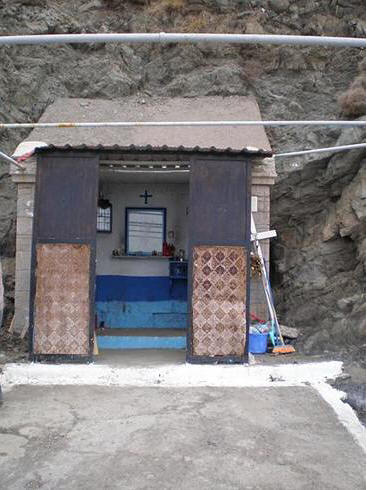
Location marking where the martyr was slaughtered and the water turns blood-red annually on her feast-day.
Shrine on the
coast - facing the
martyr's place of
martyrdom
The Monastery of Saint Markella on Chios
Island, Greece
The same is true for the feast day of the
Holy Great
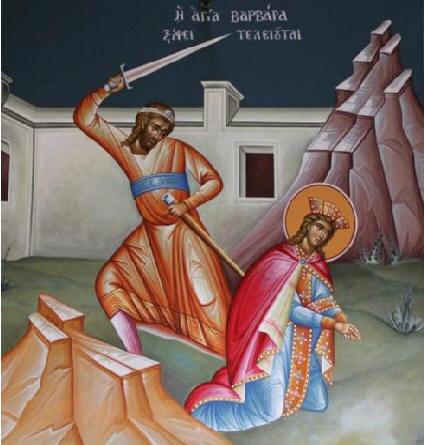
Martyr Barbara (December 4th), where the
predominant element of her life that has impressed people is the fact that her own father
betrayed her to the Romans as a Christian, allowing her to be subjected to gruesome torture and finally,upon his personal insistence,
to be decapitated
by his own hand
(only to be struck and killed
by a bolt of lightning a few days later). This detail is the reason Saint Barbara has been established
in Greece as the
patron saint of the Military Division of Heavy Artillery.
Saint Barbara being decapitated by her father
Two other (but less well-known) saints who were murdered by their
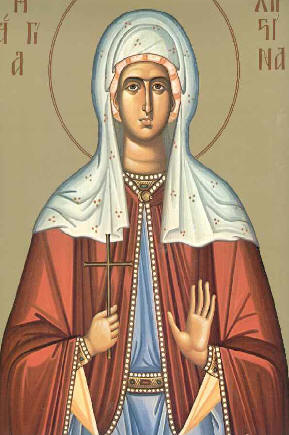
father are the Great Martyr Christina, horrifically
tortured for being a Christian (commemorated July 24th)
Saint Christina
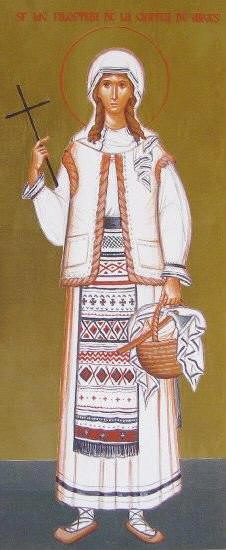
and Saint Philothea of Arges, Romania, (commemorated
December 7th). Orphaned on the mother’s side and with
an abusive stepmother, the saint was mortally wounded by her
father (possibly not intending to kill her) because she
was giving away to the poor most of the food her stepmother
would give her to take to her father working in the fields. She
was only 12 years old!
Saint Philothea of Arges, Romania
We might also mention two married Christianwomen who were victims of domestic violence
and are also honoured by the Church as martyrs: they are the
Saints both named Thomais: Saint Thomais of Lesvos Islqnd, Greece
(commemorated January 3rd) who was beaten to death by
her husband, and Saint Thomais of Alexandria,
Egypt (commemorated April 14th), who was murdered
by her father-in-law for resisting his sexual desires!
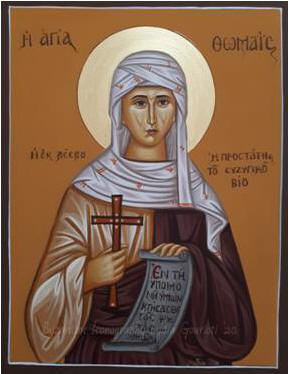
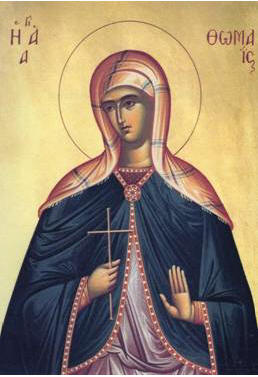
Saint Thomais of Lesvos
Island (Greece) & Saint Thomais of Alexandria Egypt
The conclusion
one reaches
from all the above
instances is that domestic violence and child abuse was brought
to light by Christians and openly denounced
through the Christian Synaxarions (Books of Saints’ biographies)
mentioning
womenvictims of
such violence who are
commemorated annually by the
Church as saints and martyrs.
It must be emphasized that a person
is deified (recognized by
the Church as a saint), through
evidence of their
unyielding faith and
love for Christ. They have alsobeen recognized as
saints for steadfastly defending
their moral Christian principles to their
dying breath - and not
merely because they happened to have fallen
victims to a certain kind of criminal behaviour. The same
applies to all the martyrs who had preferred torture and death
rather than betray their faith and their moral principles. Most
of them would have attained sainthood anyway, for having lived
holy lives; although a holy life
was also
understood as an occasion
for them to be tested unto death,even sacrificing their very lives
and - according to Orthodox Christianity – anticipating they have earnedEternity.
Ota Benga (c. 1883[2] – March 20, 1916) was a Mbuti (Congo pygmy) man, known for being featured in an exhibit at the 1904 Louisiana Purchase Exposition in St. Louis, Missouri, and as a human zoo exhibit in 1906 at the Bronx Zoo. Benga had been purchased from native African slave traders by the explorer Samuel Phillips Verner,[3]
a businessman searching for African people for the exhibition, who took
him to the United States. While at the Bronx Zoo, Benga was allowed to
walk the grounds before and after he was exhibited in the zoo's Monkey
House. Benga was placed in a cage with an orangutan as a lampoon on Darwinism.
To enhance the primitive image and presumably protect himself if need
be from the ape, he was given a functional bow and arrow. He used this
instead to shoot at visitors who mocked him and partially as a result of
this the exhibition was ended.[4]
Except for a brief visit to Africa with Verner after the close of the
St. Louis Fair, Benga lived in the United States, mostly in Virginia, for the rest of his life.
In 1910, Gordon arranged for Benga to be cared for in Lynchburg, Virginia, where he paid for his clothes and to have his sharpened teethcapped.
This would enable Benga to be more readily accepted in local society.
Benga was tutored in English and began to work at a Lynchburg tobacco
factory.
He tried to return to Africa, but the outbreak of World War I in 1914 stopped all ship passenger travel. Benga developed depression, and died by suicide in 1916.[5]
Early life
As a member of the Mbuti people,[6] Ota Benga lived in equatorial forests near the Kasai River in what was then the Congo Free State. His people were attacked by the Force Publique, established by King Leopold II of Belgium
as a militia to oppress the local people and communities, most of whom
were used as forced laborers in the extraction and exploitation of
Congo's massive supply of rubber.[7]
Benga's wife and two children were slaughtered; he survived because he
was on a hunting expedition when the Force Publique attacked his
village. He was later captured by slave traders from the enemy
"Baschelel" (Bashilele) tribe.[8][9]
In 1904, American businessman and explorer Samuel Phillips Verner traveled to Africa,[10] under contract from the St. Louis World Fair, to bring back an assortment of pygmies to be part of an exhibition.[11] Verner came across Benga while en route to a Batwa
pygmy village visited previously. He purchased Benga from the Bashilele
slave traders, giving them a pound of salt and a bolt of cloth in
exchange.[12][8] Verner later claimed he had rescued Benga from cannibals.[13]
The two spent several weeks together before reaching the Batwa village. The villagers did not trust the muzungu
("white man"). Verner was unable to recruit any villagers to join him
for travel to the United States until Benga said that the muzungu
had saved his life, and spoke of the bond that had grown between them
and his own curiosity about the world Verner came from. Four Batwa, all
male, ultimately decided to accompany them. Verner also recruited other
Africans who were not pygmies: five men from the Bakuba, including the son of King Ndombe, ruler of the Bakuba; and other related peoples.[14][15]
Exhibitions
St. Louis World Fair
Benga (second from left) and the Batwa in St. Louis
The group was taken to St. Louis, Missouri, in late June 1904 without Verner, as he had been taken ill with malaria.
The Louisiana Purchase Exposition had already begun, and the Africans
immediately became the center of attention. Benga was particularly
popular, and his name was reported variously by the press as Artiba, Autobank,[16]Ota Bang, and Otabenga. He had an amiable personality, and visitors were eager to see his teeth that had been filed to sharp points
in his early youth as ritual decoration. The Africans learned to charge
for photographs and performances. One newspaper account promoted Benga
as "the only genuine African cannibal in America", and claimed that "[his teeth were] worth the five cents he charges for showing them to visitors".[14]
Benga in 1904
When Verner arrived a month later, he realized the pygmies were more
prisoners than performers. Their attempts to congregate peacefully in
the forest on Sundays were thwarted by the crowds' fascination with
them. McGee's attempts to present a "serious" scientific exhibit were
also overturned. On July 28, 1904, the Africans performed to the crowd's
preconceived notion that they were "savages", resulting in the First
Illinois Regiment being called in to control the mob. Benga and the
other Africans eventually performed in a warlike fashion, imitating Native Americans they saw at the Exhibition.[17] The Apache leader Geronimo (featured as "The Human Tyger" – with special dispensation from the Department of War)[16] grew to admire Benga, and gave him one of his arrowheads.[18]
American Museum of Natural History
Benga
accompanied Verner when he returned the other Africans to the Congo. He
briefly lived amongst the Batwa while continuing to accompany Verner on
his African adventures. He married a Batwa woman who later died of
snakebite, but little is known of this second marriage. Not feeling that
he belonged with the Batwa, Benga chose to return with Verner to the
United States.[19]
Verner eventually arranged for Benga to stay in a spare room at the American Museum of Natural History
in New York City while he was tending to other business. Verner
negotiated with the curator Henry Bumpus over the presentation of his
acquisitions from Africa and potential employment. While Bumpus was put
off by Verner's request of what he thought was the prohibitively high
salary of $175 a month and was not impressed by the man's credentials,
he was interested in Benga. Benga initially enjoyed his time at the
museum, where he was given a Southern-style linen suit to wear when he
entertained. He became homesick for his own culture.[20]
What at first held his attention now made him want to
flee. It was maddening to be inside – to be swallowed whole – so long.
He had an image of himself, stuffed, behind glass, but somehow still
alive, crouching over a fake campfire, feeding meat to a lifeless child.
Museum silence became a source of torment, a kind of noise; he needed
birdsong, breezes, trees.[21]
The disaffected Benga attempted to find relief by exploiting his
employers' presentation of him as a 'savage'. He tried to slip past the
guards as a large crowd was leaving the premises; when asked on one
occasion to seat a wealthy donor's wife, he pretended to misunderstand,
instead hurling the chair across the room, just missing the woman's
head. Meanwhile, Verner was struggling financially and had made little
progress in his negotiations with the museum. He soon found another home
for Benga.[20]
Bronx Zoo
At the suggestion of Bumpus, Verner took Benga to the Bronx Zoo in 1906. William Hornaday,
director of the zoo, initially enlisted Benga to help maintain the
animal habitats. However, Hornaday saw that people took more notice of
Benga than the animals at the zoo, and he eventually created an
exhibition to feature Benga.[9] At the zoo, the Mbuti man was allowed to roam the grounds, but there is no record that he was ever paid for his work.[8] He became fond of an orangutan named Dohong, "the presiding genius of the Monkey House", who had been taught to perform tricks and imitate human behavior.[22]
The events leading to his "exhibition" alongside Dohong were gradual:[8] Benga spent some of his time in the Monkey House exhibit, and the zoo encouraged him to hang his hammock
there, and to shoot his bow and arrow at a target. On the first day of
the exhibit, September 8, 1906, visitors found Benga in the Monkey
House.[8]
Ota
Benga at the Bronx Zoo in 1906. Only five promotional photos exist of
Benga's time here, none of them in the "Monkey House"; cameras were not
allowed.[23]
Soon, a sign on the exhibit read:
The African Pygmy, "Ota Benga."
Age, 23 years. Height, 4 feet 11 inches.[a]
Weight, 103 pounds.[b] Brought from the
Kasai River, Congo Free State, South Cen-
tral Africa, by Dr. Samuel P. Verner. Ex-
hibited each afternoon during September.[24]
Hornaday considered the exhibit a valuable spectacle for visitors; he was supported by Madison Grant, Secretary of the New York Zoological Society,
who lobbied to put Ota Benga on display alongside apes at the Bronx
Zoo. A decade later, Grant became prominent nationally as a racial anthropologist and eugenicist.[25]
African-American clergymen immediately protested to zoo officials about the exhibit. Said James H. Gordon,
Our race, we think, is depressed enough, without
exhibiting one of us with the apes ... We think we are worthy of being
considered human beings, with souls.[8]
Gordon thought the exhibit was hostile to Christianity and was effectively a promotion of Darwinism:
The Darwinian theory is absolutely opposed to Christianity, and a public demonstration in its favor should not be permitted.[8]
A number of clergymen backed Gordon.[26] In defense of the depiction of Benga as a lesser human, an editorial in The New York Times suggested:
We do not quite understand all the emotion which others
are expressing in the matter ... It is absurd to make moan over the
imagined humiliation and degradation Benga is suffering. The pygmies ...
are very low in the human scale, and the suggestion that Benga should
be in a school instead of a cage ignores the high probability that
school would be a place ... from which he could draw no advantage
whatever. The idea that men are all much alike except as they have had
or lacked opportunities for getting an education out of books is now far
out of date.[27]
After the controversy, Benga was allowed to roam the grounds of the
zoo. In response to the situation, as well as verbal and physical prods
from the crowds, he became more mischievous and somewhat violent.[28] Around this time, an article in The New York Times quoted Robert Stuart MacArthur as saying, "It is too bad that there is not some society like the Society for the Prevention of Cruelty to Children. We send our missionaries to Africa to Christianize the people, and then we bring one here to brutalize him."[24]
The zoo finally removed Benga from the grounds. Verner was
unsuccessful in his continued search for employment, but he occasionally
spoke to Benga. The two had agreed that it was in Benga's best
interests to remain in the United States despite the unwelcome spotlight
at the zoo.[29]
Toward the end of 1906, Benga was released into Reverend Gordon's custody.[8]
So that he could more easily be part of local society, Gordon
arranged for Benga's teeth to be capped and bought him American-style
clothes. He received tutoring from Lynchburg poet Anne Spencer[31] in order to improve his English, and began to attend elementary school at the Baptist Seminary in Lynchburg.[27]
Once he felt his English had improved sufficiently, Benga discontinued his formal education. He began working at a Lynchburg tobacco factory, and began to plan a return to Africa.[32]
Death
In 1914, when World War I
broke out, a return to the Congo became impossible as passenger ship
traffic ended. Benga became depressed as his hopes for a return to his
homeland faded.[32]
On March 20, 1916, at the age of 32 or 33, he built a ceremonial fire,
chipped off the caps on his teeth, and shot himself in the heart with a
borrowed pistol.[33]
Benga was buried in an unmarked grave in the black section of the Old City Cemetery, near his benefactor, Gregory Hayes.
At some point, the remains of both men went missing. Local oral history
indicates that Hayes and Benga were eventually moved from the Old
Cemetery to White Rock Hill Cemetery, a burial ground that later fell
into disrepair.[34] Benga received a historic marker in Lynchburg in 2017.[35]
Legacy
Phillips Verner Bradford, the grandson of Samuel Phillips Verner, wrote a book on Benga, entitled Ota Benga: The Pygmy in the Zoo (1992). During his research for the book, Bradford visited the American Museum of Natural History,
which holds a life mask and body cast of Ota Benga. The display is
still labeled "Pygmy", rather than indicating Benga's name, despite
objections beginning a century ago from Verner and repeated by others.[36]
Publication of Bradford's book in 1992 inspired widespread interest in
Ota Benga's story and stimulated creation of many other works, both
fictional and non-fiction, such as:
1994 – John Strand's play, Ota Benga, was produced by the Signature Theater in Arlington, Virginia.[37]
1997 – The play, Ota Benga, Elegy for the Elephant, by Dr. Ben B. Halm, was staged at Fairfield University in Connecticut.[38]
2002 – The Mbuti man was the subject of the short documentary, Ota Benga: A Pygmy in America, directed by Brazilian Alfeu França. He incorporated original movies recorded by Verner in the early 20th century.[39]
2005 – A fictionalized account of his life portrayed in the film Man to Man, starring Joseph Fiennes, Kristin Scott Thomas.
2006 – The Brooklyn-based band Piñataland released a song titled "Ota Benga's Name" on their album Songs from the Forgotten Future Volume 1, which tells the story of Ota Benga.[8]
2007 – McCray's early poems about Benga were adapted as a performance piece; the work debuted at the Columbia Museum of Art in 2007, with McCray as narrator and original music by Kevin Simmonds.
Ishi, a Native American who has been compared to Benga
Similarities have been observed between the treatment of Ota Benga and Ishi. The latter was the sole remaining member of the YahiNative American tribe, and he was displayed in California around the same period. Ishi died on March 25, 1916, five days after Ota.[49][50]
Graves, Katherine (September 15, 2017). "Ota Benga Honored". The Critograph. Retrieved August 31, 2020.
Bradford and Blume (1992), p. 54.
Crawford, John R. (1982). "Pioneer African Missionary: Samuel Phillips Verner". Journal of Presbyterian History (1962-1985). 60 (1): 42–57. JSTOR23328464.
"The Language Of Genes" by Steve Jones, p. 197.
Evanzz, Karl (1999). The Messenger: The Rise and Fall of Elijah Muhammad. New York: Pantheon Books. ISBN978-0679442608.
Bradford
and Blume describe Benga as Mbuti and write, "A feature article
described Ota Benga as 'a dwarfy, black specimen of sad-eyed humanity.'
He was sad because the others were Batwa but he was not ..." (p. 116).
They later mention that he "never fully assimilated into the Batwa"
during his time with them. Parezo and Fowler refer to "[t]he Mbuti
(Batwa) Pygmies and 'Red Africans'" and note that "McGee called them all
Batwa, 'real aboriginals of the Dark Continent' ... [Benga] was
slightly taller than the other Pygmies, a characteristic common to his
society, the Badinga or Chiri-chiri. Verner considered the Chiri-chiris a
Pygmy society, and McGee and the press decided not to quibble over
details." (pp. 200–203). Many sources, e.g. Adams 2001, p. 25 and NPR, simply describe him as "a Batwa Pygmy from Africa".
Weaver, Jace (2003). "When the Demons Came: (Retro)Spectacle among the Savages". In Kroeber, Karl; Kroeber, Clifton B. (eds.). Ishi in Three Centuries. Lincoln: University of Nebraska Press. p. 41. ISBN978-0-8032-2757-6.
Adams, Rachel (2001). Sideshow U.S.A: Freaks and the American Cultural Imagination. Chicago: University of Chicago Press. ISBN978-0-226-00539-3.
Bradford, Phillips Verner; Blume, Harvey (1992). Ota Benga: The Pygmy in the Zoo. New York: St. Martins Press. ISBN978-0-312-08276-5.
McCray, Carrie Allen (2012). Kevin Simmonds (ed.). Ota Benga under My Mother's Roof. Columbia: University of South Carolina Press. ISBN978-1-61117-085-6.
Newkirk, Pamela (2015). Spectacle: The Astonishing Life of Ota Benga. New York: Amistad. ISBN978-0-06-220100-3.
Parezo, Nancy J.; Fowler, Don D. (2007). Anthropology Goes to the Fair: The 1904 Louisiana Purchase Exposition. Lincoln: University of Nebraska Press. ISBN978-0-8032-3759-9.
Spiro, Jonathan Peter (2008). Defending the Master Race: Conservation, Eugenics, and the Legacy of Madison Grant. Burlington: University of Vermont Press. pp. 43–51. ISBN978-1-58465-715-6.