Τρίτη 27 Ιουνίου 2017

Why Orthodox Men Love Church


Many men may not love church, but Orthodox men do. 
 
by Frederica Matthewes-Green
Journey to Orthodoxy
1st photo from here (Zambia)

In a time when churches of every description are faced with Vanishing Male Syndrome, men are showing up at Eastern Orthodox churches in numbers that, if not numerically impressive, are proportionately intriguing. This may be the only church which attracts and holds men in numbers equal to women. As Leon Podles wrote in his 1999 book, “The Church Impotent: The Feminization of Christianity,”
“The Orthodox are the only Christians who write basso profundo church music, or need to.”
Rather than guess why this is, I emailed a hundred Orthodox men, most of whom joined the Church as adults. What do they think makes this church particularly attractive to men? Their responses, below, may spark some ideas for leaders in other churches, who are looking for ways to keep guys in the church.

Challenges. The term most commonly cited by these men was
“challenging.”
Orthodoxy is
“active and not passive.”
“It’s the only church where you are required to adapt to it, rather than it adapting to you.”
“The longer you are in it, the more you realize it demands of you.”
The “sheer physicality of Orthodox worship” is part of the appeal. Regular days of fasting from meat and dairy, “standing for hours on end, performing prostrations, going without food and water [before communion]…When you get to the end you feel that you’ve faced down a challenge.”
“Orthodoxy appeals to a man’s desire for self-mastery through discipline.”
“In Orthodoxy, the theme of spiritual warfare is ubiquitous; saints, including female saints, are warriors. Warfare requires courage, fortitude, and heroism. We are called to be ‘strugglers’ against sin, to be ‘athletes’ as St. Paul says. And the prize is given to the victor. The fact that you must ‘struggle’ during worship by standing up throughout long services is itself a challenge men are willing to take up.”
A recent convert summed up,
“Orthodoxy is serious. It is difficult. It is demanding. It is about mercy, but it’s also about overcoming oneself. I am challenged in a deep way, not to ‘feel good about myself’ but to become holy. It is rigorous, and in that rigor I find liberation. And you know, so does my wife.”

Tanzania, Orthodox Christians with Patriarch of Alexandria & All Africa (from here)

Clear Disciplines. Several mentioned that they really appreciated having clarity about the content of these challenges and what they were supposed to do.
“Most guys feel a lot more comfortable when they know what’s expected of them.”
“Orthodoxy presents a reasonable set of boundaries.”
“It’s easier for guys to express themselves in worship if there are guidelines about how it’s supposed to work—especially when those guidelines are so simple and down-to-earth that you can just set out and start doing something.”
“The prayers the Church provides for us — morning prayers, evening prayers, prayers before and after meals, and so on — give men a way to engage in spirituality without feeling put on the spot, or worrying about looking stupid because they don’t know what to say.”
They appreciate learning clear-cut physical actions that are expected to form character and understanding. “People begin learning immediately through ritual and symbolism, for example, by making the sign of the cross. This regimen of discipline makes one mindful of one’s relation to the Trinity, to the Church, and to everyone he meets.”

 
Fr Seraphim Rose (here)

A Goal. Men also appreciate that this challenge has a goal: union with God. One said that in a previous church
“I didn’t feel I was getting anywhere in my spiritual life (or that there was anywhere to get to — I was already there, right?) But something, who knew what, was missing. Isn’t there SOMETHING I should be doing, Lord?”
Orthodoxy preserves and transmits ancient Christian wisdom about how to progress toward this union, which is called “theosis.” Every sacrament or spiritual exercise is designed to bring the person, body and soul, further into continual awareness of the presence of Christ within, and also within every other human being. As a cloth becomes saturated with dye by osmosis, we are saturated with God by theosis.
A catechumen wrote that he was finding icons helpful in resisting unwanted thoughts.
“If you just close your eyes to some visual temptation, there are plenty of stored images to cause problems. But if you surround yourself with icons, you have a choice of whether to look at something tempting or something holy.”
A priest writes,
“Men need a challenge, a goal, perhaps an adventure — in primitive terms, a hunt. Western Christianity has lost the ascetic, that is, the athletic aspect of Christian life. This was the purpose of monasticism, which arose in the East largely as a men’s movement. Women entered monastic life as well, and our ancient hymns still speak of women martyrs as showing ‘manly courage.’”
“Orthodoxy emphasizes DOING. …. Guys are ACTIVITY oriented.”
No Sentimentality. In “The Church Impotent,” cited above (and recommended by several of these men), Leon Podles offers a theory about how Western Christian piety became feminized. In the 12th-13th centuries a particularly tender, even erotic, strain of devotion arose, one which invited the individual believer to picture himself or herself (rather than the Church as a whole) as the Bride of Christ. “Bridal Mysticism” was enthusiastically adopted by devout women, and left an enduring stamp on Western Christianity. It understandably had less appeal for guys. For centuries in the West, men who chose the ministry have been stereotyped as effeminate. A life-long Orthodox layman says that, from the outside, Western Christianity strikes him as
“a love story written for women by women.”
The Eastern Church escaped Bridal Mysticism because the great split between East and West had already taken place. The men who wrote me expressed hearty dislike for what they perceive as a soft Western Jesus.
“American Christianity in the last two hundred years has been feminized. It presents Jesus as a friend, a lover, someone who ‘walks with me and talks with me.’ This is fine rapturous imagery for women who need a social life. Or it depicts Jesus whipped, dead on the cross. Neither is the type of Christ the typical male wants much to do with.”

 
Orthodox Christians men & women in Pointe-Noire, Republic of Congo (from here)
  
During worship,

“men don’t want to pray in the Western fashion with hands clasped, lips pressed together, and a facial expression of forced serenity.”
“It’s guys holding hands with other guys and singing campfire songs.”
“Lines about ‘reaching out for His embrace,’ ‘wanting to touch His face,’ while being ‘overwhelmed by the power of His love’—those are difficult songs for one man to sing to another Man.”
“A friend of mine told me that the first thing he does when he walks into a church is to look at the curtains. That tells him who is making the decisions in that church, and the type of Christian they want to attract.”
“Guys either want to be challenged to fight for a glorious and honorable cause, and get filthy dirty in the process, or to loaf in our recliners with plenty of beer, pizza, and football. But most churches want us to behave like orderly gentlemen, keeping our hands and mouths nice and clean.”
One man said that worship at his Pentecostal church had been
“largely an emotional experience. Feelings. Tears. Repeated rededication of one’s life to Christ, in large emotional group settings. Singing emotional songs, swaying hands aloft. Even Scripture reading was supposed to produce an emotional experience. I am basically a do-er, I want to do things, and not talk about or emote my way through them! As a business person I knew that nothing in business comes without effort, energy, and investment. Why would the spiritual life be any different?”
Another, who visited Catholic churches, says,
“They were conventional, easy, and modern, when my wife and I were looking for something traditional, hard, and counter-cultural, something ancient and martial.”
A catechumen says that at his non-denominational church
“worship was shallow, haphazard, cobbled together from whatever was most current; sometimes we’d stand, sometimes we’d sit, without much rhyme or reason to it. I got to thinking about how a stronger grounding in tradition would help. It infuriated me on my last Ash Wednesday that the priest delivered a homily about how the real meaning of Lent is to learn to love ourselves more. It forced me to realize how completely sick I was of bourgeois, feel-good American Christianity.”
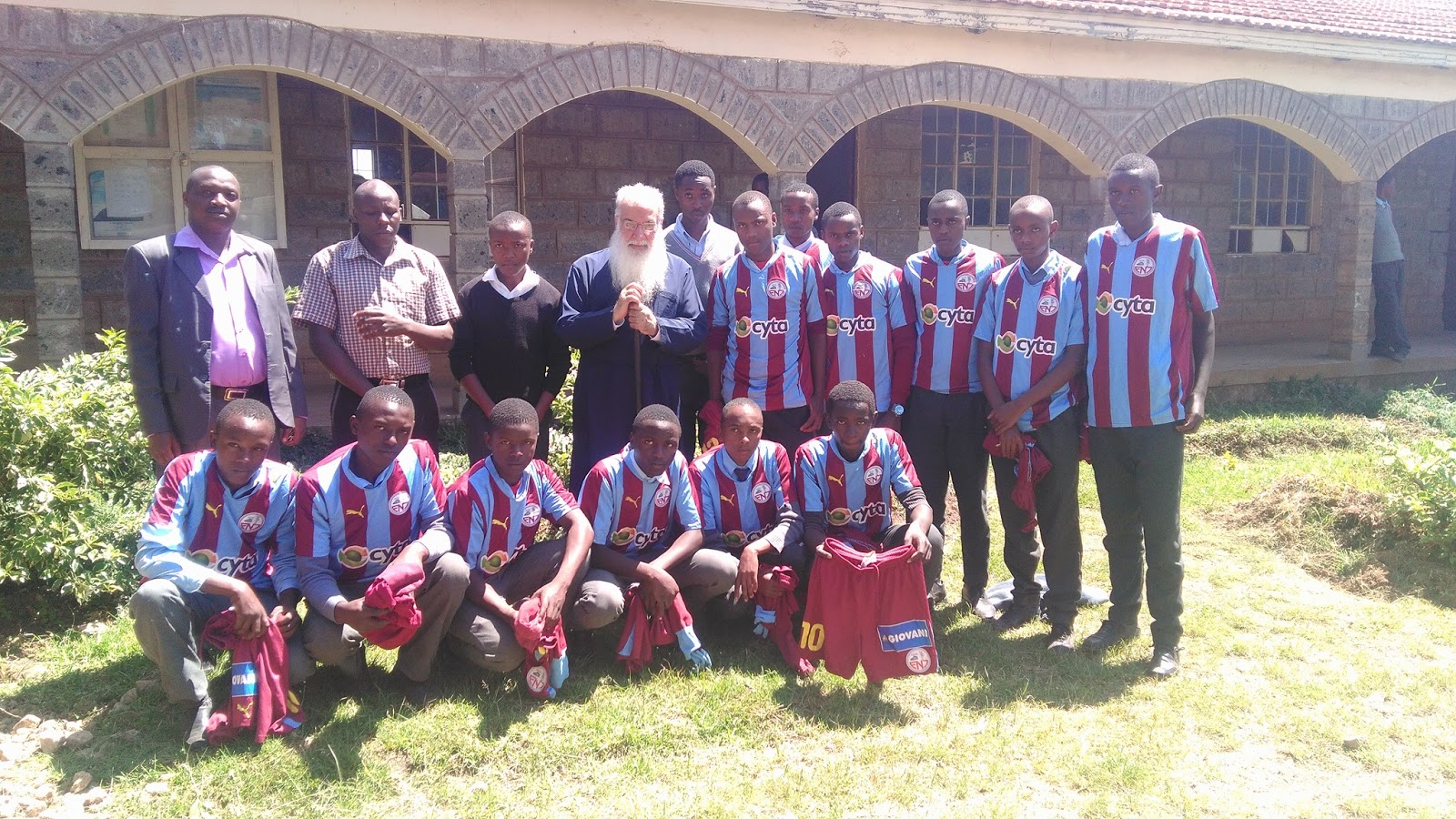
Kenya, photo from here
 
A convert priest says that men are drawn to the dangerous element of Orthodoxy, which involves “the self-denial of a warrior, the terrifying risk of loving one’s enemies, the unknown frontiers to which a commitment to humility might call us. Lose any of those dangerous qualities and we become the ‘JoAnn Fabric Store’ of churches: nice colors and a very subdued clientele.”
“Men get pretty cynical when they sense someone’s attempting to manipulate their emotions, especially when it’s in the name of religion. They appreciate the objectivity of Orthodox worship. It’s not aimed at prompting religious feelings but at performing an objective duty.”
Yet there is something in Orthodoxy that offers
“a deep masculine romance. Do you understand what I mean by that? Most romance in our age is pink, but this is a romance of swords and gallantry.”
From a deacon:
“Evangelical churches call men to be passive and nice (think ‘Mr. Rogers’). Orthodox churches call men to be courageous and act (think ‘Braveheart’).
Jesus Christ. What draws men to Orthodoxy is not simply that it’s challenging or mysterious. What draws them is the Lord Jesus Christ. He is the center of everything the Church does or says.
In contrast to some other churches, “Orthodoxy offers a robust Jesus” (and even a robust Virgin Mary, for that matter, hailed in one hymn as “our Captain, Queen of War”). Several used the term “martial” or referred to Orthodoxy as the “Marine Corps” of Christianity. (The warfare is against self-destructive sin and the unseen spiritual powers, not other people, of course.)
One contrasted this “robust” quality with
“the feminized pictures of Jesus I grew up with. I’ve never had a male friend who would not have expended serious effort to avoid meeting someone who looked like that.” Though drawn to Jesus Christ as a teen, “I felt ashamed of this attraction, as if it were something a red-blooded American boy shouldn’t take that seriously, almost akin to playing with dolls.”
A priest writes:
“Christ in Orthodoxy is a militant, Jesus takes Hell captive. Orthodox Jesus came to cast fire on the earth. (Males can relate to this.) In Holy Baptism we pray for the newly-enlisted warriors of Christ, male and female, that they may ‘be kept ever warriors invincible.’”
After several years in Orthodoxy, one man found a service of Christmas carols in a Protestant church “shocking, even appalling.” Compared to the Orthodox hymns of Christ’s Nativity,
“‘the little Lord Jesus asleep on the hay’ has almost nothing to do with the Eternal Logos entering inexorably, silently yet heroically, into the fabric of created reality.”
Continuity. Many intellectually-inclined Orthodox converts began by reading Church history and the early Christian writers, and found it increasingly compelling. Eventually they faced the question of which of the two most ancient churches, the Roman Catholic or the Orthodox, makes the most convincing claim of being the original Church of the Apostles.
 
Burundi, photo from here

A lifelong Orthodox says that what men like is
“stability: Men find they can trust the Orthodox Church because of the consistent and continuous tradition of faith it has maintained over the centuries.”
A convert says,
“The Orthodox Church offers what others do not: continuity with the first followers of Christ.”
This is continuity, not archeology; the early church still exists, and you can join it.
“What drew me was Christ’s promises to the Church about the gates of hell not prevailing, and the Holy Spirit leading into all truth—and then seeing in Orthodoxy a unity of faith, worship, and doctrine with continuity throughout history.”
Another word for continuity is “tradition.” A catechumen writes that he had tried to learn everything necessary to interpret Scripture correctly, including ancient languages.
“I expected to dig my way down to the foundation and confirm everything I’d been taught. Instead, the further down I went, the weaker everything seemed. I realized I had only acquired the ability to manipulate the Bible to say pretty much anything I wanted it to. The only alternative to cynicism was tradition. If the Bible was meant to say anything, it was meant to say it within a community, with a tradition to guide the reading. In Orthodoxy I found what I was looking for.”
Kenya, Deacon Athanasius, photo from here
 
Men in Balance. A priest writes:
“There are only two models for men: be ‘manly’ and strong, rude, crude, macho, and probably abusive; or be sensitive, kind, repressed and wimpy. But in Orthodoxy, masculine is held together with feminine; it’s real and down to earth, ‘neither male nor female,’ but Christ who ‘unites things in heaven and things on earth.’”
Another priest comments that, if one spouse is originally more insistent about the family converting to Orthodoxy than the other,
“when both spouses are making confessions, over time they both become deepened and neither one is as dominant in the spiritual relationship.”
Men in Leadership. Like it or not, men simply prefer to be led by men. In Orthodoxy, lay women do everything lay men do, including preach, teach, and chair the parish council. But behind the iconostasis, around the altar, it’s all men. One respondent summarized what men like in Orthodoxy this way:
“Beards!”
“It’s the last place in the world men aren’t told they’re evil simply for being men.”
Instead of negativity, they are constantly surrounded by positive role models in the saints, in icons and in the daily round of hymns and stories about saints’ lives. This is another concrete element that men appreciate — there are other real human beings to look to, rather than a blur of ethereal terms.
“The glory of God is a man fully alive,”
said St. Irenaeus.
One writer adds that
“The best way to attract a man to the Orthodox Church is to show him an Orthodox man.”
But no secondary thing, no matter how good, can supplant first place.
“A dangerous life is not the goal. Christ is the goal. A free spirit is not the goal. Christ is the goal. He is the towering figure of history around whom all men and women will eventually gather, to whom every knee will bow, and whom every tongue will confess.”
HT: St. George Church of Prescott
Source: December 2007 issue of The Word magazine


Click

LIVE, BEYOND THE LIMITS!
The Church as the Liberated Zone: "All we Christians are terrorists..." 
A Letter from an Orthodox Christian to our Native Americans Brothers  
Grace and “the Inverted Pyramid” 
Orthodox Martyrs

SONGS OF FREEDOM: The Rastafari Road to Orthodoxy 

Saint Nickolas of Japan & the samurai Fr Paul Sawabe Takuma
(& here)
LOVERS OF TRUTH: THE LIFE OF HIEROMONK SERAPHIM ROSE
Lover of Truth: St John, The Wonderworker of San Francisco
Orthodoxy's Worship: The Sanctification of the Entire World
Orthodoxy in the Heart of Africa - in the Ends of the Earth!


Κυριακή 25 Ιουνίου 2017

Strangers in a Foreign Land: Nationalism and the Orthodox Church


Photo: Bishop Athanasius Akunda of Kisumu and Western Kenya during a recent visit to St. John the Baptist Cathedral in Washington (more here)

Death to the World (about)

In calling the Church ‘catholic,’ Orthodox Christians confess belief in a Church for all ages, nations, and races.
The Catholic Church [= Orthodox Church] is whole, complete, and lacking nothing—for this is what ‘catholic’ truly means. It is a calling for all, and Christ our God is sacrificed ‘on behalf of all, and for all.’
There is often confusion—especially for those either outside or unfamiliar with the Orthodox Church—in viewing our local, autonomous churches as ‘ethnic’ churches. Nevertheless, such a perspective was condemned as heresy (termed ‘ethno-phyletism’) by an ecumenical council in Constantinople (August 10, 1872).1 In that context, the concern was the uncanonical creation of an ethnic church for Bulgarians—a church sharing essentially the same ‘space’ as the Ecumenical Patriarchate.
Both the fall of monarchy and the wiles of the Enlightenment led even Orthodox Christians into the arms of the nineteenth century’s pseudo-replacement for imperial veneration and identity in Christian faith: nationalism. Logical ends of nationalism were, of course, both racism and Hitler’s Third Reich. To be clear, a pride in one’s cultural or religious heritage is not necessarily a problem, but pride based solely on the superiority of one’s race over others is far removed from the Orthodox faith.
And though certain, Balkan churches (in Serbia, Greece, and Romania) were ratified and ordered canonically (and especially as the Ottoman Empire dissolved in the wake of World War I), the Bulgarian situation was a step too far.2
Our holy fathers reacted appropriately, and the synod of 1872 concludes:
[I]n the Christian Church, which is a spiritual communion, predestined by its Leader and Founder to contain all nations in one brotherhood in Christ, racism is alien and quite unthinkable. Indeed, if it is taken to mean the formation of special racial churches, each accepting all the members of its particular race, excluding all aliens and governed exclusively by pastors of its own race, as its adherents demand, racism is unheard of and unprecedented. All the Christian churches founded in the early years of the faith were local and contained the Christians of a specific town or a specific locality, without racial distinction. They were thus usually named after the town or the country, not after the ethnic origin of their people.3
And further:
We renounce, censure and condemn racism, that is racial discrimination, ethnic feuds, hatreds and dissensions within the Church of Christ, as contrary to the teaching of the Gospel and the holy canons of our blessed fathers which ‘support the holy Church and the entire Christian world, embellish it and lead it to divine godliness.’
(see here & here)
Many today still demonstrate confusion over the ordering of Orthodoxy, even as our foundation as local (not ethnic) churches is rather ancient. After all, did not the apostle write letters to the Christians—both Jew and Gentile—of Rome, Galatia, and Colossæ? Was not the Gospel a universal message for all the world (Matt. 28:18–20; John 3:16–17)?
Since the earliest centuries, the governance of the Orthodox Church has been aligned with geographical or national boundaries (as the synod of 1872 makes plain)—and this irrespective of the ethnicity, language, or skin color of those within each region.
In their definitive report on these issues, the synod discusses the ancient, canonical foundation for the organization of all local Orthodox churches. The Bulgarians at that time were claiming the thirty-fourth canon of the Holy Apostles:
[T]he bishops of each nation (ethnos) must recognize the first amongst them, and he shall preside as head.
But the council interprets this canon within the broader, and more accurate, scope of canonical precedent:
[This canon] is best explained by the sacred form of government prevailing throughout the church, which is entirely alien to racism. Its true meaning is confirmed by the ninth canon of the Council of Antioch, which says explicitly: “The bishops in each province must recognize the bishop presiding in the metropolis, and he must take care of the entire province [. . .] following the ancient canon which has prevailed from our fathers.” Moreover, the Apostolic canon explains itself and makes clear the sense of the word ethnos when it goes on: “And each (bishop) is only to do such things as are proper to his congregation (paroichia) and the areas under his authority.” Local, not racial churches are clearly meant here. This is confirmed by the thirty-fifth Apostolic canon, which prescribes that: “A bishop should not venture beyond his boundaries to perform ordinations in towns and areas not subject to him.” From all this, it is quite clear that racism finds no recognition in the government and sacred legislation of the Church.4
While in Egypt, Moses has a child with Zipporah, one of Reuel’s daughters. Naming the child ‘Gershom,’ Moses remarks (Ex. 2:22):
I am a stranger in a foreign land.
Photo from here
The tagline for our website is: ‘Orthodox Christianity in the Diaspora.’ While that term ‘diaspora’ has a tangible and even self-evident meaning for those living in the West as Orthodox Christians, there’s a deeper sense in which all Orthodox Christians are diaspora Christians. Like Moses’ sojourn in Egypt, we are all ‘strangers in a foreign land.’
A second century letter addressed to a ‘Diognetus’ describes the conduct of early Christians:
For the Christians are distinguished from other men neither by country, nor language, nor the customs which they observe. For they neither inhabit cities of their own, nor employ a peculiar form of speech, nor lead a life which is marked out by any singularity . . . They dwell in their own countries, but simply as sojourners. As citizens, they share in all things with others, and yet endure all things as if foreigners. Every foreign land is to them as their native country, and every land of their birth as a land of strangers . . . They pass their days on earth, but they are citizens of heaven. —Epistle to Diognetus 5
After extolling the innumerable virtues of various, old covenant saints, the apostle Paul concludes: “And all these, though well attested by their faith, did not receive what was promised” (Heb. 11:39). Moses, too, endured the toils of a foreign land, brought freedom to captives, and yet was unable to cross over. And for Christians—the ‘Israel of God’ in Jesus Christ—the kingdom is not of this present, evil age. The reign or ‘kingdom’ of God is one that transcends not only space and time, but also language, culture, and race.
Of course, having a citizenship ‘in heaven’ does not mean that we should neglect this life (or planet) as merely transitory, but it does mean that we should seek to order our lives according to eternal principles, rather than transitory. And this is why the Church—imaging the Holy Trinity—is a ‘monarchy,’ with each bishop as the local head of each local church. We are not ordered according to race or even language, but rather according to the providence of where God has placed us.
Malawi (from here)
In the Church, dividing walls of our fallen world are broken down, with each person treating and honoring the other as a precious icon, created in the image and likeness of God. In the Church, we are called to love one another—regardless of race, culture, age, or gender—and confess our changeless, Trinitarian faith. In the Church, we are all equally beloved of God, because we are all equally ‘strangers in a foreign land’:
There is neither Jew nor Greek, there is neither slave nor free, there is neither male nor female; for you are all one in Christ Jesus. —Gal. 3:28
Only by opposing both nationalism and racism can Orthodox Christians proclaim the one, true faith. A faith in a loving God who has trampled down death—and all forms of division—by his own death; a faith in a loving God who died and rose again ‘on behalf of all, and for all.’

By Gabe Martini On Behalf of All Blog
  1. The Ecumenical Patriarch, Gregory, referred to it as such in a letter to the Ottoman leadership of that era, although this is not at the same level of importance as the first seven (or eight) Ecumenical Councils of the Orthodox Church. 
  2. And of course, the Bulgarian Patriarchate today is a fully canonical and Orthodox church. These issues were not long-lived, nor is this post meant to be a slight to Bulgarians in any way, shape, or form—merely a description of historical facts. 
  3. Metropolitan Maximos of Sardis, The Œcumenical Patriarchate in the Orthodox Church: A Study in the History and Canons of the Church (trans. Gamon McClellan, 1976), p. 303 
  4. ibid., p. 305 
Click

Orthodoxy and nationalism
The Kingdom of Heaven, where racial discrimination has no place  
The Heresy of Racism
The Church as the Liberated Zone: "All we Christians are terrorists..."  

The Story of Nelson Mandela Begins in Byzantium
A Letter from an Orthodox Christian to our Native Americans Brothers 
Christians and the immigration issue
Nationalism (tag)
 
 
About Orthodox Bulgaria
 
Bulgarian Orthodox Church (official website) 

A Native American chief’s ‘secret path’ to Orthodoxy


The path of a Native American - a chief of the Mohawk tribe – led him to the bosom of the Orthodox Church.
A modern-day story of orthodox "lunacy" in the Native American reservations of Canada.


OODE, o Nekros (photos from Internet)
ΕΛΛΗΝΙΚΑ ΕΔΩ
 
Saturday night. Very few lights were on. In the Russian Cathedral of Saints Peter and Paul, Vespers have just started. The shadowy silhouettes of the few faithful who were attending the service became more defined, as the candles were lit, one by one, in the candle stand. The iconostasis of the altar was very imposing; it was something that was carved by experienced craftsmen at the beginning of the century…
It was my second time at Vespers, years ago… The words of the prayer “mirthful light” in Slavonic gave one a sense of inner peace and relaxation. Everything seemed to be in prayer at that moment; for the day that passed and the day that was to come. After the madness of the day, this refuge of thankfulness actually calmed the wild beasts of the mind….
In the dim, half-light I could discern a few of the profiles there: an old Russian lady with her grandchild, a tall, skinny, middle-aged man, a young girl around fifteen, a young family with their two children… and suddenly, my attention was caught by a figure near the large window. Directly below it, I made out a silhouette that was completely different to all the others. It was a fifty-year old Indian with vivid, characteristic features, and his long hair tied back in a ponytail that reached his waist. My gaze stopped upon him… What a strange figure in here… I imagined he was just a visitor.
At the end of the service, I couldn’t fight the urge. I approached him, eager to meet him.
-Yannis, I said to him in English. Welcome..
- Vladimir, he replied.
- I’m Greek. And you? I asked him.
- So am I, he replied.
I was stunned…. That was the last thing I expected to hear!
- Do you speak Greek? I asked.
He paused to think for a moment, then quoted in Greek:
- «In the beginning was the Logos and the Logos was with God, and God was the Logos».
Just as he finished saying this phrase, he burst into laughter. I was lost for words…
- I am Indian, he said sharply. But somehow, I also feel Russian and Greek and Serbian and Romanian, because…. I’m Orthodox…..

A glimmer appeared in his eye, as it did in my heart…
This was how Vladimir and I met. His real name was Frank Natawe, before becoming orthodox and being baptized as Vladimir. I so craved to hear his life story – both out of curiosity as well as genuine interest..
Much later, we became friends. We shared many conversations and walks together, especially in his Indian village. He showed me paths and manners totally unknown to us white folks. And always simply and unpretentiously. With no trace of arrogance. When I was with him, I always had a strong sensation of tuition, and whenever I admitted this to him, he always said that all beautiful things are mutual….
That first period has become unforgettable, when I was swept away by my youthful enthusiasm and kept asking him difficult questions. He would always calmly reply:
- I don’t know – will you tell me?
Once, when I was fed up with hearing “I don’t know”, I begged him to tell me something, so, he showed some pity and said:
- Well, if you insist, I will tell you, after I ask my friend first.
He sprang up and then lay down on the ground, placing his ear to the earth.
- What are you doing? I asked.
- I am asking the earth, he said, and before I could recover from my surprise, he added somewhat hesitantly:
- Like Aliosha Karamazov.
I never again insisted on replies. I guess that with him, I was just living the surprise of a sudden lightning bolt that gives birth to gentle rain that nourishes the earth…


It has been some time now, that Vladimir has left us. His passing away - along with his will and testament – overwhelmed me. Now that the feeling of his presence – instead of fading into oblivion – appears before me every now and then, I thought I should record on paper all of his incidents, images, memories, words and expressions, in order to sketch a portrait of his presence amongst us… hopefully so that my ear will also perceive… the tumultuous silence of the mother earth of Vladimir - Karamazov to me…
He was born in the Indian reservation of Caughnawaga, just outside Montreal, where he lived all his life, to the day he died. His village numbers 5.000 Indians today. It was built by the government, next to the river, and houses the greater part of the Indians of that area. The Indians, as the only true indigenous people of America, along with the Eskimos, enjoy special privileges and treatment, due to the fact that they had ceded vast areas of their “mother earth” -as they call it- to their white brothers.
These privileges – such as not needing a passport yet enjoying state welfare – are sometimes interpreted as an intentional attempt by whites to keep the Indians uneducated – something that is observed extensively. The percentage of alcoholism is very high. The struggle for survival –as a group- is their daily concern, along with the preservation of their traditions, which they are very proud of. They are governed in a unique way, which however may have much to teach “civilized” politics and social structures.
The supreme authority is the Confederation of all the Indian tribes. There is a respect towards all of the Indian tribes. There is a respect towards the chiefs and the elders, and the elderly women of each tribe, from generation to generation. Their love and respect for each other is the foundation of the Confederation.
In the village Caughnawaga there are basically three Indian tribes. The majority however are Mohawk. The village has existed since about 1600 and comprises the main center of the Mohawk tribe. The last generations are mostly involved with steel construction and building.
«Our village», Vladimir told me, «along with other Indian reservations was turned basically into a Roman Catholic protectorate in the 18th century. The Catholic missionaries had actually tried in every way to forcefully convert our entire community. Not with love, but with a noose around the neck. They trampled on centuries-old traditions and they used other ones as springboards for their own designs. Myself, to the age of 32, had kept to the trodden path. As my mother used to say – who was an elderly tribal leader of our tribe – “By day a roman catholic for the eyes of the world and by night an Indian, for the eyes of the soul.” 
 

But at that age of 32, I couldn’t tolerate that kind of restriction, that noose that I was wearing, so I revolted in my own way… I researched our roots, I learnt all of our native tongues, I studied at white men’s universities – which, for an Indian of my generation, was a very unusual thing. For years, they had me as a traveling lecturer of comparative linguistics. Quite often, I would dishonestly play the clown at their academic games, since to them I was a rare, exotic species of bird, with a different kind of plumage. I used to compare our words with their French or English equivalents; our habits with theirs. There were times that I felt as though they were observing me like archaeologists observe fossils. To me however, those meetings alone – those cultural meetings – regardless of the response, contained joy and grief together. My revolution was still thundering, because it was muted, like the tread of a rabbit… My mother – the pillar of our community – was to me a source of wisdom and immense pain. She was my…. Indian Zosimas….”
(He took a deep breath and continued …..)
«My path to the Orthodox Church was a “secret path”, as we say in our tongue. There came a time, that I became caught in her net, and ever since then, I have been treading very discreetly, carrying a very heavy crucifix. It happened to me through linguistics. It was always the subject that impressed me most. By taking linguistics courses, I became impressed when I happened to read the lives of saints Cyril and Methodius, who are known as the Apostles of the Slavs. I was especially intrigued by the Cyrillic alphabet and the pursuant Slavonic tongue. I asked my professor if there was any chance I could listen to Slavonc being spoken. He suggested that I should visit one of the Russian churches. I rang one of them, but I heard only the answering machine. I rang the next day, and a friendly voice informed me that Vespers were held at 7in the evening, and that Sunday Service was held at 10 in the morning. I asked if I could attend. He replied of course I could. I told him I wasn’t Russian, or Orthodox. He responded that the Orthodox Liturgy was not only for the Russians or only for the Orthodox, but for all people. 
 
One more person, an especially charismatic one with a tremendous passion for the truth, who discovered his path after visiting a Russian Church in America: Fr. Seraphim Rose. And here, a Buddhist priest who discovered the same path, following a lengthy Orthodox Christian experience.

So, I mustered some courage and went on a Saturday evening to listen to spoken Slavonic and to meet the priest, who had spoken so pleasantly. He was a priest-monk from Mavrovouni of Serbia. His name was father Anthony… He too has passed away now…. Well, anyway, the first Saturday that I attended Orthodox Vespers in the cathedral of saints Peter and Paul, I experienced something unprecedented. Looking at the icons, listening to the melodies, observing the penance bows and the prostrations, the fragrance of the incense wafting in the atmosphere, were all reminiscent of my having discovered the “secret path”…”
«You won’t believe it, but, every now and then, I can discern parallels between the Indian traditions and Orthodox tradition. Somewhere inside me, this discovery fulfilled my Indian ethos and supplemented it. At first, I felt I was floating among the clouds. During my first liturgy, I asked if I could stay on, after the benedictions for the catechumens… They said: you may. So I sat down, like an Indian dog! Ever since then, I began to go more frequently. At first, on Sundays only, then on Saturdays, and later on, during weekdays, whenever there were important feasts. It wasn’t much later, that I noticed confession was taking place in the evening, after Vespers. It was the period of Lent. At the end, they all asked for forgiveness from the priest. He placed his stole over their head and blessed them with the sign of the cross. I stood in line, but they said:
-You can’t, you’re not Orthodox. This is a holy Sacrament.
- But our entire life is a sacrament, I said.
I pondered again, and asked them:
- So, how can I become Orthodox?
- Talk it over with the priest, they suggested.
Not much time had passed by, when I decided I wanted to become Orthodox. On the day that it was to take place, there was a snowstorm that didn’t allow me to leave the village. It was postponed, for the feast of the Induction of the Theotokos. And that’s how it finally happened…. I was given the name Vladimir.
Much later, when reminiscing over my induction into the Orthodox Church, I drew out of my memories the imposing figure of a Serb priest, who had visited our village when I was young. His appearance and his manner had left a deep impression inside me. I remember my mother having commented that:

-Now there’s someone who isn’t making propaganda with his truth…”.
Quite some time had passed, when I decided to visit him again. This time, I went with two of my friends and a little car, equipped with tape recorders and microphones, and we departed one sunny morning for his village, Caughnawaga. He had suggested that we meet at the Indians’ radio station since he had been the radio commentator for several years, and had promised us walks and conversations in their territory.
We did find him at the radio station in the village, with headphones over his ears, reading the morning prayer in each and every Indian tongue. Then in French and English. Naturally his audience did not…detect him making the orthodox sign of the cross.
We waited respectfully until he had finished…. He removed the headphones and approached us... He was more talkative than usual, and somewhat cheerier.
- What would you like me to tell you? He asked warm-heartedly. And what could you ever want to learn from me?
- Tell us whatever you want, Gregory replied. Say, for instance, something about your people, your celebrations, your mission….
- You’re going too fast, he interrupted. One thing at a time.
- Well, my people...
It took him some time to formulate his reply. He was seated in an armchair, but found it was not comfortable for him… he abandoned it and sat down on the porch with us… he preferred to be on the same level with us… 
 
I like this photo, because I find it to be quite Indian, uninfluenced by "pale faces". I don't know who he is, or if he is Orthodox or Catholic... Whoever he is, may Christ preserve him near Him. I borrowed it from here.

«My people are simple, just like their food. The chief of the tribe is a man, but he is elected by the council of woman-elders of the tribe. All of our group rituals take place in the “long house”. This has two doors. The men enter through the eastern door and the women from the western one. It is a simple edifice, just like most of our rituals are. In our marriages, an integral part of the ritual is the blessing of the elders. During our funerals, for both men and women, when they are carried into the long house they enter through their separate doors, but the head of the deceased always faces the east. After nine days, we prepare the funeral meal, but without salt…”
He suddenly jumped up, because the record he had selected to be played over the radio had stuck. He put on another record, made an announcement, and came back to us…
«What were we talking about? Ah, yes! The rituals. I will show you the long house, before it gets too dark… Now, about our celebrations. The entire year is a celebration (he burst out laughing). We have the mid-winter festival (four days long); we have the snow festival, the first bloom festival, the first crop – which is the berry; the festival of plenteous harvest (thanksgiving), the threshing festival (4 days), the festival of surplus, of rain and of sowing, and the cycle starts all over again.. Something like an ecclesiastic calendar of our holy earth…”
He took another deep breath and continued:
«We don’t say much, nor do we eat much; We don’t get angry often, we love what was given to us and we continuously give thanks for the bounteous gifts...»
- Do you happen to have any tobacco? He asked me.
- No, I said.
- You know, we chew our tobacco – in other words, we eat it. We don’t smoke it. When you smoke it, it turns into air, whereas if you eat it, it becomes one with you, and you bless the earth that gave it to you… Now, what else did you ask me? Ah, yes! About my mission…..
«What can I say? My people got tired of the missionaries. They have been coming here for years, mostly to take rather than to give.. They never showed any interest in what we have. They just brought on the steamroller, they flattened everything, and then they embarked on their…. evangelical sowing.
But that Serb was different. He actually gave something, with his presence…he took nothing from us, except a piece of our heart. That was what I loved, when I later read about saint Herman of Alaska and the Orthodox missionaries amongst the Eskimos… it is impossible for the mind not to make comparisons…as hard as it may try…
I still remember that Jesuit, who told me to my face that he was instructed to teach spirituality. When he left our home, my mother shook her head in disapproval, saying: “we, my child are a spiritual people, while he, even if his Christ came to him, he would sit him down to preach at Him…”.
- Are there any other orthodox amongst the Indians? Gregory asked again.

­- I have met an Orthodox Eskimo in Plattsburg and one more - a very tall Mis Mac. There may be others, who I’m not aware of. But in the Indian hospital we do have a couple of Serb doctors, the Moscovitches. Real gems of people; they have a special love for our world, and they offer all their assistance.”

St Olga of Alaska (Yup'ik Eskimo)

Lesley looked him directly in the eyes.
- Tell us if you want about that story with the Indian masks*. It was in all the newspapers and they all mentioned your name. What happened exactly ?
Vladimir sat down, cross-legged, and after taking a few minutes to think, replied:
«To us, those masks are sacred. We always keep them in the dark, and we protect them with silk material. They represent the…holy personage that we are in search of. We find it in silence, in darkness, where we also find the light of our soul. Our soul is never displayed in exhibitions, or in artificial lighting… Those who organized the exhibition have lost every sense of what is sacred, and that is why they strive to “gently” remove it from our souls also…. We love the earth, because it knows how to keep silent and be fruitful. We have learnt to humbly love it and to honor it.. It is something like Orthodoxy’s Holy Mother….since you like parallels. But, I have said too much… Let’s get up now, and I will show you my village…”
We got into the little car, and I sat in the driver’s seat. Vladimir was the co-driver. He began to show us all the landmarks:
«Here in the center of the village you can see the catholic church. It is dedicated to saint Kateri Tekekwitha, an Indian woman whom the priest proclaimed a saint. We keep her bones in this church, which perform miracles. This is a pilgrimage for the laity. Her life is as beautiful as a fairytale… To me, she was a fool in Christ… She was a grace-filled fool.. She would roll over in the snow, to purify her heart… 
My fellow villagers –who became Catholics- are not particularly fond of catholic propaganda, but they do show reverence to their saint; it was their pressure on the Vatican that brought on her beatification… 
 

Next to the church, there is a small museum. In there, you will find a map of the confederation, that describes in detail all of the Indian tribes, the symbols, the numbers, the places they originated from, their historical course, their languages…. Everything has become a part of the….. museum… Now turn right, here…. This is our Cultural Center. Above it, is the radio station where we met…. That is where I broadcast from… Now, during the Triodion, and afterwards, during Lent, I play a lot of western spiritual music and little by little, I include some Orthodox innuendos, but only just enough as to not be provocative. Indian spiritual music is not permitted over the radio. It is only for the “long house”. The cultural center is financially supported by the white government. The powers outside, of the “civilized” world, want to help us, but only on paper; in actual fact, they want to drown us, to humiliate us, to exhaust us – not so much us, as our souls and whatever we carry. They want to turn us into masks for museums, clowns at parties, research for archaeologists… They haven’t taken a whiff of, nor do they suspect what kind of….tobacco we prefer.”
He burst into laughter. I nearly lost control of the steering wheel…I continued to drive on, following his instructions – left- right – straight ahead etc….Until, at a bend in the road, we saw a modern but very unusually shaped structure..
«This is our school, Grade School and High School. It has a good program, I like it. It is truly Indian. Apart from the classic subjects of “white” education, we have many other lessons that are most probably unfamiliar to the whites. We don’t call them “customs” or “culture”, but “Indian ways”, “Indian paths” (the sounds of the earth), Indian dances, Indian songs and cries (like an ancient drama), Indian law, and other things. The grounds surrounding the school are sacred. We also have a “dark room”, but not for photographs… it is for the making of the….mask inside us”
- Now go straight ahead, eastward. Continue, until you find the highway. Two-three kilometers from there...
«This here is our Hospital. It is a new building and is a new idea for us. A beneficial one, I hope. It was built in 1985. Before that, we had our own medicine men, or we resorted to the white man’s hospitals. But.. they were difficult.. Most of their staff was unaccustomed to our way; it was difficult for them to look after our old folk. They have to be in our shoes, in order to understand… Many try. Besides, you can tell apart those who truly love and who can be discerned from the usual professionals….”

Holy New Martyr Peter the Aleut (from here)


Vladimir Natawe was the chief of his tribe; he was their spiritual leader. It was he who recited at their funerals and their weddings – he was something like a priest for them. In the evening, he would sit cross-legged in the “long house”, listening to his people’s problems and solving them with the advice he offered. He had a judge’s role, which was one of their most powerful traditions. He was a poet and a translator, and also a philosopher. He knew their problems better than anyone else; he also knew the strict laws that governed their tribes. Those who denied their ancestral principles and became Christians were allowed to remain in the village, but were not given any office. They would have to leave the council of the wise, the elders; they would “lose their destiny” as they described it … in their own special kind of way, they would be disowned. All of this may not be of much significance for an ordinary Indian, but for a chief…
No-one in the village ever found out –until the day he died- that their chief was an Orthodox Christian. And Vladimir –who was Frank to them- lived and worked with them, for them, with the ever-present fear that they might find out. He had to be perpetually moderate, careful, flexible, otherwise his image would have been smashed inside them. He was in charge of the radio station for years, and he also worked at their cultural Center. He was considered an authority on subjects of tradition, and was unimaginably touched, whenever he found “parallels” –as he called them- in Orthodox tradition. He shared many of his experiences with us, because he couldn’t share them with his own people. What a heavy crucifix to bear….
Whenever I would see him coming out of the inner sanctum of the little orthodox church of the Sign of the Theotokos –which held services in English and French- dressed as an altar-boy and holding the candle in front of priests and bishops, I couldn’t help wondering what kind of heart that old Indian wolf had inside him, who persistently said “God knows”. And he would forever be prostrating himself on the ground, so that God would give him enlightenment to govern his people through tempests and ordeals, and to give him the strength to hold up the heavy load that was given to him, right to the end.
The years passed. Every friend that visited us in Montreal had to make the imperative trip to the Indian village and to meet Vladimir. And many of them told me that they had recorded their own experiences there.
One morning, I received a phone call in Montreal, telling me that Vladimir had passed away in his village. The question that arose in my mind was: who was going to bury him, what was to become of him? He had however left a specific, written instruction for all the rituals to be done in the Indian tradition in the “long house” and for an Orthodox priest to read benedictions over him. Naturally, the Indians had no idea what he meant by “an Orthodox priest”, but he had left a few telephone numbers too.
They did actually phone, and an Orthodox priest went and recited the funeral service before they carried Vladimir into the long house.
Unfortunately I didn’t have the opportunity to attend the ritual in the long house, but a mutual friend who attended the funeral conveyed the details to me.
Two days after the funeral, that same friend, Michael, brought me the news, together with a package. He told me that he had attended the entire ritual. It was truly impressive. When they go to the long house, the Indians put on the outfits that befit their rank in the village. The ritual –which was of course in their own languages- had a particular form, much like the old, Byzantine type. At the end, the tribal chief’s testament was read out aloud, before all the tribe. In his will and testament, he mentioned where he left each of his belongings. Vladimir was 75 years old at the most. He had children, grandchildren and great-grandchildren. He left something to every single member of his family. At one point, the Indian who was reading the will found some difficulty in reading a name – a non-Indian name- and, after grimacing a bit, he put on his glasses and pronounced the name, in a distorted kind of way: “Ya-nis Ha-ji-ni-ko-la-ou”. My friend Michael raised his hand and they gave him the package, which he in turn gave to me.
When I opened the package, I saw what was inside: it was a book, “The Divine Liturgy”, in Greek and in English, which I had given to him many years ago. Inside, on the first page, it said: “To Yanni”, and below that, in Greek: “Until we meet again – Vladimir Natawe”. I took this to be a very kind gesture on his behalf; he had in fact inserted those words before his final departure; perhaps because he had sensed that his death was near. He had written the words “Until we meet again” in Greek. Of course, the surprise did not end there; there was more to come. When I leafed through the book, I was astounded, my mouth gaping… He had translated the entire text of the liturgy into the Mohawk tongue, above the lines of the English text! Of course I can’t read Mohawk, but I am holding on to the book as a memento – this orthodox liturgy by Vladimir in Indian – the entire Liturgy of Saint John the Chrysostom… If God bestows me the honor, I may publish it one day…
Contemporary stories like this one may sound like a fairytale, because our life seems equally fleeting. And yet, these stories are filled with a never-setting light; they are modern-day testimonies of that blessed “lunacy” – that yeast, which leavens all of the dough, from the tiny church atop an Aegean islet, to the distant Indian reservations of Canada.
Until we meet again, Vladimir… Karamazov…
 
[Reproduced from the magazine “Synaxis” and the article by John (Yanni) Hadjinikolaou, titled “The passing of an Indian”]
OUR TALENT OF FREEDOM & SOME PITFALLS
 
________________
* For the reader’s information, I will briefly report the events. The Canadian government decided to open a new museum in Western Canada, in the city of Calgary, where it would put on display amongst other exhibits a number of Indian masks, which it had borrowed in an ‘unorthodox’ manner from a long house, as folklore artifacts… This provoked the indignation of the Indians, who assigned Vladimir to look into the matter, to visit the exhibition at the expense of the government and to give his opinion to his people as well as to the government….