We are Orthodox Christian Greeks.
Because we are Orthodox Christians, we love our country, our people and all the peoples of the earth; this of course includes our African brothers and sisters.
What happened during the first difficult year in Kisumu diocese?
These and many more in the new issue. Browse through it online, read it, share it with the world. Read it online (here!) to learn the latest updates from our Missions in Kolkata, Madagascar, Brazzaville, Kisumu. ΕΛΛΗΝΙΚΑ ΕΔΩ!
Ρομφαία (& here) The greatest concentration of Orthodox Youth in modern history was held in Iasi, Romania.The Beginning of the 4th World Festival of Oroposous Youth was proclaimed by His Beatitude Patriarch of Romania, Messrs. Daniel. The
opening ceremony was attended by more than 6,000 young people from 32
countries including Greece, Cyprus, Palestine, Syria, Lebanon, Tanzania, Uganda, Kenya, Burundi, Rwanda, Democratic Republic of Congo, from almost
all of Europe, as well as delegations from America, Uruguay, Argentina, India and China...
Manifestation contre l’exploitation des enfants pour la mendicité, à Dakar, Sénégal, le 3 mars 2015.
AFP PHOTO / SEYLLOU
Pour la quatrième année consécutive, l'ONG
australienne Walk Free Foundation a publié le 31 mai son rapport sur
l'esclavage moderne dans le monde, grâce à un travail réalisé dans 167
pays. Prostitution, enfants soldats, travailleurs forcés : toutes les
régions du globe sont touchées par le phénomène qui sévit surtout en
Asie, comme par exemple en Inde. La guerre, et notamment certains
conflits récents comme en Centrafrique, joue souvent un rôle
d'accélérateur des trafics, notamment d'enfants.
Walk Free Foundation a publié
mardi 31 mai 2016 à Londres son tout dernier rapport sur les pratiques
d'esclavage moderne dans le monde. Pour cette quatrième édition,
l'organisation australienne a recueilli plus de 40 000 entretiens dans
167 pays en plus de 50 langues. Les conclusions de l’étude révèlent que
l’esclavage moderne est beaucoup plus répandu que ce que l’on pensait.
Une tendance qui se traduit non pas par une aggravation du phénomène,
mais par une meilleure collecte des données. Selon l’ONG Walk Free, plus de 45 millions de personnes dans le monde
sont touchées par ce fléau. Plus de 200 ans après l’abolition de
l’esclavage, des millions de personnes sont toujours soumises à diverses
formes de servitude. Trafic de personnes, prostitution forcée,
enfants soldats, travail forcé, utilisation des enfants dans le
commerce international de stupéfiants : aucun continent n’est épargné.
Ces formes d’esclavage se multiplient dans le monde indique l’ONU, en
grande partie à cause de la vulnérabilité exacerbée par la pauvreté, la
discrimination et l’exclusion sociale.
En Inde, 18 millions de victimes Selon le rapport 2016,
sur plus de 45 millions de personnes réduites à l’esclavage, les deux
tiers vivent en Asie-Pacifique. L’Inde occupe la première position avec
plus de 18 millions de personnes victimes de travail forcé, de
prostitution ou de trafics, souligne Fiona David, la directrice de
recherche à la Walk Free Foundation. « Notre étude réalisée ces
quatre derniers mois couvre 15 des 29 Etats indiens. Nous avons relevé
de nombreux cas de mendicité forcée, de violences extrêmes contre des
travailleurs domestiques, des méthodes d’un autre temps à l'encontre de
travailleurs forcés dans l'agriculture », explique-t-elle. Suivent la Chine (3,39 millions), le Pakistan (2,13 millions), le Bangladesh (1,53 million). Fiona David cite également l’exemple très particulier de la Corée du Nord où
le pouvoir exploite ses citoyens. En Corée du Nord, l’incidence de
l’esclavage est la plus forte au monde : 4,37% de la population est
asservie. « Nous savons qu'il existe dans ce pays des camps de
travail, et certains Nord-Coréens sont aussi autorisés à quitter le pays
pour travailler à l'étranger, poursuit-elle. Mais leur salaire
est directement versé au régime nord-coréen, et ils ne peuvent pas
fuir, car ils savent que leur famille restée au pays peut être en
danger ». Fiona David pointe la responsabilité des Etats et l’importance du
contrôle des entreprises qui exercent à l’étranger. Selon la directrice
de recherche pour lutter contre les formes contemporaines d’esclavage,
il est essentiel que les gouvernements puissent imposer aux entreprises
nationales un contrôle de leurs chaînes d’approvisionnement. Et de citer
l’exemple du Royaume-Uni qui a adopté, en 2015, le Modern Slavery Act,
une loi qui permet d’interdire l’achat de biens ou de services qui ont
recours à la traite d’êtres humains. « Toutes les plus puissantes économies du monde en devraient faire autant », souligne Fiona David.
Esclavage et pays en guerre La pratique de l’esclavage moderne est très répandue dans les pays en
guerre, aussi bien au Moyen-Orient que sur le continent africain,
explique Fiona David.« Nous constatons un lien entre l'esclavage et les situations de conflit. Par exemple en République centrafricaine,
un quart de la population est déplacée et nous avons relevé de nombreux
cas d'enfants contraints à la servitude domestique, à du travail forcé
dans l'agriculture ou qui sont engagés dans des groupes armés. Sur le
continent africain, c'est dans la République démocratique du Congo que
nous avons noté le plus grand nombre de personnes soumises à une forme
moderne d'esclavage, comme le recours à des enfants soldats ou le
travail forcé en général ». La Côte d'Ivoire est également concernée par ce problème : 144.000 personnes sont victimes de ce fléau dans ce pays. « Nous avons dénombré aussi 80 000 personnes au Sénégal, où nous avons également constaté certains cas particulièrement préoccupants d'abus dans des institutions religieuses, poursuit Fiona David. Des
enfants dans certaines de ces écoles coraniques sont enfermés la nuit,
parfois même enchaînés à la cheville pour éviter qu'ils ne s'enfuient,
et sont aussi forcés à mendier ». L’esclavage moderne demeure donc un vrai problème. De nombreux pays
dans le monde sont dotés de lois qui criminalisent la traite des êtres
humains. En Afrique, 26 Etats ont adopté des lois allant dans ce sens.
Mais, selon Fiona David, ces lois ne sont pas appliquées correctement. (...)
Ils sont écoulés en grande majorité dans les commerces de rue des villes
africaines, mais se retrouvent aussi dans les pharmacies des hôpitaux
publics ou dans les stocks de grandes ONG humanitaires, feintées par
l’habileté des faussaires. Les faux médicaments – avec un sinistre bilan
évalué à plusieurs centaines de milliers de morts par an – sont devenus
un fléau en Afrique.
Le vaste coup de filet opéré par l’Organisation mondiale des douanes
(OMD) en septembre 2016, et dont les résultats ont été dévoilés vendredi
20 janvier à Paris, confirme l’ampleur du problème.
Quelque 126 millions de médicaments falsifiés ou illicites ont été
saisis lors de l’opération menée entre le 5 et 14 septembre 2016 dans
seize ports africains. Sur les 243 conteneurs inspectés, 150 contenaient
des produits non conformes. 75 % venaient d’Inde et 25 % de Chine. Le Nigeria (35 %) et le Bénin
(26 %) ressortent comme les deux principales portes d’entrée sur le
continent. Il s’agit de la quatrième opération d’interception de l’OMD
depuis le lancement du programme commun avec l’Institut international
de recherche anti-contrefaçon de médicaments (IRACM) en 2012. Au total,
près de 900 millions de médicaments d’une valeur estimée à 400 millions
d’euros ont été confisqués au cours de ces quatre années.
La contrefaçon cible les pathologies les plus courantes
Gastro-entérinaux ● part en %: 7,00
Source : Organisation mondiale des douanes
Ces médicaments ciblent les pathologies les plus répandues, en particulier le paludisme. « Cette
invasion se déroule en silence et vise les populations les plus
défavorisées. Non seulement ces faux médicaments sont la cause de
centaines de milliers de décès, mais ils sont aussi responsables du développement de résistances à certains traitements »,
déplore le diplomate Jean-David Levitte, président du conseil
d’administration de l’IRACM. Il estime que les faux médicaments
représentent un tiers du marché en Afrique. L’inertie des pouvoirs publics et l’absence de dispositif législatif
réellement punitif laissent le champ libre aux réseaux de criminalité
organisée. « Les criminels connaissent les failles du droit. Ils savent par exemple que, dans beaucoup de pays, le douanier ne peut pas ouvrir le conteneur pour le contrôler si l’importateur n’est pas présent », explique Ana Hinojasa, de l’OMD. L'Afrique, envahie par les médicaments contrefaits
L'Organisation
mondiale des douanes a lancé un cri d'alerte : sur le continent
africain, un tiers des médicaments sont des produits illicites ou
contrefaits.
Dans 150 conteneurs sur 243 inspectés, ainsi que dans douze envois aériens, les douanes ont saisi des produits de santé illicites.
"Plus de 97% des produits pharmaceutiques saisis venaient de Chine et
d'Inde", a précisé Ana Hinojosa, responsable du contrôle et de la
coordination au sein de l'OMD.
L'Inde, premier pays de contrebande
D'après l'OMD, l'Inde est le premier pays
d'origine des produits pharmaceutiques illicites. Ces derniers sont des
vrais médicaments mais sont introduits en contrebande, d'autres sont
même mal conditionnés ou périmés. D'autres encore sont contrefaits mais
fabriqués le plus souvent en Chine.
L'opération de
saisie, appelée ACIM, est la quatrième du genre en Afrique. Au total,
869 millions de produits pharmaceutiques illicites ou contrefaits ont
été interceptés lors de ces opérations depuis 2012, représentant une
valeur commerciale de 400 millions d'euros, a détaillé Bernard Leroy,
directeur de l'Institut international de recherche anti-contrefaçon de
médicaments (Iracm).
Des chiffres vertigineux mais qui ne sont qu'une goutte d'eau comparé à l'ampleur supposée du phénomène, selon l'institut.
Les faux médicaments représenteraient, en réalité, 10% du marché
mondial de la pharmacie. Soit un chiffre d'affaires estimé à 85
milliards de dollars.
Trafic contrôlé par le crime organisé
Et l'Afrique est particulièrement touchée. En
effet, près d'un tiers des médicaments utilisés sur le continent est
illicite ou contrefait.
A l'inverse du
trafic des stupéfiants, celui des faux médicaments, contrôlé par le
crime organisé, est largement impuni, étant considéré comme un "simple"
délit de violation de la propriété intellectuelle. Ce, bien qu'il soit
responsable de centaines de milliers de morts par an, déplore l'Iracm.
"Le nombre de poursuites est ridicule et concerne en général des gens
locaux", et non les organisateurs de ce trafic, a rappelé Bernard Leroy.
En Afrique, les douanes donnent
la priorité à la collecte des taxes sur les importations, une importante
source de revenus pour les Etats. Par ailleurs, le manque criant de
moyens, de nombreuses failles juridiques et "une interférence très forte
de la corruption" facilitent grandement la tâche des trafiquants, selon
le directeur de l'Iracm.
A Cotonou, la pharmacie à ciel ouvert où prospère le trafic de faux médicaments
Au
Bénin, 40 % des médicaments en vente libre seraient des faux. Une
véritable mafia s’est constituée, avec la complicité des autorités.
Par Hermann Boko (contributeur Le Monde Afrique, Cotonou)
Des odeurs
d’antibiotiques mêlées aux exhalaisons de solutions injectables
glucosées éprouvent les narines. Bienvenue au marché Adjégounlé. Située
en plein centre de Cotonou, sur la partie est du marché Dantokpa, cette pharmacie à ciel ouvert suffit à prendre la mesure de l’ampleur du trafic de faux médicaments au Bénin.
Assises devant de minuscules échoppes, des commerçantes élégamment vêtues hèlent les passants venus se procurer
des médicaments – le plus souvent sans ordonnance. Derrière elles sont
rangés, les uns sur les autres, des produits pharmaceutiques et aussi
des cartons de consommables médicaux conservés dans des conditions peu
réglementaires, à la merci de la poussière et de la chaleur. Plus que la drogue et que les armes
Anselme, chauffeur d’une quarantaine d’années, est venu prendre de la
quinine. Un antipaludéen fabriqué par Pharmaquick, une société
pharmaceutique spécialisée dans le générique et installée au Bénin
depuis 1982. Le Bénin ne produit que 2 % de ses besoins en médicaments. « Je
viens toujours m’approvisionner en médicaments ici. Même quand le
médecin me fait une ordonnance. C’est le même qu’en pharmacie et c’est
moins cher », dit-t-il sans ciller. Comme Anselme, ils sont des milliers de Béninois à venir
s’approvisionner sur ce marché de vente de médicaments issus de
circuits illicites, non contrôlés, mais autorisé par la Société de
gestion des marchés autonomes (Sogema).
Selon les données de l’Organisation mondiale de la santé (OMS), 10 % des médicaments vendus dans le monde
sont non conformes. Un marché évalué à 75 milliards de dollars
(67,5 milliards d’euros), devant le trafic de la drogue et tout juste
derrière le commerce des armes. La situation est encore plus grave en Afrique, où 30 % à 70 % des médicaments en circulation seraient des faux. Au Bénin, pays perçu par les spécialistes comme une plaque tournante
du trafic à cause de l’impunité dont bénéficient les trafiquants et de
l’absence d’arsenal juridique adéquat, « c’est plutôt 40 % des médicaments qui seraient faux »,
avance le docteur Charles Ainadou, président de l’Ordre des
pharmaciens. En 2004, le marché des médicaments au Bénin pesait
55 milliards de francs CFA (85 millions d’euros), dont 6 milliards de
francs CFA (9 millions d’euros) pour les faux médicaments, d’après des
données de l’Institut national de la statistique et de l’analyse
économique (Insae). Un faux médicament est défini selon le Conseil de l’Europe comme « tout
médicament comportant une fausse présentation de son identité, ne
contenant aucun principe actif ou des principes actifs à un mauvais
dosage »… Médicament « vide »
Sur le marché Adjégounlé sont en vente des produits d’origine douteuse comme le Cumorit, un médicament censé modifier l’équilibre hormonal et provoquer un avortement. « Des analyses au laboratoire ont permis de constater qu’il n’y avait rien dans ce médicament », explique le docteur Charles Ainadou. Une bonne partie viendrait du Nigeria, champion toutes catégories en faux médicaments. On y trouve aussi des antipaludéens, des antalgiques, des
antihypertenseurs… dont les emballages renseignent des laboratoires
pharmaceutiques chinois ou indiens comme Sun Pharma. Mais aussi des
laboratoires européens comme le Français Sanofi avec son antipyrétique
Doliprane 500 mg, vendu un peu moins cher sur le marché parallèle :
800 francs CFA (1,2 euro) contre 1 100 francs CFA en pharmacie. Il est difficile d’authentifier les produits à l’œil nu. Ils sont
souvent très proches de leur date de péremption, comme ce sirop
antitussif Sekisan de la firme espagnole Almirall que l’on peut trouver sur l’étalage de Tunde*, un commerçant nigérian. Son usage n’est plus recommandé après le 17 juillet 2016.
Dreadlocks sur la tête, Tunde, un
habitué du marché depuis quatre ans, propose aussi du Tramadol 100 mg,
un puissant psychotrope analgésique qui peut aussi être utilisé comme stupéfiant – et donc théoriquement sous contrôle international.
Il doit être prescrit strictement sur ordonnance. C’est un produit du
laboratoire américain Mylan, lit-on sur l’emballage. Comment a-t-il pu
se retrouver sur le marché ? « Certains ont été volés dans des officines en Europe, confesse le vendeur. Mais contrairement à ce que les pharmaciens disent à la télévision, ce ne sont pas des faux. » « Un médicament, dès lors qu’il quitte le circuit d’approvisionnement formel, ne mérite plus qu’on lui fasse confiance »,
rappelle le docteur Philppe Capo-Chichi, pharmacien toxicologue. A
cause des mauvaises conditions de stockage et de conservation, il a pu
se dénaturer et devenir nocif.
« Véritable peste »
Au sein de la corporation des pharmaciens, de graves accusations sont portées contre les sociétés grossistes qui alimenteraient le marché parallèle. « Les grossistes sont la véritable peste », dénonce sans vouloirdonner de nom le docteur Louis Koukpémédji, président du Syndicat des pharmaciens du Bénin (Syphab). Le Bénin compte six sociétés grossistes, dont une publique : la
Centrale d’achat des médicaments essentiels (CAME). Le problème se
situerait plutôt chez certaines sociétés grossistes privées qui, pour gonfler leur chiffre d’affaires, livreraient des barons du marché noir. « Les trafiquants viennent avec du cash. Mais les pharmaciens prennent souvent à crédit et paient des acomptes », reconnaît un pharmacien travaillant pour un grossiste.
Les structures grossistes profiteraient ainsi de leur couverture pour importer des conteneurs de médicaments pour le compte des trafiquants. « Au
port, les conteneurs peuvent être bien en règle avec une autorisation
dûment signée du ministère de la santé. Mais une fois le camion chargé,
il disparaît dans les magasins de trafiquants », explique un cadre du ministère de la santé. Des chargements en transit pour les pays de l’hinterland, en particulier le Niger, sont souvent détournés pour le marché parallèle. Une technique dont s’accommodent les douanes, souvent très complaisantes. « Les douaniers ne nous aident pas. Ils sont pourris et corrompus », affirme un acteur averti du secteur, qui préfère garder l’anonymat. « Nous sommes dans un merdier total », n’hésite pas à résumer Antoine Houssou, PDG de Pharmaquick, la seule industrie pharmaceutique du Bénin, sans pour autant entrer
dans les détails. Les produits génériques de cette société, qui
fabrique 3 à 5 millions de comprimés par jour, se retrouvent en quantité
importante sur le marché parallèle. « Nous, nous ne faisons pas de
faux médicaments. Mais dès lors que cela sort de nos usines dans les
fourgonnettes des grossistes que nous livrons, nous ne savons plus ce
qu’ils en font », se défend l’industriel.
« Combat voué à l’échec »
Le nom d’un grossiste revient souvent : UB Phar. L’une des plus
anciennes de la place. Contactée, l’entreprise s’est refusée à tout
commentaire. « N’insistez pas. C’est simplement non. Je ne suis pas disposé à vousaccorder un entretien sur ce sujet », tranche le directeur commercial, le docteur Ghislain Agonsanou. En 2014, une opération menée conjointement par les douanes et la police a permis d’arraisonner 350 tonnes de chargement de faux médicaments, sans compter
les 150 tonnes de comprimés de Tramadol interceptés dans la période.
Mais que sont devenus les trafiquants ? Croupissent-ils en prison ? « Je ne peux pas jurer de ce qu’est devenu ce dossier », soupire le directeur des pharmacies, qui dit avoir les mains liées. La pression viendrait « d’en haut ». Certains députés à l’Assemblée nationale trouveraient dans ce trafic des revenus conséquents pour financer
leurs activités politiques. Des noms reviennent avec insistance,
notamment celui d’un jeune homme qui a été candidat à la présidentielle
de mars. « Sans preuve, nous ne pouvons pas avancer de noms. Ils sont très malins. Et sans un arsenal juridique, c’est un combat voué à l’échec. Mais qui doit voter les lois ? N’est-ce pas les députés ? », affirme, impuissant, un cadre du ministère de la santé.
Dans le trafic des faux médicaments,
les lobbys sont puissants et influencent les décisions. Entre 2007 et
2013, le gouvernement a tenté de réprimer sévèrement les trafiquants en prenant d’assaut les marchés et dépôts illicites. La pression s’est intensifiée en 2009 avec l’Appel de Cotonou contre les faux médicaments, initié par la Fondation Chirac. « Mais les résultats étaient mitigés », reconnaît le général Idrissou Abdoulaye, ancien directeur du Centre nationale hospitalier et universitaire (CNHU). « En réprimant au lieu de régler le problème, on ne faisait que le déplacer. Les bonnes dames quittaient le marché pour se retrancher dans les maisons et les ruelles », explique le général, aujourd’hui à la tête du laboratoire de biochimie du CNHU. La convention Médicrime, adopté par le conseil de l’Europe en septembre 2010 pour criminaliser le trafic, est un début de solution. Mais, depuis son adoption, elle n’a été ratifiée que par cinq pays, dont la Guinée, sur une vingtaine de signataires. Au Bénin, aucun projet
de loi ou de ratification condamnant le trafic n’a encore été soumis au
Parlement. En attendant, à Adjégounlé, les trafiquants font de bonnes
affaires sous le regard complice des autorités.
The new summer issue of our magazine with updates from 11 missionary
divisions and reports by 2 visitors of the field is now available for
you online. What happens in the orphanage in Fiji? How was Pascha celebrated in
Kolkata? What problems do Pentecostals causee in Ghana? What about the
catecheses in the Congo? These and more others in the issue at hand. Browse through it, read it, share it with your friends. Click here!
In
the middle of the first century, the Apostle Thomas arrived in India,
bearing the Gospel of our Lord Jesus Christ. Laboring in southern India,
he performed numerous miracles and was eventually martyred for the
Faith in Moulapore, an ancient city near Madras.
Despite being geographically separated from the rest of the Orthodox
world by Muslim empires for many centuries, Christianity survived in
small pockets into modern times. Although many of these groups trace
their lineage back to the Apostle Thomas, none of these churches
remained in communion with the Orthodox Patriarchates. In
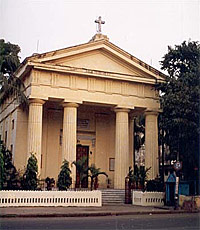
modern times the Orthodox Church returned to India. Greek merchants
built a grand and richly endowed church dedicated to the Holy
Transfiguration in Calcutta
(Kolkata) in 1924, but it was not until the 1980s that an Orthodox
mission to the Indians was established. This occurred with the arrival
of Fr. Athanasios (Anthedes), a Greek hieromonk from Egypt. Basing his mission in the village of Arambah, West Bengal (about ninety miles from Calcutta),
Fr. Athanasios built there a church dedicated to the Apostle Thomas.
For the next ten years he traveled on foot to the surrounding villages,
preaching the Gospel. By the time of his repose in 1990 he had formed
twenty-four clusters of believers and translated the Divine Liturgy, a
Service Book, and an Orthodox Catechism into the local Bengali dialect.
In 1991 Fr. Ignatios (Sennis), a hieromonk from Mount Athos, arrived in West Bengal
to continue Fr. Athanasios' work. Soon after his arrival Fr. Ignatios
established the Philanthropic Society of the Orthodox Church. The
society was formed for two reasons: first, to provide basic health care
and food for the destitute and starving in a state that has practically
no social services; and second, to protect the Orthodox mission from the
West Bengal Communist regime, which prohibits any kind of missionary
activity. While ministering to the physical needs of the Indian people,
the missionaries are also able to spread the Orthodox Faith.
In
2004 Fr. Ignatios was consecrated Bishop of Madagascar under the
Patriarchate of Alexandria. By the time of his departure from India,
the Orthodox Church had grown to include sixteen parishes, five
thousand faithful, ten priests and two deacons — all under the
jurisdiction of Metropolitan Nikitas of Hong Kong and South East Asia (Ecumenical Patriarchate). Since 1995 the Orthodox Christian Mission Center
(OCMC) has been sending teams to Calcutta
annually. Working with the local clergy, team-members offer catechism
and seminars, and assist with the ongoing mission outreach. In 2006, an
American priest, Fr. Paul Martin, traveled to India as part of an OCMC
team, in order to spiritually and physically feed the hungry of
Calcutta. Our mission team leader, Fr. Stephen Callos, warned us that Calcutta
would be an assault to all of the senses, and he was right. The eyes,
the ears and the nostrils — but especially the nostrils — find ample
reason to take offense.
To say that the city is overpopulated would be
an understatement. The eye is glutted, busy with impressions, and most
of these are unpleasant: people squeezed together in cardboard sheds;
shops all a jumble, tightly pressed within congestedstalls,
bringing to mind the bas-relief on a Hindu temple — or a closed
accordion; noise unremitting, the cries of peddlers and beggars,
automobile horns by day and night, packs of stray dogs howling at the
moon. And then there is the chaos of traffic, no emission control, few
stop lights, signs or speed limits; a multitude of cars, rickshaws, and
buses racing about every which way, riders like rag dolls sitting
precariously atop or clinging for dear life to bumpers — all madness to
an occidental. In Calcutta entire families squat near trash heaps in the
streets, with plastic tarps their only protection from the elements.
Holy Transfiguration church in Calcutta
But
what is most offensive about this place, and most distinctive, is the
smell — the scent of decay in the hot, wet air — urine, dung, and
disease. An essay on Calcutta,
"The City of Dreadful Night," speaks of "The Great Calcutta Stink": "It
is faint, it is sickly, and it is indescribable. It resembles the
essence of corruption that has rotted for the second time — the clammy
odor of blue slime. And there is no escape from it."
Rudyard
Kipling wrote this around the year 1890, but it is as true today as
ever. Some things never change. I still have the dreadful smell of the
City in my nostrils, and there I expect it will stay for some time. Fr.
Stephen, who has represented OCMC in Calcutta four times, says the smell
remains with him long after returning home. As far as I'm concerned, it
may never go away. While
serving the OCMC mission in India I kept recalling the 17th chapter of
the Acts of the Holy Apostles. There St. Paul addresses the Athenians.
He sees the shrines to the gods and acknowledges the Greeks to be in all things very religious (Acts
17:22). It is telling to see Paul choosing a Greek word that can mean
both "religious" and "superstitious" — and here, I think, is the key to
understanding the people of India,
the vast majority of whom are Hindu.
These
people are very religious,
but also very superstitious. They worship many strange gods, and one
finds little shrines to the gods on every street — shrines to Kali,
Krishna, Shiva, Durga, and others. But towering above them all is Kali
Temple,
one of the largest temples in the world dedicated to any Hindu deity.
In a section of town called Kalighat it stands, an assault to all reason
and civility, decayed and primeval, just next door to Mother Theresa's
Home for the Dying and only blocks away from Holy Transfiguration Greek
Orthodox Church, our home in Calcutta.
Gangs of Kali priests gather in front, hawking, gesticulating. Take
note: daily animal sacrifices are offered here, and the sanctum
sanctorum is open to all for a price! I am accosted when passing in
civilian clothes, but when in cassock I am left alone. See the viscera
of goats, thrown in the streets where they decay in the dust and slime!
The stink is intensified, as if the essence of Calcutta is located here,
so near the ancient river Hughli.
I
do not understand this dark Kali and her appeal. I do not understand
her heart of darkness. Yet in Bengal Kali is most popular of all, the
goddess of destruction, black, depicted with bloody tongue, a necklace
of skulls and a skirt of severed arms. Cherubim Ghosh, a young convert
to Orthodox Christianity and our guide in West Bengal,
tells me that he had once been devoted to Kali and at first had
difficulty resisting the almost incessant nagging of his mother and
companions to return to the goddess. Knowing something about British India,
I ask him about the Thaggies or "Thugs," a sect of Kali worshippers
whose practice of ritual murder had been outlawed in the nineteenth
century. He says that ritual murder is still practiced, though not
openly, and that the Thugs have long been underground. Is this possible?
It has the ring of a ghost story. Nevertheless, I get chills just
thinking of it.
I have said that the Indians of West Bengal are
superstitious. They appeal to their gods for favors and relief from
suffering, which is perfectly understandable, given their deplorable
living conditions. But they seem to do this with superstitious dread.
The Hindus include in their pantheon Christ, the Theotokos, and even
Mother Theresa. Some of them come to our Matins and Vespers services,
venerating our icons and praying with us. Tim Arestou, administrator of
the Orthodox orphanage near Calcutta,
tells me that thousands come every year to worship Christ at His
Nativity. I have the sense that they are covering all the bases, so they
see nothing contradictory about turning to Christ and the Mother of God
and then returning to Krishna and Kali, the mother of destruction.
But
clearly these people are also very religious, and parts of what they
have can be baptized, brought into Christianity. They are a pious and
gracious people. When Hindus come to our services, they have an unusual
way of venerating icons that is very beautiful, waving their hands over
the lighted candle next to the icon and then patting their heads and
faces before pressing their cheeks on the icon surface. Then they kiss
and make prostrations. In our distribution of food to the poor — and we
ministered to thousands in one morning — some made prostrations before
us, touching our feet with both hands.
The Hindus have three major
gods — Brahma, Shiva and Vishnu — and in theory, at least, they believe
in a single deity. This one God or single Reality they call Brahman.
Although this belief is fundamentally different from Christian belief in
the Holy Trinity, it may help prepare Hindus to accept Trinitarian
doctrine when they come to the true revelation of God in Orthodox
Christianity.
Many know that the Hindus greet one another with
joined hands, palms touching, and a bow. This form of greeting is
actually widespread throughout Asia, and is interpreted in different ways by various traditions.[1]
In the context of Orthodox Christianity, it may be accepted as a
gesture of love, respect, and the recognition of the image of God within
each person. I love this gesture and am pleased to say that it is has
been assimilated into the indigenous Orthodox Christian culture.
India
is such a strange world. It seemed to me another planet, or at least
centuries removed from our modern existence — though in many ways I had
the sense that this world is more "real" than ours. The people in Calcutta
are in touch with the realities of existence, suffering and death,
while we often live artificial lives, plugged into our computers and
seeking escape in our pleasures and our work.
Fr. Christos Sarkar with his family. Fr.
Christos serves in India, at St. Thomas Orthodox Church in Arambagh
Hooghly (photo from here).
I am still overwhelmed, just beginning to make sense of my stay of nearly one month in West Bengal.
Fr. Stephen Callos of the Greek Archdiocese, Fr. Nathan Kroll of the
Orthodox Church in America, and I spent most of our time at St.
Nektarios Greek Orthodox Church and Compound near the village of Akina
about sixty miles from Calcutta. Our mission was to teach the native
clergy, catechists, and the newly baptized, some of whom came long
distances to participate in our seminars. This was far and away the most
satisfying of all my experiences in India. Our brothers and sisters in India
are hungry for the truth, and they respond with great love and
gratitude. But communication is not always easy. My translator, Fr.
Andrew Mondale, was excellent, though even with his help there were
obstacles to overcome. Several instances come to mind. During a class on
the Eucharist some were having difficulty with the Christian concept of
sacrifice, until I alluded to an offering made to the god Shiva at a
shrine just outside the compound gates — a potato set before a clay
idol. I asked whether we should bring our potatoes, goats, fruits, and
vegetables to church and place them on the altar. They replied with a
resounding, "No!" "What then does God want?" Their response, almost in
unison, delighted me beyond words — "He wants our hearts!" After this I
was able to speak of the "sacrifice of praise" and the lifting up of our
hearts as essential elements of Eucharistic worship.
During a
class on creation I used the analogy of the sun's heat when speaking of
God's creative love, His energies, and there was a misunderstanding. One
man asked, "Is God the sun?" The people can be very simple and literal,
but they have no difficulty understanding that God is Love.
I have said that the situation in India recalls St. Paul
among the pagans. At no time was this clearer than when a question was
raised concerning eating foods offered to the gods. This is a pressing
matter among the Christians in India, since all of them have Hindu
relatives and friends, and often they are expected to eat of these
foods.-Of course, the problem is addressed in I Corinthians, chapter 8,
but before India I had never expected to find this passage of any
practical value, at least not in this quite literal sense.
After
morning classes Fr. Nathan and I took walks in the village. The natives
live in mud huts with grass roofs. I am convinced that we were some of
the first whites ever encountered there. The people gaped at us — we
might as well have been alien life forms — but all were excited to see
our cameras. Often they would draw near and hint for us to take their
pictures, as if they would thereby attain a kind of immortality. Rice
paddies are all around, of course, as are shrines to the gods. And palms
trees. Cobras are common. Gregory, a fifteen-year-old Christian boy,
told me that a cobra had taken his father's life two years before. He
lives in a two-room mud hut with his mother, but she is the sole
supporter and rarely home. He has to fend for himself, yet he is full of
joy and still innocent.
In the countryside around Akina we saw a cremation site or ghat, with
earthen jars, sticks, and charred human bones. After a recent burning
ceremony those paying homage had placed sticks topped with rags onto the ghat. These
are like little flags, and their purpose is to indicate a favor owed
the deceased, so as to avoid the reprisals of an angry spirit. The pots
contain body parts that didn't burn — mostly belly buttons, I am told.
But the Hindus do not always practice cremation. Cherubim explained to
me that the bodies of little children and wandering ascetics (called sannyasis) are sometimes buried, since it is believed that the fire of God burns clean the souls of such as these.
Tim
asked me to come to the orphanage on a Sunday after Liturgy to see the
children and comfort those who had no visiting relatives. I did, and the
orphans showered me with affection. In the evening, after I told them
some stories, they even put on a show for me, with traditional dancing
and singing. One fragile wisp of a blind child got up to sing "Twinkle,
Twinkle Little Star" in English, and little Despeta — who is five or six
and has a fatal brain tumor — spent the whole time clinging to me. This
little girl had been abandoned at the orphanage gates. She is certainly
well loved here, both by the teachers and the other orphans. She is not
expected to live beyond the age of eight, but in her little, special
way she has brought such joy to this place, and I am sure her spirit
will continue to give blessings even after she is gone. Many, both here
and in America,
pray for her. The orphanage is a place where God's light shines
distinctly, in the faces of children and in the work of the teachers.
On
a tour of the orphanage grounds, I was shown a large shop area where
children are instructed in various practical skills, such as sewing.
There is a house for the blind, and at present five blind children are
in residence. The blind children sit together at mealtime with their
teacher, a Christian woman of sixty-two years whose face fairly beams
with the love of God.
It is important to see that the ministry at
the orphanage is one of great, divine love — a love distributed to all,
regardless of creed. Many of the orphans are not Christian. I met Rupa, a
Hindu girl of about fifteen, who is very good and has a big heart. She
worries about her friends and her little sister and wants them to do
well in school. I spoke with her privately, praised her and offered some
encouragement. She responded warmly, happily, and I noticed that she
danced for me with a special joy.
But there are many Rupas. The
point I want to make is that the area where children are instructed in
various practical skills, such as sewing. There is a house for the
blind, and at present five blind children are in residence. The blind
children sit together at mealtime with their teacher, a Christian woman
of sixty-two years whose face fairly beams with the love of God.
It
is important to see that the ministry at the orphanage is one of great,
divine love — a love distributed to all, regardless of creed. Many of
the orphans are not Christian. I met Rupa, a Hindu girl of about
fifteen, who is very good and has a big heart. She worries about her
friends and her little sister and wants them to do well in school. I
spoke with her privately, praised her and offered some encouragement.
She responded warmly, happily, and I noticed that she danced for me with
a special joy.
But there are many Rupas. The point I want to make
is that the good people oflndia are ripe for Christ. As I have tried to
say, they are religious by nature. They hunger and thirst for Christ,
and some pray with us without understanding Who He is. It is our mission
as Orthodox Christians to reveal Christ in our actions, to show these
dear people the meaning of God's love. And I can assure you that this is
exactly what is being done in Calcutta, in Akina, and at the orphanage.
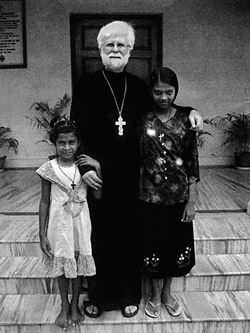
Father Paul Martin and children of the Orthodox orphanage in India
Every Monday at the church in Calcutta
rice, beans, salt, sugar, and soap are distributed to the poor. Fr.
Stephen arranged it so that Fr. Nathan and I had a chance to
participate, not together but separately, since at least two priests
were needed in Akina to conduct classes. Preparing for the distribution
is heavy work in the heat. Many bags need to be weighed and put into
stacks. During the preparation, long lines formed around the church —
armies of the poor and the maimed, numbering in the thousands. I saw an
old midget in rags leading his tall, blind friend. Both were crippled. I
saw several people without hands or legs. Many had large tumors and
growths. All were grateful to receive from us. To see the love and
gratitude on their faces as I gave them food and soap, to have them
prostrate themselves before me and touch my feet, was deeply humbling. I
am writing this with some trepidation. I am not worthy, but the story
needs to be told.
On my last day in Akina, Sarbojit Dalle, an
English-speaking boy who will be baptized soon, came to me with a group,
saying that the people think we have been "very good, very clear, very
good teachers." "You understand us," he says, and they ask if I am a
teacher at home. When I say that I used to teach English, they give wide
smiles and many nods. Sarbojit explains that they all want Fr. Stephen,
Fr. Nathan and me to return. He asks that we pray for them, and we ask
that they pray for us.
Then we three priests give speeches. I tell
the people that they will be in my heart always, that we will be joined
in Christ by our prayers and thoughts and in the Sacraments. Fr. Nathan
speaks briefly and sincerely — as he says, "with words locked in my
heart." And Fr. Stephen finishes with loving sentiments. As usual, Fr.
Andrew Mondal translates, since few of the people speak English. Then
George, one of the catechists, comes forward as a representative of the
people with something to say. He thanks Fr. Stephen for being so
faithful over the years to the mission, and Fr. Nathan for his dedicated
service. I do not know what I said or when I said it, but he thanks me
for having helped him resolve some trouble he had. Indeed, God works in
strange ways.
Over the weeks we all heard many inspiring stories demonstrating the strong faith of our Orthodox brothers and sisters in India.
Fr. Stephen told us about a man whose employer threatened to fire him
should he be baptized. He ignored the threat, and nothing happened.
Eventually, the employer began expressing an interest in Christianity
and even came to one of the seminars sponsored by OCMC. It takes real
courage to become a Christian in India
— and it takes courage to remain Christian. Converts are often rejected
by family and friends, but they know that to be rejected for love of
Christ is cause for rejoicing. One man told me that, when he converted
and his home became a center of Christian worship, the villagers
threatened him and his family with bodily harm. He remained firm,
however, and now years later many in his village are Orthodox.
Unfortunately, this does not always happen. And even when it does,
acceptance and peace come gradually and often with pain. One of the
catechists said that his parents still will not talk to him years after
his baptism. He prays for a change of heart in his parents, and he longs
for it. But the point is that there is a price to pay in India
for converting to Christianity, and we all should be aware of this. The
witness of such people is inspiring. It demonstrates the power of our
Faith, as well as God's loving-kindness and care for His children.
So
I am pleased to report that the Church in West Bengal, India is alive
and well. Needless to say, I'm also pleased to have survived to tell
about it. Notwithstanding the terrible jet lag and culture shock, both
coming and going; in spite of the swarming gnats, mosquitoes and other
pests; regardless of intestinal problems and the sweltering heat and
humidity — even in consideration of that Great Calcutta Stink — it was a
deeply rewarding experience, one I'll cherish until my dying day. Now
just weeks after my return
I long to go back, if it is God's will. But
there remains so much to assimilate, so much more to understand and talk
about before I can think of returning. I am not finished with India.
My writing and thinking about it has become a daily obsession. But I
offer here some of my thoughts, hoping that something will capture your
interest and move you to pray for our brothers and sisters there and be
generous with your time and money. Missionaries are needed, but if you
cannot go, please remember these people in your prayers and in your
offerings.
I am sure Frs. Stephen and Nathan join me in thanking the many good and generous people who have supported our trip to India
with their prayers and offerings. And we pray that God will continue to
bless His Church, and that He will open our hearts to the wonderful
possibilities for Orthodox Christian missionary work in India and throughout the world. Amen!
October 2006
Fr.
Paul Martin is attached to the Sts. Peter and Paul Ukrainian Orthodox
Church in Palos Park, Illinois, and is serving as priest at the
Annunciation-Agia Paraskevi Greek Orthodox Church in New Buffalo,
Michigan. To support the Orthodox mission in West Bengal by making a donation or by becoming a missionary to India, contact the OCMC: Orthodox Christian Mission Center P.O. Box 4319 St. Augustine, FL 32085-4319 USA Phone: 1-877-GO-FORTH (1-877-463-6784) Website: www.ocmc.org And:
Theotokos Greek Orthodox Girl’s Orphanage, India (from here)
Lastly, there is an interview with Christina Thanos, who produced a short documentary called Lucky Girls
about the Theotokos Greek Orthodox Girl’s Orphanage. She also
organized a lenten fundraising campaign for the orphanage. Lent is
over, but they are still accepting donations, even of just a few
dollars. You can listen to the podcast here, and visit the film’s website, which includes fundraising details, here. The film here. Site here!