Τετάρτη 5 Αυγούστου 2015

During the time that Luther and Calvin were formulating the Reformation...


The medieval West with its so-called “Catholic Church” or “Roman Catholic Church” had already excised itself from its ancient, authentic roots – which were in fact Orthodox – and had succumbed to the dominance of heresy. Luther had attempted to confront this heresy of the Papacy, but he unfortunately distanced himself even more from those ancient, authentic roots of the One Church.
During the time that Luther and Calvin were formulating the Reformation in the West, the Orthodox Christian monasteries of Eastern Europe and certain quarters in Asia and Northern Africa were hosts to hundreds of saints – both men and women. Needless to mention that there were also the faithless, the immoral and unrepentant sinners living in those same areas (as they do in every place and every era); however, there were also millions of true Christians with the authentic faith in Christ who lived among them: countless “little” and “big” holy persons, many of which were also miracle-workers, as verified within the Book of Acts of the Apostles - as were the Disciples of Jesus Christ. 
These saints - each of them not less important than Luther or Calvin - were students and spiritual children of the saints of the preceding generation of saints, who in turn had likewise been spiritual children of the saints before them etc., thus reaching back as far as the first Apostles and their disciples, of the first century A.D..  None of them “needed” to break away from the Church in which they belonged or create a new version of Christianity, because that was the Church which had not altered its teaching or its way of life over time (as did the Papacy); it was the actual, original Church, which Jesus Christ Himself had founded, and which the Holy Spirit had thereafter undertaken to guide throughout History, by means of the holy Apostles and their disciples, i.e., the saints of the second century A.D., the third, the fourth, and so on, until this day. 
St. David of Euboea (16th century)
Sadly, during the time of Luther, most of those territories had come under Ottoman (Muslim) occupation; however, that did not hinder the Christians from developing spiritually within the bosom of the Church or progress in their union with Christ and amongst themselves, in the same way that they did during the centuries of Roman persecutions.
Protestants had fought against the terrible heresy of Papism; and yet, right beside them at a very small distance stood the ancient Church of the proto-Christian era – still alive and breathing, and without having ever broken the ties that link it to the original Church of the Apostles and the first Christians.

See
 
Hieromartyr Cyrillos Lukaris. He was Patriarch of Alexandria from 1601 to 1620 and Patriarch of Constantinople for five different periods from 1620 until 1638.
 

Τρίτη 4 Αυγούστου 2015

Capitalism, Protestant Ethics & Orthodox Tradition


By the Metropolitan of Nafpaktos and Saint Vlasios, fr. Hierotheos Vlachos

Orthodox Outlet for Dogmatic Enquiries
This is a part from the article Capitalism as the offspring of Western Metaphysics
 
It must be underlined that Orthodoxy – Romanity (Romanity = Byzantine Tradition & Culture) has no affinity whatsoever to Protestant ethics - as realistically presented by Max Weber with regard to the capitalist spirit - nor is it expressed by Latin theology. For this reason, in what follows, we will examine as briefly as possible the views of the Orthodox Church on the central positions underlined by Max Weber. We will underline five basic points, without citing Patristic texts and related bibliography, because in my other studies, there is ample material.

a) It is characteristic that the spirit of Capitalism, i.e.. Capitalism as a system, was not born in the East, in Romanity, but the West. This is not unrelated to the theology and the way of life that prevailed in these two areas. In the Orthodox East there was no need to refute the feudalist system with its racist mentalitythe way this had prevailed in the West.
Apart from this, in the Orthodox East there prevailed the teachings of the Fathers of the Church on philotheia (the love of God) and philanthropy (the love of fellow-man), on kenosis (self-evacuating) and sacrifice, on philotimo (honourable reciprocation) and the sacrifice of one’s rights. In other words, there was a balanced social teaching, which was the fruit of genuine Christology, ecclesiology and anthropology. This social teaching was neither created nor implemented as a system, but was itself a way of life.
The par excellence centres of Romanity - where they applied the genuine social teaching, which was a result of the advent of the Grace of God and the spiritual rebirth of man - were the Monasteries. Within the confines of the Monasteries, the community functioned in the best possible manner, where the love of God and our neighbour prevailed; where philautia (self-love) was be repelled by ascetic labours. The life of the Monasteries influenced the Roman societies also; even the very palace.
Of course, neither was Socialism born in the Orthodox East; as we saw previously, even the socialist system had been organised on rationalist criteria and was subjugated to bureaucracy and the entire mentality of a man-centred system.
Indeed, Orthodoxy differs radically, both Capitalism as well as Socialism, from a philosophical, structural and organisational point of view, since both these systems are offspring of Western metaphysics. The social teaching of Socialism is related to the social teaching of Christianity, but we there are two basic differences. The one difference is that its implementation is achieved through revolutions and laws and not with freedom and love; the other difference is that Socialism, in most of its manifestations, is linked to a specific world theory and is thus an atheistic ideology. Most certainly however, while Orthodoxy may relate to Socialism from the aspect of social teaching, it is nevertheless in complete dialectic opposition to the spirit of Capitalism.
Both Capitalism and Socialism are transferred and imported systems. One could add here that the Socialist theories infiltrated the Orthodox East where Orthodoxy prevailed, because the views on justice, equality, love etc. were familiar here, years ago. Even today, the theories of Socialism – Marxism are difficult to prevail in the Western world, because the individual prevails there. And in these individualist perceptions, Capitalism flourishes.
Consequently, Capitalism cannot fit into the teaching and the way of life that prevails in Romanity. It is the offspring of Western man and is destined for him.

b) Orthodoxy is not linked to metaphysics. We saw in the previous analysis that the spirit of Capitalism, as analysed by Max Weber, is very closely linked to the theory of predestination, which is one of the characteristic marks of metaphysics. Of course, the term metaphysics includes many other aspects that will not be analysed here.
We could preferably say that Orthodoxy is anti-metaphysical. The centre of Orthodox anthropology is not the “orthos logos” (the appropriate word, reasoning). Without abolishing logic, Orthodoxy transcends it through a revelation by God, which is beyond all reasoning and not against reasoning.
The theory of predestination is rejected by the theology of the Fathers of the Church. God does not violate man’s freedom and those who wish can become sons of God. In Orthodoxy there is no “aristocracy of the pious”. When man follows a specific method of therapy, he can even reach the state of theoptia (the ‘sight’ of God). Thus, he comes to know God, he acquires selfless love and loves the entire world. Just as medical science cannot be metaphysical, so Orthodox theology cannot be metaphysical.

c) The views of Orthodoxy on labour and profession are also different to those of the Protestants. The vast difference lies in the fact that Protestants link the profession to Divine Providence, to divine commandments, and especially to the predestination. In Protestant ethics, the profession, as well as the profit that originates from it, all take place within the framework of those saved by God. In Orthodoxy, since we do not believe in an predestination, it is to be expected that we do not link the profession to this inhuman theory.
After all, even though labour may have its value for man’s life in this world and can even be regarded as a spiritual task when conducted within genuine gnosiological and hesychastic frames, it nonetheless does not relate to a specialised profession. For example, medical science cannot become a profession, nor can any other humanitarian sciences; they are incorporated within the perspective of diaconia (ministering). We are all deacons (ministers). Job professionalism, and especially the mentality of professionalism, is linked to profit, to the increase in production by any means, to the exploitation of man and so many other terrible things.
The view that the profession of each person is predetermined by divine Providence is inhuman, since it abolishes man’s freedom or makes him even more audacious. Imagine what could happen if the merchant, the manufacturer and in general every businessman thought that their work was a profession determined by God. In this case, every kind of abuse, injustice and exploitation would be justified.  This is why labour does not identify with the profession. After all, the tradition of our land in rural societies and communities and in the Monasteries has proved that one can work and offer much, without exercising a particular profession. But when man is obliged to exercise a specialised profession, he must perceive it as a labour that is performed within the framework of philotheia (love of God) and philanthropy (love of fellow man).
After all, each man’s labour is not an end in itself in his life. It is useful, essential, so that he does not fall into akedia (spiritual laxity), but also necessary for him to feed those who are under his protection; but it is not his sole purpose. It is regarded as a gift from God, and should be exercised eucharistically (in a spirit of thanksgiving). Man’s objective is neither justification, nor the reassurance of Grace existing in his heart, but his theosis (glorification).
 
d) Orthodox ascesis does not aspire to the fulfilment of our duties to God, or to the reassurance that one belongs in the aristocracy of the chosen, but to the liberation of our nous (mind) from its subjugation to creations.
In opposition to rationalism, according to which rational reason (orthos logos) is man’s centre, Orthodoxy accepts that man’s centres are two, nous (mind) and logos (word, reason). The nous relates to God and the divine, while the logos relates to our environment. When the nous is enslaved by creations, man is psychically, psychologically and spiritually ill. The ascetic effort aspires to liberating man’s nous from its subjection to logic, to passions and the world that surrounds him. This is achieved in Orthodox hesychasm.
Speaking of Orthodox hesychasm, we need to view it from two perspectives. Firstly, that it is a command of God. In other words, the commands of God do not only refer only to external works for the performance of one’s duty, but also to inner cleanliness, nepsis, hesychia etc. Secondly, Orthodox hesychasm is not possible within a climate of individualism. Because he has freed himself of existential and internal tyrannies, the hesychast is the par excellence free, genuine person, who loves all people truly.
Consequently, Orthodox hesychia (quiet) is closely connected to man’s therapy, and from the aspect of methodology it resembles modern psychiatry. We say “from the aspect of methodology” because there is a great difference between the two from the perspective of ontology and anthropology. In any case, no one can blame a psychoanalyst that with his effort, with the psychotherapy that he practises, he is not performing any social activity, or that he views man as isolated. On the contrary, one praises him because the psychoanalyst helps the already distant and antisocial person to learn how to confront other people and society in a proper manner, by healing his dysfunctional personality. The same and much more holds true for orthodox hesychia (quiet). Through hesychia, man discards his anti-social manner and becomes genuinely social; he cures his individualism and thus, in place of selfish love, he now acquires selfless love.
Orthodoxy similarly views both wealth and material goods in general within this perspective. It does not confront them idolatrously or manichaeically; that is to say, it neither worships nr rejects them. When man is spiritually complete and takes the proper stance towards them, he sees no regenerative power and value in money; he is not interested in using methods and ways of reproducing money. To him, offering, sacrifice, kenosis, or denying his own rights have a greater value.
Orthodox ascesis does not aspire to any state of blissfulness (eudaemonia), whether idealistic or materialistic. Idealistic bliss is dominated by the soul’s return to the world of ideas, while the materialistic bliss is dominated by the enjoyment of material goods in this life. In fact, Orthodox ascesis cures man from such bliss-oriented tendencies.
Also, in Orthodoxy we are not overcome by the obsession of accomplishing a duty. Western morality has taught us to speak of “our duties to God, to our neighbour and to ourselves”. We learned to speak of man’s natural course. Love is not a duty, nor can it be confined to this notion; it is the natural state of man. The lack of love is nothing more than the deviated course of man’s psychic (soul-related) powers.

e) Of course, there may be baptised Orthodox who are discerned in their lives by the Protestant morality and the spirit of Capitalism, and who belong to the category of the people analysed by Max Weber. These however are not genuine Orthodox Christians; they are not permeated by the atmosphere of Orthodox Tradition; they are not Romans, but Vaticanising and Protestantising Orthodox. The fact is that when we want to be informed about the life of the Church, we must approach those who breathe inside Her atmosphere; those who swim inside Her life-flowing river and who do not sink into stagnant and polluted waters, nor remain on the banks of the river.
Orthodoxy bears no relation to Protestant ethics or to the spirit of Capitalism. It has an entire life that is a transcending of all created realities; of deterioration and even of death itself.

See also

Habari Kutokanyumba la Watawa Mukanisa la Orthodoksi Mtakatifu Nektario Mudji wa Kolwezi Inchi la Kongo Baada Zaire


Nyumba la watawa katika kanisa la Mtakatifu Nektario

KUTWAA KIPAWA LA KITAWA KWA BINTI
 

Diakonima

Katika inchi la Kongo na Mudji Kolwezi kuna Mama mtawa wa kwanza jina lake Thekla,anakaa kukanisa la Mtakatifu NEKTARIO, naye ni mtawa wa kwanza katika Afrika mzima tokeya mwaka 1988. Mpaka leo alikuwa na watawa ine,kwa mapendo ya Mwenyezi mtawa wa tano anaongezeka mu mwezi wa saba 2009 Hivi kipawa la kitawa kilitwala kwa Mwaskofu wa Katanga Mweshimiwa Meletio.


Mama mtawa mkubwa Thekla na mwana funzi binti mbele ya kuwa mtawa

Mtawa wa sasa alipata jina la AGNIESE, ni mtoto wa padiri,ana na miaka 24, Alikuwa najifunza kunapita miaka tano karibu na wa tawa wengine kanisani.


Kutwaa kipawa la kitawa la Agniese ku mkono la Askofu Mweshimiwa Meletio

Hizi habari za kupasha Neno la Ukweli katika Kiorthodoksi ni mambo Ya MIUJIZA katika myoyo yawa ndugu wenye AFRIKA CHINI LA SAHARA.


Kiisha kutwaa kipawa la kitawa, mtawa Agniese na Askofu

Ni furaha katika Bwana kwakuwona Ngufu la Roho Mtakatifu na kutumikisha wa tumishi wa Bwana hama Mwaskofu Katanga Mweshimiwa Meletio mtoka mlima takatifu la Athosi mu Monastari Grigoriou, yeye alimpiana marehemu padiri Kosma, Mpaka leo anaendelesha na kupasha NENO LA UKWELI, na kubatiza ma elfu ya wa pagani,na kujenga makanisa pamoja na ma nyumba la wa padiri ,tena anajenga ma masomo,kwanza primari,sekundari,masomo la kazi na lamikono,wanafunzi wanakuja ma elfu,walimu wengi,ivi tunamwomba Bwana asaidiye kazi lake liendeleye na watumishi wa haki wakudje shambani lake watumike.


Mtawa wasasa, ivi machoni mwake anaagaa na mwangaza la neema.

Mwenyezi apate kumu saidiya achunge hii baraka kila siku la maisha lake.

Tazama hapa


KUTAFUTA IMANI LAKUNYOLOKA – AMA KI ORTHODOKSI

Umonaki katika Kanisa la Orthodox 

Wamisionari tano halisi ambaye heri Afrika kusini mwa Sahara
(na takatifu mtoto bila majina ya Afrika)


The historical background of the monastery in Kolwezi, Congo (DRC)
Orthodox Mission in Tropical Africa (& the Decolonization of Africa)
Liturghia Takatifu

Liturghia Takatifu


Picha linatokana na hapa
Kusoma
LITURGHIA TAKATIFU
 

...our villages is our tradition

Δευτέρα 3 Αυγούστου 2015

Hotel Rwanda


Video from
Kelly Mullin


Hotel Rwanda is a 2004 American historical drama film directed by Terry George. It was adapted from a screenplay written by both George and Keir Pearson. It stars Don Cheadle and Sophie Okonedo as hotelier Paul Rusesabagina and his wife Tatiana. Based on real life events in Rwanda during the spring of 1994, the film which has been called an African Schindler's List, documents Rusesabagina's acts to save the lives of his family and more than a thousand other refugees, by granting them shelter in the besieged Hôtel des Mille Collines. Hotel Rwanda explores genocide, political corruption, and the repercussions of violence.

The film was a co-production between United Artists and Lions Gate Films. It was commercially distributed by United Artists theatrically and by MGM Home Entertainment for home media. As an independent film, it had an initial limited release in theaters; but it was nominated for multiple awards, including Academy Award nominations for Best Actor, Best Supporting Actress, and Best Original Screenplay. The film also won a number of awards including those from the Berlin and Toronto International Film Festivals. On January 11, 2005, the Original Motion Picture Soundtrack was released by the Commotion label. It features songs written by several recording artists including Wyclef Jean and Deborah Cox. The film score was composed by Rupert Gregson-Williams, Andrea Guerra, and the Afro Celt Sound System.

Hotel Rwanda premiered in theaters in limited release in the United States on December 22, 2004 and in wide release on February 4, 2005 grossing more than $23 million in domestic ticket sales. It earned an additional $10 million in business through international release to top out at a combined total near $34 million in gross revenue. The film was technically considered a moderate financial success after its theatrical run, and was met with positive critical reviews before its initial screening in cinemas. The Blu-ray Disc edition of the film featuring special documentaries along with selected scenes and audio commentary, was released in the United States on May 10, 2011.


Video from CwnInternational. Part II, part III, part IV, part V, part VI.

Genocide in Rwanda

United Human Rights Council

In 1994, Rwanda’s population of seven million was composed of three ethnic groups: Hutu (approximately 85%), Tutsi (14%) and Twa (1%). In the early 1990s, Hutu extremists within Rwanda’s political elite blamed the entire Tutsi minority population for the country’s increasing social, economic, and political pressures. Tutsi civilians were also accused of supporting a Tutsi-dominated rebel group, the Rwandan Patriotic Front (RPF). Through the use of propaganda and constant political maneuvering, Habyarimana, who was the president at the time, and his group increased divisions between Hutu and Tutsi by the end of 1992. The Hutu remembered past years of oppressive Tutsi rule, and many of them not only resented but also feared the minority.
On April 6, 1994, a plane carrying President Habyarimana, a Hutu, was shot down. Violence began almost immediately after that. Under the cover of war, Hutu extremists launched their plans to destroy the entire Tutsi civilian population. Political leaders who might have been able to take charge of the situation and other high profile opponents of the Hutu extremist plans were killed immediately. Tutsi and people suspected of being Tutsi were killed in their homes and as they tried to flee at roadblocks set up across the country during the genocide. Entire families were killed at a time. Women were systematically and brutally raped. It is estimated that some 200,000 people participated in the perpetration of the Rwandan genocide.
In the weeks after April 6, 1994, 800,000 men, women, and children perished in the Rwandan genocide, perhaps as many as three quarters of the Tutsi population. At the same time, thousands of Hutu were murdered because they opposed the killing campaign and the forces directing it.
The Rwandan genocide resulted from the conscious choice of the elite to promote hatred and fear to keep itself in power. This small, privileged group first set the majority against the minority to counter a growing political opposition within Rwanda. Then, faced with RPF success on the battlefield and at the negotiating table, these few power holders transformed the strategy of ethnic division into genocide. They believed that the extermination campaign would reinstate the solidarity of the Hutu under their leadership and help them win the war, or at least improve their chances of negotiating a favorable peace. They seized control of the state and used its authority to carry out the massacre.
The civil war and genocide only ended when the Tutsi-dominated rebel group, the RPF, defeated the Hutu perpetrator regime and President Paul Kagame took control.
Although the Rwandans are fully responsible for the organization and execution of the genocide, governments and peoples elsewhere all share in the shame of the crime because they failed to prevent and stop this killing campaign.
Policymakers in France, Belgium, and the United States and at the United Nations were aware of the preparations for massive slaughter and failed to take the steps needed to prevent it. Aware from the start that Tutsi were being targeted for elimination, the leading foreign actors refused to acknowledge the genocide. Not only did international leaders reject what was going on, but they also declined for weeks to use their political and moral authority to challenge the legitimacy of the genocidal government. They refused to declare that a government guilty of exterminating its citizens would never receive international assistance. They did nothing to silence the radio that televised calls for slaughter. Even after it had become indisputable that what was going on in Rwanda was a genocide, American officials had shunned the g-word, fearing that it would cause demands for intervention.
When international leaders finally voiced disapproval, the genocidal authorities listened well enough to change their tactics although not their ultimate goal. Far from cause for satisfaction, this small success only highlights the tragedy: if weak protests produced this result in late April, imagine what might have been the result if in mid-April the entire world had spoken out.

See also

En.wikipedia, Rwanda
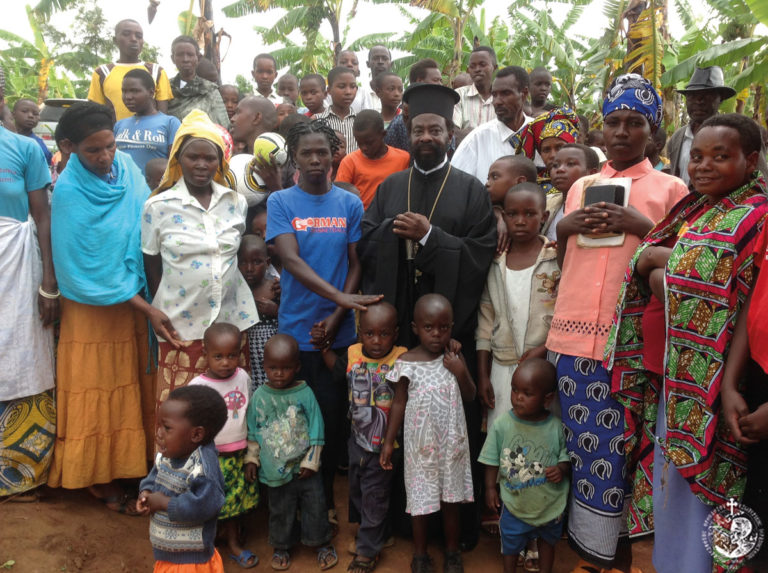
Orthodox Rwanda

IMG_6598
The Orthodox Bishop of Burundi & Rwanda Innocentios

Nine of the most controversial leaders in Africa


dailymail.co.uk

Auhust 6, 2014. President Barack Obama drew a diplomatic line at the first ever U.S-Africa summit at the White House this week by not inviting Zimbabwe’s brutal dictator Robert Mugabe.
But the guest list still included several other African leaders with only slightly better human rights records.
The White House promoted the summit as the largest-ever gathering of African leaders in the United States, with more than 50 countries represented.
The red carpet was rolled out for Equatorial Guinea's Teodoro Obiang Nguema Mbasogo, who shot or jailed virtually all his political opponents, Gambia’s Yahya Jammeh, who threatened to ‘cut off the head’ of any homosexuals in the country and for Cameroon’s Paul Biya, who has the dubious honor of ranking 19th on author David Wallechinsky's 2006 list of the world's 20 worst living dictators.
Many of the leaders were later photographed in the White House, posing for individual portraits with Obama and the First Lady.
The President's opening speech avoided the prickly issues of homophobia and torture and instead sought out similarities between the two continents.
He opened with: ‘I stand before you as the president of the United States, a proud American. I also stand before you as the son of a man from Africa’.
Before going on to say: ‘Our faith traditions remind us of the inherent dignity of every human being and that our work as nations must be rooted in empathy and compassion for each other, as brothers and as sisters.’
Here we run the rule over nine of the most controversial leaders who enjoyed the lavish affair. 


Equatorial Guinea president Teodoro Obiang Nguema Mbasogo and his wife Constancia Mangue De Obiang, pictured arriving for a dinner hosted by President Barack Obama for the U.S. Africa Leaders Summit

Pictured outside the White House waving and grinning with his wife President Obiang of Equatorial Guinea is Africa’s longest serving dictator after seizing power from his uncle and mentor (who used to hang regime critics from the capital’s street lights) in 1979.
Since then he has won the yearly elections with 99% of the vote. Taking the lead from his uncle, he has since had shot or jailed virtually all political opponents and ruled the country with an iron fist. Despite running one of sub-Saharas biggest oil-producing countries and amassing a personal wealth in excess of an estimated $600million, he’s far from generous with his riches.
The average income of his citizens is $2 a day, few live beyond 53 and 20 per cent of children die before they reach five years of age. Last year the country ranked 163 out of 177 on Transparency International. There is no freedom of the press, the country’s one television station is government-run and clean water is scarce. In 2011, the United States' Department of Justice made moves to seize more than $70 million in assets from President Obiang's son, Teodorin Nguema Obiang Mangue.
Justice Department lawyers alleged Nguema, on top of his official government salary of $100,000, used his position to amass more than $100 million through corruption and money laundering, including a $30 million dollar mansion in Malibu, California, a $38.5 million Gulfstream jet and one of the world’s finest Michael Jackson memorabilia collections including  the red and black 'Thriller jacket' and Jackson’s crystal-studded 'Bad Tour' glove worth more than $2m. He was also the focus of a corruption investigation in France who seized his 101-room Paris mansion, a collection of cars and other luxury assets. He has repeatedly denied the allegations.


President Blaise Compaore (With First Lady Chantal Compaore) of Burkina Faso seized power in a bloody coup

Burkina Faso's Blaise Compaore is another African leader who seized power by bloody coup. The Burkina Faso president’s 1987 uprising left his predecessor Thomas Sankara dead – who himself had taken power four years earlier alongside Compaore. In 2011 he watched as protests gave way to calls for his resignation over claims of police brutality and government corruption. However, his presidential guard eventually squashed a mutiny, then made concessions to appease the remaining protesters - but questions remain over corruption among the ruling elite.


Cameroon president Paul Biya (with his wife Chantal Vigouroux) pictured at the President Obama's summit yesterday

Paul Biya has the dubious honour of ranking nineteenth on author David Wallechinsky's 2006 list of the world's 20 worst living dictators. The Cameroon's grip on his country's presidency has remained tight since he came to power in 1983 and there have been widespread allegations of fraud and voting consistencies in every election cycle. In fact, Mr Wallechinsky claims in the Huffington Post Biya is credited with the innovative election fraud tactic of paying for a set of international observers to certify his elections as legitimate.


Human rights groups claim Angolan president Jose Eduardo do Santos has murdered many and exploited the country's resources to his own gain. After Mariah Carey was paid $1million for performing for him last year, Human. Rights Foundation president Thor Halvorssen said: 'It is the sad spectacle of an international artist purchased by a ruthless police state to entertain and whitewash the father-daughter kleptocracy that has amassed billions in ill-gotten wealth while the majority of Angola lives on less than $2 a day'


President of Gambia Yahya Jammeh (with his wife, First Lady Zineb Jammeh) attended the dinner at the White House


Barack Obama shakes hands with Gambia's Yahya AJJ Jammeh as the presidents pose for an official photo

Gambian president Yahya Jammeh took power in a military coup in 1994. Although the coup itself was bloodless, in the 20 years since he has been accused of countless breaches of human rights. In 2008, he threatened to 'cut off the head' of any homosexuals in the country. The following year, it was reported up to 1,000 Gambians had been abducted by the government on charges of witchcraft - they were taken to prisons and forced to drink poison.


Rwanda president Paul Kagame's rule over his country has been notable for its restrictions on the press - (seen here at the White House on Tuesday with his daughter, Ange Ingabire Kagame)


Rwanda's president Paul Kagame with Barack Obama at the White House on Tuesday

When he came to power in 2000, Rwanda's president Paul Kagawe inherited a nation still raw from the brutal genocide of 1994 which claimed up to one million lives. But during his heavy-handed time in power, the country's ranks for press freedom have plummeted and a suspicious number of public and political opponents have been harassed or have died in increasingly suspicious circumstances.


Nigerian president Goodluck Jonathan casting a vote in his country's 2011 elections


Barack and Michelle Obama have an official portrait taken with Nigeria's president, Goodluck Jonathan

Goodluck Jonathan, president of Nigeria, signed harsh anti-gay laws this year. They criminalise gay relationships, being involved in gay societies and organizations and gay marriages. Violation of this law can result in up to 14 years in prison, with dozens of homosexuals already jailed. Jonathan also sparked major controversy over his decision in 2012 to end fuel subsidies. He is also accused of pardoning corrupt politicians.


Guinea president Alpha Conde came to power in December 2010 and while known for his brainpower and charm – has also been criticised for being impetuous and authoritarian.This assessment comes not just from his political opponents, but from his allies, too, according to the BBC. Opposition figures accused him of rigging the vote in the December 2011 parliamentary elections. However, after agreeing to delay the vote until 2013, Conde’s Rally of the Guinean People won, with the Supreme Court stamping its approval on proceedings.


Kenyan president Uhuru Kenyatta is embroiled in major controversy over electoral violence. He has pleaded innocent to murder and other charges for an alleged role in organizing violence that left more than 1,000 people dead after Kenya's 2007 elections. The case is before an international criminal court, and Obama pointedly skipped visiting Kenya when he toured Africa with his family last summer.


Kenya's President Uhuru Kenyatta with Barack and Michelle Obama