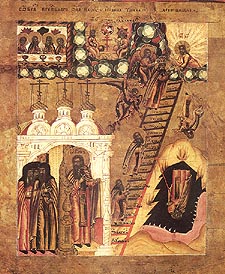
St. John Climacus is honored by the Church as a great ascetic and as the author of a remarkable work entitled, The Ladder of Divine Ascent, and therefore he has been named “Climacus,” or “of the Ladder.”
There has been very little information preserved about his origin.
Tradition tells us that he was born in around the year 570, and was
the son of Sts. Xenophon and Maria, who are commemorated on January
26/February 28. St. John came to the monastery on Mt. Sinai at age
sixteen. Abba Martyrius became his spiritual father and mentor. After
four years of living on Mt. Sinai, John was tonsured a monk. One of
the fathers present at his tonsure foretold that John would become a
great luminary of Christ's Church. St. John labored in asceticism for
nineteen years in obedience to his spiritual father. After the death
of Abba Martyrius, St. John chose the life of reclusion, departing
to a desert place called Thola, where he lived forty years in silence,
fasting, prayer, and repentant tears. It is not by chance that St.
John speaks so much of repentant tears in The Ladder.
"As fire
burns and destroys dead wood, so do pure tears cleanse all impurity,
both inwardly and outwardly." His prayer was strong and
effective—this can be seen in the following example of the great
ascetic's life.
St. John had a disciple, Monk Moses. One day
St. John sent his disciple to spread soil on the garden beds. As he
was fulfilling his obedience, Monk Moses became weary from the
fierce summer heat and reclined under the shade of a large cliff. St.
John was in his cell at that moment, resting a bit after his labor of
prayer. Suddenly a man of venerable countenance appeared and woke the
ascetic, reproofing him: "John, why are you resting peacefully here
while Moses is in danger?" St. John immediately arose and began
praying for his disciple. When Moses returned that evening, the saint
asked him if anything had happened to him that day. The monk answered,
"No, but I was in serious danger. A large rock broke off from a cliff
under which I had fallen asleep at midday and nearly crushed me.
Fortunately I was having a dream in which you were calling me, and I
jumped up and ran; at that moment a huge rock fell with a crash upon
that very place where I was…"
It is known from St. John's
life that he ate what was allowed by the rule of fasting, but within
measure. He did not go without sleep at night, although he never slept
more than was needed to support his strength for ceaseless
vigilance, and so as not to negatively affect his mind. "I did not
fast beyond measure," he said of himself, "and I did not conduct
intensified night vigil, nor did I sleep on the ground; but I humbled
myself…, and the Lord speedily saved me." The following example of
St. John's humility is notable. Gifted with a strong, sharp mind that
was made wise by deep spiritual experience, he taught everyone who
came to him and guided them to salvation. But when certain others
out of jealousy accused him of loquaciousness, which they said sprung
from vainglory, St. John took a vow of silence in order not to temp
anyone, and remained thus for a year. His enviers admitted their error
and begged the ascetic not to deprive them of his beneficial
instruction.
To hide his ascetic labors from people, St. John
would sometimes depart to a solitary cave, but fame of his holiness
spread far beyond his enclosure, and people from all walks of life
would come to him seeking a word of edification and salvation. When he
was seventy-five years old, after forty years of ascetic labors in
solitude, the saint was chosen to be abbot of Sinai. St. John Climacus
ruled the holy monastery for four years. The Lord granted the saint
many gifts of grace toward the end of his life, including
clairvoyance and miracle-working.
Saint John Climacus is seen standing at the foot of the ladder. With his left hand he directs our attention towards the ladder, while in his right hand he holds a scroll on which is written: "Ascend, ascend, Brethren."
During St. John's abbacy,
another St. John, abbot of Raithu Monastery (commemorated on the
Saturday of Cheesefare week) asked him to write the famous Ladder—instructions
for the ascent to spiritual perfection. Knowing of the saint's wisdom
and spiritual gifts, the abbot of Raithu asked on behalf of all the
monks of his monastery for "true instruction for those who seek
unwaveringly, and a kind of steadfast ladder that will take those who
desire it to the Heavenly gates…" St. John, who had a humble opinion
of himself, first balked at the task but then set about writing the
treatise out of obedience to the request of the Raithu monks. He thus
called the work, The Ladder, explaining his choice: "I have
built a ladder of ascent… from earth to holiness… In honor of the
thirty years of the Lord, I have built a ladder of thirty steps, which
if we climb it to the age of the Lord, we will be righteous and safe
from falls." The aim of this treatise was to teach us that the
attainment of salvation requires difficult self-denial and intense
ascetical labor. The Ladder first suggests the cleansing of
sinful impurity, the uprooting of vices and passions of the "old man";
second, it shows the restoration of God's image in man. Although the
book was written for monks, any Christian who lives in the world
will find it a reliable guide on the ascent to God. Pillars of
spiritual life such as St. Theodore the Studite, St. Sergius of
Radonezh, St. Joseph of Volokolamsk, and others continually referred
to The Ladder as the best book for soul-saving instruction.

Sinai Monastery of st Catherine, monk climbs chapel, 1900-20 (from here)
The content of one of the steps of The Ladder (No. 22) discusses the labor of uprooting vainglory. St. John writes,
Like the sun, which shines on all alike, vainglory beams on every
occupation. What I mean is this: I fast, and turn vainglorious. I stop
fasting so that I will draw no attention to myself, and I become
vainglorious over my prudence. I dress well or badly, and am
vainglorious in either case. I talk or I remain silent, and each time I
am defeated. No matter how I shed this prickly thing, a spike
remains to stand up against me.
A
vainglorious man is a believing idolater. Apparently honoring God, he
actually is out to please not God but men. To be a showoff is to be
vainglorious. The fast of such a man is unrewarded and his prayer
futile, since he is practicing both to win praise. A vainglorious
ascetic doubly cheats himself, wearying his body and getting no
reward.…
The Lord frequently hides
from us even the perfections we have obtained. But the man who praises
us, or, rather, who misleads us, opens our eyes with his words and
once our eyes are opened, our treasures vanish.
The flatterer is a servant of the devils, a teacher of pride, the
destroyer of contrition, a ruiner of virtues, a perverse guide. The
prophet says, Those who honor you deceive you (Isa. 3:12).
Men of high spirit endure offense nobly and willingly. But only the
holy and the saintly can pass unscathed through praise.…
No one knows the thoughts of a man except the spirit within him
(cf. 1 Cor. 2:11). Hence, those who want to praise us to our face
should be ashamed and silent.
When
you hear that your neighbor or your friend has denounced you behind
your back or indeed in your presence, show him love and try to
compliment him.
It is a great achievement to shrug the praise of men off one's soul. Greater still is to reject the praise of demons.
It is not the self-critical who reveals his humility (for does not
everyone have somehow to put up with himself?). Rather it is the man
who continues to love the person who has criticized him….
Our neighbor is moved by nothing so much as by a sincere and humble
way of talking and of behaving. It is an example and a spur to others
never to become proud. And there is nothing to equal the benefit of
this….
The Lord often humbles the
vainglorious by causing some dishonor to befall them. And indeed the
first step in overcoming vainglory is to remain silent and to accept
dishonor gladly. The middle stage is to restrain every act of
vainglory while it is still in thought. The end—if one may talk of an
end to an abyss—is to be able to accept humiliation before others
without actually feeling it….
When those who praise us, or, rather, those who lead us astray, begin
to exalt us, we should briefly remember the multitude of our sins, and
in this way, we will discover that we do not deserve whatever is said
or done in our honor.
This and other sayings that we can find in The Ladder
serve as an example of that holy zeal for our salvation that is
necessary to everyone who wishes live a pious life; and this written
treatise, which is the fruit of abundant and subtle observation over
his own soul along with very deep spiritual experience, is a great
benefit and guide along the path of truth and goodness.
The steps of The Ladder
are the ascent from strength to strength on the human path to
perfection, which can only be attained gradually and not suddenly;
for, in the words of the Savior, The Kingdom of Heaven suffereth violence, and the violent take it by force (Mt. 11:12).
More on this topic: Sunday of st John Climacus