Παρασκευή 14 Σεπτεμβρίου 2018

The Universal Exaltation of the Precious and Life-Giving Cross


Commemorated on September 14 

Greek Orthodox Holy Icon of the Universal Exaltation of the Holy Cross (from here)

Troparion & Kontakion

Orthodox Church in America


The Elevation of the Venerable and Life-Creating Cross of the Lord: The pagan Roman emperors tried to completely eradicate from human memory the holy places where our Lord Jesus Christ suffered and was resurrected for mankind. The Emperor Hadrian (117-138) gave orders to cover over the ground of Golgotha and the Sepulchre of the Lord, and to build a temple of the pagan goddess Venus and a statue of Jupiter.

Pagans gathered at this place and offered sacrifice to idols there. Eventually after 300 years, by Divine Providence, the great Christian sacred remains, the Sepulchre of the Lord and the Life-Creating Cross were again discovered and opened for veneration. This took place under the Emperor Constantine the Great (306-337) after his victory in the year 312 over Maxentius, ruler of the Western part of the Roman empire, and over Licinius, ruler of its Eastern part. In the year 323 Constantine became the sole ruler of the vast Roman Empire. 


September 14, 2018: Bishop Athanasius of Kisumu and all western Kenya celebrated the Feast of the elevation of the Precious and Life-giving Cross (from here)

In 313 he had issued the Edict of Milan, by which the Christian religion was legalized and the persecutions against Christians in the Western half of the empire were stopped. The ruler Licinius, although he had signed the Edict of Milan to oblige Constantine, still fanatically continued the persecutions against Christians. Only after his conclusive defeat did the 313 Edict of toleration extend also to the Eastern part of the empire. The Holy Equal of the Apostles Emperor Constantine, having gained victory over his enemies in three wars with God’s assistance, had seen in the heavens the Sign of the Cross, and written beneath: “By this you shall conquer.”

Ardently desiring to find the Cross on which our Lord Jesus Christ was crucified, Saint Constantine sent his mother, the pious Empress Helen (May 21), to Jerusalem, providing her with a letter to Saint Macarius, Patriarch of Jerusalem.

Although the holy empress Helen was already in her declining years, she set about completing the task with enthusiasm. The empress gave orders to destroy the pagan temple and the statues in Jerusalem. Searching for the Life-Creating Cross, she made inquiry of Christians and Jews, but for a long time her search remained unsuccessful.

Finally, they directed her to a certain elderly Hebrew by the name of Jude who stated that the Cross was buried where the temple of Venus stood. They demolished the pagan temple and, after praying, they began to excavate the ground. Soon the Tomb of the Lord was uncovered. Not far from it were three crosses, a board with the inscription ordered by Pilate, and four nails which had pierced the Lord’s Body (March 6).

In order to discern on which of the three crosses the Savior was crucified, Patriarch Macarius alternately touched the crosses to a corpse. When the Cross of the Lord touched the dead one, he came to life. Having beheld the raising of the dead man, everyone was convinced that the Life-Creating Cross was found.

Christians came in a huge throng to venerate the Holy Cross, beseeching Saint Macarius to elevate the Cross, so that even those far off might reverently contemplate it. Then the Patriarch and other spiritual leaders raised up the Holy Cross, and the people, saying “Lord have mercy,” reverently prostrated before the Venerable Wood. This solemn event occurred in the year 326. 


Feast of Elevation of the Holy Cross in Rwanda 2018 (from here)

During the discovery of the Life-Creating Cross another miracle took place: a grievously sick woman, beneath the shadow of the Holy Cross, was healed instantly. The elder Jude and other Jews there believed in Christ and accepted Holy Baptism. Jude received the name Cyriacus and afterwards was consecrated Bishop of Jerusalem.

During the reign of Julian the Apostate (361-363) he accepted a martyr’s death for Christ (see October 28). The holy empress Helen journeyed to the holy places connected with the earthly life of the Savior, building more than 80 churches, at Bethlehem the birthplace of Christ, and on the Mount of Olives where the Lord ascended to Heaven, and at Gethsemane where the Savior prayed before His sufferings and where the Mother of God was buried after her death.

Saint Helen took part of the Life-Creating Wood and nails with her to Constantinople. The holy emperor Constantine gave orders to build at Jerusalem a majestic and spacious church in honor of the Resurrection of Christ, also including under its roof the Life-Giving Tomb of the Lord and Golgotha. The temple was constructed in about ten years. Saint Helen did not survive until the dedication of the temple, she died in the year 327. The church was consecrated on September 13, 335. On the following day, September 14, the festal celebration of the Exaltation of the Venerable and Life-Creating Cross was established.

Another event connected to the Cross of the Lord is remembered also on this day: its return to Jerusalem from Persia after a fourteen year captivity. During the reign of the Byzantine emperor Phocas (602-610) the Persian emperor Khozroes II in a war against the Greeks defeated the Greek army, plundered Jerusalem and captured both the Life-Creating Cross of the Lord and the Holy Patriarch Zachariah (609-633). 


"Love God and love your Neighbor as you love yourself' Believe in God Who is the Creator of all things. The greatest gift that God offered to His creation, with much love He offered His begotten Son!" (from here).
An African child (from Kenya) forms on his body the Holy Cross in the orthodox way, like the ancient Christians.

The Cross remained in Persia for fourteen years and only under the emperor Heraclius (610-641), who with the help of God defeated Khozroes and concluded peace with his successor and son Syroes, was the Cross of the Lord returned to the Christians.

With great solemnity the Life-creating Cross was transferred to Jerusalem. Emperor Heraclius in imperial crown and royal purple carried the Cross of Christ into the temple of the Resurrection. With the emperor went Patriarch Zacharios. At the gates by which they ascended Golgotha, the emperor suddenly stopped and was not able to proceed farther. The holy Patriarch explained to the emperor that an angel of the Lord was blocking his way. The emperor was told to remove his royal trappings and to walk barefoot, since He Who bore the Cross for the salvation of the world from sin had made His way to Golgotha in all humility. Then Heraclius donned plain garb, and without further hindrance, carried the Cross of Christ into the church.

In a sermon on the Exaltation of the Cross, Saint Andrew of Crete (July 4) says: “The Cross is exalted, and everything true gathers together, the Cross is exalted, and the city makes solemn, and the people celebrate the feast”. 


Fr Timotheos Ntumba, Orthodox Church of Saint Nicolas, Bunia (DRC), with the Holy Cross on his breast (see here). 
 
See also

 
The Feast of the Exaltation of the Holy Cross (September 14): the crossroads of history and the Tree of Life... (an article from the Orthodox Metropolis of Zambia and Malawi)
Giving Thanks for All Things – The Cruciform Life
Jesus Christ and Nicodemus - A little of the theology of the Cross: The Sunday before the feast of the Exaltation of the Holy Cross
Sunday after the feast of the Exaltation of the Holy Cross: "Whoever desires to come after Me, let him deny himself, and take up his cross and follow Me"

 
Two miracles of the Holy Cross in Africa (Congo) 
An Atonement of Shame – Orthodoxy and the Cross
Orthodoxy and Orthopraxy
Holy Cross Resource Page
Elevation of the Holy Cross
Kiss The Who's What?  

 
Του Τιμίου Σταυρού & άγιοι + μνήμες (& ένα βιβλίο) γύρω απ' αυτόν!...

Bishop Athanasius of Kisumu and fr John from Kenya 
with the Holy Cross on their breast (from here)

Σάββατο 8 Σεπτεμβρίου 2018

Theotokos vs Nazi - The Miracle of the Theotokos in Orchomenos on September 10, 1943


ΕΛΛΗΝΙΚΑ ΕΔΩ 
 
On 8 September 1943, the day of the feast of the Nativity of the Theotokos, the Italians capitulated and in the beginning refused to surrender their weapons to their German allies. In Orchomenos of Boetia the regional organization E.A.M. felt they could capitalize on this and accept the Italian arms. The Italians refused this and went with their weapons to Livadia. On the way the Germans surrounded them and disarmed them, and the Italians betrayed the people of Orchomenos by stating their intentions. When the Germans learned of the intentions of the people of Orchomenos they sent against them the next day, September 9th, armored vehicles. When the people of Orchomenos heard this they left and arrived at the crossroads of Agios Andreas, unprepared and disorganized as they were, and scattered throughout the surrounding area to the most remote Dionysus (Tsamaliou). The Germans continued the chase, to retaliate against Orchomenos, as was their usual tactic.

 
When the Germans entered Orchomenos they took 600 hostages, left a section in the village, and sent three tanks against the rest to Dionysus. On the night of the 9th towards the 10th of September, at around midnight, about 550 meters away from the Byzantine Church of the Panagia Skripou (874 AD), the three German tanks were immobilized for no apparent reason. As the German commander known as Hoffman later recounted, the form of a woman had appeared in the night sky with her hand raised in a prohibitive stance. Commander Hoffman then requested a tractor to pull the tanks, and he beheld another miracle when the tractor was able to easily pull the heavy tanks like an empty matchbox. He then proclaimed "miracle! miracle!" and asked the residents to take him into the church. From the icon in the church the commander recognized the woman to be the Virgin Mary. He fell down on his knees and said: "This woman saved you! You must honor her and glorify her!"

 
Orchomenos was indeed saved by the Panagia and the 600 hostages were freed with a vow by the commander that the village would not be harmed. Following the war, Commander Hoffman returned to the Church of Panagia Skripou, donating an icon of the vision he saw along with an large oil lamp. Just about every year he returned on September 10th to commemorate the event and light a candle in the church. For this reason the Panagia Skripou celebrates a feast on September 10th every year. A procession takes place with the icon on this day to the spot where the tanks were immobilized.
 
See also:  

Saint Charalambos of Magnesia (vs Nazi) 

The Miracle of Saint Menas in El Alamein in 1942
Orthodox New Martyrs in France vs Nazi

Not often you see a Nazi serpent in an icon
Holy New Martyrs of Jasenovac Concentration Camp
Orthodox Holiness - The New Martyrs of Bosnia

Orthodox Pascha (Easter) in Dachau 


Τρίτη 4 Σεπτεμβρίου 2018

OLD PROBLEMS IN THE NEW WORLD: A Forum on Modern Slavery in the Ecumenical Patriarchate


Ecumenical Patriarchate (the title from here)
  1. We, Bartholomew, Archbishop of Constantinople-New Rome and Ecumenical Patriarch, and Justin, Archbishop of Canterbury and Primate of All England, co-sponsored a special international Forum on Modern Slavery titled “Sins Before Our Eyes” at the Phanar from February 6-7, 2017. The Forum, originally proposed during the official visit by the Ecumenical Patriarch to Lambeth Palace in November 2015, was a high-level gathering of distinguished scholars, practitioners and policymakers from around the world, invited to discuss the contemporary problem of human exploitation. The Forum also takes place within the context of 2017: The Year of the Sanctity of Childhood, as declared by the Ecumenical Patriarchate.
  2. For religious communities worldwide and for the global human-rights community, the protection of human dignity and fundamental human rights is of utmost importance. The role of the Church in the world is “to preach good news to the poor, to bind up the brokenhearted, to proclaim release to the captives and to set at liberty the oppressed.” (Isaiah 61.1, Luke 4.18) This was clearly articulated in the final Encyclical of the Holy and Great Council of the Orthodox Church (Crete, June 2016): “The Church lives not for herself. She offers herself for the whole of humanity in order to raise up and renew the world into a new heaven and a new earth.”
  3. We are convinced that there is an intimate and inseparable link between preserving God’s natural creation and protecting God’s image in every human being, especially those most vulnerable to the myriad forms of human exploitation that comprise the sin of modern slavery. The same arrogance and greed are to blame for the oppression and exploitation of innocent victims – most often children and women – of human trafficking, human smuggling, prostitution, the sale of human organs, indentured labor, and the many other dimensions of modern slavery. Each and every person bears the burden and pays the price for the fact that there are more people in slavery today than at any other time in history.
  4. In his keynote address, the Ecumenical Patriarch observed: “The Orthodox Church is often accused of neglecting the world for the sake of liturgical worship and spiritual life, turning primarily toward the Kingdom of God to come, disregarding challenges of the present. In fact, however, whatever the Church says, whatever the Church does, is done in the Name of God and for the sake of human dignity and the eternal destiny of the human being. It is impossible for the Church to close its eyes to evil, to be indifferent to the cry of the needy, oppressed and exploited. True Faith is a source of permanent struggle against the powers of inhumanity.” In his opening address, Archbishop Welby emphasized: “Slavery is all around us, but we are too blind to see it. It is in our hands, and yet we are too insensitive to touch it. The enslaved are next to us in the streets, but we are too ignorant to walk alongside them. It must not be relegated to a footnote in history. It is still a living reality in all of our communities, as I have seen from personal experience in the United Kingdom, not because we think it is acceptable, but because our sin lies in blindness and ignorance.”
  5. Therefore,
    1. We condemn all forms of human enslavement as the most heinous of sins, inasmuch as it violates the free will and the integrity of every human being created in the image of God.
    2. We commend the efforts of the international community and endorse the United Nations Protocol to Prevent, Suppress and Punish Trafficking in Persons, especially Women and Children.
    3. We pray that all victims of modern slavery may be liberated in order to rebuild their lives and that the perpetrators may be brought to justice.
    4. We repent for not doing nearly enough swiftly enough to curb the plague of modern slavery, acknowledging that our ignorance and indifference are the worst forms of tolerance and complicity. We are judged each day by what we refuse to see and fail to do for the most vulnerable among us.
    5. We appeal to local and national governments to pass and implement strict laws against modern slavery, with a budget and capability to ensure organizations are held to account for modern slavery in their supply chains, while also allocating resources and services for trafficking victims, who are exposed to and endangered by such injustice.
    6. We encourage our leaders to find appropriate and effective ways of prosecuting those involved in human trafficking, preventing all forms of modern slavery, and protecting its victims in our communities and promoting hope wherever people are exploited.
    7. We urge our faithful and communities – the members of the Orthodox Church and the Church of England – as well as all people of good will to become educated, raise awareness, and take action with regard to these tragedies of modern slavery, and to commit themselves to working and praying actively towards the eradication of this scourge against humanity.
    8. We commit to the establishment of a joint taskforce for modern slavery to bring forward timely recommendations as to how the Orthodox Church and the Church of England can collaborate in the battle against this cruel exploitation.
At the Phanar, February 7, 2017

✠ BARTHOLOMEW
Archbishop of Constantinople-New Rome
and Ecumenical Patriarch
✠ JUSTIN
Archbishop of Canterbury
and Primate of All England

Σάββατο 1 Σεπτεμβρίου 2018

Happy Spring [or Autumn] Day! Happy New Year! (September 1)


Click here, please!...


Details from the orthodox christian icon of the Creation of the World (here)


Icon from here

Love and Freedom


Ancient faith / Glory 2 God for all things
 
The most difficult aspect of love is the freedom it inherently requires. Love, in its ultimate and proper form, only exists between equals. There can be a sort of benevolence and nobility towards another who is not equal, but never love. This makes it difficult to understand the God-who-is-love.
It will quickly be said by most that God is not our equal, and that we can never be His equal. What we suggest by that is that He can never love us and we can never love Him. He can be kind and caring towards us, and we can be affectionate and respectful towards Him, but we can never love Him as our equal.
Against this denial is the blatant Christian teaching (constantly affirmed in the Orthodox Church) that God’s intention towards us is to raise us up as equals. We say that “God became man so that man could become God.” Often that statement is “fudged.” We quickly add that we do not mean that human beings will become “God” in the same manner that He is God. But what the Fathers say is that we will become, by grace, everything that God is by nature. This is to say that we will become what He is because it is His gift to us.
And in this gift, we can say that He loves us. He intends to raise us up as equals.
Christ says, “I no longer call you servants… but friends (Jn. 15:15). He has held nothing back from us.
The image that speaks of this most deeply for me is that of seeing God “face to face.” This is much more than an expression of closeness or visibility. It is also an expression of an encounter with an equal.
All of this, of course, is predicated on the fact that God wills Himself to be our equal. It is His condescension that makes it possible. He became “small” and “weak,” not only to enter into our world, but, in entering it, to come as our equal. He came as a man among men, not as a ruler or a lord. He washed feet with the suggestion that we should do the same.


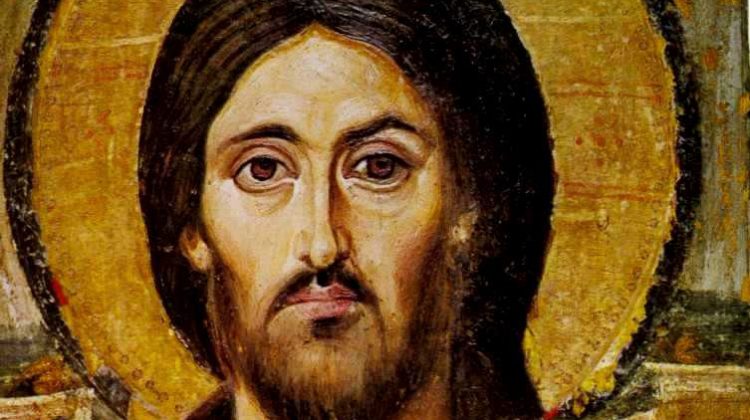
The Lord & the saints (click here)

And this is love. Love is only possible between equals. This is perhaps not obvious to us at first. We think of parent and child and do not consider them equal. But, properly, they are. Something which establishes our equality with one another is the nature of our “boundaries.” There is something inviolable and intrinsically deserving of regard and respect between equals. With my dog, such a boundary does not quite exist. He conforms to my will and, generally, gets no vote in matters that arise. A child is not a dog. Though a child requires more guidance and help from an adult, they have boundaries that remain. Those boundaries say to an adult, “You cannot trespass here, without doing harm.” The child’s boundaries become equal to the parent in that moment.
For that matter, even a dog has a certain form of equality: that of a fellow creature. We cannot do with them just anything. Cruelty is real and constitutes an unwarranted violation of an animal.
It is said by some that God has no boundaries regarding us, that He is God and may do with us (and to us) whatever He wills. This, of course, is true in an abstract sense. However, it is not true of God as He has made Himself known in Christ. Christ is a God who “asks.” He is the God who allows a freedom so great that it can kill Him.


Orthodox women from Guinea (from here)

The mystery of our freedom is found in the condescending love of God. The exercise of our freedom, particularly when used for evil ends, inevitably makes God appear weak or non-existent. We rarely consider the fact that it makes Him look like an equal, and an equal who loves us. Obviously, this allows for the tragedy of our evil actions. But, even there, God does not exempt Himself from that tragedy but embraces its consequences in His death on the Cross. It is fully within our freedom that He addresses us and rescues us from the consequences of our own evil (and the evil of others).
Of course, such a voluntarily weak God is deeply frustrating. He could do so much more. What we want Him to do is not love some in order to love others. If He ignores the freedom of the evil-doer in order to preserve the life of the innocent, we ask Him to violate His love (or negate it). This reality creates the paradox of love and freedom. That paradox is only solved in the mystery of Pascha itself. In His voluntary suffering and death, God takes upon Himself the suffering that love allowed to our freedom. Without violating that freedom, He nullifies the effects of its abuse in the resurrection of the dead (not just His own, but that of all).
All of this turns the usual arguments (and thoughts) about the so-called “problem of evil” on its head. Those arguments require a God whose power selectively loves and nowhere limits itself. When I have written that Pascha is at the heart of everything (and I believe this faithfully represents the teaching of the Church) this weakness born of love is its consequence. It is the love of God that surrounds us and calls us to be His friends. It seeks us, face to face, even searching for us when we hide. But it is a love that stands weakly at the border of our freedom, and waits for our invitation.

See also

God the Holy Trinity: 'The Lover of Mankind' 
God in Trinity - A Communion of Persons 
The Holy Trinity in the Old Testament
 
The Church as the Liberated Zone: "All we Christians are terrorists..." (and 2 videos, from Tanzania, Maasai, & DRC)
The Kingdom of Heaven, where racial discrimination has no place
"THE WAY" - An Introduction to the Orthodox Faith


In Memory of fr. Seraphim Rose († September 2, 1982)
Fr. Seraphim Rose, “Orthodoxy and the Religion of the Future”
Lover of Truth: St John, The Wonderworker of San Francisco
 
Travelers on the Way to the Light